CALL US& CONNECT







Top 5 Student Visa Mistakes to Avoid as Indian Students
Written byMaven
on
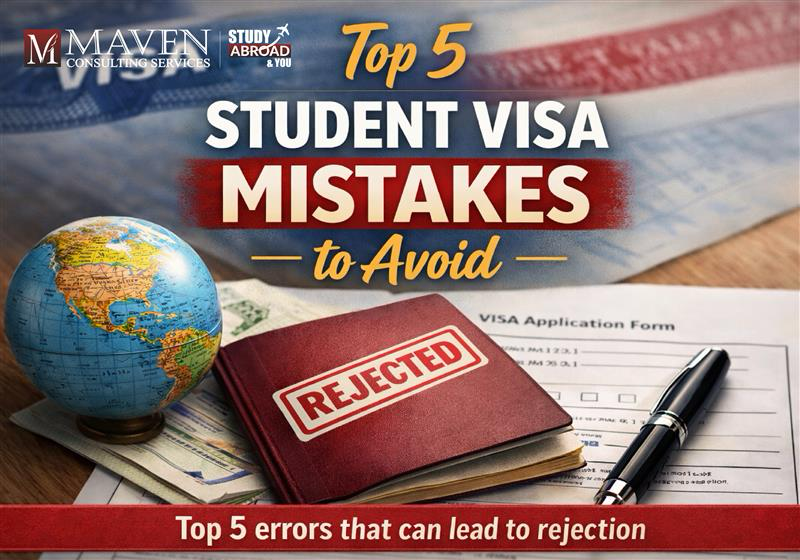
One small student visa mistake can snowball into delays, extra costs, or in the worst cases, a student visa rejection. And with visa rules becoming stricter, timelines becoming tighter, and embassy evaluations more detailed, these risks are higher than ever, making a guide on the top student visa mistakes to avoid all the more necessary.
The reality is this: most visa refusals don’t happen because students are unqualified. They happen because of avoidable student visa mistakes, rushed decisions, incomplete documents, weak planning, or unclear intent.
This blog is based on insights shared by Maven Consulting Services’ top counsellors, each with 10+ years of experience and a 99.8% student visa success rate across thousands of applications. They’ve seen what works, what fails, and, most importantly, what Indian students should absolutely avoid during visa season.
Our top counsellors also gave their top 5 tips for Indian students to survive visa seasons. Click here to know how you can swim through the visa process with ease.
Jumping right in…
Mistake 1: Underestimating how strict embassy evaluations really are
Assuming that embassies are “lenient” or that approvals for students are routine is one of the biggest student visa mistakes to avoid. Visa officers today work under increasingly cautious and detailed policies. Every application is evaluated as a risk assessment, not a formality.
Common assumptions that hurt students:
- “My university is good, and my admit was easy — so visa will be easy.”
- “Everyone is going this year; approval rates will be high.”
- “Minor errors won’t matter.”
In reality, embassies carefully check:
- consistency across all documents
- academic logic and career progression
- financial credibility
- genuine student intent
Even small issues, like mismatched dates, unclear funding sources, or vague explanations—can raise red flags and become reasons for student visa refusal.
This is why experienced student visa consultants in India always stress preparation over speed. A calm, well-reviewed application stands a far better chance than a rushed one.
Mistake 2: Submitting incomplete, inconsistent, or incorrect documents
Document-related errors are among the most common student visa mistakes Indian students make. Missing papers, wrong formats, or inconsistencies across documents can delay processing or lead directly to rejection.
Common student visa document mistakes include:
- submitting applications without an unconditional admit letter
- missing mandatory documents like financial proofs or academic transcripts
- uploading wrong document formats or unclear scans
- providing incorrect information such as:
- mismatched dates
- incorrect course or university names
- inconsistent sponsor details
Even honest mistakes can trigger background verification or additional scrutiny. Submitting fake or manipulated documents, however, can lead to instant rejection or long-term bans.
A critical but often-missed requirement:
For a lot of the countries like Poland, New Zealand, Ireland, etc a Police Clearance Certificate (PCC) is mandatory. In India, this must be obtained through the Passport Seva Portal only.
Official link to apply for PCC:
https://www.passportindia.gov.in/psp/ApplyPCC
Students who discover this requirement late often face visa appointment delays or miss deadlines entirely, classic visa season mistakes.
If you’re unsure what’s required, refer to a proper student visa checklist India (varies from country to country) or a trusted student visa documentation guide instead of relying on assumptions.
Mistake 3: Choosing a course with no clear academic or career logic
Selecting a course that doesn’t align with your academic background or career trajectory is another major student visa mistake to avoid is . Visa officers are trained to assess academic intent, not just admissions.
Red flags include:
- switching fields without a clear explanation
- choosing a course unrelated to past education or work experience
- failing to explain how the course fits into long-term career goals
This mistake shows up in both SOP errors for student visa and visa interview answers. A weak or unclear explanation often leads to doubts about genuine intent and increases the risk of rejection.
A strong application clearly answers:
- Why this course?
- Why this university?
- Why this country?
- What happens after graduation?
If these answers don’t align across your SOP, forms, and interview, it becomes one of the most common reasons for student visa rejection in India.
For Germany-bound students, academic alignment is even more critical. Resources like
German APS Certificate & Germany Student Visa Process – The One-Stop Guide for EVERYONE
help students understand how academic scrutiny works before applying.
Mistake 4: Weak financial planning or unrealistic funding sources
Financial mistakes in student visa applications are another major cause of refusals. Many students underestimate how deeply embassies assess finances—not just the amount, but the source and stability.
Common student visa financial mistakes include:
- showing insufficient funds
- last-minute large deposits
- unrealistic sponsor income
- inconsistent financial documents across applications
- unclear education loan details
Embassies expect financial proof to be:
- genuine
- traceable
- sufficient for tuition and living costs
- aligned with visa rules (such as holding periods)
Improper financial documentation or unrealistic funding sources can easily lead to student visa rejected due to finances. These mistakes are especially risky during peak visa season when scrutiny increases.
A well-planned financial file reduces doubt and often speeds up processing. If you’re unsure, reach out to our counsellors by registering here.
Mistake 5: Treating the SOP and interview as a formality
Underestimating the importance of the Statement of Purpose (SOP) is one of the most damaging student visa mistakes to avoid. Generic, copied, or weak SOPs fail to show personal fit, and visa officers notice.
Common SOP and interview mistakes:
- copying templates without customisation
- repeating generic lines with no examples
- mismatch between SOP and interview answers
- exaggerating achievements or hiding study gaps
- memorizing answers instead of understanding them
Honesty beats perfection. Providing fake details or manipulated narratives can result in background verification issues and rejection.
A strong SOP:
- clearly explains academic and career intent
- aligns with past education and future plans
- supports interview answers naturally
If you’re unsure how to structure it, read
How to Write a Strong Statement of Purpose (SOP) in 2026 for Indian Students.
Bonus: The silent mistake is poor timing and rushing the process
One mistake that connects all others is poor timing. Applying too late forces students to rush documentation, skip checks, and submit incomplete applications.
Applying late can:
- delay visa appointments
- cause students to miss initial classes or entire semesters
- increase the chance of document and financial errors
This is one of the most common visa season mistakes Indian students make.
If timelines are a concern, refer to
Fastest Student Visa Processing Countries in 2026 for Indian Students
to plan realistically instead of guessing.
Here are the top, most common student visa rejection reasons
- Incomplete documents / inconsistent information
- Weak financial proof / unclear funding source
- Unclear intent (generic SOP, vague study plan, mismatch with background)
- Course choice doesn’t show logical progression
- Late application + rushed submission
- Incorrect information in visa forms (dates, sponsor details, course name)
- Interview contradictions (especially for F-1)
- Country-specific compliance gaps (PCC, TB test, APS, insurance)
- Fake/altered documents (can lead to bans)
- Prior refusals were not addressed properly
Click here to read our full, in-depth guide on student visas for Indian students.
FAQs
1. Why do student visas get rejected?
Most rejections happen due to document errors, unclear academic intent, weak finances, or inconsistent information.
2. What are the most common student visa mistakes?
Incomplete documents, generic SOPs, unrealistic finances, late applications, and interview inconsistencies.
3. How can I avoid student visa rejection?
Plan early, follow country-specific rules, ensure document consistency, and present genuine academic intent.
4. Can wrong documents lead to visa rejection?
Yes. Even small mismatches can trigger rejection or delays.
5. Can financial mistakes affect student visa approval?
Absolutely. Weak or unclear financial proof is a major rejection reason.
6. Is SOP important for a student visa?
Yes. A weak SOP is one of the top student visa mistakes that cause rejection.
7. How late is too late to apply for a student visa?
It depends on the country, but rushing always increases risk.
8. Can interview mistakes cause visa rejection?
Yes. Nervous, inconsistent, or dishonest answers often lead to refusal.
9. Can I reapply after a student visa rejection?
Yes, but only after fixing the exact refusal reasons.
10. Is it normal to feel anxious during the visa process?
Yes. Visa applications are high-stakes, and stress is common—but preparation reduces it significantly.
How Maven helps students avoid these visa mistakes
At Maven Consulting Services, our counsellors don’t just “process” visas. With 10+ years of experience and a 99.8% success rate, they:
- review applications end-to-end
- flag student visa mistakes before submission
- guide SOPs and interviews based on real embassy expectations
- help students plan timelines realistically
Students also benefit from country specific resources like:
- US F-1 Student Visa: Complete Guide for Indian Students
- German APS Certificate & Germany Student Visa Process
Conclusion: Avoiding mistakes is the real visa strategy
Student visas aren’t about luck. They’re about clarity, consistency, and preparation. Most student visa mistakes to avoid are predictable—and that’s good news. It means they can be fixed before they become costly.
If there’s one takeaway, it’s this: don’t rush, don’t assume, and don’t treat the process casually. Visa officers are strict, timelines are tight, and expectations are high—but with the right guidance, approvals are very achievable.
Take the word of experienced counsellors who’ve seen thousands of outcomes. Work carefully, plan early, and let preparation, not panic, drive your visa journey.
Found it useful?
Don't forget to share this article
[addtoany]
0
0
votes
Article Rating
Subscribe
0 Comments
Oldest
Newest
Most Voted