WhatsAppCHAT
CALL US& CONNECT


By Maven Consulting Services | Study Abroad Insights
Every year, hundreds of thousands of Indian students pack their bags, say emotional goodbyes at airports, and fly halfway across the world to build a better future.
The degree is the goal.
But the job? That’s the real dream.
And yet, the most common question we get at Maven Consulting Services isn’t about universities or scholarships. It’s this:
“Will I actually get a job after studying abroad?”
“Do Indians still get jobs abroad in 2026 after studying?”
It’s a fair question. And, It deserves a fair answer, not a brochure.
So let’s talk about reality.
You can also read our take on study abroad in 2026-27 here: Is Studying Overseas Still Worth It in 2026? A Data-Driven Study Abroad ROI Analysis
Yes, Indian students do get jobs abroad, especially in countries like Canada, UK, and Australia if they choose in-demand fields and plan early.
Based on our experience working with 5000+ Indian students across major study destinations we can confidently say that success depends mainly on your field (STEM vs non-STEM differences), early job search, and strong networking.
Here’s what determines it:
| Success Factor | What It Means |
| Country | Canada & UK are easier than the US for post-study work |
| Field of Study | STEM, healthcare, and tech have the highest success rates |
| Timing | Job search must start 6–9 months before graduation (Suggested timeline here) |
| Networking | 40–70% of jobs in Western markets are filled through connections |
Typical success rate for Indian graduates:
The sections below break down exactly what this looks like, by country, by field, and by the decisions that determine which category you fall into.
A few years ago, the narrative was simple:
Study abroad → Get job → Settle abroad
That narrative is outdated.
In 2026, the gap between students who succeed and those who struggle has widened.
Indian students do secure jobs abroad. In significant numbers; across the US, UK, Canada, Australia, Germany, and Ireland.
But what the glossy study abroad content won’t tell you:
The good news?
Every one of these factors is controllable, if you plan early.
Not every study destination offers equal employment opportunity. Here’s what the landscape actually looks like in 2024–25:
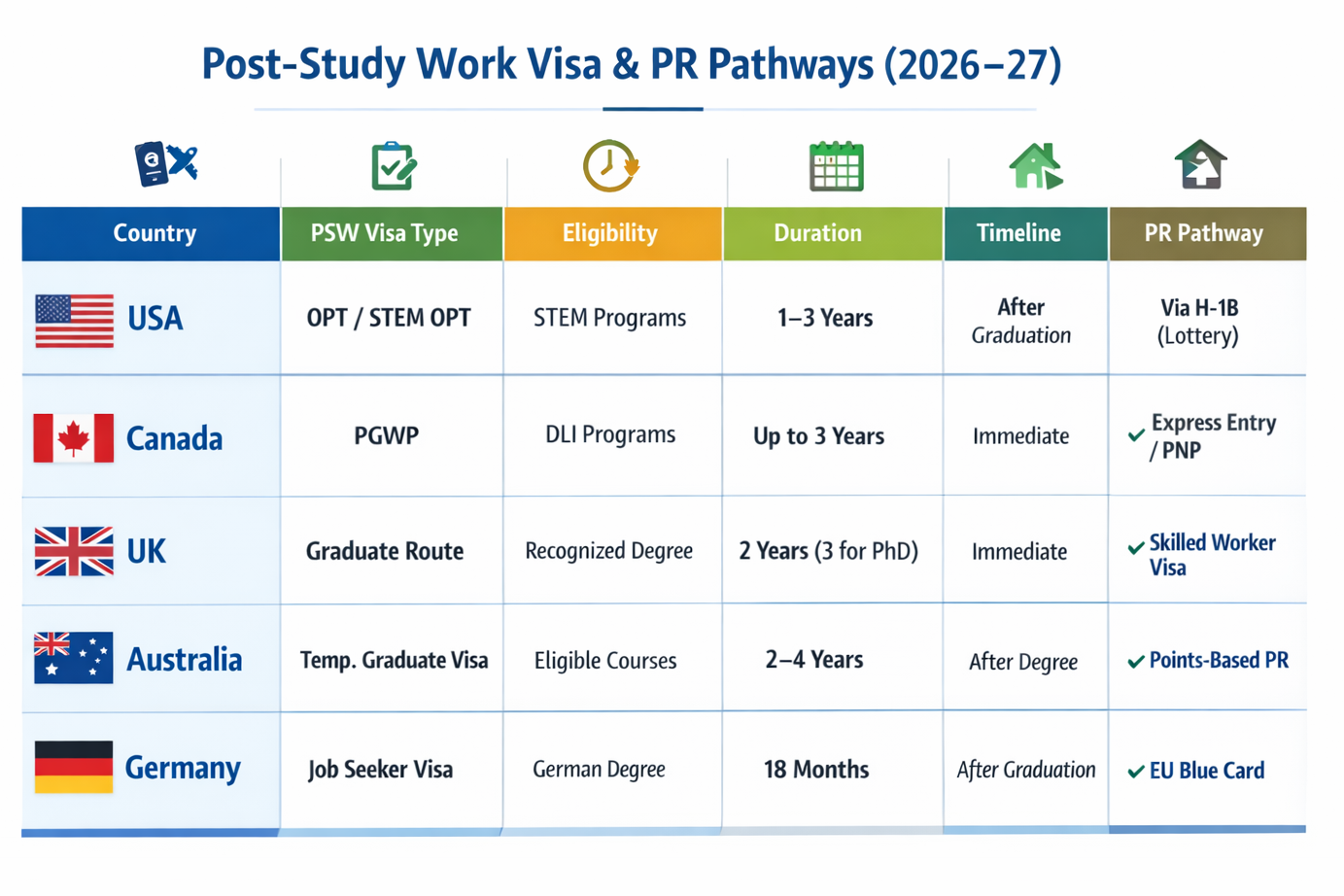
The US remains the top destination for Indian students, and for good reason. STEM graduates benefit from Optional Practical Training (OPT) — 12 months of work authorisation post-graduation — and STEM OPT extends this to 3 years. That’s a 3-year window to find employer sponsorship for an H-1B visa.
Read: US F-1 Student Visa: A complete guide for Indian Students
The catch? The H-1B lottery is exactly that — a lottery. Competition is fierce. Non-STEM graduates have a much narrower window. And recent policy shifts have made immigration more uncertain. The US rewards those who are strategic, networked, and persistent.
Best for: Software engineers, data scientists, financial analysts, researchers
Canada is arguably the most straightforward pathway from student to permanent resident in the world today. The Post-Graduation Work Permit (PGWP) allows graduates to work for up to 3 years after completing a program of 2 years or more. This work experience feeds directly into Express Entry and Provincial Nominee Programs (PNPs) — making Canadian PR far more accessible than US green card routes.
Best for: IT professionals, engineers, healthcare workers, finance graduates
The Graduate Route Visa, introduced in 2021, was a game-changer. It allows graduates from UK universities to stay and work — or look for work — for 2 years after graduation (3 years for PhD graduates). This removed one of the biggest historic barriers for Indian graduates in the UK.
London remains one of the most competitive job markets in the world, which cuts both ways. Opportunities are abundant, but so is competition. The key is sector fit: finance, consulting, tech, and healthcare all have strong demand for internationally trained professionals.
Best for: Finance, consulting, healthcare, technology
Australia’s Temporary Graduate Visa (Subclass 485) offers 2–4 years of post-study work rights depending on your qualification and location of study. Regional study incentives have made certain cities and towns even more attractive, offering extended work visa durations.
The country’s migration system is points-based, and studying there gives you a head start in accumulating those points for permanent residency.
Best for: Engineers, nurses, IT professionals, trades
Germany offers one of the most underrated opportunities for Indian students: an 18-month job seeker visa post-graduation, during which you can look for work in any field related to your degree. Germany has a significant shortage of skilled workers in engineering, IT, and healthcare.
The language factor remains a consideration — while many international companies operate in English, German proficiency dramatically expands your options.
Best for: Engineers, IT professionals, healthcare graduates
| Country | Job Opportunity | PR Ease | Best For |
| Canada | High | Easy | PR-focused students |
| UK | Medium-High | Moderate | Finance, consulting |
| Australia | High | Strong | Engineering, healthcare |
| USA | High (STEM) | Difficult | High-paying careers |
| Germany | High (technical) | Strong | Engineers, IT |
Here’s the data picture most consultants avoid sharing. These are approximate ranges based on graduate employment outcomes across top study destinations:
| Field of Study | Estimated Job Success Rate Abroad |
| Software Engineering / IT | 75–85% |
| Data Science / AI / ML | 70–80% |
| Healthcare & Nursing | 75–85% |
| Civil / Mechanical Engineering | 65–75% |
| Finance & Accounting | 60–70% |
| Business / General MBA | 35–50% |
| Arts, Humanities, Social Sciences | 20–35% |
| Law (foreign degree) | 15–30% |
Note: These are field-level estimates. Individual outcomes vary significantly based on university, location, networking effort, and preparation. Students in “lower-success” fields who are highly proactive often outperform those in “higher-success” fields who are passive.
The takeaway is clear: field selection is a career decision, not just an academic one.
Not sure which category you fall into?
Talk to Maven Consulting Services for a personalised career roadmap.
These reflect entry-to-mid-level for Indian graduates abroad, converted where needed (1 USD ≈ CAD 1.35, GBP 0.78, AUD 1.5, EUR 0.92).
| Role | USA (USD) | Canada (CAD) | UK (GBP) | Other Key Countries |
|---|---|---|---|---|
| Software Engineer | 120k–160k | 80k–120k | 55k–85k | Australia: AUD 120k–150k |
| Data Scientist/ML Engineer | 140k–185k | 95k–160k | 60k–90k | Germany: 80k–100k USD |
| Investment Banking Analyst | 110k–190k | N/A | 70k–130k | N/A |
| Cloud/DevOps Engineer | 125k–160k | 90k–130k | £50k–80k GBP | N/A |
| Healthcare (Nurse/Physician) | N/A | Nurse: 75k–105k; Physician: 350k+ | Nurse: 35k–55k; Doctor: 50k+ GBP | Germany: Nurses 50k–70k EUR |
| Civil/Structural Engineer | N/A | N/A | £40k–60k GBP | Australia: AUD 80k–120k; Germany: 50k–75k EUR |
| Financial Analyst/CPA | 80k–120k | 60k–100k | £40k–65k | N/A |
| Cybersecurity Analyst | 90k–145k | N/A | 45k–75k | N/A |
The highest-paying outcomes are concentrated in the US, (tech/finance averages 100k–200k USD), but H-1B visas are competitive and it the highest barrier to long-term work authorisation (85k cap, lottery-based with no easy PR).
Canada excels for accessibility via Express Entry (CRS scoring on skills/language; 6-month processing) and PNPs, plus 3-year post-study work. Germany/Australia offer Blue Card/skilled migration with 18–24 month job search visas post-study.
Your choice of field is the single biggest determinant of post-study employment success.
Fields with strong hiring demand for international graduates:
| Courses | Why It Works Abroad |
| Technology & Software Engineering | Global demand; largely employer-driven, not government-restricted |
| Data Science & AI/ML | Fastest-growing talent need across every sector |
| Healthcare & Nursing | Critical shortages in UK, Canada, Australia, and Germany |
| Civil & Mechanical Engineering | Consistently in demand in Canada, Australia, and Germany |
| Finance & Accounting | Strong in US, UK, and Canada for CPA/CA-qualified professionals |
| Supply Chain & Logistics | Surged post-pandemic; strong in Canada and Australia |
Fields where international job hunting is significantly harder:
Fields tied to domestic shortages tend to have stronger visa support and employer appetite. Research labour market demands in your target country before choosing your program, not after.
There’s a narrative that Indian students face discrimination in hiring abroad. In some pockets, bias does exist — being honest matters. But the larger picture is that Indian graduates bring a genuinely competitive skill set.
| Strength | Why It Matters to Employers |
| Technical depth | Strong foundational skills in engineering, math, and science — widely recognised by US, Canadian, and German employers |
| English proficiency | Near-native fluency is a significant advantage over international peers in English-speaking markets |
| Work ethic & adaptability | Hiring managers across the US, UK, and Australia consistently rate Indian professionals highly on commitment and flexibility |
| Cost-effectiveness | International graduates on post-study work visas can be hired without the cost and delay of full sponsorship processes |
These are real advantages. Own them.
This is chronically underweighted in most decision-making processes, and it’s one of the most important factors Maven works through with every student.
University reputation matters — A degree from a well-ranked, regionally respected institution opens doors with employers that lesser-known colleges don’t. Campus recruiting, where companies actively come to campus to hire, is far more active at flagship universities.
| City | Employment Advantage |
| Toronto, Canada | Canada’s largest job market and financial hub |
| London, UK | Finance, consulting, and tech epicentre |
| Sydney / Melbourne, Australia | Strongest graduate hiring ecosystems in Australia |
| Berlin / Munich, Germany | Tech and engineering hiring hubs |
| New York / San Francisco, USA | Highest concentration of tech, finance, and startup employers |
These are the decisions that Maven helps students make strategically, because the right university in the right location with the right program structure is where the employment journey actually begins.
At Maven, we work with students through the entire journey, not just the admission. We see consistent patterns in the students who struggle to find employment. Here’s what typically goes wrong:
1. Starting the job search too late:
Many students begin applying in their final semester. Employers in most countries start recruiting 6–9 months ahead. Starting in your second semester isn’t ambitious, it’s on time.
2. Not adapting the resume to local standards:
An Indian-style CV does not work in Canada, the US, or Germany. Each country has different norms, format, length, what to include, what to omit. Students who don’t localise their applications get filtered out before anyone reads their qualifications.
3. Neglecting networking:
In Western job markets, an estimated 40–70% of roles are filled through networks before they’re ever publicly posted. LinkedIn, alumni connections, industry events, and professor introductions are the primary job search strategy, not job boards.
4. Underestimating soft skills:
Strong technical skills open a door. Soft skills, communication, team dynamics, cultural fluency, determine whether you walk through it. This is consistently underestimated by international students.
5. Over-relying on the university placement cell:
University career services are a resource, not a guarantee. Students who treat the career centre as a starting point, and build their own pipeline in parallel, consistently outperform those who wait.
6. Choosing the wrong program or country for their field:
A student who studies general management in a country with limited MBA hiring demand, without a network, without internship experience, without a STEM background, faces a genuinely difficult employment environment. This decision is made before they fly.
Avoiding these mistakes early can completely change your outcome.
Maven helps you plan this before you even choose your university.
After working with hundreds of students across study abroad destinations, here’s what the successful ones do differently:
At Maven, we don’t just get students admitted. We help them get employed.
The decisions you make before you fly — the country, the city, the university, the program structure, the field of study — directly determine how smooth or how difficult your job search will be.
| What We Do | Why It Matters |
| Country strategy built around employability | We map your field and goals against actual hiring patterns in each destination |
| University selection with location intelligence | We evaluate campus recruiting, co-op structures, and employer relationships — not just rankings |
| Pre-departure career coaching | LinkedIn optimisation, resume localisation, and job search frameworks before you fly |
| Post-arrival support | We stay engaged through the transition, not just until the visa arrives |
Our students don’t just study abroad. They build careers abroad.
So, Are Job Prospects Real for Indian Students Abroad?
Yes. Absolutely yes.
Indian students are:
But it doesn’t happen by accident. It happens when a student:
The question is not:
“Should I study abroad?”
The real question is:
“Where should I study so that jobs, visas, and demand actually align?”
At Maven Consulting Services, we don’t just help you get admits.
Because the real outcome isn’t admission.
It’s employment
Ready to map out your study abroad and career journey?
Related Reading: