WhatsAppCHAT
CALL US& CONNECT

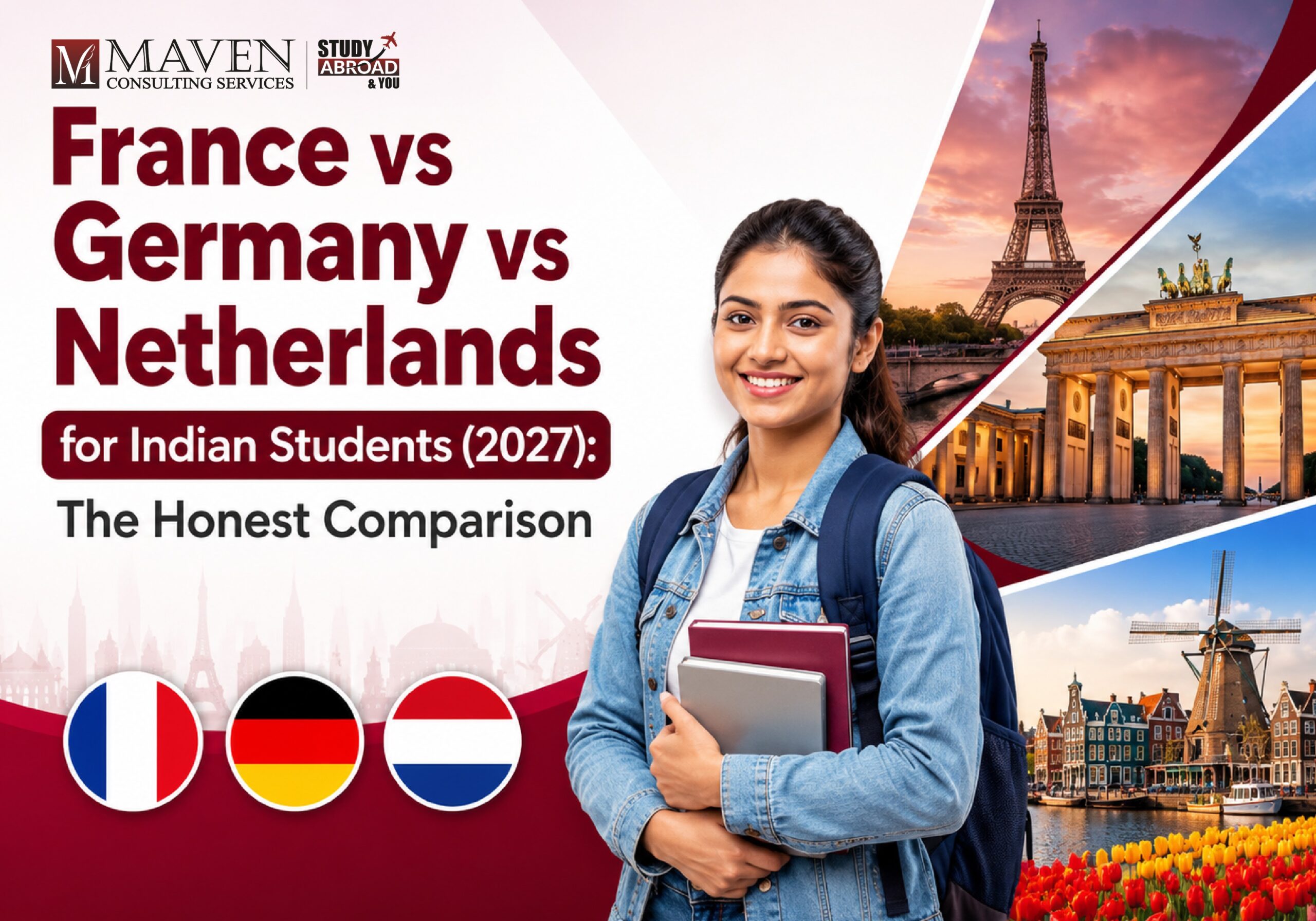
This France vs Germany vs Netherlands for Indian Students guide compares three of Europe’s most-searched study destinations without the marketing gloss — tuition, real living costs, visa financial-proof requirements, work rights, and what actually happens to your career after graduation.
For anyone researching France vs Germany vs Netherlands for Indian Students, this is the number every comparison article leads with — and the number most get wrong, because all three countries have multi-tier fee structures depending on nationality and, in France’s case, on institutional exemptions that are shrinking but not gone.
| Country | Non-EU Tuition (Public Universities) | Notes |
|---|---|---|
| France | €2,902/year (Bachelor’s) €3,950/year (Master’s) | Decree No. 2026-385 (May 2026) made these “differentiated fees” the default; institutions can still exempt up to 30% of non-EU students in 2026-27, falling to 25% in 2027-28. Grandes Écoles and business schools charge far more (€6,000–€18,000+/year). |
| Germany | €0–€1,500/semester | Public universities are tuition-free for most degrees in most states. Baden-Württemberg charges non-EU students a separate semester fee at its public universities — confirm the exact current rate with the specific university before applying, as this is set at state level and revised periodically. |
| Netherlands | €8,000–€35,000/year | Non-EU “institutional fee” set independently by each university and programme (WO research universities generally cost more than HBO applied-science institutions). EU/EEA students pay the statutory fee (~€2,314/year) — non-EU students do not qualify for this rate. |
When it comes to France vs Germany vs Netherlands for Indian Students, visa financial-proof minimums are not the same as what students actually spend. Both figures matter — the minimum determines whether your visa gets approved, the realistic figure determines whether you can live comfortably.
| Country | Visa Financial Proof (Annual) | Realistic Monthly Living Cost |
|---|---|---|
| France | ~€7,380/year (~€615/month) minimum for the student visa; CAF housing benefit can return €150–€230/month once enrolled | €700–€1,400/month depending on city (Paris highest, smaller cities like Lyon or Nantes considerably lower) |
| Germany | €11,904/year (€992/month) via blocked account (Sperrkonto) — figure unchanged since the September 2024 BAföG update, confirmed current for 2026 | €900–€1,400/month; Munich and Frankfurt run highest, eastern German cities and smaller towns lowest |
| Netherlands | ~€13,600/year (~€1,130–€1,140/month) via the IND “study norm,” which is revised every 1 January — reconfirm the exact figure closer to your application date | €1,100–€1,600/month; Amsterdam, Utrecht, and The Hague are the most expensive, and the student housing shortage adds real pressure on top of the cost itself |
All three countries require proof of funds before issuing a student visa, but the mechanism differs meaningfully — a key factor in any France vs Germany vs Netherlands for Indian Students decision.
Processed via Campus France’s Études en France portal. Minimum financial proof is roughly €615/month. After arrival, you validate the visa with OFII within three months — skipping this step causes renewal problems later.
Requires the German Federal Foreign Office-recognised Sperrkonto (blocked account) with €11,904 deposited, released as €992/month after arrival. Alternatives exist — a scholarship certificate, or a notarised Verpflichtungserklärung (declaration of commitment) from a German resident — but the blocked account remains the most commonly accepted route for Indian applicants.
Your Dutch university acts as your IND-recognised sponsor and typically handles both applications for you. Financial proof (the “study norm”) must be shown for 12 months and does not include tuition — tuition is verified separately. Processing runs 60–90 days, so apply early.
This is where the three countries diverge most sharply on France vs Germany vs Netherlands for Indian Students — and where marketing material tends to oversimplify things for applicants.
English-taught master’s programmes have expanded significantly, especially at Grandes Écoles and business schools, and are genuinely accessible without French. But bachelor’s programmes remain overwhelmingly French-taught (B2 level typically required), and from 2026, converting the post-study APS permit into a long-term multi-year residence permit requires A2 French — even if your degree itself was taught entirely in English. If you plan to stay in France beyond the first job-search year, factor in French classes from day one.
Public university bachelor’s programmes are mostly German-taught, and functional German (usually B1–B2) is expected for daily life and part-time work regardless of programme language. Master’s programmes have a much wider pool of English-taught options, particularly in engineering, data science, and business. Germany’s job market — outside a handful of multinational-heavy sectors — still runs largely in German, which matters more for long-term settlement than for the degree itself.
The Netherlands has the deepest bench of English-taught programmes among the three, at both bachelor’s and master’s level, and Dutch universities are used to teaching and assessing international cohorts in English. Dutch is not required for the degree or the Zoekjaar. That said, day-to-day life and many entry-level jobs still favour Dutch speakers, and English-only graduates sometimes find the local job market narrower than the programme’s English-medium instruction suggested.
This is often the deciding factor for Indian families thinking beyond the degree itself.
| Country | Permit | Duration & Conditions |
|---|---|---|
| France | APS (Autorisation Provisoire de Séjour / RÉCE) | Available to Master’s-level graduates (Bac+5) and above from recognised French institutions. Roughly 12 months to find qualifying work; during this period you can work full-time in any role, no employer sponsorship needed. It is designed to convert into a salarié or Passeport Talent permit once you secure a job meeting the salary threshold (around 1.5x SMIC) — it is not intended for indefinite renewal. |
| Germany | 18-month job-seeker residence permit | Available to graduates of German universities, degree level generally not restricted to Master’s. Allows work in any job (not just field-related) while searching, and converts to a Blue Card or standard work visa once a qualifying offer is secured. |
| Netherlands | Zoekjaar (Orientation Year) | One year, available to graduates of Dutch higher education institutions. No work-hour restrictions and no TWV work permit needed during this year — one of the more flexible schemes in Europe. Must be applied for within three years of graduating; costs roughly €210. |
Tuition and visas are the easy part to compare. Job market outcomes are harder, and this is where honesty matters most for anyone weighing France vs Germany vs Netherlands for Indian Students.
France offers strong opportunities in aerospace, luxury/retail management, business, and increasingly AI and quantum computing (a stated government funding priority), but non-French-speaking graduates outside Paris and a handful of multinational hubs will find the market noticeably narrower.
Germany remains one of Europe’s strongest engineering, automotive, and manufacturing job markets, with genuine demand for skilled graduates — but German-language ability is the single biggest lever on how wide that market actually is for a non-EU graduate.
Netherlands has a comparatively English-friendly professional environment in Amsterdam, Rotterdam, and Eindhoven (especially tech, finance, and logistics), but competition for entry-level roles among international graduates is intense, and the tight housing market compounds the challenge of settling in while job-hunting.
Taken together, these job-market realities are central to any France vs Germany vs Netherlands for Indian Students decision.
Use this quick France vs Germany vs Netherlands for Indian Students snapshot to narrow things down by profile:
On France vs Germany vs Netherlands for Indian Students, our founder puts it plainly:
“Every intake, we get the same question in a slightly different form: ‘Which of these three is the best?’ There isn’t one. I’ve seen students thrive in Germany specifically because they committed to German lessons from month one, and I’ve seen equally strong students struggle in the Netherlands because they assumed an English-taught degree meant an English-speaking career. The honest answer is that the best country is the one that matches your budget, your appetite for a new language, and what you actually want to be doing five years after graduation — not the one with the lowest tuition sticker or the most polished university brochure.”
Public universities in most German states charge no tuition for bachelor’s and many master’s programmes, but Baden-Württemberg charges non-EU students a separate fee, and you’ll still need the €11,904 blocked account for your visa regardless of tuition being free.
On total cost — tuition plus realistic living expenses — France’s public universities are typically the lowest of the three, provided you’re comfortable in a mid-sized city rather than Paris. Germany can be similarly affordable if you land outside the highest-cost cities, but the upfront blocked-account deposit is a larger one-time burden.
Not for most master’s programmes, which are increasingly English-taught in all three countries. Bachelor’s programmes are the exception in France and Germany, where local-language instruction is still the norm. Dutch is rarely required even at bachelor’s level.
Netherlands’ Zoekjaar (1 year, no work-hour restrictions) and Germany’s 18-month job-seeker permit are both genuinely strong. France’s APS is shorter in comparison and, from 2026, ties long-term settlement to basic French proficiency — a real consideration if you plan to stay beyond the first year.
Yes, in all three countries — France’s APS, Germany’s job-seeker permit, and Netherlands’ Zoekjaar are all designed as in-country transitions from study to work status, provided you apply before your student permit expires.
Roughly €13,600/year (the IND “study norm,” currently around €1,130–€1,140/month), which excludes tuition and is revised every 1 January — reconfirm the exact figure close to your application date.
None of the three is categorically “harder” — each has a well-defined, document-heavy process. Netherlands’ university-as-sponsor model tends to feel the most streamlined from the student’s side, since the university handles much of the IND coordination directly.
Germany has the deepest engineering and manufacturing industry base of the three, but expect to invest in German language skills to access the full breadth of that job market as a non-EU graduate.
In short, the France vs Germany vs Netherlands for Indian Students decision is rarely about which country is objectively “best” — it is about which one matches your budget, language comfort, and career goals.
This France vs Germany vs Netherlands for Indian Students guide’s figures are verified against Campus France, the German Federal Foreign Office/BAföG framework, and the Dutch IND as of July 2026. Tuition, visa, and financial-proof figures change annually — always confirm current numbers on the official government or university source before finalising your budget or application.
That wraps up our France vs Germany vs Netherlands for Indian Students comparison — bookmark this guide and explore the country-specific resources below for deeper detail.
Get an honest, data-first assessment of your profile against France, Germany, and Netherlands — free, commission-free, no pressure.
Book a Free Consultation
Sunday, October 26, 2025 | The Taj MG Road, Bangalore | 10 AM – 4 PM