WhatsAppCHAT
CALL US& CONNECT

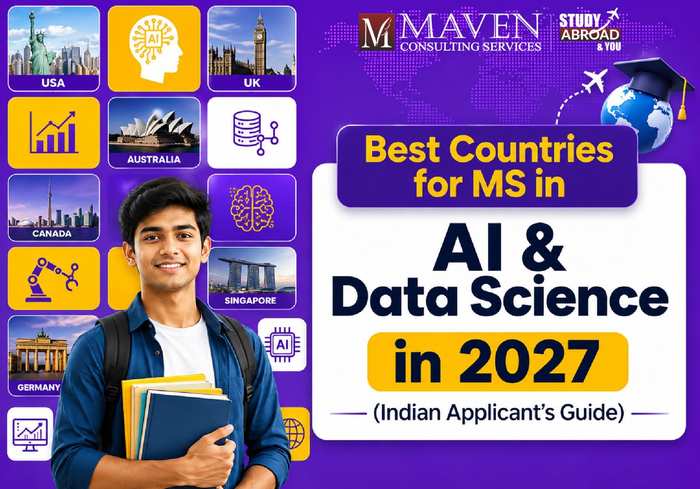
Choosing where to pursue an MS in AI and Data Science shapes your career for the next decade — yet “Best country for AI” is the wrong question if you stop at rankings. Every country on this list has strong AI research — that part is easy. What actually decides your outcome is whether you can afford the two years it takes to get there, what your visa lets you do the day you graduate, and whether the local job market is hiring for the skills your specific program teaches. A QS top-20 ranking means very little if your post-study work window closes before you land a role.
This guide compares the five destinations Indian students actually shortlist for an MS in AI and Data Science for 2027 intakes — the USA, UK, Canada, Germany, and Ireland — on tuition, program length, post-study work rights, and what the AI hiring market actually looks like in each. We’ve also verified this month’s STEM OPT eligibility rules and our cost comparisons across countries so the numbers here are consistent with those pieces.
Who This Blog Is For
What This Blog Covers
All figures are annual tuition for international students pursuing an MS in AI and Data Science unless noted, verified against university and government sources as of August 2026.
| Country | Duration | Annual Tuition | Post-Study Work Rights |
|---|---|---|---|
| USA | 1–2 years | $30,000–$90,000+ (₹28.7L–₹86L+) | OPT 12 months + STEM OPT extension = up to 3 years |
| UK | 1 year (most) | £20,500–£46,700 (₹26.4L–₹60.2L) | Graduate Route: 2 yrs if applied by 31 Dec 2026; 18 months from 1 Jan 2027; 3 yrs for PhD |
| Canada | 16 months–2 years | CAD 10,700–37,300 (₹7.4L–₹25.7L) | PGWP up to 3 years for master’s grads (CLB 7 required) |
| Germany | 2 years (4 semesters) | €0–€12,000 (mostly semester fee only) | 18-month Job Seeker visa post-study |
| Ireland | 1 year | €15,000–€32,000 (₹16.4L–₹34.9L) | Stamp 1G: 24 months for master’s/PhD grads |
The US still dominates the global AI research map — MIT tops the 2026 QS World University Rankings for Data Science & AI, with Stanford, Carnegie Mellon, UC Berkeley, and Georgia Tech close behind. Programs run 1–2 years, with tuition ranging from Georgia Tech’s comparatively affordable ~$31,000–$34,000/year (₹29.6L–₹32.5L) to $74,000+/year (₹70.7L+) at UC Berkeley and Columbia. CMU offers multiple AI-specific tracks, including a 12-month MS in AI Systems Management.
Post-study, F-1 graduates get 12 months of OPT, extendable to 3 years total if your program’s CIP code sits on the DHS STEM Designated Degree list — nearly every AI/DS program qualifies, but confirm the exact CIP code on your I-20, not just the degree title (we cover this in detail in our STEM OPT eligibility guide). The I-765 filing fee is $470 online / $520 paper — not the $1,780 figure floating around online, which is the optional premium-processing add-on, not the base fee.
Entry-level AI/ML roles in the US pay $95,000–$135,000 (₹90.7L–₹1.29Cr), the highest in this comparison by a wide margin — but that has to be weighed against H-1B lottery odds after OPT runs out, and against a new DHS rule (effective 15 September 2026) that replaces the old “Duration of Status” with a fixed admission period, adding a planning step most students haven’t had to think about before.
UK MSc programs in AI and Data Science are almost all one year — the fastest route to a credential on this list. UCL, Edinburgh, and Imperial rank highest in the UK on the QS Data Science & AI subject rankings, with tuition from around £20,500 (₹26.4L) at more accessible universities to £46,000–£46,700 (₹59.3L–₹60.2L) at Imperial. Manchester, Southampton, and Bath sit in a more moderate £32,000–£35,500 band.
Maven Note: The UK Graduate Route visa is being cut from 2 years to 18 months, but only for applications submitted on or after 1 January 2027. If you complete your degree and apply before 31 December 2026, you still get the full 2 years (3 years for PhD). This is enacted law, not a proposal — the Statement of Changes was laid before Parliament in October 2025. Your intake timing relative to this cutoff genuinely changes your post-study runway.
Entry-level salaries for AI/DS grads in the UK run roughly £35,000–£58,000 (₹45.2L–₹74.8L), with London and Edinburgh (home to the Bayes Centre and strong fintech/NLP hiring) the strongest markets. The UK’s edge is speed — you’re job-hunting a full year sooner than in a 2-year US or Canadian program — but the compressed Graduate Route window from 2027 means you need a sponsorship plan earlier, not later.
Toronto, Waterloo, and Vancouver form Canada’s AI corridor, anchored by the Vector Institute. University of Toronto’s MScAC is a 16-month applied AI program with a mandatory 8-month industry internship built in; Waterloo’s Master of Data Science and Artificial Intelligence (MDSAI) is 2 years with a co-op track. Tuition varies widely by program — from roughly CAD 10,700/year (₹7.4L) to CAD 37,300+/year (₹25.7L) — so the program structure matters as much as the university name here.
Maven Note: Since 1 November 2025, every PGWP applicant with a bachelor’s, master’s, or doctoral degree needs CLB 7 in all four language skills (reading, writing, listening, speaking) — not an average, each skill separately. IELTS Academic does not count for this; you need IELTS General Training, CELPIP General, or PTE Core. This has quietly become one of the more common reasons Canadian PGWP applications get refused, and it’s a test most students don’t plan for until it’s late.
The payoff: master’s graduates from PGWP-eligible programs get up to a 3-year open work permit — regardless of program length, as long as it’s at least 8 months. That’s the longest guaranteed post-study runway in this comparison. Entry-level AI/DS salaries run CAD 70,000–100,000 (₹48.3L–₹69L).
Germany is the only country on this list where tuition genuinely isn’t the main cost. Most public universities — RWTH Aachen, University of Hamburg, Göttingen — charge only a semester administrative fee (€150–€350, ~₹16,300–₹38,100), regardless of nationality. TU Munich (TUM) is the exception: its more selective Data Science and AI-adjacent programs charge €4,000–€6,000/semester (roughly €8,000–€12,000/year, ₹8.7L–₹13.1L) for non-EU students, and its acceptance rate for data science hovers around 8–10%.
An MS in AI and Data Science in Germany can cost almost nothing in tuition. Canada is a strong pick for an MS in AI and Data Science thanks to its post-study work rules. If you’re weighing an MS in AI and Data Science in the UK, The real upfront cost is the blocked account required for the student visa: official figures confirm €11,904/year (₹12.97L), released at €992/month, unchanged from 2025. After graduation, the 18-month Job Seeker visa requires a higher blocked-account rate (~€1,091/month, ~€13,092/year for a 12-month permit — up to ~€19,638 if the full 18 months is required upfront).
Entry-level salaries run €45,000–€60,000 (₹49.1L–₹65.4L). The honest caveat Maven gives every Germany applicant: most English-taught master’s programs don’t require German, but most AI/DS jobs after graduation increasingly do, at least at a conversational B1–B2 level, especially outside Berlin and Munich’s most international employers. Budget time to learn it during your program, not after.
Ireland’s pitch is specific: a 1-year MSc, EU-adjacent AI research at Trinity, UCD, UCC, and Dublin City University, and Dublin’s status as the European base for Google, Meta, Microsoft, and Amazon — all inside a country of under 6 million people. Tuition runs €15,000–€32,000/year (₹16.4L–₹34.9L) depending on program and university.
Maven Note: Ireland’s Stamp 1G (Third Level Graduate Programme) grants master’s and PhD graduates up to 24 months of stay-back — more than double the UK’s post-2027 Graduate Route, and on a program that’s typically only 1 year long. It’s granted as an initial 12 months, renewable for a further 12 on evidence you’re actively job-hunting. For a 1-year investment, that’s the strongest work-rights-to-program-length ratio in this comparison.
Entry-level salaries for AI/DS roles in Ireland run roughly €43,000–€55,000 (₹46.9L–₹60L), with strong upside given Dublin’s concentration of Big Tech EU headquarters and a fast-growing demand for AI governance and compliance roles tied to the EU AI Act.
Two destinations that don’t make the primary five but are worth researching if your shortlist is still open: the Netherlands (TU Delft, University of Amsterdam) offers strong AI/DS programs with an 18-month orientation-year post-study visa, English-taught and EU-adjacent like Ireland; and Singapore (NUS, NTU) — NUS ranks outside the US/UK/China top 10 but is the highest-ranked AI/DS program outside those three on the 2026 QS subject rankings, with strong Southeast Asian tech-hub access, though it carries a firmer salary floor for the Employment Pass that Indian applicants should verify against their expected starting offer.
Tuition alone is misleading for an MS in AI and Data Science abroad — living costs and mandatory financial-proof requirements change the real number materially. Approximate first-year all-in cost, tuition + living + visa-mandated funds where applicable:
| Country | Approx. First-Year All-In Cost | Biggest Hidden Cost |
|---|---|---|
| USA | ₹45L–₹95L+ | Health insurance + Bay Area/NYC rent |
| UK | ₹35L–₹68L | Immigration Health Surcharge, upfront visa costs |
| Canada | ₹18L–₹35L | Language test retakes if CLB 7 is missed |
| Germany | ₹18L–₹28L | Blocked account (upfront, refundable) + APS certification |
| Ireland | ₹28L–₹48L | Dublin rent — among the highest in Europe |
Founder Perspective — Rajshekar Tubachi
“Every year I meet students who picked their country based on which one their cousin went to. For AI and Data Science specifically, that’s a bad way to choose — this field moves fast enough that the program structure and post-study runway matter more than they do in most disciplines.
If your budget is tight and you want the cleanest ROI, Germany and Canada are hard to beat. If you want the fastest credential and can manage a compressed job search, the UK still works — but only if you’re applying before the Graduate Route shortens in 2027. If you want the single best stay-back-to-tuition ratio, Ireland is the one nobody shortlists early enough.
The US remains the best ceiling on salary, but it’s also the one where a bad STEM-OPT eligibility call or an H-1B miss costs you the most. Match the country to your risk tolerance, not just the ranking.”
Which country is best for MS in AI and Data Science for Indian students in 2027?
There’s no single best country for an MS in AI and Data Science — it depends on budget and risk tolerance. Germany and Canada offer the strongest cost-to-outcome ratio; the US offers the highest salary ceiling; Ireland offers the best stay-back window relative to a 1-year program; the UK offers speed but a shrinking post-study visa window from 2027.
Is an MS in Data Science better than MS in AI for jobs?
Employers largely don’t distinguish sharply between the two titles — what matters is the coursework (machine learning, deep learning, statistics, systems) and any internship/practicum built into the program. Check the syllabus, not just the degree name.
Does an MS in AI and Data Science qualify for STEM OPT in the US?
Almost always yes, but eligibility is determined by the 6-digit CIP code on your I-20, not the program title. Confirm the exact code against the DHS STEM Designated Degree Program List before you commit — see our full STEM OPT guide.
Is Germany really tuition-free for an MS in AI and Data Science?
Most public universities charge only a €150–€350 semester administrative fee. A few programs — notably at TU Munich — charge real tuition (€4,000–€6,000/semester) for non-EU students. Always check the specific program, not just “Germany” as a blanket assumption.
How long can I stay and work in Canada after an MS in AI and Data Science?
Master’s graduates from PGWP-eligible programs can get up to a 3-year open work permit, provided the program was at least 8 months and you meet CLB 7 in all four language skills (effective for applications from 1 November 2025 onward).
Will the UK Graduate Route change affect my 2027 intake?
Only if you apply for the Graduate visa on or after 1 January 2027. If your Graduate Route application goes in by 31 December 2026, you still get the full 2 years (3 years for PhD). Your intake date and program length determine which side of that line you fall on.
Do I need German to work in Germany after an MS in AI?
Not for the degree itself, but most employers outside a handful of very international companies expect at least conversational (B1–B2) German for full-time roles. Build this into your program timeline rather than treating it as optional.
Which country gives the longest post-study work visa for a 1-year master’s?
Ireland — a 1-year MSc qualifies master’s graduates for up to 24 months on the Stamp 1G Third Level Graduate Programme, the strongest work-rights-to-program-length ratio among the countries in this comparison.
There’s no universal “best” country for an MS in AI and Data Science — there’s a best fit for your budget, your risk appetite, and how much runway you need to convert a degree into a job. Germany and Canada offer the cleanest cost-to-outcome math; Ireland offers the best short-program stay-back ratio; the UK is fast but is about to get tighter; the US remains the highest ceiling with the highest cost and complexity. Get the visa timeline and the real cost — not just the ranking — nailed down before you commit to a shortlist.
Not sure which country actually fits your profile?
Maven Consulting Services has placed 10,000+ students across 20+ countries with 700+ university partners — commission-free, with a 99.8% visa success rate. Book a free consultation to map your MS in AI and Data Science shortlist against your actual budget and goals.
Here’s what a year of an MS in AI and Data Science actually costs across these countries. Beyond the top five, an MS in AI and Data Science in the Netherlands or Singapore is worth comparing. Ireland offers a compelling MS in AI and Data Science option for a 1-year master’s. Book a Free Consultation
WhatsApp | Instagram | LinkedIn | YouTube

Sunday, October 26, 2025 | The Taj MG Road, Bangalore | 10 AM – 4 PM