







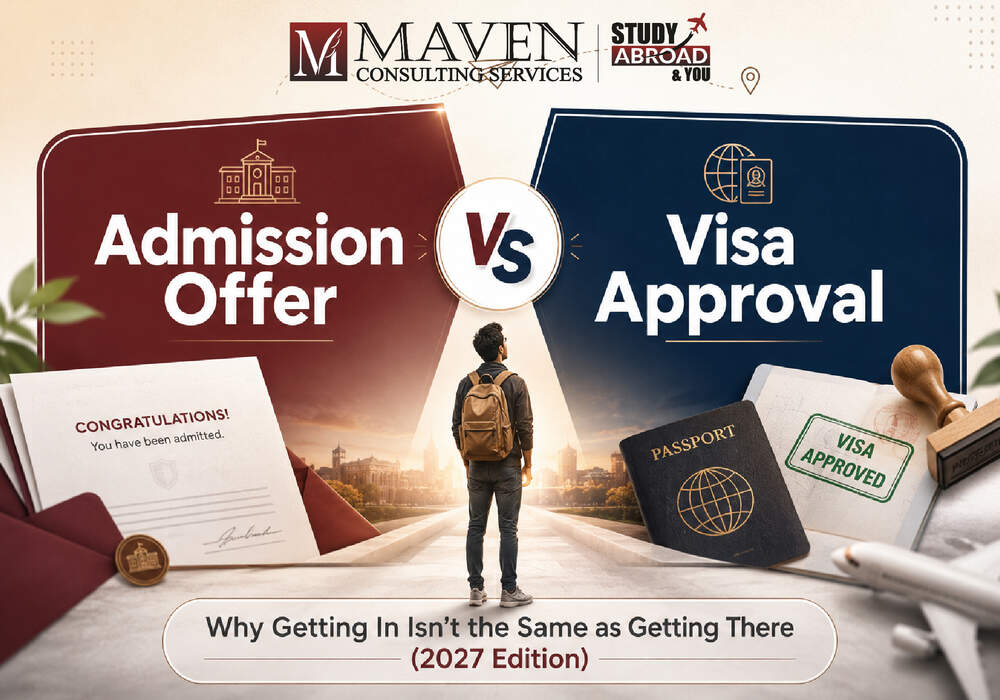
Admission Offer vs Visa Approval: Why Getting In Isn’t the Same as Getting There (2027 Edition)
Every intake cycle, thousands of Indian students open an admission offer, share the screenshot with family, and start planning the move. Then the visa outcome comes back different from what the offer letter implied — and the question that follows is almost always the same: “But I got in. How can they refuse me?”
The honest answer is structural, not personal — admission offer vs visa approval are two separate tests run by two separate gatekeepers. Across every major destination for Indian students, the university and the immigration authority are answering two different questions. This gets more, not less, important for 2027 applicants, as Australia’s Genuine Student framework, Canada’s officer-discretion model, the UK’s credibility interview process, and the US’s 214(b) standard have all seen tightened scrutiny in recent cycles.
Who This Blog Is For
- Students who’ve received an offer letter and are treating the visa as a formality
- 2027-intake applicants preparing Genuine Student statements, study permit applications, UK credibility interviews, or F-1 visa interviews
- Parents trying to understand how a “strong profile” can still face a visa refusal
What This Blog Covers
- Why admission offer vs visa approval comes down to two entirely different bodies making two separate decisions
- How Australia, Canada, the UK, and the US each run an independent, separate check
- The common threads behind refusals across all four countries
- What actually strengthens a visa case, separate from the admission file
For the specific mechanics of each country’s genuine-student style test, see our detailed guide on what “genuine student” actually means to an immigration officer, and our companion piece on the most common reasons study visas get refused.
Admission Offer vs Visa Approval: What Each One Actually Confirms
A university offer letter — whatever form it takes, from a conditional offer to a formal Letter of Acceptance, CAS, or I-20 — confirms exactly one thing: that the institution’s admissions office has assessed your academic record, English proficiency, and (where relevant) supporting documents, and considers you eligible to enroll.
It says nothing about your finances, your intent to comply with visa conditions, your ties to India, or how an immigration officer will read your file. That assessment hasn’t happened yet — it happens at the visa stage, by a completely different set of people using a completely different test.
Four Countries, Four Independent Tests
| Destination | Who Decides | What’s Being Tested | Legal Basis |
|---|---|---|---|
| Australia | Department of Home Affairs delegate | Genuine Student (GS) — genuine temporary intent to study | Migration Regulations 1994, clause 500.212 |
| Canada | IRCC visa officer | Genuine temporary intent, sufficient funds, program logic | IRPA / Immigration Regulations, officer discretion |
| United Kingdom | UKVI Entry Clearance Officer | “Genuine student” requirement, sometimes via Credibility Interview | Immigration Rules, Appendix Student |
| United States | US Department of State consular officer | Overcoming presumption of immigrant intent | INA Section 214(b) |
Australia: The Genuine Student (GS) Requirement
Australia runs the most explicit version of the admission offer vs visa approval separation. Since 23 March 2024, every Subclass 500 applicant must satisfy the Genuine Student requirement — a set of short, targeted written responses assessed by a Department of Home Affairs delegate, entirely apart from the university’s own offer decision. The delegate must be satisfied that the applicant genuinely intends to stay in Australia temporarily to study, considering course choice, academic background, career logic, and financial evidence. A university’s Confirmation of Enrolment gets you to this stage — it doesn’t clear it.
Canada: Officer Discretion and Dual Intent
This is admission offer vs visa approval in Canadian terms: a Letter of Acceptance from a Canadian institution is a required document for a study permit application — not a decision. Study permits are issued at the discretion of IRCC officers, who separately weigh proof of funds, program logic, and intent. Canadian law explicitly allows “dual intent” — holding a temporary study intention alongside a longer-term goal of permanent residence — and officers are instructed not to refuse an application for dual intent alone. In practice, refusals still happen where an officer isn’t convinced the applicant will comply with the terms of the temporary stay if a PR pathway doesn’t work out, or where financial evidence looks recently arranged rather than genuinely available.
United Kingdom: The Credibility Interview
Under Appendix Student of the UK’s Immigration Rules, applicants must meet a “genuine student” requirement. Here too, admission offer vs visa approval stay distinct: a Confirmation of Acceptance for Studies (CAS) from a university is necessary to apply — it isn’t the deciding factor. UKVI selects some applicants, at its discretion, for a Credibility Interview conducted by an Entry Clearance Officer, typically by video call, covering immigration history, study plans, and financial circumstances. Not everyone is interviewed, and being called for one doesn’t itself signal a problem — but the interview outcome, where it happens, feeds directly into the visa decision, separate from the university’s own admissions process.
United States: Section 214(b) and Immigrant Intent
The US version of admission offer vs visa approval works the same way: an I-20 from a US university lets you apply for an F-1 visa — it doesn’t grant one. Under INA Section 214(b), every nonimmigrant visa applicant is presumed to intend to immigrate unless they satisfy the consular officer otherwise. For Indian F-1 applicants, this means demonstrating strong, credible ties to India — family, academic and career plans, financial grounding — in an interview that has nothing to do with the university’s own evaluation of the applicant’s academic file.
The Common Threads Behind Refusals
Despite different legal frameworks, refusals across Australia, Canada, the UK, and the US tend to cluster around the same patterns — a reminder that admission offer vs visa approval outcomes rarely fail for random reasons:
- Financial evidence that doesn’t hold up to scrutiny — funds that are sufficient on paper but recently deposited, unclear in source, or inconsistent with the applicant’s declared financial background
- Generic or templated responses — genuine-student statements, SOPs, or interview answers that read as copied rather than specific to the applicant’s own course and career logic
- Weak study-gap or academic-progression explanations — a break in education or a course choice that appears to step backward without a clear reason
- Inconsistencies between application and interview — answers that don’t match the documents already on file
None of these are things a university’s admissions office is positioned to catch — which is exactly why an offer letter clearing does not predict a visa outcome.
What Actually Strengthens the Visa-Stage Case
Once you understand admission offer vs visa approval as two separate tests, the practical question becomes what actually moves the needle at the visa stage:
- Start financial documentation early enough that funds have a clean, traceable history — not a lump sum that appears weeks before the application
- Write genuine-student or SOP-adjacent responses specific to the actual course, institution, and a realistic next career step — not a reused template
- Address anything unusual in the profile directly — a study gap, a prior refusal, a change in field — rather than hoping it isn’t noticed
- Where an interview is possible (UK credibility interview, US F-1 interview), prepare for it as its own event, separate from admissions prep
Frequently Asked Questions
Does an admission offer guarantee a student visa?
No. Admission offer vs visa approval is the core distinction here: an admission offer confirms you meet a university’s academic and English-language entry criteria, while a student visa is a separate decision made by a different authority testing whether you’re a genuine temporary student who will comply with visa conditions.
Why do students get visa refusals after receiving an offer letter?
Because the offer letter and the visa application are assessed against different tests by different bodies. Common triggers include weak financial evidence, unclear study-gap explanations, and generic genuine-student responses — none of which admissions offices evaluate.
What is the Genuine Student (GS) requirement in Australia?
A mandatory assessment for every Subclass 500 application under clause 500.212 of the Migration Regulations 1994, replacing the Genuine Temporary Entrant test since 23 March 2024. A Home Affairs delegate must be satisfied the applicant genuinely intends to study temporarily in Australia.
Can a Canada study permit be refused even with a valid Letter of Acceptance?
Yes. The Letter of Acceptance is a required document, not a decision. IRCC officers separately assess funds, program logic, and — where relevant — dual intent, at their discretion.
What is a UK credibility interview and who gets one?
An interview by a UKVI Entry Clearance Officer assessing the “genuine student” requirement under Appendix Student. Not every applicant is selected — UKVI decides at its own discretion, and a CAS doesn’t itself determine the outcome.
What does a 214(b) visa refusal mean for F-1 applicants?
INA Section 214(b) presumes every nonimmigrant applicant intends to immigrate unless they prove otherwise. F-1 applicants must demonstrate strong ties to India separately from the university’s I-20 issuance.
Is dual intent allowed for a Canada study permit?
Yes. Canadian law explicitly permits holding both a temporary study intention and a longer-term PR goal. Officers are directed not to refuse for dual intent alone, though the applicant must still show they’ll comply with the temporary stay’s terms.
What can I do to strengthen my visa application separately from my admission file?
Build traceable, consistent financial evidence early; write specific, non-generic responses about course and career logic; and address unusual profile elements directly rather than hoping they’re overlooked.
Does a visa refusal affect my university admission?
Not directly, though most universities set a deadline to secure your visa or defer/forfeit the seat for that intake. Check your specific offer letter for the institution’s policy.
Can I reapply for a visa after a refusal?
In most cases yes, across all four countries — but the effective approach is addressing the specific refusal reason with new or stronger evidence, not resubmitting an unchanged application.
The Takeaway
Admission offer vs visa approval: these are not two steps in the same decision — they’re two separate decisions, made by two separate authorities, testing two separate things. For 2027 applicants, the students who move through this smoothly are the ones who start building their visa-stage case the moment the offer arrives, not after it.
Maven Consulting Services has guided over 10,000 students through admission and visa processes across 20+ countries, with a 99.8% visa success rate built on treating these as two distinct, equally important pieces of work — commission-free, from day one.
Don’t Let a Strong Admission Offer Meet a Weak Visa File
Book a free consultation with Maven’s counsellors and start your visa-stage preparation alongside your applications — not after them.
10,000+ Students Placed | 700+ University Partners | 20+ Countries | 99.8% Visa Success Rate | Commission-Free