CALL US& CONNECT








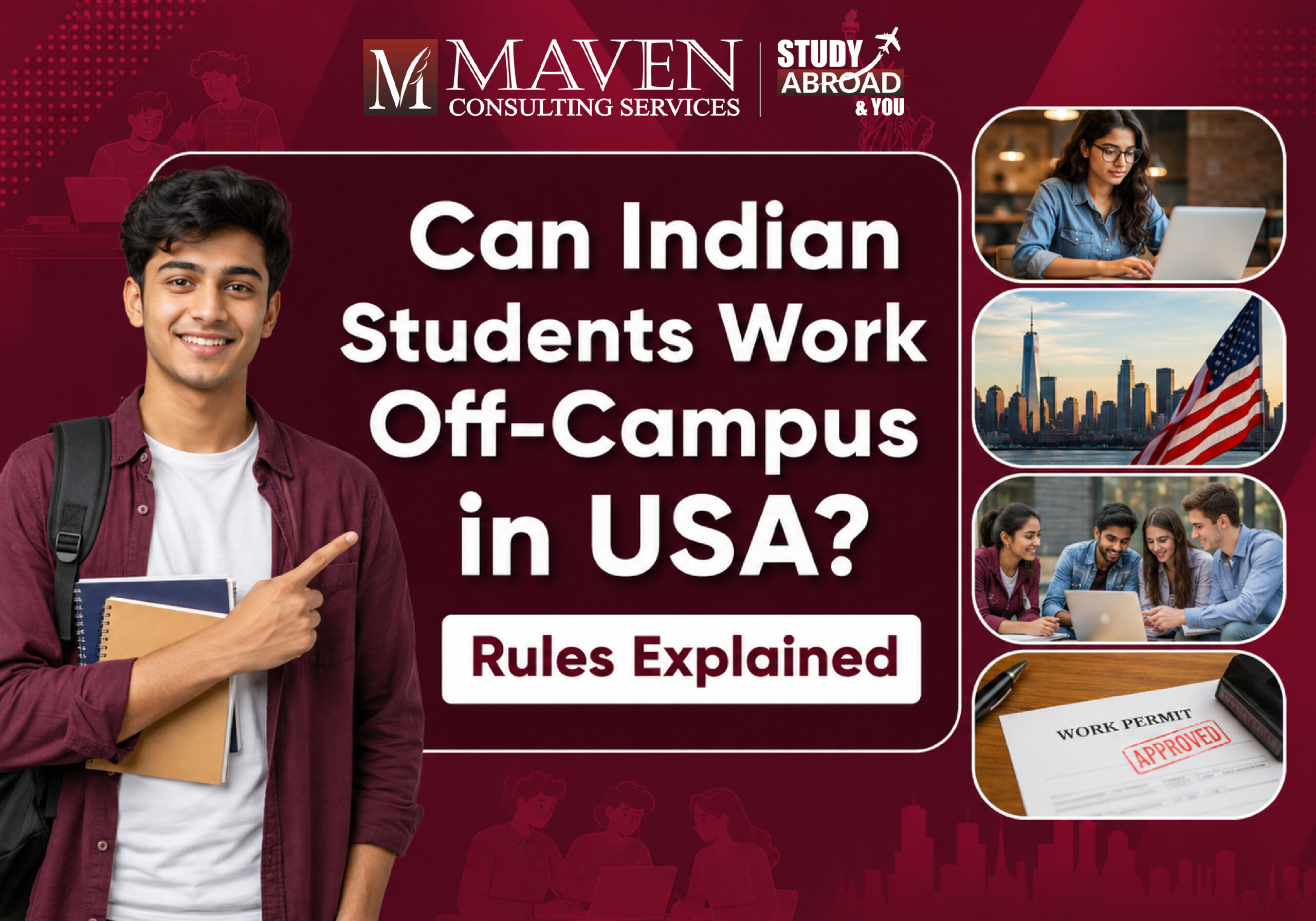
Many Indian students arrive in the USA expecting to cover living expenses with a part-time job.
One of the most common questions you find people asking is:
“Can Indian Students Work Off-Campus in USA?”
The reality is more complicated — and the consequences of getting it wrong are serious. This guide explains what is allowed, what is not, and what every student and parent needs to know before accepting any job.
| 20 hrs/week Maximum authorised off-campus work during term time | 1 year Minimum F-1 enrolment before most off-campus work is allowed | 0$ Legal earnings from unauthorised off-campus work | SEVIS termination Consequence of working without authorisation |
| QUICK ANSWER |
|---|
| Indian students on an F-1 visa cannot freely work off-campus in the USA. Off-campus work is only allowed in specific, authorised situations — primarily through CPT, OPT, or in rare cases of severe economic hardship. In the first academic year, off-campus work is not permitted at all. Working without authorisation — including cash jobs, restaurant work, freelancing, or delivery apps — is a violation of F-1 status and can result in visa cancellation, SEVIS termination, and a bar from re-entering the USA. |
This guide is for:
- Indian students on F-1 visas currently studying in the USA
- Students in India planning ahead and budgeting for living costs
- Parents co-funding a US education who want to understand work rights
- Anyone who has been offered a job and is not sure whether they can accept it

On-Campus vs Off-Campus Work: The Difference Matters
The rules on either side of this line are completely different.
| On-Campus Work | Off-Campus Work | |
|---|---|---|
| Allowed from Day 1? | Yes | No — not in the first academic year |
| Authorisation required? | No — automatic under F-1 status | Yes — always, without exception |
| Hours during term time | Up to 20 hours per week | Up to 20 hours per week (if authorised) |
| Hours during holidays | Full-time | Full-time (if authorised) |
| Examples | Library, campus cafeteria, research assistant | Restaurants, retail, freelancing, remote work for outside companies |
On-campus work is built into F-1 status and needs no approval. Off-campus work is a separate category entirely and requires formal authorisation every time.
One point most students miss: remote work is not on-campus work. If you are working from your dorm room for a company that is not your university, that is off-campus employment and requires authorisation.
What Counts as Off-Campus Work?
Off-campus work is broader than most students realise. All of the following count under US immigration rules:
- Jobs at restaurants, cafés, shops, warehouses, or supermarkets
- Delivery app work such as Uber Eats, DoorDash, or Instacart
- Freelancing or project-based client work
- Remote work for any company that is not your university, including Indian companies
- Cash jobs of any kind
- Paid internships at companies outside campus
- Running a paid service — tutoring privately, photography, social media brand deals
- Helping a friend’s business in exchange for payment
The rules apply regardless of whether the employer knows your visa status, whether you are paid in cash or by transfer, and whether the work is occasional or regular.
| COMMON MISCONCEPTION | THE REALITY IN 2026 |
|---|---|
| “Cash jobs do not count because there is no paper trail and my employer will not report me.” | USCIS does not need an employer to report you. Unauthorised work surfaces during visa renewals, OPT applications, and H-1B petitions — sometimes years later. A short-term cash job can affect a long-term immigration record. |
Can Students Work Off-Campus in the First Year?
No. According to official USCIS guidance, F-1 students may not work off-campus during the first academic year under any standard work authorisation category.
What is allowed in the first year:
- On-campus work only, up to 20 hours per week during term time
- Full-time on-campus work during official university vacation periods
What is not allowed in the first year:
- Any off-campus job, regardless of how casual or short-term
- Freelancing, even if done from home
- Remote work for any non-university employer
The only exception is severe economic hardship — an extremely limited category requiring documented proof of unforeseen financial crisis after enrollment, DSO recommendation, and USCIS approval. It is not a routine pathway.
Legal Ways to Work Off-Campus After the First Year
After one full academic year in valid F-1 status, students become eligible for authorised off-campus work categories.
| Work Category | When It Applies | Key Condition |
|---|---|---|
| CPT (Curricular Practical Training) | During the course, for internships or practical training | Must be part of the curriculum; DSO endorsement on Form I-20 required |
| Pre-Completion OPT | Before graduation, in the field of study | Counts against total OPT days; EAD card required |
| Post-Completion OPT | After graduation, in the field of study | 12 months standard; STEM extension available |
| Severe Economic Hardship | Case by case, after one full academic year | Proof of unforeseen hardship; DSO and USCIS approval required |
CPT and OPT are not general part-time work permission. Both require the work to be directly related to the student’s field of study and must be formally authorised before work begins.
For a detailed breakdown of how CPT and OPT work, eligibility, and how to apply, read our full guide: OPT vs CPT in America for Indian Students.
| COMMON MISCONCEPTION | THE REALITY IN 2026 |
|---|---|
| “Once I have OPT approval, I can work anywhere in any role.” | OPT authorises work only in a role directly related to your field of study. A computer science graduate working at a restaurant on OPT is in violation of their authorisation, even with a valid EAD card. |
Jobs That Put F-1 Students at Risk
| Job Type | Legal on F-1? | Risk |
|---|---|---|
| Restaurant or café work | No, without authorisation | One of the most common F-1 violations |
| Delivery apps | No | Treated as self-employment; not covered by any F-1 category |
| Cash jobs | No | Surfaces during visa renewals and immigration applications |
| Remote work for Indian companies | No | Working inside the USA requires US authorisation regardless of employer’s country |
| Freelancing | No, without EAD | Even occasional paid work counts as off-campus employment |
| Social media brand deals | No | Paid sponsorships count as self-employment income |
| Helping a friend’s business | No, if paid | Informal paid arrangements still count as employment |
What Happens If a Student Works Without Authorisation?
Working off-campus without authorisation is a violation of F-1 status. According to USCIS and ICE regulations, the consequences can include:
- SEVIS record termination — the student’s legal basis for being in the USA is cancelled
- Visa cancellation and requirement to leave the USA immediately
- Bar from re-entering the USA for a defined period or permanently in serious cases
- Impact on future visa applications including H-1B and green card petitions
- Loss of CPT and OPT eligibility
The immigration record does not reset after graduation. A status violation from the first year of study can surface during an H-1B petition five years later.
What to Ask Your DSO Before Accepting Any Job
The DSO at your university’s international student office is the only person who can officially clear you for work. Before accepting anything, ask:
- Is this on-campus or off-campus under my F-1 status?
- Do I need CPT, OPT, or an EAD before I can start?
- Is this role related to my field of study?
- Can I start before my authorisation is approved?
- Will this affect my SEVIS record or future OPT eligibility?
- What documents does my employer need from me?
No employer, recruiter, or well-meaning friend can replace this conversation.
FAQs: Off-Campus Work for Indian Students in the USA
1. Can Indian students work in restaurants in the USA?
Not on an F-1 visa without authorisation. Restaurant work is off-campus employment and is not covered by any standard F-1 work category.
2. Can F-1 students do cash jobs?
No. Cash payment does not make a job legal. The work authorisation requirement applies regardless of how a student is paid.
3. Can F-1 students work remotely for Indian companies?
No. Working inside the USA for any employer — including an Indian company — requires US work authorisation. Location triggers the rule, not the employer’s nationality.
4. Can F-1 students freelance or do project-based work?
No, without an EAD. Freelancing is treated as self-employment and is subject to the same off-campus work rules as any other job.
5. Can students work full-time during summer?
On-campus, yes — full-time is permitted during official vacation periods. Off-campus, only with active CPT or OPT authorisation that permits full-time hours.
6. What is the difference between CPT and OPT?
CPT is used for internships during the course. OPT is used before or after graduation for work in the student’s field. Both require formal authorisation. Read our full guide: OPT vs CPT in America for Indian Students.
7. Can students earn enough to cover living costs through legal work?
On-campus jobs typically pay USD 10 to USD 20 per hour at up to 20 hours per week — helpful for day-to-day expenses but not enough to cover full tuition or rent in most US cities. Financial planning for a US education must account for full costs independently of work income.
Final Word
The F-1 visa is a student visa, not a work visa — and US immigration law treats it that way. Legal work options exist and students who plan correctly can earn during their studies. But the starting point must always be authorisation, not assumption. If there is any doubt about whether a job is allowed, speak to your DSO before you start.
Planning a US education and want to understand the full financial picture before you apply?
Maven Consulting Services works with Indian students and families at every stage — from university selection and visa preparation to pre-departure planning. We help you go in with a clear plan, not surprises.
Sources: US Citizenship and Immigration Services; ICE Student and Exchange Visitor Program; Study in the States.
All rules are based on official USCIS and ICE guidance current as of 2026. Always verify current requirements with your university DSO before making any work decisions.
Read more from Maven