WhatsAppCHAT
CALL US& CONNECT

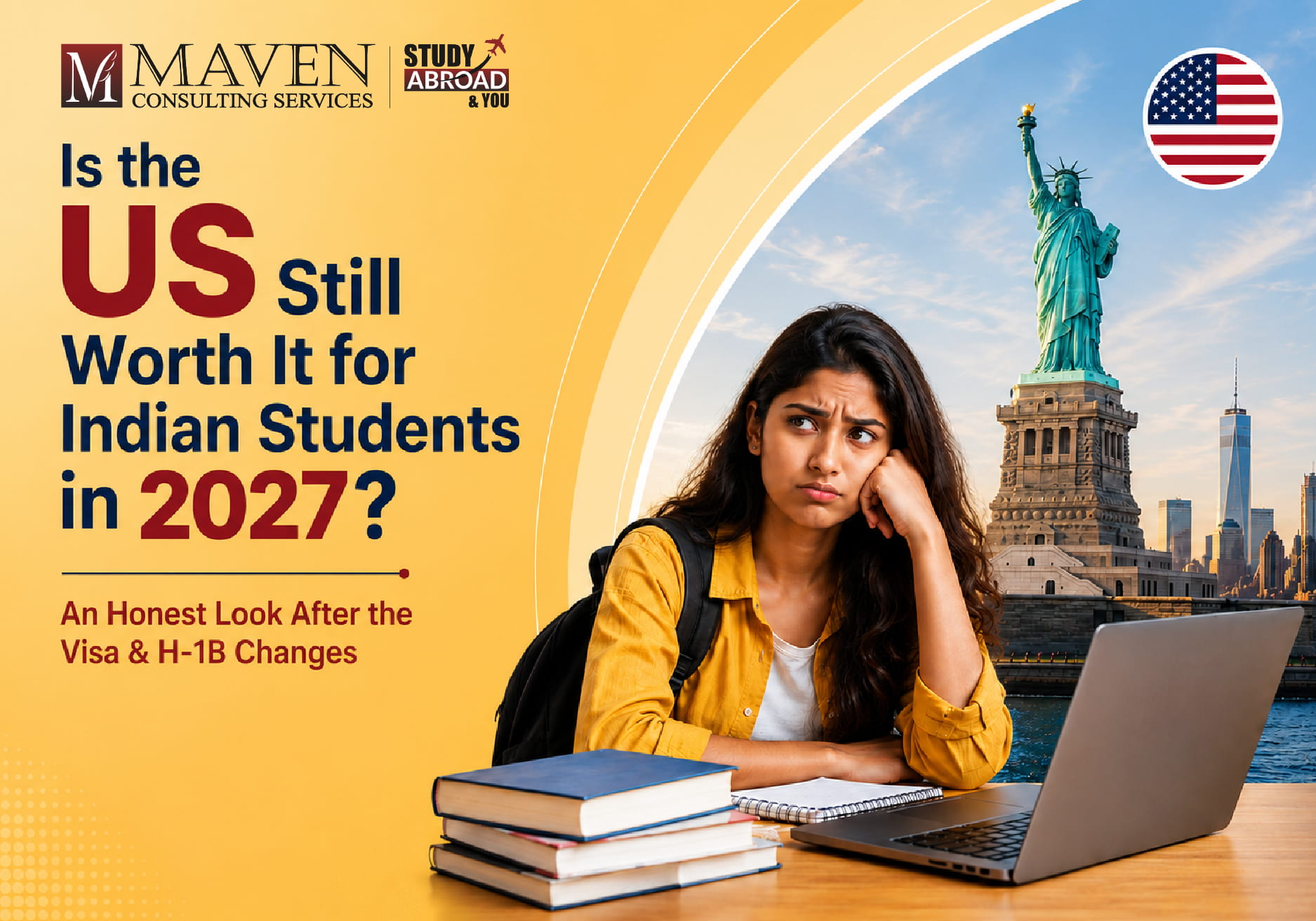
F-1 visas to Indian students fell 62% during peak 2025 admission season. Duration of Status ends September 15, 2026. The H-1B carries a $100,000 price tag on paper — except right now, it doesn’t. Here’s what actually changed, and what it genuinely means for your plans.
For strong STEM graduates from programs with real placement records, the US still offers unmatched research depth, salary ceilings, and career acceleration for Indian students — that hasn’t changed. What has changed is the path getting there: visa issuance has collapsed, student status now has a hard expiry date, the H-1B lottery increasingly favours senior over entry-level hires, and the green card queue for Indians runs past a decade. The US is not “no longer worth it.” It’s a bet that now needs to be placed with your eyes fully open, not on autopilot.
Every year, thousands of Indian students ask Maven some version of the same question: is the US still the right country to bet my degree, my savings, and a few years of my life on? In 2027, that question carries more weight than usual — not because studying in America has stopped working, but because the rules around what happens after graduation have shifted more in the past 18 months than in the previous decade combined.
This isn’t a piece designed to scare you out of the US, or to reassure you into it. It’s the honest, numbers-first breakdown we’d give a student sitting across the table from us — including the parts that are genuinely still working, and the parts where the story has gotten harder.
Three separate developments have reshaped the calculus for Indian students. They’re often reported together, which causes confusion — so here’s each one, on its own.
For more than three decades, F-1 students were admitted to the US for “Duration of Status” (D/S) — meaning they could remain as long as they kept meeting their program’s requirements, with no fixed expiry stamped on entry. On July 17, 2026, DHS published a final rule ending that system. Starting September 15, 2026, F-1 and J-1 students will instead be admitted for a fixed period tied to their program end date, capped at four years, plus grace periods for arrival and departure.
Students already in the US on D/S before the effective date get a transition cushion — they generally keep their current 60-day grace period until they either travel and re-enter, or need to file an Extension of Stay. But the practical effect going forward is real: your I-94 will now carry a hard expiry date, and staying beyond it — including, in some cases, for OPT or STEM OPT — may require a separate Extension of Stay application with USCIS rather than an automatic continuation.
Maven Note: Getting admitted to a strong program and maintaining valid status are two different things now in a way they weren’t before. Track your I-94 date as carefully as your I-20 — this is one more document that can quietly determine your timeline.
On September 19, 2025, a presidential proclamation imposed a $100,000 fee on certain new H-1B petitions — specifically those filed for workers outside the US who require consular processing. Even at the time, USCIS guidance clarified this fee did not apply to change-of-status petitions for people already in the US, which covers most F-1 students moving from OPT into H-1B status. The fee was aimed at new offshore hiring, not the standard student-to-H-1B pipeline.
Here’s the part most coverage has gotten out of date on: on June 8, 2026, a federal district court in Massachusetts vacated the fee entirely, ruling it an unlawful tax that bypassed Congress. The government appealed, and on July 24, 2026, the First Circuit Court of Appeals declined to reinstate the fee while that appeal continues. As of this writing, the $100,000 fee is not being collected. That said, the underlying appeal is still open, and the fee’s legal status could change again — this is not a settled matter, and any Maven family should verify the current status before making a decision based on it.
Separately, DHS finalized a rule replacing the traditional random H-1B lottery with a wage-weighted selection system, effective February 27, 2026. Instead of one entry per registration, higher-wage job offers now receive multiple entries — Level III and IV wage offers get three and four entries respectively, while Level I (entry-level) offers get just one. The FY2027 season, held under this new system, saw registrations fall sharply and selection skew heavily toward senior, higher-paid roles. More on what this means for odds below.
Policy changes matter, but the numbers show how students and universities have already responded.
| Metric | Figure |
|---|---|
| Active Indian students in the US (Feb 2026) | 352,644, down from 378,787 a year earlier (-6.9%) |
| Indian students enrolled, 2024-25 academic year (Open Doors/IIE) | 363,019 — 31% of all international students in the US |
| F-1 visas issued to Indians, May-Aug 2025 (peak season) | 22,149, down from 58,694 in 2024 (-62%) |
| International graduate enrollment, spring 2026 | Down 4.3% year-over-year; public 4-year colleges down 9.2% |
| US institutions expecting lower international enrollment for 2026-27 | 63% of surveyed institutions |
The proximate cause of the visa collapse was a near month-long pause on student visa interviews in mid-2025, layered on top of expanded social media screening and tighter vetting. Whether issuance rebounds toward historical norms for the 2027 intake is genuinely uncertain — interview capacity has partially recovered, but scrutiny levels haven’t reverted.
The core numbers haven’t moved: post-completion OPT still runs 12 months, and STEM-eligible degrees still qualify for a 24-month extension, giving eligible graduates up to 3 years of work authorization. That’s unchanged and remains one of the US’s genuine structural advantages over most competitor countries.
What’s changed is the paperwork around it. Because Duration of Status is ending, some students applying for OPT or STEM OPT after September 15, 2026 may need to file a matching Extension of Stay with USCIS to keep their I-94 aligned with their EAD card — a step that previously happened automatically. The I-765 filing fee (used for both initial OPT and STEM OPT applications) has also risen, from $1,685 to $1,780 in 2026. Individually minor; together, one more compliance step in a system that used to run on autopilot.
Maven Note — Admission vs. Status: A university admitting you, and USCIS extending your legal status, are two completely different approvals. Neither one guarantees the other. Build a calendar around your I-20/I-94 dates independent of your academic calendar.
For the FY2027 cap season — the first run entirely under the new weighted system — USCIS received 211,600 eligible registrations, down 38.5% from 343,981 the year before, and confirmed the 85,000 cap was reached with no second lottery. That produced an overall selection rate of roughly 40.2%, higher than recent years largely because the total pool shrank.
But the average hides the real story. Only 17.7% of selected registrations were at the lowest wage level (Level I, typically entry-level roles), while 71.5% of selected beneficiaries held US advanced degrees — up sharply from 57% the year before. In plain terms: a US master’s degree and a genuinely senior-track job offer now matter more to your H-1B odds than they used to. A strong US STEM master’s from a program with real industry placement, targeting a role with a competitive salary, sits in a meaningfully better position than a bachelor’s-level applicant chasing an entry-level offer.
This is the number that most changes the long-term math, and it’s the one competitor content tends to skip. As of the August 2026 Visa Bulletin, EB-2 India is unavailable — the category hit its FY2026 annual cap early, and Final Action Dates for both EB-2 and EB-3 India sit around 2013-2014, meaning a realistic wait of 11 to 13-plus years for many applicants filing today. The root cause is structural, not political: a 7% per-country cap on employment-based green cards, unchanged since 1990, applied to a country that generates a disproportionate share of demand.
This isn’t new information, but it matters more now because the H-1B lottery has gotten harder to win in the first place, and the fixed-status system adds compliance overhead on top of an already long wait. If your plan for the US assumes “H-1B, then green card within a few years,” that assumption needs revisiting — regardless of what happens with the $100,000 fee.
Despite everything above, these advantages still hold firmly in place for Indian students weighing the US for 2027.
Here is how the US stacks up against other popular destinations that Indian students are actively considering for 2027.
| Country | Post-Study Work | PR Pathway | Typical Cost Level | Best Fit |
|---|---|---|---|---|
| USA | Up to 3 years (STEM OPT) | H-1B lottery, then 11-13+ yr wait for Indians | High | STEM, research, top salary ceiling |
| Canada | Up to 3 years (PGWP) | Express Entry, often under 2 years | Medium | Clear, faster PR pathway |
| Germany | 18 months job search | ~21 months with skilled work visa | Low (public universities) | Engineering, near-free tuition |
| UK | 18-month Graduate Route | 5 years to ILR (Graduate Route doesn’t count) | Medium-High | Finance, shorter programs |
For a deeper look at how the numbers compare, see our USA vs Canada breakdown and our country-wise ROI guide.
The US still makes strong sense if you’re headed into a genuine STEM shortage field with funding or a strong assistantship, targeting research or academia, applying to a program with a documented track record of OPT-to-H-1B conversion in your field, or you have an alternative path (O-1 eligibility, family-based options, or a low dependency on the H-1B specifically).
It’s worth reconsidering, or at least budgeting a Plan B, if your plan depends entirely on winning the H-1B lottery in a non-shortage or generalist field, you’re financing the degree heavily through loans against an uncertain post-study outcome, or your primary goal is a fast, predictable path to permanent residency — where Canada or Germany currently offer a clearer, less lottery-dependent route.
“We’ve never told a family the US is a bad bet — for the right student, in the right field, it still isn’t. What we’ve stopped doing is letting anyone walk in assuming the old playbook still applies. The H-1B lottery, the green card queue, the fixed status clock — these aren’t reasons to avoid the US. They’re reasons to go in with a real Plan B, and to pick your program based on outcomes data, not brand name alone. That’s the conversation we have with every family before a single dollar is committed.”
For STEM graduates from strong programs with genuine employer demand, yes — the US still offers research depth, salary ceilings, and career acceleration that few countries match. For students banking on the H-1B lottery and a quick green card in a non-shortage field, the honest math has shifted, and Canada or Germany may now serve you better.
Not permanently. A federal district court vacated the fee on June 8, 2026, and the First Circuit Court of Appeals declined to reinstate it on July 24, 2026, so it is not currently being collected. The government’s underlying appeal is still pending, so the fee could return depending on how that appeal is decided.
Even while the fee was being enforced, USCIS guidance excluded change-of-status petitions for workers already in the US, including F-1 students changing status to H-1B. It was written to apply to new petitions for beneficiaries outside the United States requiring consular processing.
Duration of Status (D/S) let F-1 and J-1 students remain in the US for as long as they maintained valid student status, with no fixed expiry date. DHS published a final rule on July 17, 2026, replacing D/S with a fixed admission period of up to four years, effective September 15, 2026.
Core OPT (12 months) and STEM OPT (24-month extension) rules are unchanged. But students transitioning off D/S after September 15, 2026 may need to file a separate Extension of Stay alongside their OPT or STEM OPT paperwork.
For FY2027, USCIS received 211,600 eligible registrations against an 85,000 cap — an overall selection rate of about 40.2%. Odds vary sharply by wage level under the new weighted system, with entry-level offers selected far less often than senior, higher-paid offers.
As of the August 2026 Visa Bulletin, EB-2 India is unavailable for the rest of FY2026, with Final Action Dates for EB-2 and EB-3 India around 2013-2014 — a realistic wait of roughly 11 to 13-plus years for many applicants.
Yes, if the field, university outcomes, and funding make sense on their own — not solely as a bet on an H-1B and green card. Apply with realistic expectations about the post-study path, and ideally a backup plan that doesn’t depend entirely on US immigration approval.
The US hasn’t stopped working for Indian students — but it has stopped being the default, low-friction choice it once was. Visa issuance has fallen sharply, student status now carries a hard expiry clock, the H-1B lottery rewards seniority over entry-level offers, and the green card queue for Indians runs past a decade regardless of what happens with any single fee. None of that makes the US the wrong choice. It makes it a choice that deserves real numbers, not brand-name momentum, behind it.
If your field, funding, and risk tolerance line up with what the US still does best, it remains one of the strongest bets in the world. If they don’t, that’s exactly the conversation worth having before you commit — not after.
Book a free, honest consultation. We’ll walk through your field, your budget, and your risk tolerance — and tell you plainly where the US fits and where it doesn’t.
Book a Free Consultation
Sunday, October 26, 2025 | The Taj MG Road, Bangalore | 10 AM – 4 PM