WhatsAppCHAT
CALL US& CONNECT

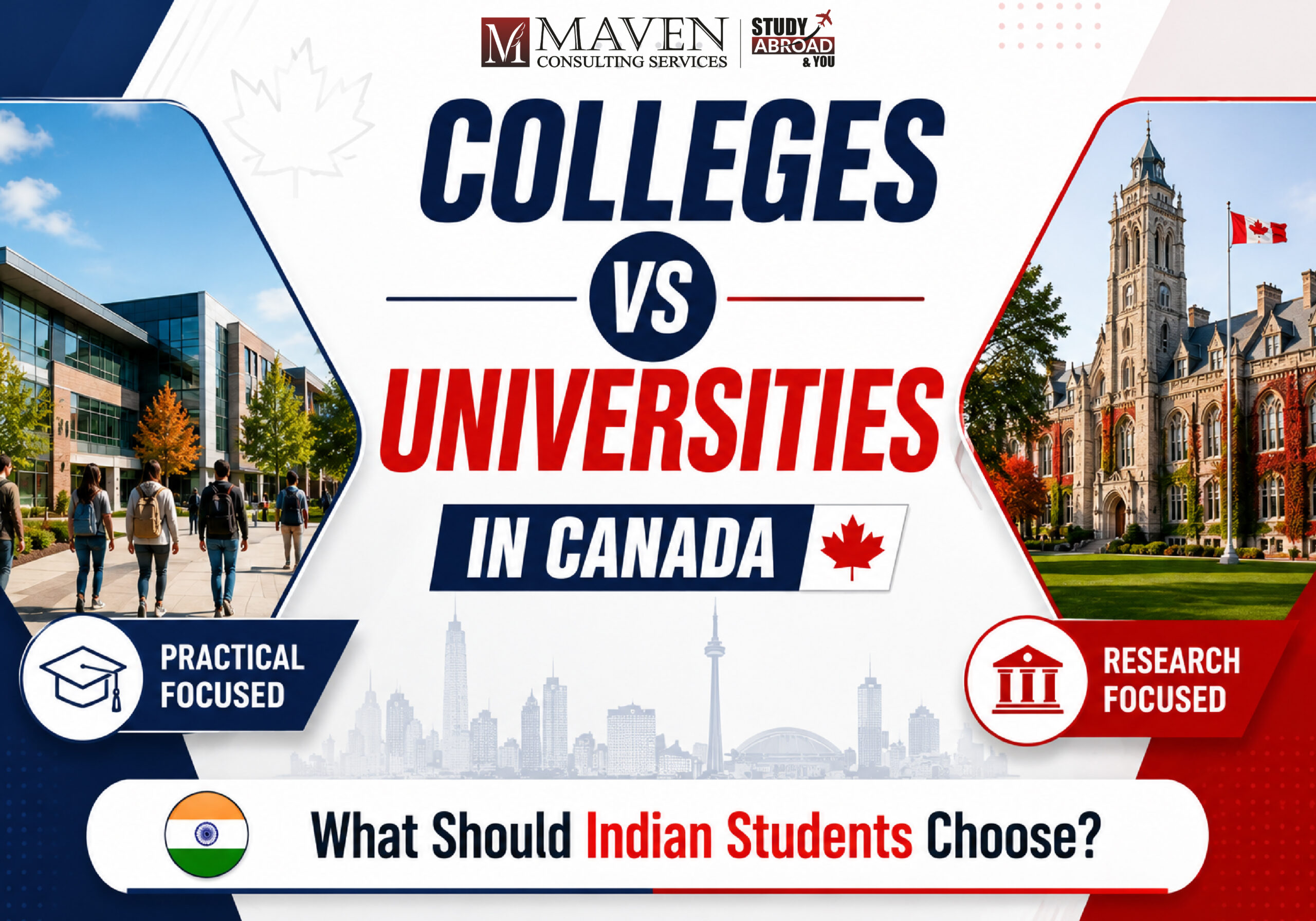
The difference between colleges vs universities in Canada is not just academic. In 2026, it determines your Canada PGWP eligibility, PR pathway, and whether your ₹15–30 lakh investment pays off.
| QUICK ANSWER |
|---|
| In Canada, universities award degree-level qualifications (Bachelor’s, Master’s, PhD) while colleges offer diploma and certificate programmes. For Indian students in 2026, the choice is no longer just academic — it is an immigration decision. University degree graduates qualify for PGWP in any field. College diploma graduates must be in IRCC-approved, labour-shortage-linked programmes. Master’s and PhD students at public universities are now exempt from Canada’s study permit cap. Most Indian families serious about PR should default to a public university unless a college programme is demonstrably PGWP-safe. |
| 408K Study permits planned 2026 (down from 485K in 2024) | ZERO Cap for Master’s/PhD at public universities from Jan 2026 | 3 yrs PGWP for 2-year+ university degree graduates | 74% Study permit refusal rate for Indian applicants (Aug 2025) |
When an Indian student or parent says “I want to study at a college in Canada,” they usually picture something close to a degree college back home, a reputable institution offering a recognised qualification. That picture is not wrong, but it is incomplete in the Canadian context.
In Canada, the word “college” means something specific and legally distinct from “university.” The difference shapes what credential you earn, how long you stay, what work rights you have, and whether you can realistically apply for permanent residence. In 2025–26, with Canada’s immigration rules undergoing the most significant restructuring in a decade, this distinction has become the single most consequential choice an Indian student makes.
| COMMON MISCONCEPTION | THE REALITY IN 2026 |
|---|---|
| “A 2-year college diploma in Canada is basically the same as a degree — and it’s cheaper, so why not choose it?” | The credential is legally different. Since November 2024, college diploma graduates must be in specific IRCC-approved fields to get a PGWP. A cheaper diploma that doesn’t qualify for PGWP is not a bargain — it is a dead end. |
India uses the word ‘college’ broadly — affiliated degree colleges, engineering colleges, medical colleges — all of which award Bachelor’s degrees under a university. Canada uses the word differently.
— Universities
In Canada, universities are research-intensive institutions that award degrees at all levels: Bachelor’s (3–4 years), Master’s (1–2 years), and Doctoral (PhD, 4+ years). They are publicly funded, provincially regulated, and globally ranked. Examples include the University of Toronto, McGill University, University of British Columbia, University of Waterloo, McMaster University, and the University of Alberta.
— Colleges
Also called community colleges, polytechnics, or institutes of technology, colleges are vocationally oriented institutions that primarily award diplomas (1–3 years) and certificates (under 1 year). Some colleges also offer applied degrees. They focus on practical training and employer partnerships.
— Private colleges
These are privately owned institutions offering diplomas and certificates. They are NOT publicly funded, often have weaker regulations, and in 2026, are largely ineligible for PGWP. This is where the biggest risks lie for Indian students.
| KEY TERM: DESIGNATED LEARNING INSTITUTION (DLI) |
|---|
| Only institutions on IRCC’s DLI list are approved for international students. Both public universities and public colleges are DLIs. However, being a DLI does not automatically make a programme PGWP-eligible. Always verify programme-level eligibility, not just institution status. |
| Factor | Public University | Public College | Private College |
|---|---|---|---|
| Credential Awarded | Bachelor’s / Master’s / PhD | Diploma / Certificate / Applied Degree | Diploma / Certificate |
| Duration | 3–4 yrs (UG), 1–2 yrs (PG) | 1–3 years | 1–2 years |
| Tuition (INR/yr) | ₹11–22 lakhs (CAD 18K–35K) | ₹7.5–11 lakhs (CAD 12K–18K) | ₹6–10 lakhs (CAD 10K–16K) |
| PGWP Eligibility | Any field — fully eligible | Approved fields only (CIP code) | Largely ineligible |
| Study Permit Cap (2026) | Master’s/PhD: Cap exempt | Subject to cap + PAL required | Subject to cap + PAL required |
| PR Pathway Strength | Strong — especially Master’s/PhD | Moderate — field-dependent | Weak — high risk |
| Global Recognition | High — degree is universally understood | Moderate — diploma less portable globally | Low — limited outside Canada |

The Post-Graduation Work Permit (PGWP) is what allows you to work in Canada after graduating — and it is the gateway to Express Entry and permanent residence. Understanding PGWP eligibility in 2026 is not optional. It is the foundation of every Canada study decision.
If you complete a Bachelor’s, Master’s, or PhD at a public Canadian university, you are eligible for PGWP regardless of what you studied. A history degree, a business degree, an engineering degree — all qualify. The PGWP duration matches your programme length up to a maximum of 3 years. A 2-year Master’s gives you a 3-year PGWP.
Since November 2024, college diploma and certificate graduates must be in a programme whose CIP (Classification of Instructional Program) code is on IRCC’s approved list — linked to genuine labour market shortages. Safe sectors include healthcare, engineering technology, IT, skilled trades, transportation, and agriculture. General business, hospitality, media production, and similar diplomas are no longer reliably PGWP-eligible.
| WARNING: THE PRIVATE COLLEGE TRAP |
|---|
| Every year, thousands of Indian students enrol in Canadian private colleges attracted by lower fees and easier entry. In 2026, this is among the riskiest choices you can make. |
| • Private colleges are generally NOT eligible for PGWP |
| • Students can complete a full 2-year programme, pay all fees, graduate — and then discover they cannot legally work in Canada |
| • Many operate through ‘curriculum licensing agreements’ — specifically made PGWP-ineligible after May 2024 |
| • A cheaper private college diploma that leads to deportation is not cheaper — it is catastrophically expensive |
| Always verify DLI status AND PGWP eligibility on the IRCC website before paying any fees. |
Canada set a national study permit cap of 408,000 for 2026 — down from 485,000 in 2024. But not all students are equally affected.
| Student Category | Cap Status | PAL/TAL Required? | Practical Impact |
|---|---|---|---|
| Master’s / PhD at public university | Cap EXEMPT from Jan 2026 | No | Smoother process, less competition |
| Bachelor’s at public university | Subject to cap | Yes — PAL needed | Early application essential |
| College diploma / certificate | Subject to cap | Yes — PAL needed | Colleges have limited PAL quotas |
| Private college | Subject to cap | Yes — PAL needed | Many private colleges running out of PALs |
| MAVEN INSIGHT |
|---|
| “The single biggest mistake I see Indian families make is treating the college-versus-university decision as a cost decision. They look at the fee difference — ₹4–5 lakhs a year — and choose the college. But they have not asked the question that actually matters: does this programme lead to a PGWP? Does that PGWP lead to Express Entry? If the answer to either question is no, the cheaper option has just cost them everything. In 2026, programme selection is an immigration decision first and an academic decision second.” |
| — Rajshekar Tubachi, Founder, Maven Consulting Services, Bengaluru |
| COMMON MISCONCEPTION | THE REALITY IN 2026 |
|---|---|
| “Just go to this college — it’s cheaper, easier to get in, and you’ll figure out the PR later.” | Your institution type, programme field, and CIP code all determine your PGWP eligibility. ‘Figuring out PR later’ is not a strategy, it is wishful thinking in a system that now requires planning from Day One. |
| Institution Type | Annual Tuition (INR) | Annual Living Costs (INR) | Total Annual Budget (INR) |
|---|---|---|---|
| Public University — Bachelor’s | ₹11–18 lakhs | ₹9–14 lakhs | ₹20–32 lakhs |
| Public University — Master’s | ₹14–22 lakhs | ₹9–14 lakhs | ₹23–36 lakhs |
| Public College — Diploma | ₹7.5–11 lakhs | ₹9–13 lakhs | ₹16–24 lakhs |
| Private College — Diploma | ₹6–10 lakhs | ₹9–13 lakhs | ₹15–23 lakhs |
| GIC REQUIREMENT 2026 |
|---|
| From September 2025, all international students must demonstrate CAD 22,895 (approximately ₹14.3 lakhs) in living funds — on top of first-year tuition and travel costs. Lump-sum deposits made immediately before application are frequently flagged and rejected. |
University degrees are recognised globally, which matters if Canada does not ultimately work out and you need to return to India or move to another country. Starting salaries for university graduates in Canada typically range from CAD 50,000–85,000 per year (₹31–53 lakhs) depending on field. University education also opens routes to professional designations (P.Eng, CPA, CFA) that are closed to diploma holders.
College education in Canada is genuinely practical. Co-op programmes give students Canadian work experience before graduation — valuable for CRS score building and employer networks. College graduates in approved PGWP fields (IT support, healthcare technology, engineering technology, trades) can earn CAD 40,000–65,000 (₹25–41 lakhs) starting salaries and have real PR pathways through Provincial Nominee Programmes.
| MAVEN VIEW |
|---|
| The co-op advantage of Canadian colleges is real and often underestimated. A student who completes 8 months of co-op work during a 3-year college programme graduates with meaningful Canadian work history — which directly improves their Express Entry CRS score. The question is not whether colleges have value. They do. The question is whether your specific college programme, in 2026, leads to PGWP. Verify first. |
One option that is genuinely underused by Indian students is the 2+2 articulation transfer. This involves completing a 2-year college diploma at a participating college, then transferring to a university to complete a Bachelor’s degree in 2 additional years. The final credential is a university degree — which carries full PGWP eligibility.
| COLLEGES WITH STRONG UNIVERSITY TRANSFER AGREEMENTS |
|---|
| Bow Valley College → University of Calgary |
| Algonquin College → Multiple Ontario universities |
| Centennial College → Toronto Metropolitan University, York University |
| Cambrian College → Laurentian University |
| Humber College → Multiple Ontario universities |
| Note: Transfer agreements vary by programme. Always confirm current articulation terms directly with both institutions. |

The right choice depends on your profile, goals, and budget. Here is a structured way to think through it.
| Choose a Public University If You… | Consider a Public College If You… |
|---|---|
| Want maximum PGWP security — any field qualifies | Are in healthcare, IT, engineering tech, or skilled trades |
| Are targeting Master’s/PhD (cap-exempt from Jan 2026) | Have verified your programme’s CIP code is PGWP-eligible |
| Have a strong academic profile (75%+ in Class 12 or graduation) | Want co-op work experience embedded in your programme |
| Want a globally portable credential | Are targeting Ontario/BC provincial nominee pathways |
| Are planning PR through Express Entry / CEC | Plan to do the 2+2 transfer to a university degree |
| Want spousal open work permit (restricted to Master’s/PhD spouses) | Have a tighter budget and a clearly PGWP-safe programme |
| Are in STEM, healthcare, business, law, or research fields |
| DO NOT CHOOSE A PRIVATE COLLEGE IF YOU ARE TARGETING PR |
|---|
| This is not a generalisation — it is the current policy reality. Private college programmes are largely ineligible for PGWP under 2026 rules. If permanent residence in Canada is your goal, a private college diploma is almost never the right starting point, regardless of what the institution’s marketing says. |
| Top Public Universities (Fully PGWP-Safe) | Public Colleges — Verify Programme CIP Code |
|---|---|
| • University of Toronto • University of British Columbia • McGill University • University of Waterloo • McMaster University • University of Alberta • Western University • Simon Fraser University • University of Ottawa • Dalhousie University | • Conestoga College (Verify CIP) • Seneca College (Verify CIP) • Humber College (Verify CIP) • Centennial College (Verify CIP) • George Brown College (Verify CIP) • Algonquin College (Verify CIP) • BCIT (Verify CIP) • NAIT (Verify CIP) • Bow Valley College (Verify CIP) • Cambrian College (Verify CIP) |
| HOW TO VERIFY PGWP ELIGIBILITY FOR A COLLEGE PROGRAMME |
|---|
| 1. Obtain the programme’s CIP (Classification of Instructional Programs) code from the college’s website or Letter of Acceptance. |
| 2. Cross-reference the CIP code against IRCC’s official PGWP-eligible programmes list at canada.ca/ircc. |
| 3. Confirm the institution is a Designated Learning Institution (DLI) on the same IRCC portal. |
| 4. Do not accept the college’s verbal assurance — check the IRCC list yourself, or have your consultant check it in writing before you pay any fees. |
✓ If you are applying for a Master’s or PhD at a public university, you are in the strongest position — no cap, no PAL, full PGWP, clear PR pathway
✓ If you are applying for a Bachelor’s at a public university, apply early — PAL allocation is limited per institution per province
✓ If you are applying to a public college diploma, verify the CIP code against IRCC’s list before paying any admission fees
✓ Never enrol in a private college if PR is your goal — the PGWP risk is too high
✓ The 2+2 transfer route is a legitimate cost-saving strategy that preserves university-level PGWP eligibility — but verify the transfer pathway is formal and current
✓ Budget CAD 22,895 (₹14.3 lakhs) in demonstrable living funds on top of tuition — and make sure the funds are verifiably yours over time, not a recent lump sum
✓ Language scores matter at two stages: study permit application and PGWP application (CLB 7 for university graduates, CLB 5 for college graduates)
1. What is the difference between a college and a university in Canada?
In Canada, universities award degree-level qualifications (Bachelor’s, Master’s, PhD) focused on research and academic study. Colleges offer diploma and certificate programmes with a practical, vocational focus. The distinction directly affects PGWP eligibility and PR pathways in 2026.
2. Which is better for PR — a Canadian college or a Canadian university?
Universities offer a stronger PR pathway. University degree graduates are eligible for PGWP regardless of field of study. College diploma graduates must be in IRCC-approved fields. For most Indian students targeting PR, a public university Master’s programme is the most reliable route.
3. Are Master’s students exempt from Canada’s study permit cap in 2026?
Yes. From January 1, 2026, Master’s and PhD students at public DLIs are fully exempt from the 408,000 permit cap and do not require a PAL. This makes postgraduate university study significantly more accessible than undergraduate or diploma programmes.
4. Can a business diploma from a Canadian college lead to PGWP in 2026?
Not reliably. General business diplomas at the college level are not on the IRCC PGWP-eligible fields list for non-degree programmes. Always verify your programme’s CIP code against the IRCC-approved list before paying any fees.
5. What is the 2+2 transfer route in Canada?
The 2+2 route involves completing a 2-year college diploma and then transferring to a university to complete a Bachelor’s degree in 2 additional years. Colleges like Bow Valley, Algonquin, and Centennial have formal transfer agreements with universities. The final degree is a university qualification — which carries full PGWP eligibility.
6. How much does it cost to study at a Canadian university vs a college, in INR?
Public university tuition ranges from ₹11–22 lakhs per year (CAD 18,000–35,000). Public college tuition ranges from ₹7.5–11 lakhs per year (CAD 12,000–18,000). Living costs are similar for both — approximately ₹9–14 lakhs per year. From September 2025, students must also demonstrate CAD 22,895 (₹14.3 lakhs) in living funds at the time of permit application.
Maven Consulting Services has placed thousands of Indian students in Canadian universities and colleges over 14+ years. We verify PGWP eligibility, PAL availability, and programme fit before you commit — not after.
Sources & Data: IRCC Canada official policy updates (2024–2026); Canada Immigration Levels Plan 2026–2028; Canadian Occupational Projections System 2024–2033; QS World University Rankings 2026. All INR figures are approximate conversions at CAD 1 = ₹62.5 and are subject to exchange rate fluctuation. Always verify current policy at canada.ca/ircc before making decisions.