WhatsAppCHAT
CALL US& CONNECT


It’s June 2026. If you’re targeting a Fall 2027 start abroad, you have roughly 14 months — and the students who land the best admits and clean visas are the ones starting today, not in January.
Most students don’t lose a Fall intake because their profile wasn’t good enough. They lose it because they started three months too late.
A rushed Statement of Purpose, a test score that came back below target with no time to retake, a scholarship deadline that closed in November while they were still shortlisting universities in December — these are the real costs.
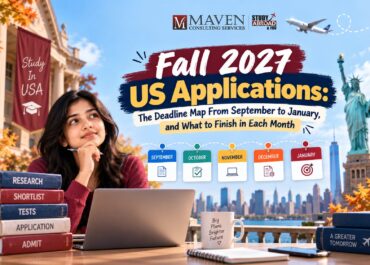
This blog lays out a complete Fall 2027 application timeline — a practical, month-by-month roadmap that takes you from research in mid-2026 all the way to boarding your flight in the second half of 2027.
It’s built specifically for Indian students and parents who want to know exactly what to do, and when, without the guesswork.
Bookmark this Fall 2027 application timeline and share it with parents and peers. If you haven’t picked a destination yet, that’s fine — start with our country overviews like the Study in USA guide or Study in UK guide and use this roadmap to time everything around your choice.
Why does the timing matter so much right now? Because nearly every expensive mistake in a study abroad application is a timing mistake, and June 2026 is the point where a Fall 2027 plan is still entirely in your control.
Quick answer: For a Fall 2027 intake, start in June–August 2026 (roughly 14 months ahead). Spend mid-2026 on research, profile audit, budgeting, and booking your tests.
Take entrance and English tests by Sep–Nov 2026, submit applications between December 2026 and February 2027, finalise offers and funding by March–May 2027, and complete your visa and departure between June and August 2027.
Starting now gives you room for retakes, scholarship deadlines, and the occasional setback — starting in January 2027 usually does not.
Here is the entire journey in one view. We’ll break each phase down in detail below, but if you only save one thing from this blog, save this table.
| Months | Phase | What you focus on |
|---|---|---|
| Jun–Aug 2026 | 1. Foundation | Research countries & courses, honest profile audit, budget & funding plan, choose and book tests |
| Sep–Nov 2026 | 2. Build & Test | Take tests, finalise university shortlist, draft SOP, request LORs, gather documents |
| Dec 2026–Feb 2027 | 3. Apply | Submit applications, meet deadlines, handle country-specific portals |
| Mar–May 2027 | 4. Decide & Fund | Compare offers, accept & pay deposit, lock education loan, arrange proof of funds |
| Jun–Aug 2027 | 5. Visa & Departure | Apply for visa, biometrics/interview, accommodation, pre-departure, fly out |
A general roadmap. Exact dates shift by country and university — always confirm deadlines on each institution’s official admissions page.
This is the phase students skip, and it’s the one that quietly decides the rest. Get the foundation right and everything downstream becomes easier.
Start broad, then narrow. Look at the destination as a whole — tuition, cost of living, post-study work rights, and your actual job prospects after graduation — not just university rankings.
Be honest about why a country fits you. A well-known concern, for example, is that some destinations have weak graduate job markets for students who don’t speak the local language; that’s the kind of thing you want to discover in June 2026, not after you’ve paid a deposit.
Look at your academics, work experience, projects, and gaps the way an admissions officer would. Where are you genuinely competitive, and where do you need to strengthen the story?
If there’s time to add a certification, a project, or relevant experience before applications open, this is the window to do it. Our profile building guide walks through how universities actually evaluate Indian applicants.
Work out a realistic all-in budget: tuition, living costs, travel, insurance, and the proof-of-funds amount the destination requires. If you’ll need an education loan, understand the timeline and documentation now — see our education loan guide and the country-specific bank balance requirements.
Funding surprises in April 2027 are the single most common reason a confirmed admit collapses.
Decide which entrance test (if any) and which English test you need, based on your target countries and courses. Then book test dates early; popular slots in metros fill up, and you want your first attempt done with time to spare for a retake.
Maven Note: Book your test slots as soon as you’ve decided which tests to take. A booked date is a commitment that keeps your timeline honest — and if your first attempt falls short, an early date means a retake is still possible without derailing your applications.
Now you execute. This is the heaviest-lifting phase, and doing it before December is what separates calm applicants from frantic ones.
Sit your English test (IELTS, TOEFL, PTE, or Duolingo) and any entrance test (GRE or GMAT) in this window. Aim to have official scores in hand by late November so they’re ready when applications open. If a score disappoints, you still have room to retake before the bulk of deadlines hit.
Build a balanced list across three tiers — ambitious, target, and safe. A common structure is a handful in each band so you have genuine choice in spring rather than a single nervous bet. Match each university to your verified scores, budget, and post-study goals.
Start your Statement of Purpose now — good SOPs go through several drafts, and the difference between a rushed essay and a considered one is visible to admissions committees.
Request your Letters of Recommendation early too; professors and managers are busy people, and a polite four-to-six week runway gets you a far better letter than a last-minute ask.
Maven Note: Don’t wait for your final test score to start your SOP. The essay and the score are independent tracks — drafting your SOP in October while scores process saves you weeks you’ll badly want in December. Request LORs at least four to six weeks before you need them.
Transcripts, mark sheets, degree certificates, passport, CV, and any portfolio or work samples. Get digital copies organised and, where needed, start any attestation or transcript-request processes that have their own lead times.
With tests done, essays drafted, and documents ready, the application phase becomes about precision and deadlines rather than scrambling.
Submit through each university’s portal, double-checking that every required field, document, and score report is in. Track deadlines in a single sheet — this is exactly where the rhythm differs by country, so read the country section below carefully.
Submitting a clean, complete application a few days before the deadline beats a rushed one at 11:59 PM every time, especially where admissions are rolling and earlier applicants are assessed first.
“In fourteen years, I’ve watched the same pattern repeat. The students who start a year out aren’t smarter than the ones who start in January — they’re just calmer, and calm shows up in the application.
Early starters retake the test that needs retaking, write the third draft of the SOP, and apply before the scholarship money runs out.
Late starters do none of those things, not because they can’t, but because there’s no time left. Timing is the cheapest advantage in this entire process, and it’s the one most people give away.”
Offers start arriving. This phase is about choosing wisely and getting your money in order — calmly, because you planned for it.
Look past the brand name. Weigh total cost, scholarships, course content, location, post-study work rights, and realistic job outcomes for your field. An offer you can afford and graduate from with strong prospects beats a more prestigious one that stretches you to breaking point.
Once you choose, accept the offer and pay the deposit by the stated date to secure your seat. Simultaneously finalise your education loan and arrange your proof of funds in the format and amount your destination’s visa rules require. Build in buffer time — loan sanction and fund-seasoning requirements can take weeks.
Maven Note: Proof-of-funds and bank-balance rules are volatile and country-specific, and they change more often than students expect. Confirm the exact current requirement for your destination on the official government or embassy source before you arrange funds — not from an old blog or forum post.
The final stretch. With your offer and funds confirmed, this phase is procedural — provided you’ve left enough lead time.
Start your visa application as soon as you have your confirmation of admission and funds in place. Visa processing times vary widely by country and season, and Fall is peak load — so apply early.
Prepare for biometrics, and where required, a visa interview. Have your documents, financials, and a clear, honest account of your study plans ready.
Lock in housing, book flights, arrange forex and insurance, and attend any pre-departure briefings. Sort out your SIM, initial expenses, and a plan for your first week abroad. Then — the part fourteen months of planning earns you — you fly out, on time and without panic.
The five phases of the Fall 2027 application timeline hold everywhere, but the calendar compresses or stretches depending on where you apply. Here’s the general rhythm — always confirm exact dates on each university’s official admissions page, because individual programmes set their own deadlines.
| Destination | General Fall 2027 application rhythm |
|---|---|
| USA (grad) | Many deadlines fall roughly December 2026–February 2027; some early ones in November. Funding and assistantship deadlines can be earlier — apply early. |
| USA (undergrad) | Early Action/Early Decision often around November 2026; Regular Decision typically around January 2027. |
| UK | UCAS undergraduate applications open in the autumn before entry with an equal-consideration deadline in January; many master’s run rolling admissions — apply early as popular courses fill. |
| Canada | Fall intake deadlines commonly cluster around January–March 2027; apply early to leave room for the study-permit timeline. |
| Germany | Winter-semester (the main intake) application windows typically run through the spring/summer before entry; uni-assist processing adds lead time, so start early. |
| Australia | Multiple intakes a year; for a mid-2027 Semester 2 start, apply several months ahead and factor in current visa-rule changes. |
For destination-specific detail, see our complete country guides — for example the USA guide and UK guide — and always cross-check deadlines against the official sources below.
Timing your tests is a real planning question, because scores expire. Test too late and you miss deadlines; test far too early and a score can lapse before you use it. Here’s the quick reference.
| Test | Validity | Planning note |
|---|---|---|
| IELTS | 2 years from test date | Testing in late 2026 comfortably covers a Fall 2027 application and visa. |
| TOEFL iBT | 2 years from test date | Same window as IELTS; confirm your university accepts the version you take. |
| PTE Academic | 2 years (commonly applied) | Universities generally apply a 2-year window — confirm per institution. |
| Duolingo English Test | 2 years from test date | Fast and affordable, but check each university accepts it before relying on it. |
| GRE | 5 years from test date | A 2026 score easily covers Fall 2027; some programmes prefer scores within 2–3 years. |
| GMAT | 5 years from test date | Same as GRE — comfortably valid for a 2027 intake. |
Validity periods per ETS (GRE), GMAC (GMAT), and the English test providers. Individual universities may apply stricter windows — confirm on each programme’s admissions page.
We’d rather be honest than reassuring. If you skip the Fall 2027 application timeline steps above, starting late in January 2027 isn’t impossible — but here’s what you typically give up:
None of this is about working harder. It’s about giving yourself the time to do ordinary things calmly. That’s the whole argument for starting now. For more on avoiding common pitfalls, see our guide on the most common reasons applications get rejected.
Ideally around June–August 2026, roughly 14 months ahead. This gives you time to research, audit and strengthen your profile, budget, and take your tests with room for a retake — all before applications open in late 2026.
Often yes, but with less margin. You’ll need to move quickly on tests and your SOP, you may have fewer university options as rolling deadlines close, and you’ll have little buffer for setbacks. It’s doable, but the earlier you start, the calmer and stronger your application.
IELTS, TOEFL, PTE, and Duolingo scores are generally valid for 2 years, while GRE and GMAT scores are valid for 5 years from the test date. A score taken in 2026 comfortably covers a Fall 2027 application, though some programmes prefer more recent scores — always confirm with your target universities.
It varies by country and university. As a general pattern, many open in autumn 2026 with deadlines spread from November 2026 through early 2027. UK and some Canadian programmes use rolling admissions, so earlier is better. Always check the official admissions page of each programme.
A balanced list across ambitious, target, and safe tiers — commonly a handful in each band — gives you real choice in spring without spreading yourself too thin. Match each to your verified scores, budget, and goals rather than just rankings.
Understand the process and documentation early, in the foundation phase (mid-2026), and finalise the loan once you’ve accepted an offer in the March–May 2027 window. Sanction can take weeks, and you’ll often need it in place for proof of funds, so don’t leave it to the last moment.
As soon as you have your confirmation of admission and funds in place — typically from around mid-2027 for a Fall start. Apply early, because Fall is peak season and processing times lengthen. Leave buffer for biometrics and, where required, an interview.
Spring intakes are smaller and not offered for every course, so options can be limited. If you have the runway, Fall 2027 generally offers more programmes, funding, and intake support. Choose based on course availability and your own readiness rather than just timing.
Following this Fall 2027 application timeline gives you everything you need. A Fall 2027 intake feels far away from June 2026 — and that’s exactly the point.
The 14 months ahead of you are enough to do everything properly: research a destination that genuinely fits, strengthen your profile, test with room to retake, write an SOP worth reading, apply before deadlines and scholarship money close, and handle your visa without panic.
The students who struggle aren’t the ones with weaker profiles; they’re the ones who started late and ran out of time for ordinary things. Start now, follow the phases, and let the calendar work for you instead of against you.
Maven Consulting Services is commission-free and honest by design — we’ll help you build a realistic, month-by-month plan around your goals and budget.