WhatsAppCHAT
CALL US& CONNECT

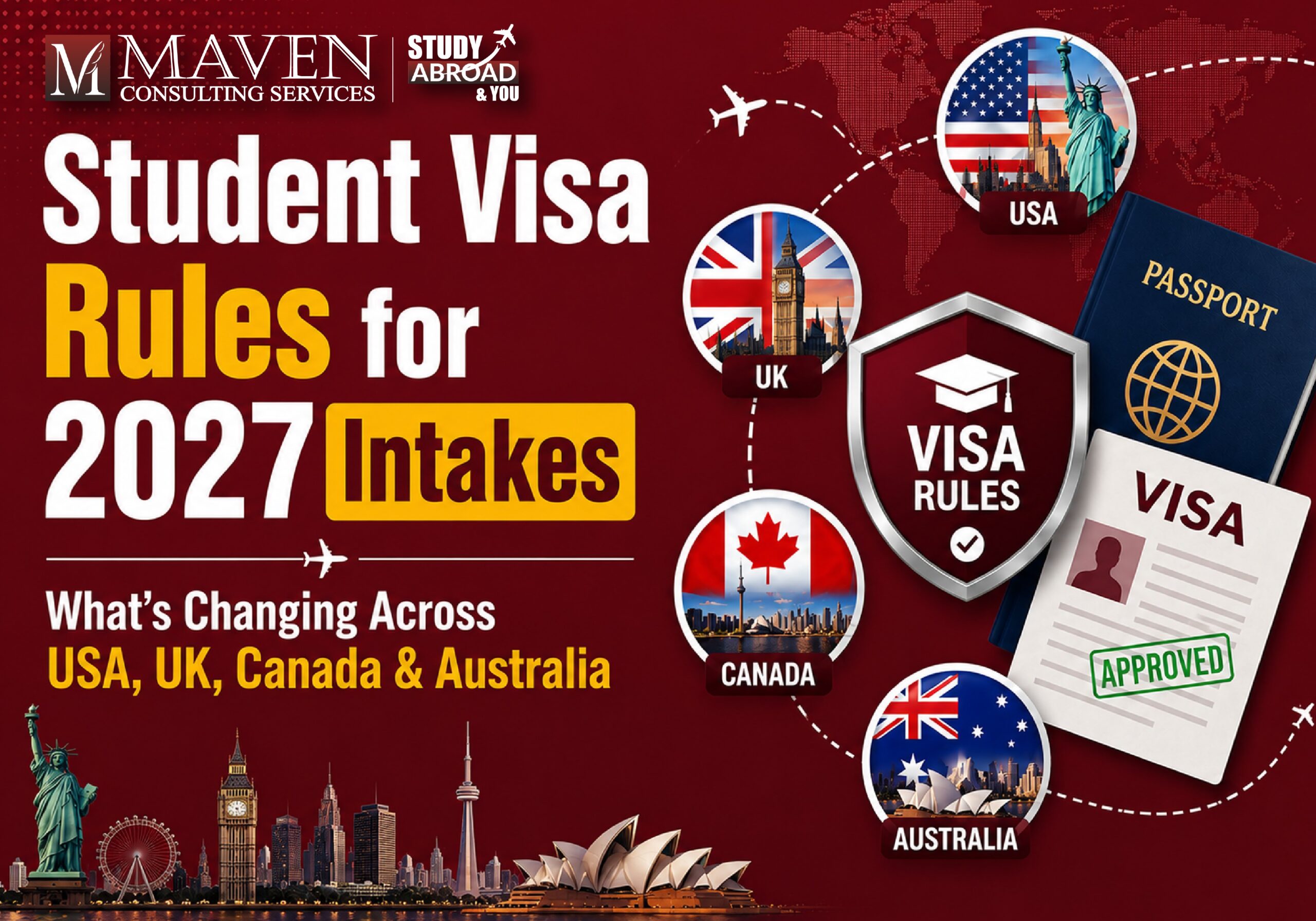

The four biggest study destinations are all tightening their student visa rules at once. Here’s an honest, country-by-country breakdown of what’s actually changing for Indian students planning 2027 intakes — funds, fees, work rights, post-study work and processing.
Quick answer: For 2027 intakes, the USA is replacing its open-ended “duration of status” with a fixed admission period (capped around four years) and has added a new $250 visa integrity fee on top of existing charges. The UK is cutting the Graduate Route from 24 to 18 months for applications made on or after 1 January 2027, and has raised maintenance funds. Canada has more than doubled its proof-of-funds figure to CAD $22,895, ended the SDS fast track, and keeps a national study-permit cap — though master’s and PhD students at public institutions are now exempt from the attestation-letter requirement. Australia raised its visa fee to AUD $2,000, lifted financial-capacity proof to AUD $29,710, and applies tighter Genuine Student scrutiny under a provider-level cap. None of this rules out a genuine, well-prepared student — but the margin for a sloppy application has shrunk everywhere.
If you are planning a 2027 intake, understanding the latest student visa rules 2027 is essential, as the rules you read about even 18 months ago may no longer apply. Across the USA, UK, Canada and Australia, governments are responding to record migration numbers and political pressure with the same broad playbook: higher money thresholds, more screening, tighter post-study work, and more enforcement. The good news is that none of these countries have closed their doors — international students remain genuinely welcome. The harder truth is that each system now expects you to be more prepared, better documented, and more strategic than students who applied even two years ago.
This guide walks through each destination separately so you can skim the one you care about, then steps back to compare them side by side. Every figure below was checked against official government sources in June 2026. Even so, immigration rules change with little notice — always confirm the current numbers on the relevant government website (or with us) before you apply. You can also start from our main country guides for studying in the USA, the UK, Canada and Australia.
Here is how the four destinations compare on the key student visa rules 2027 figures students ask about most. In this student visa rules 2027 overview, treat every number as a planning baseline, not a guarantee — all of these are adjusted periodically and several changed within the last year.
| Destination | Visa | Living funds (single, per year) | Headline government fees | Work during term | Post-study work |
|---|---|---|---|---|---|
| USA | F-1 | No fixed figure — must evidence the full cost of attendance shown on your Form I-20 | SEVIS I-901 $350 + DS-160/MRV $185 + new Visa Integrity Fee $250 | Up to 20 hrs/week, on-campus only (off-campus tightly restricted) | OPT 12 months (+24 months STEM OPT) |
| UK | Student Route | £10,539 outside London / £13,761 London (9 months max) | Visa £558 + IHS £776/year | Up to 20 hrs/week term-time | Graduate Route — 18 months from Jan 2027 (PhD 3 years) |
| Canada | Study Permit | CAD $22,895 (+ tuition + travel) | Application CAD $150 + biometrics CAD $85 | Up to 24 hrs/week off-campus | PGWP — up to 3 years (field-of-study rules for college) |
| Australia | Subclass 500 | AUD $29,710 (+ tuition + travel) | Visa AUD $2,000 | Up to 48 hrs/fortnight (~24/week) | Subclass 485 — 2 to 4 years |
Figures live-verified June 2026 against official sources (USCIS/ICE/DHS, GOV.UK, IRCC/canada.ca, Australian Department of Home Affairs). Currency conversions and exact thresholds change — verify before you apply.
The United States is making the most fundamental change of the four countries — not to a fee or a fund amount, but to the very basis on which students are admitted. For 2027 applicants, this is the development to understand first.
For more than 30 years, an F-1 student’s entry record simply read “D/S” — meaning you could stay for as long as you maintained valid student status, with no fixed expiry date. The Department of Homeland Security is replacing this with a fixed period of admission, generally tied to your program end date and capped at around four years. The rule cleared its final federal review stage in mid-2026 and is expected to take effect within months of publication — in practice, well before 2027 intakes begin.
What this means in plain terms: instead of an open-ended stay, you will get a specific end date. Students whose programs run longer (typically PhD candidates) will need to file a formal extension of stay with USCIS, complete biometrics, and wait for a government decision — rather than having a school official simply update a record, as happens today. The proposed package also cuts the post-study grace period from 60 days to 30, and restricts changing your program or major within the first year. Verify final terms on Federal Register publication
Legislation passed in mid-2025 created a new Visa Integrity Fee starting at $250 for non-immigrant visa applicants, including students. It sits on top of the existing SEVIS I-901 fee ($350) and the DS-160/MRV application fee ($185), cannot be waived, and is set to rise with inflation. Some applicants may be able to reclaim it later if they fully comply with their visa terms, but you should budget as though it is a sunk cost. Confirm exact amount & collection process before applying
Put together, the baseline US government charges for a new F-1 applicant now sit in the region of $785 or more, before you count travel, photos, or any premium-processing add-ons. That is a meaningful jump from a year ago.
Two practical shifts matter for your timeline. First, social media screening has expanded: F, M and J applicants are now generally expected to make their social accounts public for review. Second, in-person interview waivers have been sharply reduced — most students must now attend an interview, scheduled in their country of nationality or residence. Both add time, so apply early and keep your online footprint consistent with the genuine study intent in your application.
Separately, entry restrictions affecting nationals of a list of countries took effect in January 2026. India is not on that list, so this does not affect Indian applicants — but it is part of the broader tightening you may read about in the news.
The headline career benefits of the F-1 remain in place: Optional Practical Training (OPT) still gives 12 months of post-study work, and STEM OPT still adds up to 24 more months for eligible degrees — a combined window of up to three years that no other destination on this list matches for STEM graduates. These are under political scrutiny, but as of now they stand. For the full picture, see our guides on studying in the USA and the Fall 2027 application timeline.
Under the student visa rules 2027, the UK’s changes flow from its 2025 immigration white paper and a political climate focused on reducing net migration. For 2027 applicants, two changes dominate.
For student visa rules 2027 UK applicants, the Graduate Route (the UK’s post-study work visa) currently gives bachelor’s and master’s graduates two years to live and work in the UK without employer sponsorship. From 1 January 2027, new Graduate Route applications will grant only 18 months — six months less. PhD graduates are unaffected and keep three years. Crucially, what matters is when you apply for the Graduate Route, not when you start your course. A student beginning a one-year master’s in 2027 will apply well after that cut-off, so they should plan around the 18-month window.
From 11 November 2025, the monthly maintenance you must evidence rose to £1,529 per month in London and £1,171 per month outside London, for up to nine months. That works out to roughly £13,761 (London) or £10,539 (elsewhere) on top of your tuition. On top of the visa application fee (£558 from April 2026) and the Immigration Health Surcharge (£776 per year), the UK’s upfront cost has climbed steadily.
Three more shifts to factor in. Dependants: students on undergraduate and taught master’s courses can no longer bring family members — only research postgraduates (PhD) and government-sponsored students can. University compliance: from June 2026, the bar universities must clear to keep sponsoring international students rose, with a public red-amber-green rating system — expect institutions to scrutinise applications more carefully. Settlement: the government has proposed extending the qualifying period for permanent residence from five to ten years, with details expected later in 2026. Settlement change still being finalised — verify Term-time work stays capped at 20 hours per week. See our full UK study guide for the complete process.
Canada moved earliest and hardest among the four, introducing a national cap in 2024 and raising its money thresholds sharply. For 2027 planning, the picture is now clearer — and not all of it is bad news.
According to IRCC, the cost-of-living amount a single applicant must show (outside Quebec) is now CAD $22,895 per year, on top of first-year tuition and travel. This figure had been frozen near CAD $10,000 for two decades before back-to-back increases; it has been at $22,895 since September 2025. Acceptable proof includes bank statements, an education loan, sponsor support, or a Guaranteed Investment Certificate (GIC).
The Student Direct Stream — the expedited route that many Indian students used, which required a CAD $20,635 GIC — was discontinued in November 2024. Everyone now applies through the regular stream. A GIC is no longer mandatory, but it remains one of the strongest forms of financial proof and can still help your file. The trade-off is that processing is less predictable than the old SDS timelines, so apply early.
Canada is running its study-permit cap again. For 2026 there are 309,670 application spaces for students who need a Provincial or Territorial Attestation Letter (PAL/TAL), with up to roughly 408,000 permits expected overall — about 7% lower than 2025. Once a province exhausts its share, it stops issuing attestation letters for the rest of the year, so applying early in the cap year is a genuine advantage. Expect a similar framework to carry into 2027. 2027 cap numbers not yet published — verify
Under the student visa rules 2027 for Canada, off-campus work is now up to 24 hours per week during term, with full-time work allowed during scheduled breaks. The Post-Graduation Work Permit (PGWP) still offers up to three years, but field-of-study eligibility rules now apply to college and non-degree programs — meaning your program has to map to an eligible field. University degree graduates are broadly exempt from that field restriction but must meet a language benchmark. Choose your institution and program with the PGWP rules in mind from the start. Our Canada study guide covers the DLI and PGWP details.
Australia has combined higher costs with a tougher genuineness test and a provider-level cap. The student visa rules 2027 for Australia make preparation and institution choice more important than ever.
From 1 July 2025, the Subclass 500 visa application charge rose to AUD $2,000 — among the highest student-visa fees in the world, and up from AUD $1,600. The financial-capacity benchmark a single student must evidence is AUD $29,710 per year for living costs (since May 2024), on top of tuition and travel, with additional amounts for a partner or children.
In March 2024, the old Genuine Temporary Entrant test was replaced by the Genuine Student (GS) requirement, now built directly into the application as a set of targeted questions. In 2026, officers are scrutinising financial claims more deeply — including, in some cases, contacting banks directly — and a sudden lump-sum deposit shortly before applying is a recognised red flag. Refusals have ticked up, and weak or inconsistent study rationales are a leading cause.
Australia now manages intake through a national planning level with allocations distributed across institutions, and prioritises visa processing by provider under Ministerial Direction 115. In practice, applicants to higher-priority providers can be processed in weeks, while high-volume source countries — including India — can face waits of three months or more at lower-priority institutions. Your choice of institution now directly affects your processing speed. Separately, visitor and temporary-graduate visa holders can generally no longer switch to a student visa from inside Australia — they must apply from offshore. Confirm current provider priority & cap figures
Under the student visa rules 2027, term-time work is capped at 48 hours per fortnight (about 24 hours a week), with unlimited hours during breaks. After graduating, the Subclass 485 Temporary Graduate visa offers two to four years of work rights depending on your qualification, though an age cap now applies. We cover this in detail in our Australia 485 graduate visa guide and the main Australia study guide.
“Every one of these four countries is tightening — but read the changes carefully and you’ll notice they almost all target the same thing: applicants who aren’t genuine, can’t fund themselves honestly, or have no coherent reason to study. A real student with documented funds and a study plan that makes sense still gets approved. What has truly changed is the cost of carelessness. A weak statement, a last-minute deposit, or a missed deadline gets refused today where it might have slipped through two years ago. We’d rather tell you that plainly than sell you a fairytale.”
— Founder, Maven Consulting Services
Understanding the student visa rules 2027 will help you navigate each system. Across all four countries, the same handful of moves protect you against the tightening: start early, because every system has added screening time; show clean, stable funds with a clear history rather than sudden deposits; write a study plan that logically follows your background; and plan your post-study and stay-back strategy from day one rather than treating it as a problem for final year. Choose the destination whose post-study work rules and costs match your goals — a STEM graduate eyeing a long US runway, a master’s student wanting a smoother Canadian graduate path, and a budget-conscious family will each weigh these differently.
Because all student visa rules 2027 figures move, the most valuable thing you can do before committing money is have someone confirm the current rules against official sources for your exact profile and intended program. That is exactly the kind of honest, commission-free guidance we provide.
The student visa rules 2027 have become stricter across all four destinations. For genuine, well-prepared students, not dramatically — but the margin for error is smaller everywhere. Higher funds, more screening and tighter post-study work mean a sloppy or under-documented application is far more likely to be refused than it was two years ago. The bar for genuineness and financial proof has risen; the door has not closed.
When reviewing student visa rules 2027, there is no single “easiest” — it depends on your profile. Canada is notably smoother for master’s and PhD applicants at public institutions (no attestation letter, outside the cap squeeze). The UK has a relatively predictable process but a shorter post-study window. Australia rewards applicants to higher-priority providers with fast processing. The US offers the strongest STEM post-study runway but the most structural change and screening. Match the country to your goals, not to a ranking.
As a single applicant planning under student visa rules 2027, the living-cost figures (on top of tuition and travel) are roughly: Canada CAD $22,895/year; Australia AUD $29,710/year; UK about £10,539–£13,761 for nine months depending on location. The US has no fixed government figure — you must evidence the full cost of attendance shown on your Form I-20. Always confirm the current amount before applying, as all of these are adjusted periodically.
Yes — under student visa rules 2027, the government is replacing the open-ended “duration of status” admission with a fixed period tied to your program, capped around four years. For a typical bachelor’s or master’s that fits comfortably within the window. The friction lands on longer programs and anyone needing an extension, which will now require a formal USCIS application with biometrics rather than a simple school-record update. Confirm the final terms once they are officially published.
For many students applying under student visa rules 2027, yes — but only with early planning. Eighteen months is enough time to find a sponsoring employer and switch to a Skilled Worker visa, provided you start your job search at the beginning of your course and target employers who already hold a sponsor licence. If you drift and only begin looking after graduation, the shorter window becomes a real risk.
No — under student visa rules 2027, the Student Direct Stream that required a GIC ended in November 2024, so a GIC is no longer mandatory. That said, a GIC remains one of the cleanest, most accepted ways to demonstrate your living funds, and many students still choose it to strengthen their file. You can also use bank statements, an education loan, or documented sponsor support.
Mainly because of the Genuine Student requirement and deeper financial verification. Officers are looking closely at whether your study plan logically follows your background and whether your funds are genuinely yours with a stable history. Abrupt, unexplained career changes and money deposited just before applying are the most common triggers for refusal — both avoidable with honest, early preparation.
It is increasingly restricted. The UK no longer allows dependants for undergraduate or taught master’s students (only research/PhD and government-sponsored). Canada has tightened dependant work and eligibility. Australia and the US still allow dependants in defined circumstances but require you to evidence substantial additional funds. If bringing family matters to you, check each country’s specific rules for your course level before committing.
Get an honest, commission-free assessment of the visa realities for your exact profile — before you spend a rupee on applications.