WhatsAppCHAT
CALL US& CONNECT

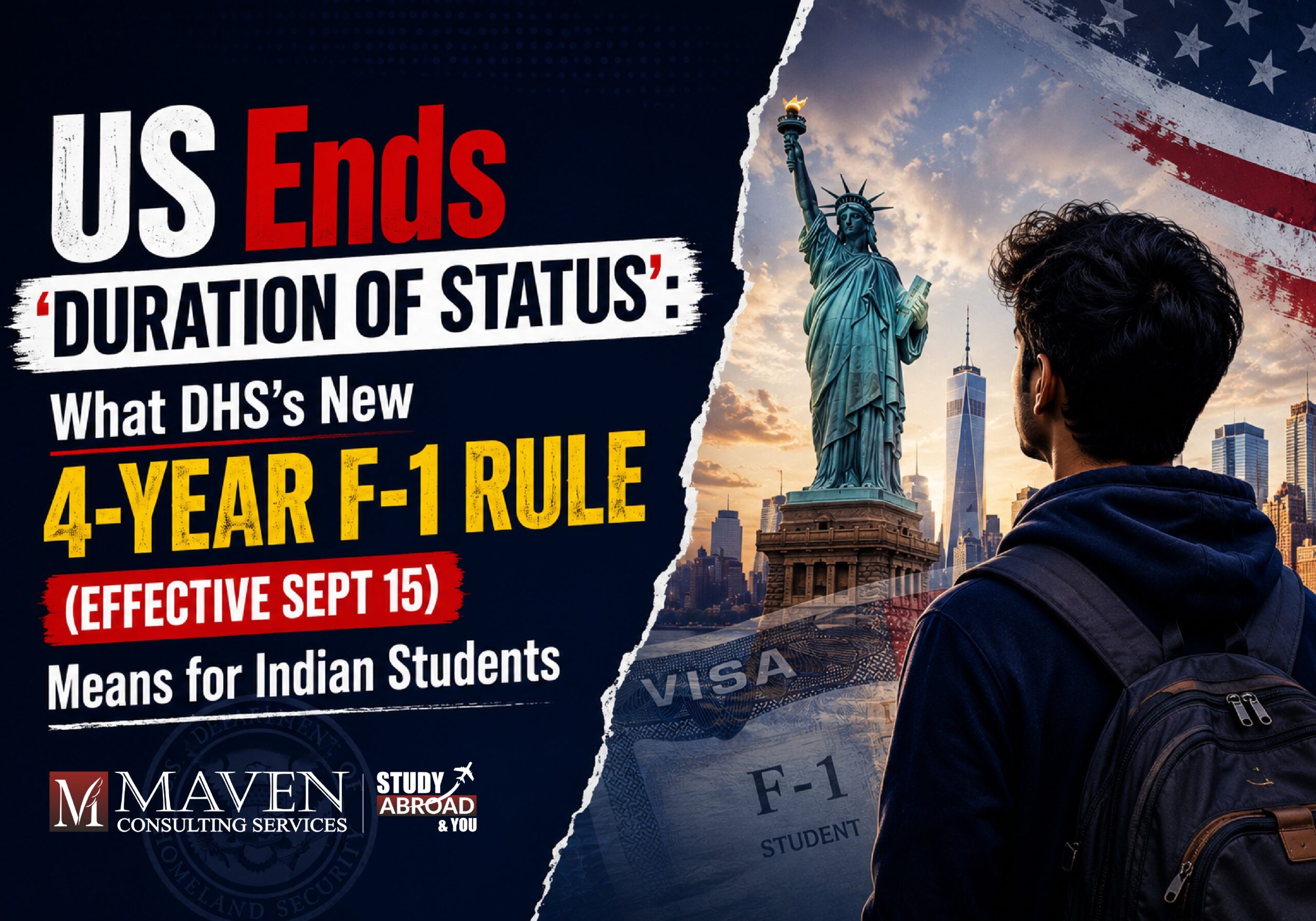
On July 17, 2026, DHS published a final rule that ends “Duration of Status” for F-1 students, effective September 15, 2026. For the first time since the early 1990s, F-1 students will not have an open-ended stay tied to their studies — they’ll have a fixed admission date, and a hard deadline to extend it if they need to stay longer. This affects every F-1 student headed to the USA, including the roughly 300,000+ Indian students already there.
Almost no Indian-facing study abroad content has caught up with what this actually means in practice — who is affected immediately, who has time, and what the new extension process looks like. This blog breaks it down plainly, using DHS’s own final rule and official USCIS/SEVP guidance.
Since the early 1990s, F-1 students haven’t been given a fixed departure date on their I-94. Instead, their admission was marked “D/S” — Duration of Status — meaning they could legally remain in the US for as long as they kept a full course of study, stayed enrolled at a SEVP-certified school, and later, engaged in authorized practical training like OPT. There was no countdown. As long as you were maintaining status, you were fine.
That framework is what DHS just eliminated.
Under the new rule, F-1 students will be admitted for a fixed time period instead of D/S. That period — called the Admit Until Date (AUD) — is based on the program end date on your Form I-20, capped at a maximum of four years, regardless of how long your actual program is. J-1 exchange visitors get the same four-year cap; I nonimmigrants (foreign media representatives) get up to 240 days.
If your program or your post-completion OPT will run past your Admit Until Date, you will need to proactively file for an Extension of Stay (EOS) with USCIS before that date arrives — something that was never required under D/S.
| Date | What Happens |
|---|---|
| July 17, 2026 | Final rule published in the Federal Register (91 FR 44976) |
| September 15, 2026 | Rule takes effect. New entrants get a fixed Admit Until Date; those already in the US on D/S move to transition provisions |
| March 18, 2027 | Deadline for transition-population F-1 students to timely file Form I-765 for post-completion OPT/STEM OPT without needing a separate EOS |
| October 15, 2030 | Outside transition date for J-1 exchange visitors and scholars (4 years from effective date + 30-day grace) |
| November 14, 2030 | Outside transition date for F-1 students under transition provisions (4 years from effective date + 60-day grace) |
Most of the confusion around this rule comes from conflating two genuinely different groups. They are not on the same clock, and they don’t follow the same grace period.
If you’re currently studying in the US on Duration of Status and you don’t travel internationally, you fall under transition provisions. You keep your existing 60-day post-completion grace period. You do not need to rush to file anything the moment the rule takes effect. You can generally remain without a separate EOS application up to the end of whatever post-completion OPT or STEM OPT is valid on the effective date — with an outside limit of November 14, 2030.
However, two things convert you out of the transition provisions and onto the new fixed-date system: (1) traveling outside the US and reentering after September 15, 2026, or (2) having USCIS adjudicate an application for you. Either one gives you a date-specific Admit Until Date with a 30-day grace period from that point forward.
If you enter the US in F-1 status on or after the effective date — including new Fall 2027 arrivals — you go straight onto the new system. Your I-94 will show a fixed Admit Until Date tied to your I-20 program length (max 4 years), and your post-completion grace period is 30 days, not 60.
This is the detail with the tightest deadline attached to it. F-1 students under the transition provisions who timely file Form I-765 for post-completion OPT, or for a STEM OPT extension, on or before March 18, 2027, will not be required to file a separate Extension of Stay application to cover that OPT period. Miss that window, or file after it, and a separate EOS filing becomes necessary — adding cost, paperwork, and processing-time risk on top of an already tight post-graduation runway.
Students admitted for the first time after September 15, 2026 don’t get this transition relief — they follow the new EOS process directly if their OPT will extend past their Admit Until Date.
Where the old D/S system required nothing as long as you kept status, the new system requires you to actively apply to stay longer. Here’s what that involves:
One exception: F-1 students benefiting from a “cap-gap” extension while an H-1B petition is pending don’t need to file a separate EOS — they can remain in F-1 status until the H-1B is approved or April 1 of the relevant fiscal year, whichever comes first.
This is a distinction Maven flags in almost every US-focused blog we write, and it matters more than ever here: a university admitting you, and DHS/USCIS allowing you to stay in the country, are two completely separate systems. Getting into your program doesn’t touch your visa timeline, and this new rule doesn’t touch your admission status. Confusing the two — assuming that because your university enrolled you, your immigration paperwork will simply take care of itself — is exactly the kind of mistake that leads to accidental unlawful presence.
If you’re an Indian applicant targeting a Fall 2027 US intake, here’s the practical checklist:
Starting September 15, 2026, new F-1 entrants get a fixed Admit Until Date instead of an open-ended D/S admission. Students already in the US on D/S before that date fall under transition provisions rather than switching over automatically.
Only if you need to stay beyond your Admit Until Date. If so, you’ll need to file Form I-539 for an Extension of Stay before your status expires.
Yes, but gradually. Continuing D/S students keep their 60-day grace period under transition provisions until a triggering event — travel and reentry, or a USCIS adjudication — converts them to the new fixed-date system.
No. This is a US-specific DHS regulation covering F, J, and I categories only. It has no effect on any other country’s student visa rules.
Transition-population students who timely file Form I-765 for post-completion OPT or STEM OPT by March 18, 2027 won’t need a separate EOS filing for that period. New post-September-15 admits follow the fixed-date rules directly.
Form I-539 currently costs $420 filed online or $470 filed on paper, per USCIS’s 2026 fee schedule, with a possible biometrics appointment or interview.
It’s final and published in the Federal Register, effective September 15, 2026. It’s classified as a “major rule” subject to Congressional Review Act oversight, so DHS has said it will issue a follow-up notice if that process changes the effective date or the rule itself.
No. This governs how long you can legally stay in the US after admission at the border — not whether a university admits you. Admission and visa/status compliance are separate systems.
The end of Duration of Status is the biggest change to F-1 rules in over three decades, and it turns visa compliance from a background formality into something students need to actively manage. The good news: if you understand which group you’re in — transition population or new fixed-date admit — and you know your key dates, this is entirely manageable. The risk isn’t the rule itself; it’s finding out about your Admit Until Date after it’s already passed.
Maven Consulting Services has guided 10,000+ students through study abroad journeys across 20+ countries, with a 99.8% visa success rate — commission-free, with honest advice on every policy change that matters.

Sunday, October 26, 2025 | The Taj MG Road, Bangalore | 10 AM – 4 PM