WhatsAppCHAT
CALL US& CONNECT

By Team Maven | Published 17 September 2026 | 15 minute read
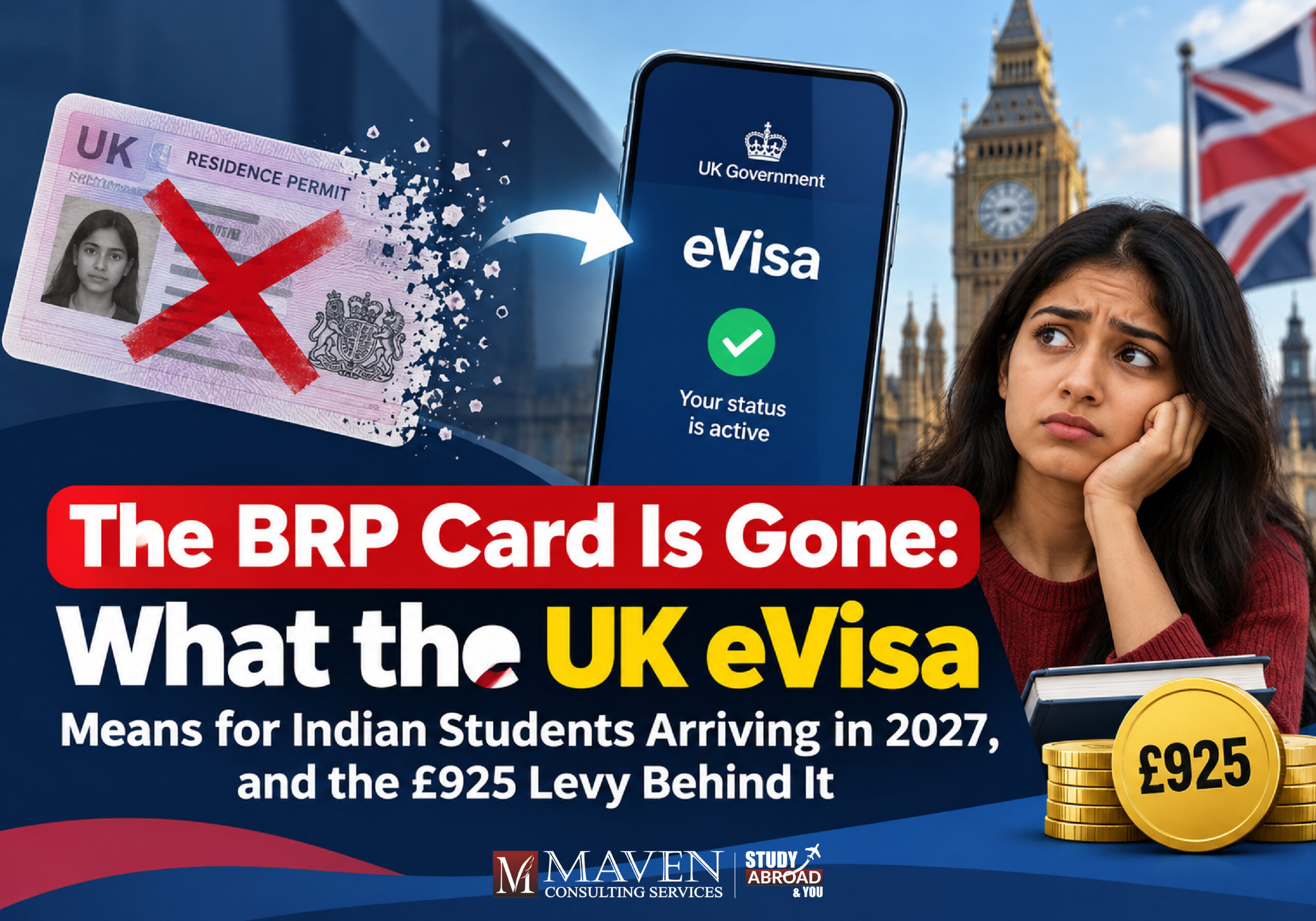
If you are flying to Britain for a 2027 intake, you will never hold a Biometric Residence Permit. Not because your card got lost in the post — because the card does not exist anymore. Every visa granted from here on arrives as a UKVI account and a digital UK eVisa, not a piece of plastic. This guide covers the two things that actually change your arrival: what you set up before you fly and what you show at the border, to a landlord and to an employer — and a £925-a-year charge that has nothing to do with your own wallet directly, but everything to do with what UK universities may be pricing into fees from 2028.
Who this is for: anyone holding a confirmed or conditional offer for a UK 2027 intake, anyone still waiting on a decision, parents managing the pre-departure checklist, and current students confused by BRP-expiry messages landing in their inbox.
What this covers: the BRP-to-UK eVisa timeline and why a 2027 arrival never touches a physical card at all, setting up and testing your UKVI account before departure, what a share code is and who can legitimately ask for one, arrival-week mechanics at the airline desk and the border, what a landlord and an employer are each required to check, what to do when the account will not link, and then the £925 international student levy — who actually pays it, when it starts, and what it may or may not mean for your own fees.
If you are still building the wider picture, start with our complete guide to studying in the UK for Indian students and our breakdown of UK student visa requirements. This article stays narrowly on the two things in the headline.
The BRP did not disappear overnight, and the confusion in most WhatsApp forwards comes from treating it as a single event rather than a two-year rollout. Here is the sequence, confirmed against the Home Office’s own guidance.
| When | What happened |
|---|---|
| On or before 31 October 2024 | The last date a new physical BRP could be issued to someone granted permission to live or work in the UK |
| 31 December 2024 | The printed expiry date on effectively every BRP still in circulation — a technical cutover date for the card programme itself, not necessarily the end of the holder’s actual visa |
| From July 2025 | Main applicants on work and study routes begin receiving a UK eVisa instead of a vignette sticker in the passport |
| From October 2025 | Visa vignette stickers phased out for work, study, family and settlement routes |
| From February 2026 | Nearly all successful applicants across almost every visa category receive a UK eVisa only |
| Today, applying for 2027 | There is no physical version of this process left to opt into. A 2027-intake student’s visa exists only as a UKVI account and a UK eVisa from the day it is granted |
A UK eVisa is a digital record of your identity and immigration status, held by the Home Office and linked to the passport you used to apply. It is not an app you install, not a PDF you can email to someone as proof, and not something that lives in your passport at all — your passport stays completely blank.
The record shows your photograph, your visa category, the conditions attached to it (for a student visa, that includes your permitted working hours), and the date your permission ends. You access it through a UKVI account — UK Visas and Immigration’s online portal — at gov.uk.
You do not carry the UK eVisa itself anywhere. What you carry is the ability to prove it, on demand, through that account. That single shift is the whole change. Once it clicks, the rest of the UK eVisa system is just mechanics, and the steps below are all there is to it.
If you applied for your student visa through the standard online process, a UKVI account holding your UK eVisa was very likely created automatically, tied to the same email address you used on the application. The task before departure is not creating an account from nothing — it is signing in, checking your UK eVisa record, and testing it.
A share code is a short, free, alphanumeric code you generate yourself from the UK eVisa record in your UKVI account, valid for 90 days from the moment you create it. It is not a login and it does not expose your account to whoever you give it to — it only unlocks a specific view of your status, for a specific purpose, for a specific person.
You choose the reason each time you generate one — right to work, right to rent, or a general status check — and the resulting code, together with your date of birth, is what you hand to an employer, a landlord or letting agent, or anyone else entitled to check. They then run the code themselves through the official GOV.UK service, which returns the same UK eVisa record the Home Office holds. You can generate as many codes as you need, for as many different people as you need, at no cost.
Airlines run an electronic UK eVisa check against your passport before you board, matched to the Home Office record behind your UK eVisa. There is no stamp for you to show and no sticker for staff to inspect.
In practice, the passport-mismatch issue described above — a renewed passport that has not been updated in your UKVI account — is the single most commonly reported reason a genuine UK eVisa holder gets stopped at check-in, according to UK immigration advisers who deal with these cases routinely. The fix is entirely preventable: update your passport details in the account before you travel.
At the UK border, an officer checks your passport electronically against your UK eVisa against the same Home Office record. You will not be stamped, and there is nothing physical to hand over. It is worth keeping a saved screenshot or PDF of your own “your immigration status” page on your phone purely as a personal backup for your own peace of mind — but understand that it carries no formal standing in an official check; the Home Office’s live record is what matters, not your screenshot of it.
A landlord or letting agent is legally required to run an online right-to-rent check via the official GOV.UK service before signing a tenancy with you, and your UK eVisa is what that check reads. This means generating a “right to rent” share code and giving it, with your date of birth, before you view or sign for a room — not producing a card that no longer exists.
If a landlord seems unfamiliar with this and asks for a physical document instead, it is not you who is out of step — a properly compliant landlord in 2026 already knows to expect a share code, and one who insists on paper documentation is the one behind on the rules. Generate the code a day or two ahead of any viewing where you expect to sign, since it takes a landlord only a minute to run once you hand it over.
Universities typically confirm your UK eVisa status digitally as part of enrolment — bring your passport and offer or CAS documentation as usual, but do not expect, and do not need, any physical visa document at registration.
If you take on campus or part-time work, your employer is required to run the official right-to-work check using a share code and your date of birth before your first day. Asking you to instead produce “the visa card” is simply the wrong process on their part, and you can point them, politely, to the correct GOV.UK checking page rather than trying to produce something that no longer exists.
Your permitted working hours have not changed because the proof went digital — they are a condition of your student visa, visible on the UK eVisa record itself, and breaching them carries exactly the same consequences it always did.
With the UK eVisa, it is worth naming what has stayed exactly the same, because a lot of the anxiety around this shift comes from assuming more has moved than actually has.
Your CAS, your financial requirement, your English requirement, your credibility interview and the rules on dependants are untouched by the UK eVisa — those sit in the immigration rules, not in the format of your proof. The HC 259 changes that hit the January 2027 intake are a separate matter entirely, and worth reading alongside this. The cost side is also unchanged by going digital: our 2027 cost-of-studying-in-the-UK guide still applies line for line.
What genuinely changed is the medium of proof, and one habit: you now have to actively log in and check, because there is no card sitting on your desk reminding you to.
The other change behind this headline has nothing to do with your UK eVisa or what you carry and everything to do with university finances. In the Autumn Budget on 26 November 2025, the government confirmed a new International Student Levy: universities and colleges in England will pay a flat £925 per international student, per year of study, from 1 August 2028. It is charged to the institution and collected by the Office for Students — it is not a bill sent to you directly, and it has no connection at all to your UK eVisa.
| Detail | What’s confirmed |
|---|---|
| Amount | A flat £925 per international student per year of study |
| Who pays | The higher education provider — not the student, directly |
| Applies to | Higher education providers in England only, registered with the Office for Students |
| Effective from | 1 August 2028, the start of the 2028–29 academic year |
| Exemption | The first 220 international students at each provider each year, worth roughly £200,000 of exempted liability |
| Where the money goes | Reinvested into higher education and skills, including the planned return of maintenance grants for eligible lower-income domestic students from 2028–29 |
Worth knowing where this idea came from: it was first floated in May 2025’s Immigration White Paper as a 6% charge on universities’ international fee income. After sustained pushback from the sector, the government switched to a flat per-student fee in the November 2025 Budget — a design that, by its nature, falls relatively lighter on high-fee institutions and relatively heavier, as a share of revenue, on lower-fee ones. It also, notably, applies only to England; providers in Scotland, Wales and Northern Ireland are outside it. The full policy position is set out in the Department for Education’s international student levy policy paper.
Two things are worth separating carefully here, because the government’s own wording leaves one of them genuinely open. The levy is described as applying to “international student enrolments from August 2028,” charged “per international student per year of study.” Read literally, that could mean every international student enrolled from that date onward, including someone partway through a longer programme who started before August 2028 — not only students who begin a brand-new course that year.
Neither GOV.UK nor Universities UK’s public guidance spells out the continuing-student question in plain terms as of this writing, so if your UK programme runs three or four years and crosses that date, this is genuinely worth a direct question to your specific university rather than an assumption either way.
The second, separate question is whether any of this shows up in your own tuition fee. As of September 2026, no major UK university has published exactly how much of the £925 it plans to pass on to students through higher fees, if any — vice-chancellors have publicly warned some financial impact is likely, but the actual number remains each institution’s own decision, not the government’s.
The government’s own impact assessment projects a net income loss to the sector rising from roughly £270 million in 2028–29 to around £330 million by 2030–31, alongside an estimated fall in international enrolments of about 14,000 in the first year, rising to roughly 16,500 by 2030–31 — figures worth treating as the government’s modelling of the sector-wide effect, not a promise about any one university’s fees.
Not on its own, and not for a 2027 start, and nothing about the UK eVisa changes it either. A levy that lands on an English university’s balance sheet in 2028 is a real signal about the direction of UK higher education funding, but it is not a line item on your 2027 invoice, and the enrolment modelling behind it is a projection, not an observed outcome.
What it should do is sharpen the questions you ask about long programmes and about institutions that look financially stretched. If you are weighing destinations rather than universities, our UK vs Ireland comparison for 2027 lays out the cost and work-rights trade-off honestly, and why an admission offer is not the same as a visa approval is the other half of that decision.
Before you fly, have your UK eVisa evidence pack in one place: your current passport, linked and correct in your UKVI account; one freshly generated share code you have tested in the last 90 days; a saved screenshot of your “view and prove” page for your own reference; your offer letter or CAS reference; proof of funds if requested at the border; and your accommodation confirmation.
None of it is a physical visa document, and under the UK eVisa system none of it needs to be — that is the entire point of the system you are now arriving under. Our Fall 2027 pre-departure checklist for Bengaluru students covers the rest of the pre-flight sequence in full.
No. You will not be issued a BRP at all. Your student visa exists only as a UK eVisa, accessed through a UKVI account, from the moment it is granted.
It is a free online account at gov.uk that holds your UK eVisa and digital immigration record. If you applied for your visa online, one was very likely created automatically, tied to your application email — sign in and check it rather than assuming you need to start from scratch.
A share code is a free, 9-character code generated from your UKVI account, valid for 90 days. You give it, with your date of birth, to an employer, landlord or letting agent, who then runs it through the official GOV.UK checking service themselves.
No. A screenshot of your UK eVisa does not give the person checking it a valid, official record of the check, even if it looks convincing. The share code, run through the GOV.UK service, is the only method that counts.
This is most often caused by a passport renewal that has not been updated in your UKVI account. Log in and correct your passport details before you travel, and keep your confirmation email as a backup in case you need to show it at the desk.
No. It is charged to the university or college you attend, not billed to you directly, and it only takes effect from 1 August 2028 — the start of the 2028–29 academic year.
No. It applies only to higher education providers registered with the Office for Students in England.
Universities have not published specific pass-through figures as of now. Some financial impact on the sector is expected, but the actual decision belongs to each institution. If your programme runs three or four years, ask your specific university directly and in writing about its fee plans from 2028–29 onward.
No. One UKVI account can hold more than one UK eVisa over time. Sign in, confirm your new student permission has been added, and generate a fresh share code once it appears.
No. Your work conditions come from your student visa itself, not from the UK eVisa and are shown on the UK eVisa record. Going digital changed how you prove the condition, not what the condition is.
Nothing about the UK eVisa system is actually harder than a BRP was — it is just unfamiliar, and unfamiliar things feel riskier than they are. A student who checks their UK eVisa in their UKVI account a week before flying, fixes any passport mismatch in advance, and knows what a share code is and is not, will move through arrival week without a single surprise.
The £925 levy is a genuinely bigger story, but it is a university-finance story playing out over the next two to three years, not a line item that appears on your own invoice this year. Keep both in proportion: prepare thoroughly for the UK eVisa side, and ask sharp, written questions about the second before you commit to a multi-year programme — and do not let either one talk you out of an offer that otherwise fits.
Send us your offer letter and visa decision email and we will walk through your UKVI account with you, confirm your passport details are correctly linked to your UK eVisa, and make sure you fly with a tested share code — not a guess. Maven has guided 10,000+ students with 700+ university partners across 20+ countries, commission-free, and if you are still deciding between the UK and another destination, we will run the same honest comparison we run for every family.
Book a Free ConsultationSources: GOV.UK, “Biometric residence permits (BRPs),” Home Office guidance; GOV.UK, “Get access to your eVisa”; GOV.UK, “View and prove your immigration status”; GOV.UK, “Prove your right to work to an employer”; GOV.UK, “Introducing an international student levy on higher education providers,” Department for Education policy paper, published 13 July 2026; HM Treasury, Autumn Budget 2025, 26 November 2025; Universities UK, “Understanding the UK’s new levy on universities.” Figures current as of 10 September 2026. This article is general information for Indian students and families, not immigration or legal advice; confirm your own case with UKVI or a qualified immigration adviser, and confirm fee policy directly with your chosen university.
Maven Consulting Services
Bangalore — Jayanagar 9th Block | Malleshwaram | St Marks Road · Belagavi · Dubai

Sunday, October 26, 2025 | The Taj MG Road, Bangalore | 10 AM – 4 PM