WhatsAppCHAT
CALL US& CONNECT

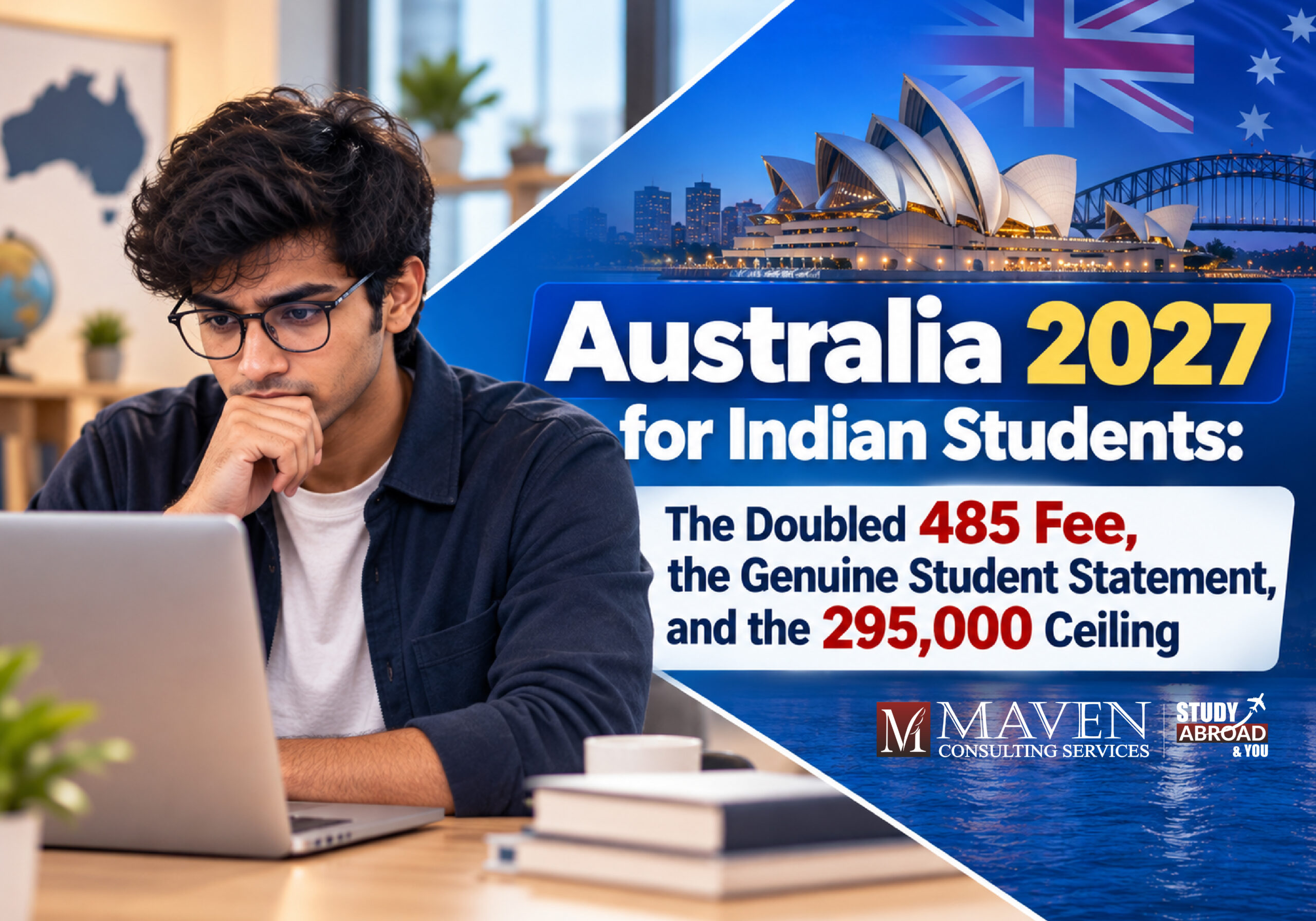
Australia 2027 for Indian students is being reported badly, and the errors are expensive ones. Between March and July 2026 the Temporary Graduate visa charge went from AUD 2,300 to AUD 5,750 — doubling once, then rising again, both times with no advance warning. In the same window the government confirmed 295,000 new international student commencements for 2027. And half the market is still describing a “new” Genuine Student requirement that has been law since March 2024. If you are planning a 2027 intake, here is the version with the dates checked against the source documents.
This article does three things. It builds one honest cost ladder for an Australian master’s, from the visa application to the graduate visa on the other side, using the fee schedule as it stands today. It explains what the Genuine Student requirement actually asks — not the version currently recirculating as breaking news. And it untangles the 295,000 planning level from the much scarier idea, held by a large number of applicants and parents right now, that only 295,000 student visas will be granted next year. None of those three things are true in the way they are usually reported, and getting them right changes what you should actually do before you apply.
This is written for anyone weighing up Australia 2027 for Indian students — the applicant targeting an undergraduate, coursework master’s or vocational intake, and the parent trying to work out whether the budget from eighteen months ago still holds. By the end you will have the real total cost from application to graduate visa, the exact four questions the Genuine Student assessment asks and where Indian files tend to lose marks on them, and a working answer to whether the 295,000 figure should change your provider choice or your timeline.
The honest budget for Australia 2027 for Indian students starts with the number nobody puts in one place, because it lives across three government fee schedules and two years of separate press releases. Here is the ladder as it stands for an applicant lodging from 1 July 2026 onward.
| Stage | Government charge | Notes |
|---|---|---|
| Student visa (subclass 500) application charge | AUD 2,500 | Up from AUD 2,000, effective 1 July 2026. Indian passport holders pay the full rate; a concessional charge (the former fee plus indexation, around AUD 2,050) applies only to ELICOS-only and non-award applicants, ASEAN passport holders, and Pacific Island and Timor-Leste passport holders |
| Overseas Student Health Cover (OSHC) | Varies by provider and duration | Compulsory for the length of the visa; get a quote from an approved OSHC provider for your exact course dates rather than budgeting a flat figure |
| Financial capacity — living costs | AUD 29,710 per year | The amount you must show you can access, on top of tuition and travel, to satisfy the financial requirement |
| Tuition (indicative, taught master’s) | Roughly AUD 25,000–45,000 per year | Varies widely by university, city and field — confirm against the specific offer letter, never a market average |
| Temporary Graduate visa (subclass 485) application charge | AUD 5,750 | Up from AUD 4,600 in March 2026, which was itself up from AUD 2,300. Paid after graduation — budget for it from day one |
| 485 charge, partner aged 18 or over | AUD 2,875 | Up from AUD 2,300 on 1 July 2026 |
| 485 charge, dependent child under 18 | AUD 1,450 | Up from AUD 1,160 on 1 July 2026 |
The “doubled 485 fee” in this article’s title is one specific event: on 1 March 2026 the Department of Home Affairs raised the Temporary Graduate visa charge for a primary applicant from AUD 2,300 to AUD 4,600 — exactly double, under the Migration Amendment (Temporary Graduate Visa Application Charge) Regulations 2026. What most coverage in India has missed is the second half of the story. On 1 July 2026, as part of the annual visa pricing update, the same charge rose again, to AUD 5,750.
| Date | Charge | Change |
|---|---|---|
| Before February 2025 | AUD 1,945 | — |
| February 2025 | AUD 2,235 | Annual CPI-linked adjustment |
| July 2025 | AUD 2,300 | Annual adjustment |
| 1 March 2026 | AUD 4,600 | Doubled — Migration Amendment (Temporary Graduate Visa Application Charge) Regulations 2026 |
| 1 July 2026 | AUD 5,750 | Further 25 percent rise, part of the annual visa pricing update |
Anyone costing Australia 2027 for Indian students should note that a paper-based application attracts a further AUD 80 charge. Because these figures move on the government’s own timetable rather than the academic calendar, confirm your exact total on the Department’s current visa pricing tool before you commit a number to your family budget.
The government’s own framing is that the increases restore integrity to a visa it believes had become a default holding pattern for graduates without a clear next step, rather than the short bridge to skilled work it was designed to be.
Whatever view you take of that framing, the practical signal is consistent across every fee change in this sector since 2024: charges move upward, they move at the start of a financial year or on their own legislative timetable, and they are not flagged to applicants in advance. Student advocacy groups have been explicit that this unpredictability, more than the absolute amount, is what makes financial planning difficult for a cohort that typically commits to a course eighteen to twenty-four months before it needs the graduate visa.
The practical response for anyone budgeting Australia 2027 for Indian students is not to panic about the number today. It is to build a separate buffer into your total cost of attendance specifically for government charges, distinct from your tuition and living-cost buffer, because this is the line item in an Australian study budget that has moved most since 2024 and shows no sign of having stopped. We apply the same discipline when we build a February 2027 intake timeline with a student.
Here is the correction this Australia 2027 for Indian students guide exists to make. A wave of 2026 content — including video titles announcing that “the GTE essay is dead” — frames the Genuine Student (GS) requirement as a fresh change. It is not. According to the Department of Home Affairs’ own Genuine Student requirement page, the GS requirement applies to student visa applications lodged on or after 23 March 2024. Anything lodged before that date was assessed under the old Genuine Temporary Entrant (GTE) requirement. The switch is now two and a half years old.
What is genuinely new in 2026 is not the requirement itself but the environment around it. Ministerial Direction 115, which applies to applications lodged on or after 14 November 2025, introduced a three-tier priority-processing model that ties visa processing speed to how far a provider has progressed against its own allocation. That raises the practical cost of a weak or generic GS response, because a file that needs a closer look at a lower-priority provider now waits considerably longer than the same file would have in 2024. The rule has not changed. The consequences of getting it wrong have.
This is where most Australia 2027 for Indian students applications are actually won or lost. The GS requirement is not a single free-form essay. It is a structured set of responses inside the student visa application form itself, each capped at 150 words, in English. The Department prefers applicants to answer inside the form rather than attach a separate statement. There are four core questions, plus a fifth for a specific group of applicants.
Two things distinguish GS from the old GTE essay in substance, not just format. First, the Department explicitly states that the requirement recognises that genuine students may develop skills Australia needs and may later choose to apply for permanent residence, and that future intentions of this kind do not count against an applicant. Under GTE, any hint of a long-term stay could work against a file. Under GS, a credible post-study and permanent residence narrative is compatible with a genuine student finding, provided the primary stated purpose remains study.
Second, GS is assessed against a published Ministerial Direction — Direction No. 106 — which gives assessors a defined list of factors: your situation at home, your potential situation in Australia, the value of the course to your future, and your immigration history.
Because the GS questions are short and evidence-anchored, the failure modes are specific rather than vague. The pattern we see most often in Indian files is a mismatch between the stated career benefit and the applicant’s actual academic trajectory — a claim that a particular master’s will lead to a particular role, without the previous degree, work history or research interest that would make an assessor believe it.
The Department’s own assessment factors ask directly whether the course is consistent with the applicant’s current level of education and whether it is relevant to past or proposed future employment. A generic answer that could be copy-pasted into any application for any country is the fastest way to trigger closer scrutiny. It is the same weakness that shows up in the refusal patterns we track across destinations.
The second common failure is a gap between the written response and the supporting documents. The Department gives more weight to statements supported by evidence, and lists specific document categories it wants: academic transcripts, evidence of any study gaps of more than two months, current employment details with a verifiable contact, and financial evidence such as income tax returns, bank statements or documented business activity for the twelve months before lodging. A confident 150-word answer that is not backed by a matching document in the same application does more damage than a plainer answer that is.

This sits alongside the GS timing correction and belongs to the same pattern of a real 2024 reform being rediscovered as 2026 news. From 1 July 2024 the maximum age to apply for the Temporary Graduate visa’s main streams was reduced from under 50 to 35 years or under, with limited exceptions — Master by Research graduates, PhD and doctoral graduates from a CRICOS-registered Australian institution, and Hong Kong SAR or British National (Overseas) passport holders remain eligible up to 49.
Age is assessed on the date the Department receives your 485 application, not your graduation date and not the date of decision. For an applicant choosing a course today with an eye on the graduate visa two or three years from now, this is a planning constraint to check before enrolment, not after.
This is the headline number in every Australia 2027 for Indian students discussion right now. On 3 July 2026 the Australian Government confirmed the National Planning Level (NPL) for 2027 at 295,000 new international student commencements — unchanged from 2026, and around 8 percent below the immediate post-pandemic peak. The announcement also confirmed that no active education provider will receive a lower allocation in 2027 than it received in 2026, and that TAFE students, along with students from Pacific nations and Timor-Leste and Australian government scholarship holders, remain exempt from the NPL and continue to receive priority visa processing.
This is the number the headlines call a “ceiling,” and it is worth being precise about what kind of ceiling it is. Study Australia states it plainly: the National Planning Level is not a cap or a limit on student numbers. It is a planning benchmark the government uses to size the international education sector and to allocate commencement numbers across providers — a sector-level figure, not a queue of 295,000 tickets that applicants compete for one by one.
This is the single most common misreading of Australia 2027 for Indian students, and the confusion is understandable, because the government’s own reasoning for holding the NPL flat leans on both ideas at once. Actual international student commencements in 2026 are tracking roughly 8 percent below the same period in 2025 and around 13 percent below 2019 levels — real demand is currently running well under the 295,000 figure, which is precisely why the government felt able to hold the level unchanged rather than cut it. That is genuinely useful context: the planning level is not the binding constraint most students will hit.
What is more likely to bind is your specific provider’s individual allocation and where that places it in the processing queue, not the sector-wide 295,000 total. A university or college that has already used most of its own allocation can mean a slower visa outcome for you even while the national figure has plenty of headroom left. The question worth asking your shortlisted institution directly is not “has the country hit its cap” — it almost certainly has not — but “how far through your commencement allocation are you for my intake, and what processing priority does that put my application in.” That is the version of the 295,000 story that actually affects your timeline.
The last piece of Australia 2027 for Indian students is the one nobody puts on a brochure. Ministerial Direction 115 replaced the previous processing priority framework for applications lodged on or after 14 November 2025. Offshore student visa applications are sorted into three tiers based on each provider’s progress against its New Overseas Student Commencement (NOSC) allocation. Priority 1 covers providers that have not yet reached their prioritisation threshold. Priority 2 covers providers that have reached 80 percent of their NOSC allocation. Priority 3 covers providers that have exceeded their allocation by 15 percent. Applications are worked through in that order.
This is the part of Australia 2027 for Indian students that most shortlists ignore. For an applicant, the practical takeaway is to treat “which university” and “when will my visa be decided” as connected questions rather than separate ones. Two students with identical academic profiles and identical GS responses can face meaningfully different visa timelines purely because of which institution issued their Confirmation of Enrolment and how far into its allocation that institution already is when they lodge. Applying early in an intake cycle, before a popular provider crosses its thresholds, is worth more than it sounds.
For Australia 2027 for Indian students, cost, the Genuine Student assessment and provider standing are not three separate hurdles to clear in sequence — they compound. A student who under-budgets for the 485 fee two years out, submits a generic GS response, and enrols at a provider already deep into its allocation is stacking three separate sources of delay and risk on top of one another. The reverse is equally true: a realistic total cost of attendance, a GS response specific to your own academic and financial evidence, and a provider with headroom left in its allocation is the combination that moves through this system fastest. That sequencing is also what a sound pre-departure plan is built on.
Budget AUD 2,500 for the student visa, AUD 29,710 a year in provable living costs, roughly AUD 25,000–45,000 a year in tuition depending on the university, OSHC for the full visa length, and AUD 5,750 for the Temporary Graduate visa after you finish. The last of those is the one most families leave out.
The primary-applicant charge doubled from AUD 2,300 to AUD 4,600 on 1 March 2026, then rose again to AUD 5,750 on 1 July 2026 as part of the annual visa pricing update — a 150 percent increase in sixteen months. Partner and child charges rose to AUD 2,875 and AUD 1,450 on the same date.
No. The Genuine Student (GS) requirement replaced the Genuine Temporary Entrant (GTE) requirement for student visa applications lodged on or after 23 March 2024, according to the Department of Home Affairs. What changed in 2026 is enforcement and processing speed under Ministerial Direction 115, not the requirement itself.
Four core questions answered directly in the visa application form, each limited to 150 words: your current circumstances and ties to your home country, why you chose this course and provider, how the course will benefit you, and any other relevant information. A fifth question applies if you have previously held a student visa or are applying onshore from a non-student visa.
Yes. The Department states that the GS requirement recognises genuine students may later apply for permanent residence, and that this future intention does not count against an applicant, provided your primary stated purpose is genuine study. This is a substantive difference from the old GTE requirement.
No. The National Planning Level is a sector-wide planning benchmark for new student commencements, and Study Australia states directly that it is not a cap or a limit on student numbers. Actual 2026 commencements are already tracking below 295,000, and each visa decision remains a separate assessment on its own merits.
35 years or under at the time the Department receives your application, reduced from under 50 on 1 July 2024. Master by Research graduates, PhD and doctoral graduates from CRICOS-registered institutions, and Hong Kong SAR or British National (Overseas) passport holders remain eligible up to age 49.
It applies to applications lodged on or after 14 November 2025 and sorts offshore student visa applications into three priority tiers based on each provider’s progress against its New Overseas Student Commencement allocation — below threshold, at 80 percent, and more than 15 percent over. Providers with headroom are processed first.
AUD 2,500 for most primary applicants from 1 July 2026, up from AUD 2,000. Indian passport holders pay the full rate. A concessional charge applies only to ELICOS-only and non-award applicants and to ASEAN, Pacific Island and Timor-Leste passport holders.
None of the three headline changes in Australia’s 2027 settings are the story most content is telling. The 485 fee genuinely doubled, and then rose again — that part is real and it belongs in your budget today. The Genuine Student requirement is not a new hurdle sprung on the 2027 intake; it is a two-and-a-half-year-old requirement that now carries real processing consequences for a weak file. And the 295,000 planning level is a sector-sizing figure the government itself says is not a cap, at a moment when actual demand is running below it.
That is the realistic picture of Australia 2027 for Indian students. What has genuinely tightened is the relationship between the quality of your file and the speed and certainty of your outcome. A specific, evidenced Genuine Student response, a realistic budget that includes the 485 fee from the start, and a provider with headroom in its allocation together decide more of your 2027 outcome than any single headline number does on its own.
We plan Australia 2027 for Indian students file by file, not by headline. Bring your shortlist, your budget and your draft Genuine Student responses. We will check where your provider sits in the processing queue, build your real total cost of attendance including the 485 fee, and tell you honestly where your file is strong and where it needs more evidence.
Book a Free ConsultationSources: Department of Home Affairs, “Genuine Student requirement,” immi.homeaffairs.gov.au, referencing Ministerial Direction No. 106; Department of Home Affairs, “Student visa processing priorities,” on Ministerial Direction 115, applying to applications lodged on or after 14 November 2025; Department of Home Affairs current visa pricing table and Visa Pricing Estimator; Migration Amendment (Temporary Graduate Visa Application Charge) Regulations 2026; Department of Home Affairs, changes to the Temporary Graduate visa program effective 1 July 2024 (age limit reform); Department of Education, “National Planning Level for 2027 announced,” 3 July 2026; Study Australia, “Australia confirms international education settings for 2027” and “Student Visa Application Charge increase.”
Figures verified September 2026. Visa charges, planning levels and processing settings change; verify every figure against the official Department of Home Affairs and Department of Education pages before acting on it.
Maven Consulting Services
Bangalore — Jayanagar 9th Block | Malleshwaram | St Marks Road · Belagavi · Dubai