WhatsAppCHAT
CALL US& CONNECT

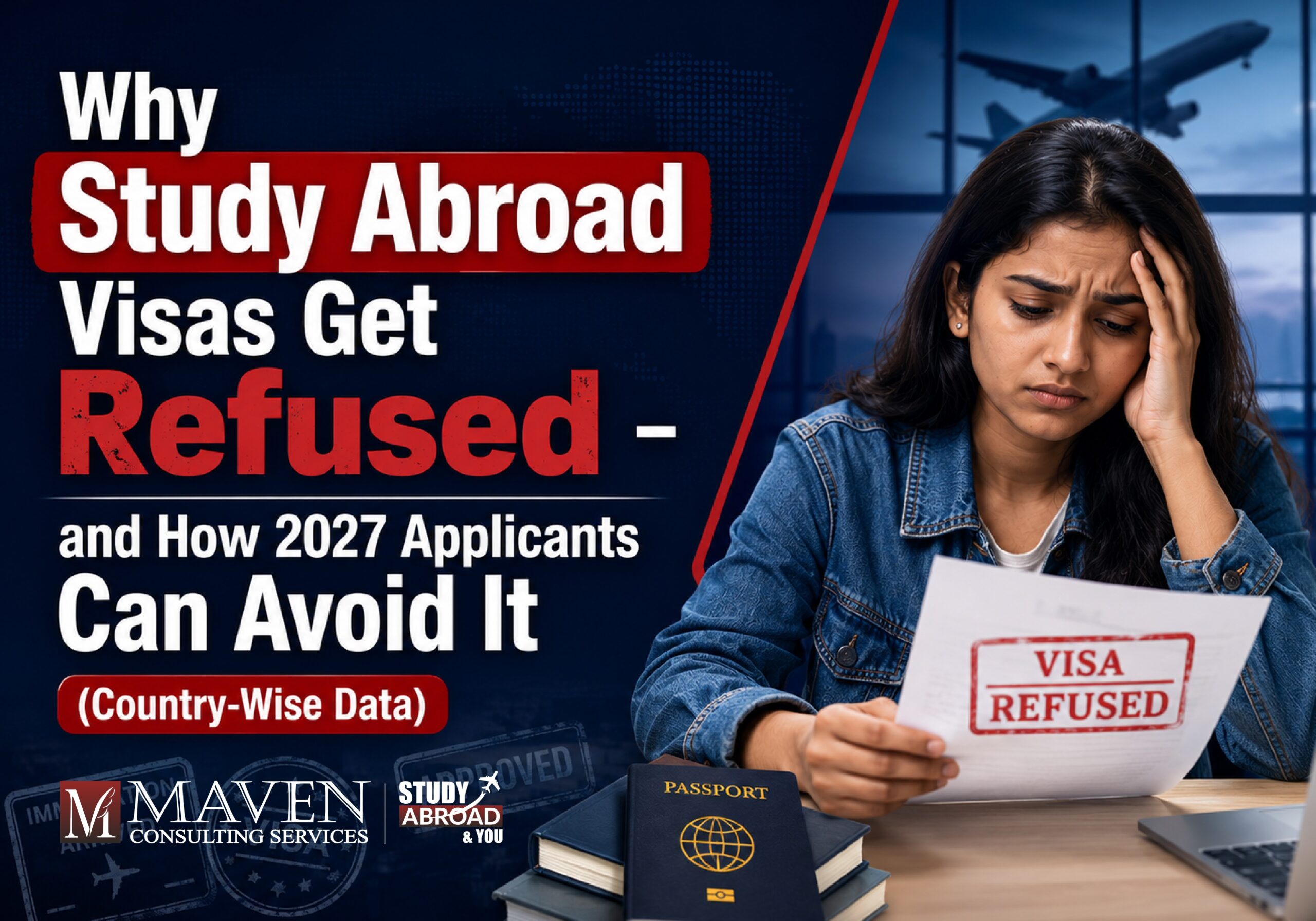
Student visas get refused for very specific, documented reasons — and the numbers are rising fast. In FY2024, the US refused 41% of all F-1 student visa applications worldwide — a decade high.
In 2025, Canada’s approval rate for first-time Indian study permit applicants fell from around 69% to roughly a quarter. In February 2026, Australia refused about 4 in 10 Indian student visa applications. Refusal is no longer a rare footnote — it is a real, rising possibility that every 2027 applicant needs to plan for.
This blog breaks down exactly why study abroad visas get refused, country by country, using the most recently published official and government-sourced data for the USA, UK, Canada, Australia, and Germany — plus a lighter look at Ireland. If you’re mapping out your study abroad plans for a 2027 intake, understanding what consular and immigration officers are actually checking for is now as important as your university shortlist.
Student visas get refused for a handful of recurring reasons. Before getting into country-specific data, it helps to understand that most refusals — regardless of destination — trace back to a small set of recurring issues:
Financial proof that looks inconsistent, not insufficient. Officers are usually less concerned about whether you have enough money and more concerned about whether the money’s source and history look genuine.
A weak or templated Statement of Purpose. Generic SOPs that could apply to any student, any course, or any country are one of the fastest ways to raise doubt about genuine intent.
Doubts about genuine intent. Every major destination now has some version of a “genuine student” or “genuine temporary entrant” test — the officer is checking whether your stated plan, your academic background, and your finances all tell the same consistent story.
Documentation inconsistency. Mismatched names, outdated bank statements, missing apostilles, or gaps in academic transcripts without explanation.
Confusing admission with visa approval. A university offer confirms you’re academically eligible. It does not confirm the separate, independent judgment an immigration officer makes about your finances, intent, and compliance risk.
This is one of the clearest examples of why student visas get refused under a legal presumption rather than a documentation gap.
Every F-1 applicant is legally presumed to intend to immigrate under INA Section 214(b), and must overcome that presumption by demonstrating strong ties to India and a genuine, temporary study intent. According to official State Department data, the worldwide F-1 refusal rate reached 41% in FY2024 — a decade high, with 278,553 refusals out of 679,290 applications.
The State Department does not publish an official F-1 refusal rate broken down by nationality, so treat any specific “India F-1 refusal rate” you see quoted online with some caution — it is not an official government figure, even where the underlying direction (a sharp rise) is consistent across independent industry reports.
Since June 2025, F, M, and J visa applicants have also been required to make their social media profiles public as part of expanded screening. Common refusal triggers include rehearsed-sounding interview answers about post-study plans, proof of funds that shows a balance but not a credible source, and SOP content that doesn’t match interview answers.
Here, student visas get refused mainly over maintenance-fund timing and CAS mismatches, not academic eligibility.
The UK’s Genuine Student requirement checks academic progression, financial maintenance, and consistency between your Confirmation of Acceptance for Studies (CAS) and your application. Official Home Office data for the year ending December 2025 shows 426,471 sponsored study visas granted out of 444,905 decisions — an overall refusal rate of 4.1%.
That figure moved sharply in Q1 2026, with roughly 13% of all study visa applications refused — the highest since 2015 — though Indian, Nepali, and Chinese applicants saw only a slight increase compared to steeper rises for other nationalities.
From 1 June 2026, the Home Office also introduced a stricter Basic Compliance Assessment for sponsoring universities, rating them red or amber based partly on their own visa refusal rates — which may make some universities more selective with borderline applicants going forward. Common refusal reasons include maintenance funds not held for the required period, unexplained deposits, and CAS detail mismatches.
In Canada, student visas get refused increasingly on compliance and financial-credibility grounds since the 2024 cap.
Canadian officers must be satisfied that an applicant will comply with the conditions of their permit and leave Canada when authorized to — a judgment that has become far more demanding since the national study permit cap took effect in 2024. IRCC data shows the approval rate for first-time Indian study permit applicants fell from around 69% in 2024 to roughly a quarter in 2025, with some quarterly datasets showing refusal rates for Indian applicants as high as 80%.
Exact figures vary by quarter and by reporting source, but the direction — a steep decline specifically for India — is consistent across IRCC-sourced reporting.
The Provincial Attestation Letter (PAL) requirement adds another documentation layer, and a GIC alone is increasingly treated as insufficient without a broader, credible financial history behind it.
Australia shows why student visas get refused even with a valid offer, once the Genuine Student test is applied strictly.
Australia replaced its long-standing Genuine Temporary Entrant (GTE) test with the Genuine Student (GS) requirement in March 2024. According to the Department of Home Affairs, the overall Subclass 500 grant rate fell to 67.6% in February 2026 — the lowest monthly rate in over two decades — with Indian applications refused at around 40% that month, compared with roughly 3.5% for Chinese applicants.
The most consequential 2027-relevant change: from 8 January 2026, India was reclassified from Evidence Level 2 to Evidence Level 3 under the Simplified Student Visa Framework, placing it alongside Nepal, Bangladesh, and Bhutan in the highest-scrutiny tier. In practice, this means bank statements are manually verified rather than sampled, and academic transcripts are cross-checked directly with issuing institutions.
Germany is the clearest counterexample to why student visas get refused elsewhere — the process rewards early, complete paperwork.
Germany’s process is structurally lower-refusal than the other destinations covered here, with approval rates for Indian applicants generally holding around 90-95%. The core financial requirement is a blocked account holding at least €11,904 per year (€992 per month).
Most refusals that do happen come down to avoidable, fixable issues rather than a genuine-intent concern: a blocked account balance that falls even slightly short, an account from a provider the embassy doesn’t recognise, a missing or delayed APS certificate, or financial documentation that looks rushed or inconsistent.
Ireland’s process centres on clear evidence of sufficient funds, a genuine course-to-career rationale, and English language proficiency evidence appropriate to the course level. Ireland does not publish the same granular refusal-rate breakdowns as the countries above, so applicants should focus less on a headline percentage and more on the same fundamentals: consistent financial documentation and a course choice that clearly follows from academic background.
| Country | Primary Legal Ground | Recent Refusal Signal | What’s Changed for 2027 |
|---|---|---|---|
| USA | INA 214(b) — immigrant intent presumption | 41% worldwide F-1 refusal, FY2024 (decade high) | Mandatory public social media screening since June 2025 |
| UK | Genuine Student requirement | 4.1% overall (2025), spiking toward 13% in Q1 2026 | Stricter university Basic Compliance Assessment from June 2026 |
| Canada | Dual intent / compliance assessment | India approval down from ~69% (2024) to ~25-27% (2025) | Study permit cap and PAL now firmly embedded |
| Australia | Genuine Student (GS) requirement | ~40% India refusal, Feb 2026; overall grant rate 67.6% | India moved to Evidence Level 3 from 8 Jan 2026 |
| Germany | Financial self-sufficiency + purpose consistency | ~90-95% approval — structurally low refusal | Blocked account threshold at €11,904/year |
| Ireland | Financial evidence + course justification | No granular official breakdown published | Focus remains on fundamentals over headline rates |
Founder Perspective — Rajshekar Tubachi“The single biggest misunderstanding I see, year after year, is students treating their university offer letter as the finish line. It isn’t. Admission and visa approval are two completely separate judgments, made by two completely different authorities, looking at two completely different things.
“A university checks whether you’re academically ready. An immigration officer is checking whether your finances, your intent, and your paperwork all tell the same consistent story — and Australia’s Genuine Student requirement is the clearest example of where that gap catches people out. In 14+ years of doing this, the applications that get refused are almost never the ones with ‘not enough money’ — they’re the ones where the story doesn’t add up on paper, even when it’s true in real life.”
Since student visas get refused for repeatable, country-specific reasons, the fixes below are practical and specific rather than generic.
The good news: student visas get refused for fixable reasons, and most of them can be addressed well before you ever sit in front of an officer or submit a portal application. Here’s a country-specific starting checklist.
USA: Rehearse post-study plan answers until they sound natural, not memorised. Make sure your SOP and your interview answers tell the same story. Review your public social media presence for consistency with your stated intent.
UK: Hold maintenance funds for the full required period before applying — don’t top up right before submission. Cross-check every CAS detail against your application word-for-word.
Canada: Build financial documentation well beyond the GIC minimum — show a credible income or savings history behind it, not just a lump sum. Confirm your PAL is complete before submitting.
Australia: Write your Genuine Student statement to match your actual documented history — course choice, academic background, and post-study plan all need to visibly connect. Expect manual verification if you’re applying from India.
Germany: Open your blocked account with a recognised provider well in advance, deposit slightly above €11,904 to avoid a marginal shortfall, and apply for your APS certificate early.
Ireland: Keep your funds evidence simple and traceable, and make sure your course choice has a clear, explainable link to your academic background.
Maven Note: Why Student Visas Get Refused Even With Strong Profiles
Before you submit any visa application, have someone who isn’t you — and isn’t emotionally invested in the outcome — read your SOP, financial documents, and application form side by side. Most inconsistencies are invisible to the applicant precisely because they know the real story. An officer doesn’t have that context; they only have the paper in front of them.
Here are direct answers to the questions applicants ask most often about why student visas get refused.
Which country has the highest student visa refusal rate for Indian students right now?
Based on the most recently published official data, Canada currently shows the steepest deterioration for Indian applicants, with first-time study permit approval rates falling from about 69% in 2024 to roughly a quarter in 2025 per IRCC data. Australia follows closely, refusing around 4 in 10 Indian Subclass 500 applications in February 2026. The US F-1 refusal rate hit a worldwide decade-high of 41% in FY2024, though there’s no official India-specific F-1 figure published by the State Department.
Does a university admission offer guarantee a student visa?
No. Admission and visa approval are assessed by two different authorities using different criteria. Australia is the clearest example — a Confirmation of Enrolment alone doesn’t satisfy the separate Genuine Student requirement the Department of Home Affairs applies.
What is the most common reason student visas get refused?
Financial documentation problems, by a wide margin — not a lack of funds, but a paper trail that looks inconsistent or recently arranged. A close second is a generic Statement of Purpose that doesn’t convincingly justify the course, country, and post-study plan.
Can I reapply immediately after a student visa refusal?
Usually yes, but only reapplying after directly fixing the issue named in the refusal letter improves your odds. Germany has a formal Remonstration process; the UK and Australia allow fresh applications once the flagged issue is resolved; Canada and the US generally expect a materially stronger application, not a resubmission.
Has Australia’s Genuine Temporary Entrant (GTE) requirement changed?
Yes — it was replaced by the Genuine Student (GS) requirement in March 2024. From 8 January 2026, India was also reclassified to Evidence Level 3, meaning closer manual verification of financial and academic documents.
Is the UK still comparatively easier for Indian students to get a visa?
Relative to other destinations, yes — recent Home Office data shows only a slight rise in refusals for Indian applicants even as the UK’s overall refusal rate climbed sharply in early 2026. Refusal rates can shift quickly, so treat this as a current signal, not a guarantee.
Why do Canada’s study permit approval rates keep changing so much?
The 2024 national study permit cap and the Provincial Attestation Letter requirement have made processing far more selective. IRCC data shows a sharp decline for Indian applicants through 2025, though the exact percentage varies by quarter and reporting source.
Does Germany really have a much lower visa refusal rate?
Yes — approval for Indian applicants has generally held around 90-95%. Most refusals trace back to a blocked account shortfall, a missing APS certificate, or inconsistent financial paperwork rather than a genuine-intent concern.
What documents get flagged most often during visa scrutiny?
Bank statements with sudden, unexplained large deposits; blocked accounts or GICs opened right before the interview with no income history behind them; templated SOPs; and academic gaps left unexplained.
Should I change my social media privacy settings before a US F-1 visa interview?
Since June 2025, F, M, and J visa applicants have had to make their social media profiles public for screening. Rather than hiding activity, focus on making sure what’s already public is consistent with your stated study and career plans.
Student visas get refused in 2027 for predictable, documented reasons — it isn’t random, and it isn’t primarily about how much money you have or which university accepted you. Across every country in this blog, the pattern is the same: officers are looking for a consistent, well-documented story — and refusing applications where the story doesn’t hold together on paper.
If you’re unsure which country, course, or intake genuinely fits your profile — and your financial and academic story — Maven Consulting Services can help you compare options clearly before you apply.
Get your 2027 application reviewed before you submit it.
Student Visa Rules for 2027 Intakes: What’s Changing Across USA, UK, Canada & Australia
Studying Abroad with a Low GPA, Backlogs, or an Academic Gap: Your 2027 Application Strategy
Forex, SIM, Bank Account & Insurance: The Pre-Departure Setup for Your 2027 Move
The MATES Visa: Should 2027 Australia Applicants Bank on the India-Australia Work Route?

Sunday, October 26, 2025 | The Taj MG Road, Bangalore | 10 AM – 4 PM