WhatsAppCHAT
CALL US& CONNECT

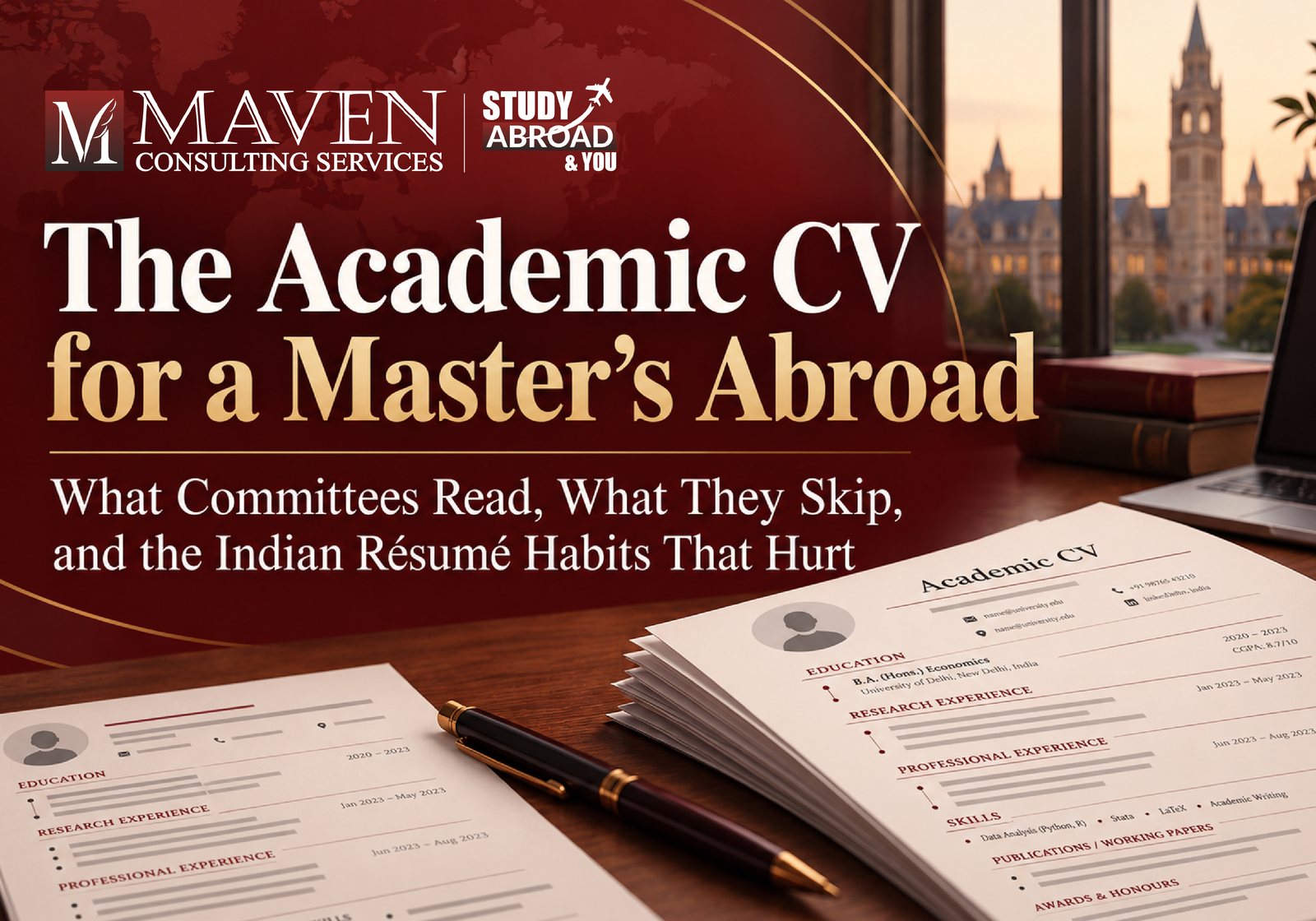
Last verified: 31 October 2026, against the official graduate admissions pages of the University of Oxford, the University of Michigan, Harvard Kennedy School, Columbia University, Purdue University, LSE, the University of Mannheim, Mainz University of Applied Sciences, TU Dresden and Utrecht University. CV rules are set programme by programme, so read the instructions for your exact course before you upload.
By Rajshekar Tubachi, Founder, Maven Consulting Services, Bengaluru · 15+ years in international education
The Short Answer
What should a CV for a master’s abroad include?
Education with your CGPA and its scale, your strongest projects and any research, relevant work or internships, grouped technical skills, and a few awards that can be checked. Keep it to one or two pages. For the US and UK, leave out the photo, date of birth, family details, objective statement and signed declaration, unless the programme asks for something different.
Most Indian students spend weeks on the SOP, days chasing professors for recommendations, and about forty minutes on the CV. Usually that means opening the résumé they made for campus placements, changing the date, and uploading it. Photo in the corner, date of birth, father’s name, a career objective about a challenging environment, and a signed declaration at the bottom.
That document was built for an Indian HR shortlist. A CV for master’s abroad is read by someone else entirely: a faculty member or admissions reader who has your transcript, your statement and your letters open in the same portal, and who wants to know one thing from the CV. What have you actually done that shows you can handle this programme?
With the first Fall 2027 deadlines in December, the CV is the last easy fix left in most applications. It needs no professor, no test date and no new content, only a clear-eyed rewrite of what you already have. This guide shows what committees read, what they skip, and which habits to drop, using the official guidance of US, UK and German universities. If you are still choosing a country, start with our Study in USA guide or our Study in UK guide.
In the US, a résumé is the short document and a CV is the long academic record with every publication and talk. In the UK and most of Europe, “CV” simply means the short document. Application portals use the words loosely, and many simply say “Résumé/CV”.
For a taught master’s, the difference matters less than students fear. The University of Michigan’s Robotics department puts it plainly: a résumé is usually one to two pages, a CV is more detailed and preferred for research-oriented programmes, and either is usually accepted unless the programme asks for one format. Purdue’s graduate programmes make the more useful point, that a graduate school résumé is different from a job search résumé. A job résumé is written to get an interview. The application version is there to add to the rest of your file.
So for a CV for master’s abroad, the real question is not CV versus résumé. It is whether your document is written for an employer or for an academic reader. The rest of this guide is about the second kind.
Maven Note: Some programmes do not want a CV at all. The University of Oxford says most of its graduate courses do not require one, that you should upload one only where the course page asks for it, and that a CV uploaded where it is not required will be removed. Oxford also says the CV is less important than your statement. Read each programme’s document list before uploading anything extra.
Nobody publishes a stopwatch figure for CV reading, and we will not invent one. But the official guidance is consistent about what a reader is looking for, and it tells you what to put where the eye lands first.
What a reader does not use is equally clear. Your photograph, date of birth, marital status, religion, parents’ names and hometown play no part in a US or UK academic assessment. They take up the top third of most Indian résumés, which is exactly where the reader looks first.
There is no single rule, and anyone who gives you one is guessing. These are the limits and expectations stated by the universities we checked.
| University or programme | What it says on length |
|---|---|
| University of Oxford (graduate admissions) | One or two pages where a CV is required; there is no strict limit, but a page is often enough at master’s level |
| Purdue University (graduate programme checklists) | Not limited to one page; two pages is fine, with contact information on both pages |
| University of Michigan (Robotics) | Must not exceed four pages; submit as a PDF |
| Harvard Kennedy School | Several pages can be acceptable for applicants with significant work experience; be concise and selective |
| Carnegie Mellon (career centre guide, not admissions) | Master’s students with under 10 years of experience should aim for one page |
Our working rule for Indian applicants: one page if you are a final-year student or a fresher, two pages at most if you have real work experience or research output. A three-page CV from a 22-year-old does not look accomplished; it looks unedited. Then check every programme on your list, because a stated limit always beats a general rule.
None of these habits will get an application rejected on its own. The problem is cumulative. Each one takes space from something useful, and together they tell the reader the document was not written for them.
| Habit | Why it hurts | Do this instead |
|---|---|---|
| Passport photo at the top | Not used in US or UK academic review; marks the document as a job template | Remove it, unless a programme asks for one (some German programmes do) |
| Date of birth, gender, marital status, religion, nationality | Irrelevant to the assessment; the application form collects what it needs | Name, email, phone, city and country, plus LinkedIn or GitHub if useful |
| Father’s or mother’s name | Has no role in an admissions decision abroad | Remove it |
| Full home address with PIN code | Takes two lines for no purpose | City and country only |
| “Career Objective: to work in a challenging environment” | Generic; Carnegie Mellon’s guide lists generic objectives as something to leave out | Drop it, or write one specific line naming your field and goal |
| “Strengths: hardworking, quick learner, team player” | Unprovable claims that every applicant makes | Let your bullet points show these qualities |
| “Declaration: I hereby declare…” with place, date and signature | Not expected in US or UK applications | Remove it for the US and UK; follow the instruction if a German programme asks for a signed CV |
| Duty lines that start with “Responsible for” | Describe a job description, not what you did | Action verb, what you did and how, then the result |
| MS Office, internet browsing, typing speed in skills | Assumed for any graduate applicant | Field-specific tools only, grouped by type |
| Skill bars or ratings (“Python 80%”) | Meaningless to a reader and impossible to verify | List the skill; prove it in a project line |
| Fifteen participation certificates and every short online course | Buries the two things that matter | Three or four relevant items, with what you did |
| Abbreviations like VTU, RVCE or a CGPA with no scale | An overseas reader may not know them | Full university name, city, and “8.42/10” |
| Two-column Canva templates with icons and colour blocks | Harder to read and can scramble when converted | One column, one font, clear headings |
| A list of references with phone numbers | Recommenders are submitted separately in the portal | Remove it; use the space for a project |
If you remove only the first eight rows from a typical placement résumé, you usually free up a third of a page. That space is what the rest of this guide fills.
Maven Note: Hobbies are not banned, but “reading, music and cricket” adds nothing. Keep an interest only if it carries an achievement or a story the reader can use: state-level cricket, a music grade, a long-running blog in your field, or volunteering you led.
For a master’s applicant, education goes first. Write it so an overseas reader needs no translation.
Should 10th and 12th marks go on a master’s CV? Usually not. The application form and your transcripts cover your record, and the reader is assessing your degree. Carnegie Mellon’s guide tells graduate students to leave out high school honours. Add them only if a programme asks for your full education history.
If your CGPA is lower than you would like, the CV is not the place to explain it. Present it accurately and let your projects and experience do the work. Our piece on why a 9.0 CGPA gets rejected and a 7.2 gets admitted explains what committees weigh alongside the number.
For most Indian applicants with little or no work experience, projects are the heart of a CV for master’s abroad applications. They are the only place a reader sees what you can actually build, analyse or design, and they are where your CV and your SOP should meet.
A strong project entry answers five questions in two or three lines:
Order projects by relevance to the programme, not by date. A data science applicant should lead with the data project even if the embedded systems project came later. Three or four strong entries beat eight thin ones.
If you have research, such as a paper, a conference poster, a funded student project or work in a professor’s lab, give it its own heading above projects. Michigan’s guidance lists the elements to include: your role, the methods and the outcomes. Mark the status of any paper honestly: published, accepted, under review, or in preparation.
Here is a typical entry from an engineering résumé, and the same project rewritten for a CV for master’s abroad applications. The project did not change. Only the description did.
Before
Project: Smart Attendance System using Face Recognition
Description: This project is about making attendance automatic using face recognition. We used Python and OpenCV. I was responsible for coding and testing. It was a team project of 4 members.
Duration: 6 months
After
Face-Recognition Attendance System | Final-year project, guide: Dr [Name] | Jan to May 2026
• Built the recognition pipeline in Python with OpenCV and a pretrained FaceNet model for a 60-student classroom under three lighting conditions
• Raised matching accuracy from 81% to 94% by adding face alignment and retraining on 2,400 images collected with consent
• Led a team of four; wrote the evaluation scripts and the project report (graded A+). Code: github.com/[username]/attendance
What changed: a title that says what the project is, the student’s own role made explicit, specific tools, two numbers that show a result, and a link the reader can open. It is also shorter in the place that matters, because “this project is about” is gone.
Maven Note: Use your own numbers. If you did not measure accuracy, do not write one. Write what you can stand behind, such as “tested on 3 classes over 4 weeks” or “cut manual entry time from about 10 minutes to under 1”. A reader, a recommender or an interviewer may ask about any number on your CV.
Indian work experience lines often describe the employer’s process rather than the applicant’s contribution. “Responsible for maintaining client applications and resolving tickets” could describe thousands of people. The reader wants to know what you, specifically, changed.
Use the pattern Carnegie Mellon’s guide recommends: an action verb, what you did and how, then the result. For example:
A few more rules that matter for Indian profiles:
Skills. Group them so a reader can scan the line in two seconds: Programming, Data and ML, Tools and Platforms, Lab or Design. List only what you could use in a test or discuss in an interview. Carnegie Mellon’s guide says to keep soft skills out of the skills section entirely; show them in your bullets instead.
Certifications. Keep the ones with an assessment that relates to the programme, such as a cloud certification for a cloud computing master’s. Drop short video courses unless one fills a specific gap in your degree, in which case say which gap. If you list a course to cover a missing prerequisite, mention it once more in your SOP so the reader joins the dots.
Awards. Give each one a scale so the reader can judge it: “1st of 120 teams, Smart India Hackathon regional round”, “Merit scholarship, top 2% of the batch”. An award without context is just a name.
Test scores. You can add your GRE, TOEFL or IELTS score in one line, but they are already in the application form and official reports. If space is tight, they are the first thing to cut. Our GRE guide for Fall 2027 covers which programmes still want the test at all.
Students often try to use the CV to manage something they are worried about. It rarely works, because the CV has no room for explanation and the reader has the transcript anyway.
Committees read your documents together. A project that is central in your SOP but missing from your CV, or a job title on the CV that your recommender describes differently, raises a question that you will not be there to answer.
Universities take accuracy seriously. Columbia Engineering asks applicants to attest to the accuracy and authenticity of everything they submit, and reviews admitted students’ materials in a verification process. LSE says it scrutinises and verifies documents, and that an application can be cancelled or an offer withdrawn if information cannot be verified.
Before you upload, lay your three documents side by side and check:
The same principle applies to tone. A CV with specific, modest entries next to an inflated, AI-polished statement reads as two different applicants. We covered how committees respond to that in our post on what admission committees do with AI-written statements.
Most of this guide applies across English-speaking destinations. Germany is the main exception, and it is where Indian students most often get the advice backwards.
| Destination | What the CV usually looks like | Watch for |
|---|---|---|
| USA | Called résumé or CV; one or two pages for most master’s applicants; no photo or personal details | Programme page limits, which range from one to four pages |
| UK and Ireland | Called CV; one or two pages; same exclusions as the US | Many courses do not require a CV at all (Oxford); do not overload the application (LSE) |
| Canada and Australia | Same conventions as the US and UK | Programme-specific instructions, as everywhere |
| Germany | Often a CV “in tabular form”, in reverse chronological order and without unexplained gaps | Some programmes ask for a signed and dated CV; a few invite a photograph |
| Netherlands | Your own format, or a university template | Utrecht’s School of Economics offers its own CV guideline for master’s applicants |
For Germany, the University of Mannheim asks master’s applicants for a CV in tabular form. Mainz University of Applied Sciences asks for a chronological, gap-free and signed CV. TU Dresden’s International Institute Zittau asks for a tabular CV, preferably with a photograph. So the signature and photo that are out of place on a US application can be expected on a German one.
Maven Note: If you are applying to both the US and Germany, keep two versions: a one-page US/UK CV and a tabular German CV. Do not send the German version, with photo and signature, to a US programme. For the German side of the process, see our guide on dMAT or APS for 2027, and for the Netherlands, our Study in the Netherlands guide.
This is the structure we suggest for a CV for master’s abroad applications to the US or UK from a final-year student or a fresher. Move Work Experience above Projects if you have more than a year of relevant work.
Template
[FULL NAME]
[City], India | [email] | [+91 phone] | linkedin.com/in/[name] | github.com/[name]
EDUCATION
Bachelor of Engineering in [Branch], [Full college name], [Affiliating university], [City] | [Month Year]
CGPA [8.42/10] | Final-year project: [title] (guide: Dr [Name]) | Selected coursework: [4 to 6 relevant courses]
RESEARCH AND PROJECTS
[Project title] | [context: final-year, lab, hackathon] | [Month Year to Month Year]
• [Action verb] + [what and how, with tools] + [result you can stand behind]
• [Second line: your role in the team, or a second result] | [link]
[Repeat for 2 to 3 more projects, most relevant first]
WORK EXPERIENCE AND INTERNSHIPS
[Role], [Organisation], [City] | [Month Year to Month Year]
• [Action + context + result] (two or three bullets for the most relevant role)
SKILLS
Programming: [ ] | Data and ML: [ ] | Tools and platforms: [ ] | Lab or design: [ ]
AWARDS, CERTIFICATIONS AND ACTIVITIES
[Award with scale, Year] | [Certification relevant to the programme, Year] | [Leadership role with one outcome, Year]
Use one font at 10.5 to 11 point, normal margins, bold for headings and organisation names, and nothing else decorative. If your CV runs to a second page, repeat your name and contact details on page two, as Purdue asks.
If your first deadlines are on 1 or 15 December, put this check into your plan for the second half of November. Our Fall 2027 US deadline map shows where each cluster falls, and our guide to US application fee waivers has request dates that land in the same weeks.
Founder Perspective
“Every season we see the same thing. A student with genuinely good work sends us a CV that hides it: half a page of personal details, a career objective, a skills list with MS Office on it, and then one line about a project they spent eight months on. That CV was written for a placement cell, and it did that job.”
“Now it has a different reader. A professor reviewing your file abroad does not need to know your father’s name or your date of birth. They want to see what you built, how you did it, and what happened. Cut everything that does not show that, and the CV usually becomes shorter and much stronger at the same time. It is the quickest improvement in the whole application.”
Rajshekar Tubachi, Founder, Maven Consulting Services
Education with your CGPA and its scale, projects and any research, relevant work or internships, grouped technical skills, and awards with context. Keep it to one or two pages, and follow any format or page limit the programme sets.
One page for most final-year students and freshers, and two pages at most with significant work or research. Programme limits vary: Purdue says two pages is fine, while Michigan Robotics allows up to four pages. Check each programme’s instructions.
Not for the US, UK, Canada, Ireland or Australia, where photos play no part in academic review. Some German programmes ask for or prefer a photograph on a tabular CV, so follow the instructions for that programme.
Usually not. The reader is assessing your bachelor’s degree, and your school record is covered by the application form and documents. Include school marks only if a programme asks for your full education history.
In the US, a résumé is the short version and a CV is a longer academic record; in the UK, CV means the short document. For a taught master’s, most programmes accept either unless they ask for one format. What matters is that it is written for an academic reader.
Not for the US or UK. The “I hereby declare” line is an Indian job-application habit. Some German universities do ask for a signed and dated CV, so add a signature only where a programme asks for it.
No. The CV has no space for explanation, and your transcript already shows backlogs to the university. If context helps, give it briefly in your SOP or the additional information section of the application.
One version can usually serve the US, UK, Canada and Ireland. Germany often expects a tabular, gap-free CV, sometimes signed and dated, so keep a separate German version and never send that one to a US programme.
A CV for master’s abroad has one job: to show an academic reader what you have done that prepares you for the programme. Lead with your degree and grade on a clear scale, give your best projects and experience the most space, show results you can stand behind, and remove the personal details and placement habits that were written for a different reader. Keep it to one or two pages, match it to your SOP and letters, and follow each programme’s instructions over any template, including this one.
Send us your current CV and the programmes you are applying to. We will mark what to cut, what to rewrite and what is missing, and check that it tells the same story as your SOP and letters. We do not write CVs for students; we help you present your own work clearly. Maven Consulting Services, Bengaluru, has guided more than 10,000 students across 700-plus university partners in 20-plus countries, with a 99.8 per cent visa success rate and a commission-free model, so our advice follows your interests, not a university’s.
WhatsApp | Bengaluru, Karnataka · Instagram · LinkedIn · YouTube
<< Previous Blog | Next Blog >>
Sources: University of Oxford graduate admissions (CV/résumé guidance); University of Michigan Robotics graduate admissions (résumé or CV); Harvard Kennedy School admissions (application FAQs, résumé/CV); Columbia University Computer Science (MS application FAQ) and Columbia Engineering (application requirements); Purdue University graduate programme application checklists; London School of Economics (how to apply, graduate); University of Mannheim (documents for the application); Mainz University of Applied Sciences (master’s application documents); TU Dresden International Institute Zittau (application documents); Utrecht University School of Economics (CV guidelines for master’s programmes); Carnegie Mellon University Career and Professional Development Center (graduate student résumé guide, a career-centre document rather than admissions policy).
All read on 30 and 31 October 2026. This article is general guidance for Indian students and families. It is not a guarantee of admission, and each programme’s own instructions take priority.

Sunday, October 26, 2025 | The Taj MG Road, Bangalore | 10 AM – 4 PM