WhatsAppCHAT
CALL US& CONNECT

Last verified: 27 October 2026, against the Common App’s 2025–26 research reports, the Institute of International Education’s Spring 2026 Snapshot and Open Doors 2025, the DHS SEVIS Data Mapping Tool, US State Department visa issuance data and the American Institute of Physics. Open Doors 2026 and IIE’s Fall 2026 Snapshot are due in mid-November, and we will update this page when they land.
By Rajshekar Tubachi, Founder, Maven Consulting Services, Bengaluru · 15+ years in international education
The Short Answer
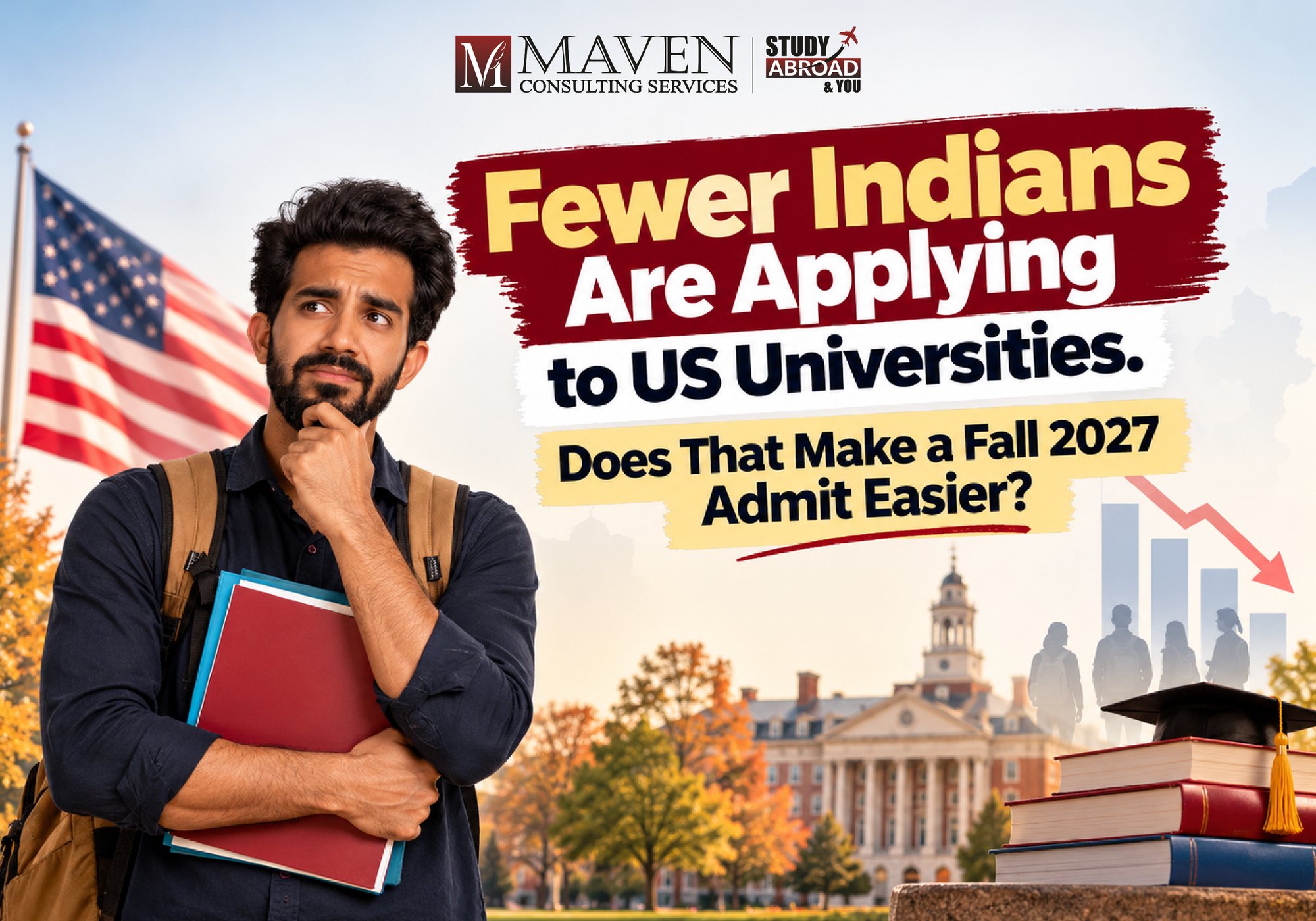
Is it easier for Indian students to get a US admit for Fall 2027 because fewer are applying?
Partly, and only in some places. The fall in Indian applications is concentrated at less-selective and mid-tier universities, where there is now more room and more scholarship leverage. At the most selective universities, international applications barely moved, and funded PhD offers to international students actually fell. The visa interview, not the admit, is still the tightest gate.
Indian applications to US universities fell sharply this year. The Common App counted 14,424 first-year applicants from India in its 2025–26 cycle, down about 15 per cent. Six in ten US institutions told the Institute of International Education that applications from India had dropped.
So families in our Jayanagar office are asking a fair question: if fewer Indians are competing, is Fall 2027 US admission for Indian students suddenly easier? This guide answers it with the data, tier by tier, rather than with a headline. We separate the four numbers that get mixed up in the news, show where the decline is real and where it is not, and explain what it changes for your Fall 2027 list.
It matters now because most Fall 2027 master’s deadlines fall between December and February, and the list you build in November decides your outcome. If you are still choosing a country, start with our Study in USA guide, then come back here.
Fewer Indian applicants does not lower the bar evenly. It lowers competition most at universities that relied heavily on Indian master’s students and were never highly selective to begin with. It does almost nothing at universities that turn away most of their applicants, because demand for those brands has barely softened.
There is a second catch. A US admit has always been the easier half of the journey for Indian students. The harder half is the F-1 visa, and that is exactly where the 2025 and 2026 numbers show the real squeeze. An admit you cannot convert into a visa is not a win.
Maven Note: If someone tells you “this is the easiest year ever to get into a US university”, ask them which university. The honest answer changes completely between a top-30 computer science programme and a regional state university.
Here are the figures that matter, from the organisations that publish them. Each one measures something different, which is why the news can sound contradictory.
| Measure | Latest figure | Source |
|---|---|---|
| Indian first-year applicants on the Common App, 2025–26 | 14,424, down about 15% from roughly 16,900 | Common App end-of-season report, 20 August 2026 |
| US institutions reporting fewer applications from India | 61%; only 39% saw stable or higher numbers | IIE Spring 2026 Snapshot, 585 institutions |
| Institutions expecting lower international enrolment in 2026/27 | 63% | IIE Spring 2026 Snapshot |
| New international enrolment, Fall 2025 | Down 17%, the steepest fall since 2020 | IIE Fall 2025 Snapshot |
| F-1 visas issued to Indians, May to August 2025 | 22,149, against 58,694 in the same months of 2024 | US State Department monthly issuance data |
| Active Indian F-1 and M-1 records, September 2026 | 335,698, down 12.5% on a year earlier | DHS SEVIS Data Mapping Tool |
| Indian students in the US, 2024/25 academic year | 363,019, a record and still the largest group | Open Doors 2025 |
You can check each figure yourself: Open Doors for enrolment, the SEVIS Data Mapping Tool for active student records and the State Department’s monthly visa issuance tables for visas. Read the table from top to bottom and a pattern appears. Applications fell. Visas fell further. The number of Indian students on campus fell, but less steeply, because students already in the US and on OPT are still counted. Each step is a different filter, and each tells you something different about your own odds.
Most confusion in this debate comes from treating these four numbers as one. They are not.
When a headline says “Indian students are turning away from the US”, it is usually describing applications. When it says “US universities lost Indian students”, it is usually describing visas and arrivals. The first affects your admit. The second affects whether you board the flight.
Maven Note: When fewer admitted students arrive, universities usually respond in the next cycle by making more offers to reach the same class size. That can make some admits easier to get. It also means an admit letter is a weaker signal of a place on campus than it used to be.
This is the most useful finding of the year, and it is buried in the Common App’s own monthly reports. In its January 2026 deadline update, international applications fell 17 per cent at member colleges admitting between 50 and 74 per cent of applicants, and 15 per cent at colleges admitting 75 per cent or more. At the most selective members, those admitting fewer than a quarter of applicants, international applications rose 1 per cent.
The full-season pattern, published in August, looked the same: the drop was concentrated at less-selective colleges, while international demand for the most selective ones held almost flat.
In plain terms, the students who stopped applying were mostly applying to universities where an Indian applicant with a reasonable profile already had a good chance. The students still applying to the hardest universities kept applying.
| University admit rate | Change in international applications | What it means for you |
|---|---|---|
| Under 25% (most selective) | Up 1% | No easier. Same competition, same bar |
| 50% to 74% (more selective) | Down 17% | Noticeably less competition and more scholarship leverage |
| 75% and above (less selective) | Down 15% | Admits were already likely; scholarship terms may improve |
Universities admitting between 25 and 49 per cent sit between these two pictures, so check each one individually. These are undergraduate figures, because the Common App is an undergraduate platform. Graduate schools do not publish a single equivalent, but the graduate evidence below points the same way.
For Indian school students applying to a US bachelor’s for Fall 2027, the Common App data is the most direct evidence there is. Three things follow from it.
One more detail is worth knowing. While applicants living in India fell, the Common App reported that applicants based in the US with an Indian background rose by 6 per cent. Universities are not short of Indian-origin talent; they are short of Indian students who need F-1 visas.
Most Indian students going to the US go for a master’s, usually in computer science, data science, engineering or business analytics. This is where the drop is largest and where it changes the most.
In IIE’s Spring 2026 Snapshot, 43 per cent of institutions reported a substantial fall in graduate applications, compared with 31 per cent at undergraduate level. India showed the most pronounced decline of any country surveyed. Nearly all respondents, 92 per cent, cited visa processing delays or rising refusals as the main factor.
If a master’s programme has room this year, these are the signs to look for on its admissions pages and in its emails:
None of this applies at the most competitive programmes. Top computer science master’s at the leading research universities remain heavily oversubscribed, and the profile they expect has not changed. Our guide to why a 9.0 CGPA gets rejected and a 7.2 gets admitted explains what those committees actually weigh.
Maven Note: A deadline extension is not a reason to wait. Funding, assistantships and the best housing still go to early applicants, and a late admit leaves the least time for the visa queue.
This is the part most commentary gets wrong. A PhD admit in the US is tied to funding, and funding has tightened alongside the visa problem.
The American Institute of Physics surveyed physics and astronomy departments for Fall 2026. More than 60 per cent received fewer international applications, but 55 per cent also made fewer offers to international students. Departments also reported lower-than-expected yield among international admits, and many expected to make a similar number of offers for Fall 2027, which would keep international offers at the reduced level.
So in funded research programmes, fewer applicants has been matched by fewer seats. Departments facing grant uncertainty are cautious about committing five years of stipend to a student who may not get a visa. For an Indian PhD applicant, the competition for each funded offer may be just as fierce as before.
The single most important number in this guide is the visa figure. Between May and August 2025, the peak season, the State Department issued 22,149 F-1 visas to Indian nationals, against 58,694 in the same months of 2024. That drop was driven by a pause in interviews, a new online presence review for student applicants and tighter scrutiny of funding and intent.
The admit and the visa are judged by different people using different tests. The university asks whether you can succeed in the programme. The visa officer asks whether your plan is credible, your funding is genuine and your intent is to study. A weaker university, a programme that does not fit your background or a loan-heavy funding story can make the second question harder, even when the first was easy.
That is the trap in a “soft” admissions year. An admit from a university that would have rejected you two years ago is still worth having, but only if you can explain it convincingly at the interview. Our guide to F-1 refusals under 214(b) and 221(g) sets out what the officer is actually testing.
Maven Note: Before you accept any admit, ask yourself whether you can explain in two sentences why this programme, why this university and how it is funded. If the answer depends on “it was the only one that admitted me”, fix the list now, not after the refusal.
Several of the policies that frightened Indian applicants last year look different today. As of 27 October 2026:
None of this guarantees a calmer 2027. But it does mean some applicants who walked away in 2026 may return, which would narrow the gap at mid-tier universities. We would not plan on Fall 2027 being as quiet as Fall 2026.
There are real advantages this year, if you know where to look.
Equally, be honest about where the shift does not reach.
National data tells you the direction. Your decision depends on the specific programme. Here is how to check it.
A balanced list still matters more than any trend. What changes this year is where the boundaries sit.
| List tier | Usual approach | Fall 2027 adjustment |
|---|---|---|
| Ambitious (2 to 3) | Programmes slightly above your profile | Keep them, but do not expect the decline to lift you into the most selective programmes |
| Target (3 to 4) | Programmes that match your profile | Move one or two slightly higher: mid-selective programmes now have more room |
| Safe (2) | Programmes you are very likely to get | Choose safes you can defend at the visa interview, not just ones that will admit you |
| Funding focus | Apply for assistantships after arrival | Ask about merit awards and assistantships before applying; leverage is better this year |
Time your applications as if the year were competitive, because the visa queue is. Our Fall 2027 US deadline map works backwards from the date you need a visa to the date each application must go in.
If the visa risk worries you more than the admit, compare countries properly before you commit. Our USA vs Canada comparison and our guide to four underrated destinations are a good starting point.
For parents, the question is not whether the admit is easier. It is whether the investment is safer. Three practical points:
Founder Perspective
“Every few years there is a season when families hear that a country has become “easy”. I have seen it with the UK, with Canada and now with the US. My answer is always the same: admissions get easier at the edges, never at the centre, and the visa never gets easier because an admissions office needs students. This year, the real opportunity for a well-prepared Indian student is a better scholarship at a solid university, and a little more ambition on the target list. The real risk is a weak admit that collapses at the interview. Build the list for the visa officer, not for the headline, and the year works in your favour.”
Rajshekar Tubachi, Founder, Maven Consulting Services
Partly. The fall in Indian applications is concentrated at less-selective and mid-tier universities, which now have more room and more scholarship leverage. At universities admitting fewer than a quarter of applicants, international applications barely changed, so those admits are no easier.
On the Common App, Indian first-year applicants fell about 15 per cent in the 2025–26 cycle, to 14,424. In IIE’s Spring 2026 Snapshot of 585 institutions, 61 per cent reported fewer applications from India, and only 39 per cent saw stable or higher numbers.
There is no evidence of formal changes to admission standards. What has changed at many mid-tier universities is flexibility: extended deadlines, fee waivers, faster decisions, more generous deferrals and more room on scholarships. Highly selective programmes have not changed their expectations.
Not in most sciences. In an American Institute of Physics survey, 55 per cent of physics and astronomy departments made fewer offers to international students for Fall 2026, as funding tightened and visa uncertainty grew, and many expected to keep offers lower for Fall 2027.
There is no sign of that. F-1 visas issued to Indians between May and August 2025 fell to 22,149, against 58,694 a year earlier, and online presence review of student applicants continues. The visa remains the tighter gate.
Not as of 27 October 2026. A federal court in Massachusetts postponed the duration of status rule on 14 September 2026, and it remains blocked nationwide while the government’s appeal proceeds. Students are still admitted for duration of status.
Moving one or two target programmes slightly higher makes sense, especially among universities that admit half or more of applicants. Do not expect the decline to carry you into the most selective programmes, and make sure every university on your list is one you can defend at the visa interview.
At mid-tier universities that depend on international master’s students, often yes, because they need to fill seats and protect revenue. Ask about merit awards before you apply and apply early. Need-based aid for international students remains scarce.
Open Doors 2026 and IIE’s Fall 2026 Snapshot are usually released in mid-November. They will show how many new international students actually enrolled this fall, which is the next useful signal for Fall 2027 planning.
Fewer Indians are applying, but the effect on Fall 2027 US admission for Indian students depends entirely on where you apply. Mid-tier and less-selective universities have more room, more flexibility and more scholarship money this year. The most selective universities and funded PhD programmes are no easier, and in some fields harder. The F-1 visa is still the real gate. Build a list that uses the opportunity at the middle, stays honest at the top, and is defensible at the interview.
Send us your profile and your current shortlist. We will place every university in the right tier for this year, show you where the scholarship leverage is, and check that each choice holds up at the visa interview. Maven Consulting Services, Bengaluru, has guided more than 10,000 students across 700-plus university partners in 20-plus countries, with a 99.8 per cent visa success rate and a commission-free model, so our advice follows your interests, not a university’s recruitment target.
WhatsApp | Bengaluru, Karnataka · Instagram · LinkedIn · YouTube
<< Previous Blog | Next Blog >>
Sources: Common App, Deadline Update for the 2025–26 season (first-year application trends through 1 January 2026) and 2025–26 End of Season Report (20 August 2026); Institute of International Education, Spring 2026 Snapshot on International Educational Exchange, Fall 2025 Snapshot on International Student Enrollment and Open Doors 2025; US Department of Homeland Security, SEVIS Data Mapping Tool (September 2026); US Department of State, Monthly Nonimmigrant Visa Issuance Statistics (May to August 2024 and 2025); American Institute of Physics, Federal Funding and Visa Uncertainty Shape Fall 2026 Graduate Admissions in Physics and Astronomy; US District Court for the District of Massachusetts order of 14 September 2026, as tracked by the Presidents’ Alliance on Higher Education and Immigration.
Current as of 27 October 2026. This article is general information for Indian students and families, not admissions or legal advice, and no trend guarantees an individual admission or visa outcome.

Sunday, October 26, 2025 | The Taj MG Road, Bangalore | 10 AM – 4 PM