WhatsAppCHAT
CALL US& CONNECT

Last verified: 8 October 2026, against the State Department’s screening page (updated 18 September 2026) and US Embassy India statements. We update this page, with the date, whenever the rules change.
By Rajshekar Tubachi, Founder, Maven Consulting Services, Bengaluru · 15+ years in international education
The Short Answer
Do US student visa applicants need public social media accounts?
In practice, yes. On 18 June 2025 the US State Department said every F, M and J applicant would go through an online presence review and asked them to set all social media profiles to public. The US Embassy in India repeated this on 23 June 2025. You must also list every handle you have used in the last five years on your DS-160. The State Department’s screening page, updated 18 September 2026, still lists F-1 and F-2.
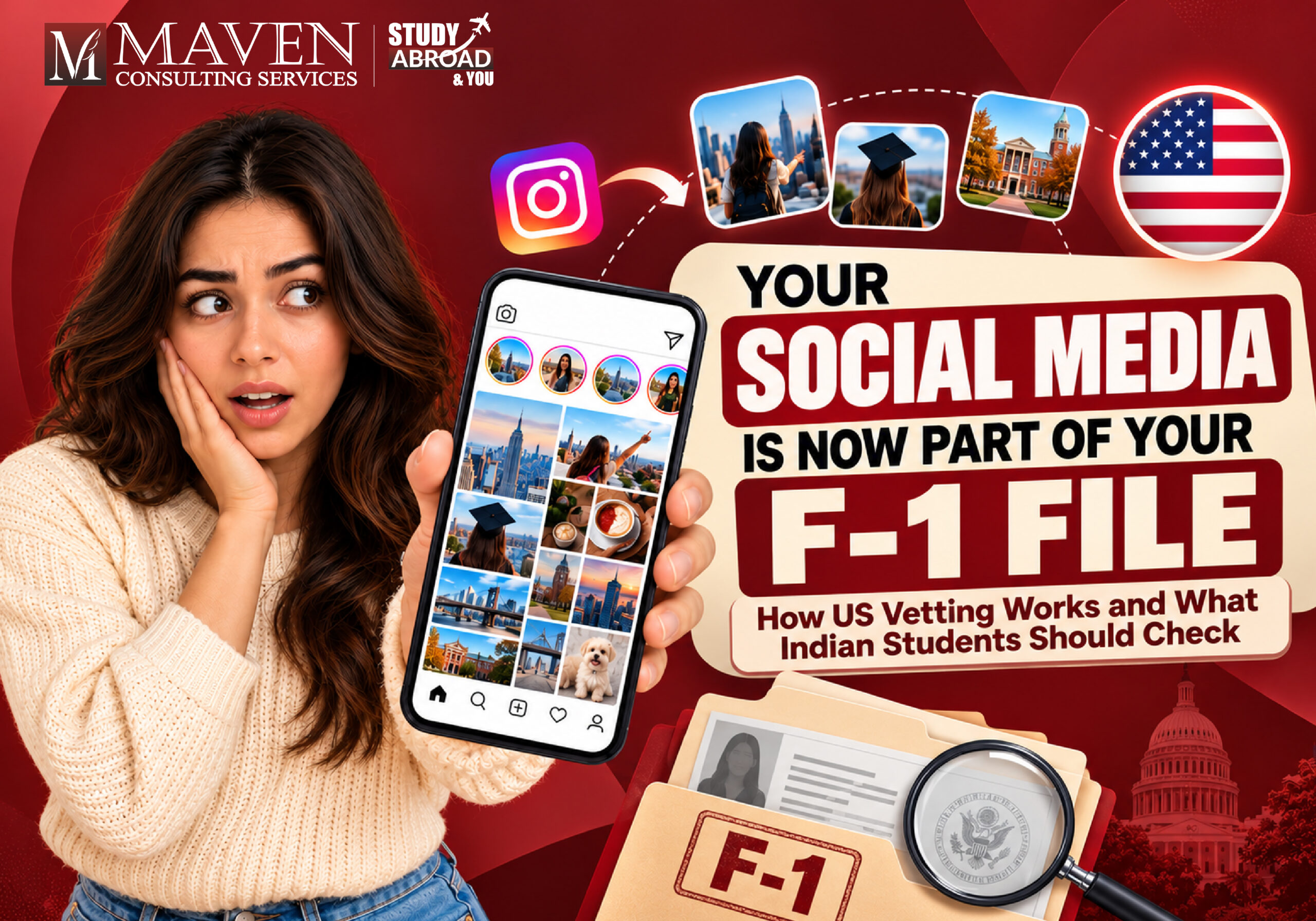
If you are applying for a US master’s this year, there is a new document in your file that you never uploaded: your Instagram. Your LinkedIn, your old Twitter handle, the YouTube channel you started in second year. Since June 2025, all of it is part of how a consular officer decides your F-1.
This guide explains US student visa social media vetting as it actually works today. We cover what the State Department announced and when, what the DS-160 asks, what officers are reportedly looking for, and why deleting accounts in a panic is the one move most likely to hurt you. It ends with a practical review you can do yourself in a week.
It matters now because Fall 2027 visa interviews will open next year, and the habits you build this winter are the ones an officer will see. Families are anxious, reels are full of conflicting advice, and some students are wiping their profiles without understanding that the form they already signed lists those very accounts. For the wider picture of studying in America, start with our Study in USA guide.
Yes, in practice. On 18 June 2025, the State Department announced in an official media note that all F, M and J applicants would undergo comprehensive vetting that includes their online presence, and that every applicant is instructed to set the privacy settings of all social media profiles to “public”.
Five days later, on 23 June 2025, the US Embassy in New Delhi repeated the instruction for Indian applicants, saying it took effect immediately. Note the exact wording: applicants were requested to adjust their privacy settings. Nobody will physically stop you at the counter for a private profile, but the reported internal guidance says limited visibility can be read as an attempt to hide something. Treat the request as a requirement.
The rule has not been relaxed since. The State Department’s expanded screening and vetting page, last updated on 18 September 2026, lists F-1, F-2, M-1, M-2, J-1 and J-2 among the categories already covered by online presence review.
Maven Note: If you read a reel saying the “public profile rule” was withdrawn in 2026, look at what actually changed. The September 2026 update added I, TN and TD visas from 1 October 2026 and told those applicants to go public. It did not remove students. F-1 and F-2 are still on the list.
Most confusion comes from mixing up three different things: the DS-160 question (since 2019), the public-profile instruction (since 2025), and continuous vetting after the visa is issued. Here is the full sequence.
| Date | What happened | Who it affects |
|---|---|---|
| 31 May 2019 | DS-160 starts asking for social media identifiers used in the previous five years | Almost all visa applicants |
| 18 June 2025 | State Department announces online presence review for F, M and J applicants and asks them to set profiles to public | Students and exchange visitors |
| 23 June 2025 | US Embassy India repeats the instruction for Indian applicants, effective immediately | Indian F, M and J applicants |
| 26 June 2025 | US Embassy India warns that omitting social media on the DS-160 could lead to visa denial and ineligibility for future visas | All Indian visa applicants |
| 12 July 2025 | US Embassy India says visa screening does not stop after a visa is issued | All visa holders |
| 15 December 2025 | Online presence review extended to H-1B and H-4 applicants | Workers and dependants, including future OPT-to-H-1B students |
| 30 March 2026 | Review extended to further categories, including K, R, H-3, Q, S, T and U visas | Fiancé(e)s, religious workers, trainees and others |
| 1 October 2026 | Review extended to I, TN and TD visas (announced 18 September 2026) | Media representatives and USMCA professionals |
Read the table from a student’s point of view and one thing stands out. The public-profile instruction is now more than a year old, it has been extended rather than withdrawn, and it covers the visa you will need after OPT as well as the one you need now.
The DS-160 social media section has been in place since 31 May 2019. According to the State Department’s 2019 FAQ on social media collection, here is what it involves:
That last point is the one most students miss. The US Embassy in India stated on 26 June 2025 that leaving out social media information could lead to visa denial and ineligibility for future visas. A missing handle is not treated as a small slip. It can be treated as a misrepresentation, which is far harder to fix than an embarrassing photo.
Maven Note: Fill in the social media section from a written list, not from memory. Open each app, go to your profile, and copy the exact handle, including dots and underscores. Then check old email accounts for sign-up confirmations from platforms you have forgotten about.
The State Department has not published a list of posts that lead to refusal. What we know comes from two official statements and from news reports on the internal cable sent to embassies in June 2025.
The official purpose, from the 18 June 2025 announcement, is to identify applicants who are inadmissible, including those who pose a threat to national security, and to confirm that applicants intend to do what their visa allows. A student visa is for study, and the officer’s job is to check that your story holds together.
Reporting on the cable, including CNN’s coverage on 18 June 2025, says officers were told to:
Set that beside the State Department’s own 2019 FAQ, which says consular officers cannot refuse a visa on the basis of political views, race, religion, ethnicity, national origin, gender or sexual orientation. Both statements exist. In practice, officers have wide discretion, and no public standard defines where an opinion ends and “hostility” begins.
For a typical Indian student, the most common risk is quieter than any of this. It is inconsistency. A LinkedIn profile that says you worked at a company your DS-160 never mentions. Instagram stories about a cousin’s job offer in Texas that you plan to take. A post saying you are “settling in the US for good”. Under section 214(b) of US immigration law, every student applicant is presumed to intend to immigrate until they show otherwise, and your own posts can undo the case you make at the counter. We explain how 214(b) refusals work in our guide to F-1 visa refusals under 214(b) and 221(g).
The instinct is understandable: if the officer might read it, remove it. Here is why that instinct usually makes things worse.
This does not mean you can never remove anything. Taking down a genuinely regrettable old photo is your right. Wiping years of history days before the interview is a different thing, and it creates exactly the kind of gap you are trying to avoid.
Maven Note: Do not clean, reconcile. The goal of a pre-interview review is not to look perfect. It is to make sure what the officer can see matches what you wrote on the DS-160, in your SOP and on your resume, and that you can explain anything that might raise a question.
Do this review logged out, on a phone that is not yours, so you see what a stranger sees. Take notes as you go.
Search each handle you listed. If one does not come up, find out why: a renamed account, a typo on the form, or an account you deactivated. A mismatch between the form and reality is the first thing to fix.
Compare LinkedIn, your resume, your SOP and the DS-160 line by line: degree, university, graduation year, employers, job titles and dates. Officers often have your DS-160 on screen, and small contradictions in dates or titles are easy to spot. If you are still drafting, our forthcoming guide to writing an SOP that sounds like you covers the consistency point in detail.
Look for anything that says you are leaving India permanently, buying a house in the US, or that your family is “shifting” there. Wanting OPT experience is normal and lawful. Public statements that you never intend to return are the ones that collide with 214(b).
Freelance gigs for US clients, “side hustle” plans for your first semester, or funding claims that do not match your financial documents. F-1 work is tightly restricted, and posts that suggest otherwise invite questions. If you are relying on CPT, read our Day 1 CPT guide before you post about internships.
Check the “tagged” tab on Instagram and Facebook. Friends’ posts can show events, places or captions you would never post yourself. You can untag yourself; you cannot edit someone else’s caption.
A share is still your activity. Look for forwarded content involving violence, hate speech, support for banned groups, or graphic material, including things you shared as a joke years ago. Reposting is the part of social media most students forget they did.
College club pages, fan pages, WhatsApp communities that have a public Instagram, a small YouTube channel. If you posted as the admin, the content can reasonably be linked to you.
Check that the name, date of birth and education history shown publicly match your passport and DS-160. If you use a nickname online, make sure the account is still clearly yours, so the officer is not left guessing whether two profiles belong to the same person.
The State Department has not published detailed guidance on shared accounts, so this is where students get stuck. The DS-160 asks for identifiers you have used. Our working rules, based on that wording:
Maven Note: Parents, check the family pages too. A family business Instagram that tags your son as the future US branch manager, or a community page celebrating your daughter “settling abroad”, is public content linked to the applicant. A quiet word before the interview season is worth it.
If you discover a missing account after submitting, a submitted DS-160 cannot be edited. The usual fix is to complete a fresh DS-160 with the correct details and update the confirmation number on your visa appointment profile before the interview. Confirm the current process with the appointment service for your post, and do it before the interview, not after.
| Don’t | Do instead |
|---|---|
| Delete accounts after submitting the DS-160 | Keep every listed account active and public until your visa decision, and beyond |
| Switch profiles to private before the interview | Set them to public before the interview and leave them that way |
| Create a new “clean” account | Keep your real account and review what is on it |
| Fill in handles from memory | Copy exact handles from each app and from old sign-up emails |
| Leave out a platform you “hardly use” | List anything you used in the last five years |
| Wipe years of posts in one night | Review calmly and remove only what is genuinely regrettable |
| Pay someone to “clean” your profile | Do the review yourself, and ask your counsellor if something worries you |
| Invent explanations at the counter | Answer honestly and briefly if an officer asks about a post |
This is the point almost every Indian guide misses. The State Department’s screening page lists F-2 alongside F-1. A spouse applying as your dependant files their own DS-160, lists their own handles, and is asked to keep their profiles public.
F-2 spouses are not allowed to work in the United States. A spouse whose LinkedIn says “open to work in the US” or whose Instagram announces a job move to Dallas is posting something that conflicts with the visa they are applying for. If children are applying as F-2 dependants, younger ones may have no accounts at all, and “None” is the right answer.
No. On 12 July 2025 the US Embassy in India said that visa screening does not stop after a visa is issued, and that visa holders who break US laws or immigration rules risk revocation and removal. On 20 July 2025, an embassy spokesperson told The Indian Express that vetting runs for as long as the visa is valid.
Keep the scale in perspective. In August 2025 a State Department official said more than 6,000 student visas had been revoked that year. About 4,000 involved breaking the law, mostly assault, driving under the influence and burglary, and roughly 200 to 300 were linked to terrorism grounds. Others involved overstays. Social media content alone was not the main driver of those numbers.
The longer-term point matters more for Indian students. From 15 December 2025, the same online presence review applies to H-1B and H-4 applicants. The profile you build as a student is the one that will be read when you change to work status. Our H-1B fee explainer and our update on the Duration of Status rule being blocked cover the other rules that shape that path.
A 221(g) slip means your case needs administrative processing or further documents before a decision. It is not a refusal, and it has many possible causes. The State Department does not publish how many 221(g) cases involve social media review, so be wary of anyone who quotes a figure.
If you are placed in 221(g):
Our guide to 214(b) and 221(g) explains what usually happens next and how long it can take.
Visa costs belong on the same checklist. Our post on the F-1 fee stack and the Visa Integrity Fee refund sets out what you pay and when.
Founder Perspective
“Every intake, at least one student tells me they deleted Instagram the night before the interview because a reel told them to. Then they sit at the counter with a DS-160 that lists the account they just deleted. That is the real risk, not the beach photo from second year. My advice is boring and it works: make a written list, make it match your form, make your profiles public, and stop touching them. An officer is not looking for a perfect person. They are looking for a consistent one, whose posts, papers and answers tell the same story. If you can explain everything on your profile in one calm sentence, you are ready.”
Rajshekar Tubachi, Founder, Maven Consulting Services
Yes, in practice. On 18 June 2025 the State Department said all F, M and J applicants would undergo online presence review and asked them to set all social media profiles to public. The US Embassy in India repeated this for Indian applicants on 23 June 2025, and the State Department’s screening page, updated 18 September 2026, still lists F-1 and F-2.
Every identifier you have used on the platforms listed in the DS-160 in the last five years, including accounts you no longer use or have deleted. If you had more than one account on a platform, list each one. Copy handles exactly rather than from memory.
You can answer None. The State Department’s FAQ says having no social media account does not, on its own, lead to a visa refusal. The answer must be true: if you used a listed platform in the last five years, it has to be declared.
No. If your DS-160 lists the account, deleting it creates a gap the officer may ask about. If you did not list it, deleting it does not remove tagged photos or other traces. Review the content, keep the account public and make sure it matches your DS-160 and SOP.
No. The State Department says consular officers do not ask for passwords and do not try to get around privacy settings. That is why applicants are asked to make profiles public instead.
It can be a factor. Reported guidance tells officers to look for derogatory information and to weigh content that undermines credibility. Omitting accounts from the DS-160 can lead to denial and future ineligibility. The State Department also says officers cannot refuse visas on the basis of political views, race or religion.
The State Department has not set an end date. The US Embassy in India has said vetting continues while the visa is valid, and the same review applies later to H-1B applicants, so the safest course is to keep listed accounts public and consistent through your studies.
Yes. The State Department lists F-2 among the covered categories. A spouse files their own DS-160, lists their own handles and should keep profiles public. Children who have never used social media can answer None.
Act before the interview. A submitted DS-160 cannot be edited, so the usual fix is to complete a new DS-160 with the correct details and update the confirmation number on your visa appointment profile. Check the current process with the appointment service for your consulate.
US student visa social media vetting is now a standard part of every F-1 and F-2 case. Since June 2025 applicants have been asked to keep profiles public, and since 2019 the DS-160 has required every handle used in the last five years. Officers are not hunting for perfect people; they are checking that your posts, papers and answers tell one consistent story. So list every account, make it match, keep it public and stop editing before the interview. Deleting accounts in a panic is the one move most likely to hurt you.
Share your DS-160, SOP and profile with us. We will check that your story is consistent from the form to the counter, prepare you for the questions officers actually ask, and tell you honestly if anything needs fixing. Maven Consulting Services, Bengaluru, has guided more than 10,000 students across 700-plus university partners in 20-plus countries, with a 99.8 per cent visa success rate and a commission-free model, so our advice follows your interests, not a university’s.
WhatsApp | Bengaluru, Karnataka · Instagram · LinkedIn · YouTube
<< Previous Blog | Next Blog >>
Sources: US Department of State, Office of the Spokesperson, "Announcement of Expanded Screening and Vetting for Visa Applicants", 18 June 2025; travel.state.gov, "Announcement of Expanded Screening and Vetting for Visa Applicants", updated 18 September 2026; US Department of State, Bureau of Consular Affairs, FAQs on Social Media Collection, 4 June 2019; US Embassy and Consulates in India statements of 23 June, 26 June and 12 July 2025, as reported by Scroll, PTI and Business Today, and the embassy spokesperson's statement to The Indian Express, 20 July 2025; CNN reporting on the State Department cable, 18 June 2025; State Department official on student visa revocations, 18 August 2025; 8 U.S.C. 1184 (INA 214(b)); travel.state.gov, Administrative Processing Information.
Current as of 8 October 2026. This article is general information for Indian students and families, not legal or immigration advice.
Sunday, October 26, 2025 | The Taj MG Road, Bangalore | 10 AM – 4 PM