WhatsAppCHAT
CALL US& CONNECT

Last verified: 3 October 2026 against SEVP Broadcast Messages 2608-01 and 2608-02, 8 CFR 214.2(f)(10) and Study in the States. We will re-check on the morning of 7 October and update this page the same day if SEVP issues anything new.
By Rajshekar Tubachi, Founder, Maven Consulting Services, Bengaluru · 15+ years in international education
The Short Answer
Is Day 1 CPT still allowed in 2026?
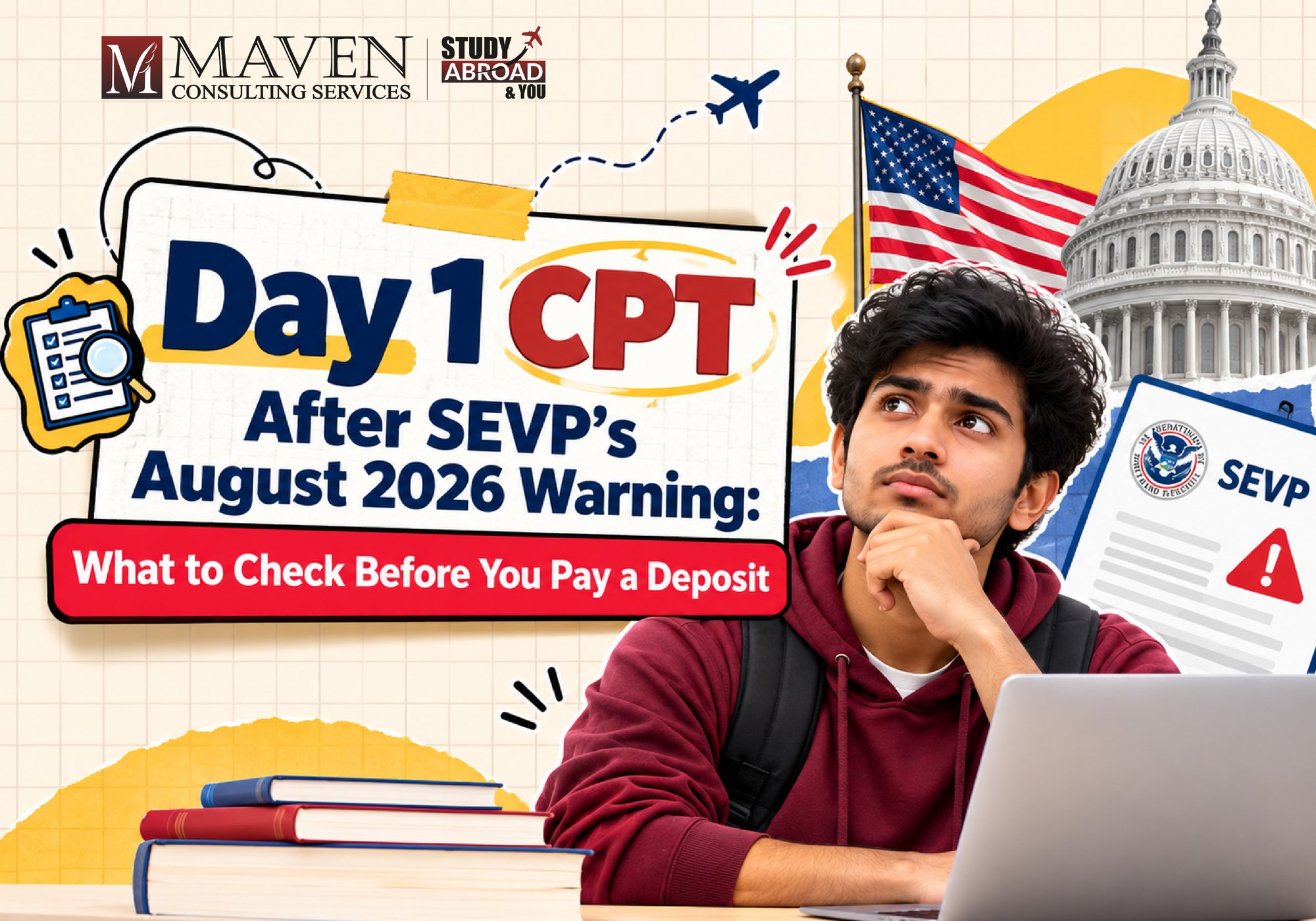
Yes, but under a much narrower reading. The CPT regulation has not changed. What changed is SEVP’s guidance: broadcast messages issued on 12 and 24 August 2026 tell schools to authorise CPT only when the training is required of every student in the programme and the degree cannot be completed without it.
Every few weeks a family walks into our Jayanagar office with the same Day 1 CPT printout. A US master’s that lets the student work full-time from the first week, a deposit deadline a few days away, and an agent who has said the words “completely legal” more than once.
Some of these programmes are legitimate. Some are not. And since August 2026, the line between the two has moved. If you are comparing Day 1 CPT universities 2027 offers, the question is no longer just whether CPT is allowed. It is whether this particular programme’s CPT will survive the way SEVP now reads the rules, and what happens to you years later if it does not.
This matters now because SEVP, the part of US Immigration and Customs Enforcement that oversees international students, has put schools on notice. Several large universities have already narrowed or paused CPT. Programmes built around Day 1 CPT are the most exposed, and the student, not the agent, carries the risk into every future visa application.
Below we explain what CPT is supposed to be, what the August guidance actually says, where the risk lands, and the six questions to put to a university in writing before any money moves. If you are still deciding on the US itself, start with our Study in USA guide and our USA vs Canada comparison for 2027.
Yes. Nothing in the federal regulation on Curricular Practical Training changed in 2026, and no law bans Day 1 CPT. SEVP itself says its August broadcast messages are not a rule and not a final agency action.
But that is only half the answer. The messages tell Designated School Officials (DSOs), the university staff who authorise CPT, to apply a much stricter test. CPT should be authorised only if the degree would be impossible to complete without the training, and only if every student in the programme must do it. A programme can be legal on paper and still fail that test in practice.
Maven Note: “Day 1 CPT” is a marketing phrase, not a legal category. You will not find it in any regulation. What exists is CPT, plus an exception that lets some graduate students start it early. Judge every programme against the regulation, not against the label.
Curricular Practical Training is off-campus work that forms an integral part of a student’s established curriculum. The rule sits in 8 CFR 214.2(f)(10)(i), and the Study in the States CPT page sets out how it works in practice.
The key points are simple. The training must relate directly to your major. A DSO authorises it in SEVIS for one specific employer and one specific period, and the authorisation prints on your I-20. You cannot start work before the start date on that I-20. And while classes are in session, you must still keep a full course of study.
| CPT | OPT | |
|---|---|---|
| What it is | Training that is an integral part of your curriculum | Practical training related to your major, not tied to a course |
| Who authorises it | Your school’s DSO, in SEVIS | USCIS, which issues an EAD card |
| When it happens | Before your programme end date | Usually after graduation, sometimes before |
| Employer | One specific employer per authorisation | Any employer in your field |
| Job needed first? | Yes, before authorisation | No |
| Effect on the other | 12 months of full-time CPT ends OPT eligibility | Does not reduce CPT |
That last row is the one most Indian students never hear about. We come back to it below.
Normally, a student must be enrolled full-time for a full academic year before CPT can be authorised. The regulation makes one exception: students in graduate programmes that require immediate participation in practical training.
That single sentence is the legal basis for every Day 1 CPT programme. It is a real exception, and some genuinely good programmes use it, for example professional degrees with a built-in practicum from the first term.
The problem has never been the exception. It is Day 1 CPT programmes that write a “required” internship into the curriculum mainly so that students can work, then attach thin coursework, occasional weekend attendance and a deposit. The August guidance is aimed squarely at the gap between what the curriculum says and what the programme really is.
SEVP sent two broadcast messages to DSOs at every SEVP-certified school. The first, Broadcast Message 2608-01, was a warning. The second, Broadcast Message 2608-02, explained how SEVP reads the word “integral”.
| BCM 2608-01 | BCM 2608-02 | |
|---|---|---|
| Date | 12 August 2026 | 24 August 2026 |
| Title | Reminder of Liability for DSOs Regarding CPT Authorization | Guidance for Designated School Officials regarding Curricular Practical Training |
| Format | Warning and list of actions requested | Questions and answers |
| Core message | SEVP has seen a rise in CPT authorisations that do not meet the rules | Practical training that is integral must be required for all students in that curriculum, regardless of citizenship |
| The test | Authorise CPT only if the degree would be impossible without it and the work is required for all students | An optional elective generally does not qualify when the training itself is optional |
| Employers | CPT must not be used simply to create employment | Work only with legitimate employers able to give genuine training related to the major |
| Consequences | Possible action by SEVP and Homeland Security Investigations, including withdrawal of a school’s certification | Restates the regulatory basis; not a rule or final action |
Two phrases do most of the work. “Impossible” means that if a student could graduate through some other route, such as a research project or an extra course, the practical training is not integral. “Regardless of citizenship” means that if American students in the same programme are not required to do the internship, it is not truly required of anyone.
Maven Note: The “all students, including US citizens” test is the most useful check a family can run, and it costs nothing. If a programme’s domestic students can skip the practical training, its CPT is unlikely to meet SEVP’s current reading, however the brochure describes it.
You will see two kinds of headline. One says SEVP has banned Day 1 CPT. It has not. The other says nothing has changed because it is only guidance. That is also wrong.
Guidance does not change the law, so a programme that genuinely requires practical training of all its students is on the same footing as before. But guidance tells you how the agency will enforce the law, and enforcement is what creates consequences. SEVP has said it may ask schools for documents showing the curricular basis of each authorisation, and that schools found to be misusing CPT can lose their certification.
For a student, that means the risk is not that a court will strike down your CPT next month. It is that your school’s CPT practice may be reviewed after you have enrolled, paid and started work, and that the review becomes part of your record.
Within days, international offices began rewriting their CPT policies. These are mainstream universities, not Day 1 CPT schools, which tells you how seriously the guidance is being read.
If careful, well-resourced universities are tightening this quickly, ask yourself how a programme whose entire model depends on CPT is adjusting. Some will have genuinely required practical training and will be fine. Others will need to change how they operate, and students already enrolled are the ones who absorb that change.
We do not name institutions, and we would be wary of anyone who sells you a ranked list of “safe” Day 1 CPT schools. What we can do is show the design features that make a programme more or less exposed under the August guidance.
| Feature | Lower exposure | Higher exposure |
|---|---|---|
| Where the requirement sits | Practical training is a graduation requirement in the published catalogue | Internship sits in an elective or “optional” course |
| Who must do it | Every student, including US citizens | Only F-1 students, or only those who want to work |
| Alternatives | No other route to the degree | Students can substitute a project or extra course |
| Employer link | Cooperative agreement with a real training plan | Any job the student finds, often through staffing agencies |
| Fit with the major | Duties clearly match the degree | Generic IT or business roles across unrelated majors |
| Attendance | Regular, recorded in-person teaching | Occasional weekend residencies, loosely tracked |
| How it is sold | Academic content first, training second | “Work full-time from week one” as the headline |
A programme does not need every feature in the higher-exposure column to be at risk. Two or three together should make you stop and ask harder questions.
This is the part agents rarely explain. The school authorises Day 1 CPT, but the student’s file carries it for the rest of their US immigration life. Three moments matter.
Most Indian students who move to H-1B do so through a change of status inside the US, and our H-1B fee explainer covers how the current fee proposals treat that route. A change of status generally requires you to have maintained your previous status. If USCIS doubts that your CPT was valid, or that you kept a full course of study, it can issue a Request for Evidence or refuse the change. Immigration practitioners report that maintenance-of-status questions are common for applicants with a Day 1 CPT history.
Your status history is looked at again when you apply for permanent residence, often many years later. Work that is later judged to have been unauthorised can complicate an application long after the programme itself has been forgotten.
Every time you apply for a US visa, a consular officer assesses whether you are a genuine student or worker in the category you are applying for, as the State Department’s student visa page explains. A programme that looks like a work arrangement with classes attached invites exactly the questions we cover in our F-1 visa rejection guide.
Founder Perspective
“I have sat across from parents who were told Day 1 CPT is risk-free, and I have sat across from the same families four years later when the H-1B petition came back with questions about attendance records nobody kept. The programme fee is the smallest cost. The real cost is a status history you cannot rewrite. As a commission-free consultancy we have no reason to push you towards or away from any university, so our advice is simple: if a programme cannot answer six questions in writing, it has answered the only question that matters.”
Rajshekar Tubachi, Founder, Maven Consulting Services
Under the regulation, a student who completes 12 months or more of full-time CPT is no longer eligible for OPT at that degree level. Full-time means more than 20 hours a week.
For an Indian student in a STEM field, OPT is often worth more than the degree itself, because it opens the door to the 24-month STEM extension and up to three years of work. Losing it to a year of full-time Day 1 CPT is a poor exchange. If STEM OPT is part of your plan, read our guide on which master’s degrees qualify for STEM OPT before you commit to any CPT-led programme.
Maven Note: Part-time CPT, 20 hours a week or less, does not count towards the 12-month limit. If a Day 1 CPT programme assumes you will work full-time from the start, ask exactly how long that full-time CPT will last and what it does to your OPT.
SEVP’s August 12 message says that schools misusing CPT can face action that includes withdrawal of their SEVP certification. A school without certification cannot enrol or keep F-1 students.
If that happens, students generally have to transfer to another certified school, change to another status, or leave the US. A transfer means finding a new programme quickly, and tuition already paid may not follow you. A student whose CPT authorisations are questioned in that process may also find their own records examined.
We are not predicting that any particular school will lose certification. We are pointing out that the downside of choosing the wrong programme is not a refund dispute. It is your immigration status.
Many Day 1 CPT students are not on their first US degree. A common pattern is a student whose OPT is ending, or whose H-1B was not selected, enrolling in a second master’s to keep working through Day 1 CPT.
The DHS rule that would have ended Duration of Status, published on 17 July 2026, would have stopped graduate students from starting a second degree at the same or lower level. A federal judge blocked that rule nationwide on 14 September 2026, as we explain in our Duration of Status update. So the door is open for now.
But the rule was postponed, not cancelled, and the government can appeal. A plan that depends on a second master’s now carries two separate risks: the CPT guidance and a rule that may return. Our original Duration of Status explainer sets out what that rule would change.
Before any of these, check the basics. Confirm the school is SEVP-certified on the Study in the States School Search and that it holds recognised accreditation. Then send these six questions, by email, to the international office or a DSO. Not to admissions, and not through an agent.
Keep the replies. If a school will not answer in writing, or answers only through a third party, treat that as the answer.
A copy-paste email you can send today
Subject: CPT requirements for [programme name], [intake]
Dear International Student Office,
I have been offered admission to [programme name] for [intake]. Before I pay a deposit, could you please confirm the following in writing:
1. Is practical training a graduation requirement in the published catalogue for this programme? Please share the catalogue link.
2. Is it required of all students in the programme, including US citizens and permanent residents?
3. Can the degree be completed through any alternative that does not involve practical training?
4. Has your CPT policy changed since SEVP Broadcast Message 2608-02 of 24 August 2026, and what documents will the DSO require?
5. If CPT is paused or not authorised after I enrol, what is your refund and deferral policy?
6. How many in-person sessions are required, at which location, and how is attendance recorded?
Thank you. [Your name], [Applicant ID]
The way a programme is marketed often tells you more than the programme page. Be careful if you hear any of these.
Day 1 CPT is not automatically wrong. For a small group it can still be a sensible choice. Three short scenarios show the difference.
Ananya has six years in healthcare administration and an offer for a professional master’s where a supervised practicum is listed as a graduation requirement for every student. The international office confirms all six points in writing. Her CPT rests on a real curricular requirement. This is the kind of programme the graduate exception was written for.
Karthik is finishing a BTech and has been offered a Day 1 CPT MS in IT where the internship sits in an elective, attendance is one weekend a term, and the agent stresses full-time pay. He wants STEM OPT and an H-1B. On every measure, this programme puts the things he actually wants at risk. He should walk away and apply to programmes built around study, with OPT after graduation.
Rohit’s OPT ends in March 2027 and a second master’s with Day 1 CPT looks like a way to keep his job. It might be, but only if the programme passes the six questions, and only with a clear view of the Duration of Status litigation. He should speak to an immigration attorney before enrolling, not after. Our Fall 2027 deadline map shows the regular-route alternatives.
If you are already in a Day 1 CPT programme, do not panic, and do not stop attending. Ask your DSO in writing whether your programme’s CPT policy has changed since August. Keep every I-20 showing a CPT authorisation, your offer letters, syllabi, attendance records and payslips, and make sure no payslip shows work before an authorised start date. If you plan to file for H-1B, share these records with the employer’s attorney early.
Yes. The CPT regulation, 8 CFR 214.2(f)(10)(i), has not changed and no law bans Day 1 CPT. However, SEVP guidance issued in August 2026 tells schools to authorise CPT only when the training is required of every student in the programme and the degree cannot be completed without it.
Broadcast Message 2608-01 of 12 August 2026 warned schools that SEVP had seen a rise in CPT authorisations that do not meet the rules. Broadcast Message 2608-02 of 24 August 2026 explained that integral practical training must be required for all students in the curriculum, regardless of citizenship.
No. SEVP states that the broadcast messages are not a rule or a final agency action. They do show how SEVP will enforce the existing regulation, and schools that misuse CPT can face action including withdrawal of their SEVP certification.
It can. An H-1B change of status inside the US generally requires you to have maintained F-1 status. If USCIS doubts that your CPT was valid or that you kept a full course of study, it may issue a Request for Evidence or refuse the change of status.
Yes, if it is full-time for 12 months or more. A student with 12 months or more of full-time CPT, meaning more than 20 hours a week, loses OPT eligibility at that degree level, which also closes the route to the STEM OPT extension. Part-time CPT does not count towards this limit.
Confirm SEVP certification on the Study in the States School Search and check accreditation. Then ask the international office in writing whether practical training is a catalogue graduation requirement, whether US citizens must also complete it, and whether any alternative route to the degree exists.
A school without SEVP certification cannot keep F-1 students. Students generally have to transfer to another certified school, change to another status or leave the US, and tuition already paid may not transfer with them.
For now, yes. The Duration of Status rule that would have barred a second degree at the same or lower level was blocked by a federal court on 14 September 2026. It was postponed rather than cancelled, so a plan built on a second master’s carries the added risk that the rule returns.
Yes. CPT is authorised by your school for a specific employer and period, and several universities narrowed or paused CPT within days of the August guidance. Ask for the school’s refund and deferral policy in writing before you pay.
Only after the international office has answered the six questions in this guide in writing, and only if the answers show practical training is a genuine graduation requirement for every student. If the school will not answer in writing, do not pay.
For anyone comparing Day 1 CPT universities 2027 offers, the bottom line is this: Day 1 CPT is still legal, but SEVP’s August 2026 guidance has made the curriculum behind it the deciding factor. A programme where practical training is a genuine requirement for every student can still work. One where the internship is optional, the attendance is thin and the selling point is full-time pay now carries real risk, and that risk follows the student into OPT, H-1B and green card decisions. Ask the six questions in writing, keep the answers, and do not let a deposit deadline make the decision for you.
Send us the offer letter and the programme page. We will check the curriculum against SEVP’s current guidance and tell you plainly whether it fits your plans. Maven Consulting Services, Bengaluru, has guided 10,000+ students across 700+ university partners in 20+ countries, with a 99.8% visa success rate and a commission-free model, so our advice follows your interests, not a university’s.
WhatsApp | Bengaluru, Karnataka · Instagram · LinkedIn · YouTube
<< Previous Blog | Next Blog >>
Sources: SEVP Broadcast Message 2608-01, “Reminder of Liability for DSOs Regarding CPT Authorization”, 12 August 2026; SEVP Broadcast Message 2608-02, “Guidance for Designated School Officials regarding Curricular Practical Training”, 24 August 2026; 8 CFR 214.2(f)(10); Study in the States, F-1 Curricular Practical Training and School Search; US Department of State, Student Visa; international office notices from the University of Southern California, Stony Brook University, the University of Texas at Dallas and the University of Washington (August and September 2026). Status current as of 3 October 2026. This article is general information for Indian students and families, not immigration or legal advice. For advice on your own case, speak to a qualified US immigration attorney.

Sunday, October 26, 2025 | The Taj MG Road, Bangalore | 10 AM – 4 PM