WhatsAppCHAT
CALL US& CONNECT

By Team Maven | Published 3 September 2026 | 25 minute read
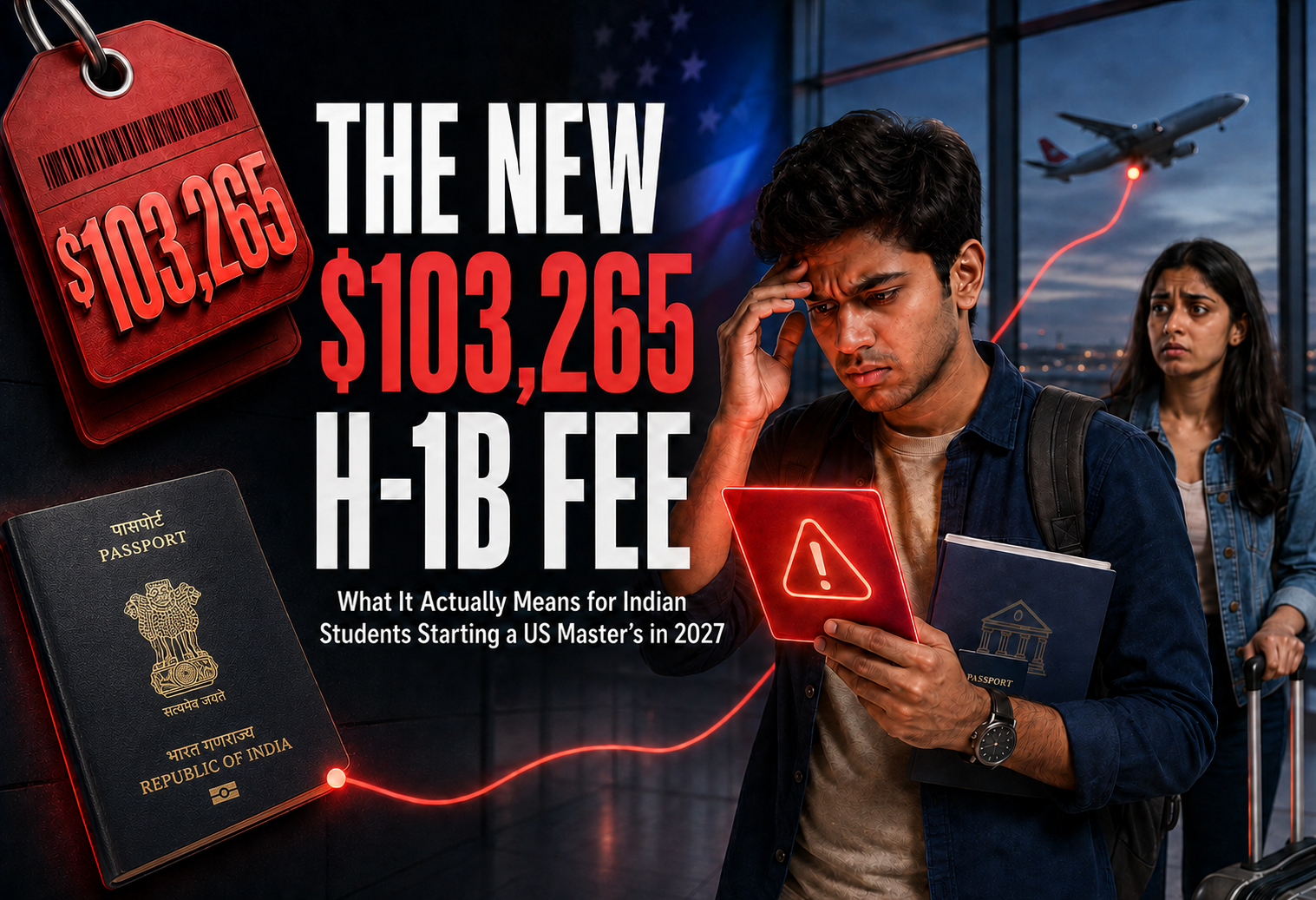
On 25 August 2026 the Department of Homeland Security published a proposed rule that would add a fee of $103,265 to every cap-subject H-1B petition. Within a day the new H-1B fee for Indian students was the only thing anyone in study-abroad WhatsApp groups was talking about, and within two days most of what was being said about it was wrong. This article is the version of the H-1B fee for Indian students story with the paperwork open.
There are two separate six-figure charges in circulation, they work differently, they came from different places, and only one of them has ever had an exemption that protected Indian students. Most of the panic of the last week comes from collapsing the two into one number. So the first job in any honest account of the H-1B fee for Indian students is to pull them apart.
The second job is harder and more useful. If you are a student planning to start a US master’s in 2027, the proposed H-1B fee for Indian students is not a bill you will receive. The H-1B fee for Indian students is a change in the economics of the employer who might sponsor you, roughly two years after you land. That is a real risk and we are not going to soften it. But the H-1B fee for Indian students is a different risk from the one being described, and it responds to different decisions.
Start here, because everything downstream in the H-1B fee for Indian students depends on it. And note before we do why this is so disproportionately an Indian conversation: Indian nationals account for roughly 71 per cent of H-1B approvals. Whatever happens to this visa, the H-1B fee for Indian students included, happens to Indian graduates first and hardest.
The first charge people call an H-1B fee for Indian students is the $100,000 proclamation payment. Presidential Proclamation 10973, signed in September 2025, imposed a $100,000 payment on new H-1B petitions filed on or after 21 September 2025 where the beneficiary was outside the United States and needed to obtain a visa at a consulate. That version of an H-1B fee for Indian students was aimed at entry from abroad. It was not aimed at people already in the country.
That distinction is why the first H-1B fee for Indian students largely left them outside it. A student who finishes a US master’s, works on OPT, and is then sponsored by an employer filing a change of status from F-1 to H-1B without leaving the country was not caught by the proclamation. Federal agency guidance confirmed this repeatedly: current H-1B employees, and people inside the United States for whom a change of status, amendment or extension of stay was filed, were not affected. That is the accurate origin of the “Indian students don’t pay it” message, and it was correct as far as it went.
That first H-1B fee for Indian students has since been struck down. On 8 June 2026 the US District Court for the District of Massachusetts, in California et al. v. Trump, vacated it on four independent grounds, holding it to be an unlawful tax rather than a fee. Judge Sorokin briefly stayed his own order on 12 June, which put the payment back in force while the government sought emergency relief, but on 24 July 2026 the First Circuit refused to stay the judgment, finding the government had not shown it was likely to win on appeal.
So as things stand today the $100,000 payment is not being collected while the merits appeal runs. Separately, the proclamation’s entry restriction was written to last twelve months from 21 September 2025, so it lapses in late September 2026 unless the President extends it.
The second charge, and the one now meant by an H-1B fee for Indian students, is the proposed $103,265 fee. This is not a proclamation. It is a notice of proposed rulemaking published in the Federal Register on 25 August 2026 under DHS Docket No. USCIS-2026-0298, RIN 1615-AD20, with a thirty-day comment window closing on 24 September 2026. The H-1B fee for Indian students is attached to a category of petition, and the category is cap-subject H-1B petitions.
| $100,000 proclamation payment | Proposed $103,265 fee | |
|---|---|---|
| Legal instrument | Presidential Proclamation 10973 | Proposed DHS rule, not yet final |
| Trigger | Beneficiary abroad, petition approved for consular processing or port-of-entry notification | The petition being cap-subject, wherever the beneficiary is |
| F-1 change of status inside the US | Exempt | No exemption written into the proposal |
| Cap-exempt employers | Not the operative distinction | Excluded — universities, non-profit and government research organisations |
| Extensions, amendments, employer changes | Exempt | Excluded |
| Status as at 2 September 2026 | Vacated 8 June 2026; First Circuit refused to stay that judgment on 24 July 2026, so it is not being collected; merits appeal pending and the proclamation itself lapses in late September 2026 unless extended | Comment period open until 24 September 2026 |
| Earliest bite | Was in force from 21 September 2025 until the vacatur took effect | FY 2028 cap petitions, filed from 1 April 2027 |
The figure behind the H-1B fee for Indian students looks arbitrary and it is not. DHS built it by identifying what it says are the annual costs the H-1B programme imposes across six federal agencies, then dividing that total by 85,000 — the statutory annual cap of 65,000 regular visas plus 20,000 reserved for holders of US advanced degrees.
The claimed costs run to roughly $8.78 billion a year. Approximately $3.0 billion is attributed to US Citizenship and Immigration Services, $1.05 billion to Immigration and Customs Enforcement, $76.2 million to Customs and Border Protection, and $2.96 billion to the Executive Office for Immigration Review, which is the immigration court system. Further amounts are attributed to the Departments of State and Labor. Divide that total by 85,000 petitions and the $103,265 H-1B fee for Indian students is what falls out.
You do not need to be a lawyer to see where the H-1B fee for Indian students will be attacked. Nearly three billion dollars of immigration court costs charged to employers sponsoring specialty occupation workers is a long way from anything most people would recognise as a user fee, and the fixed 85,000 denominator assumes a filing volume that the H-1B fee for Indian students itself is designed to suppress.
Immigration practitioners are already framing the challenge in four ways: that this is a tax rather than a fee and therefore beyond the agency’s authority, that the Immigration and Nationality Act does not support it, that it conflicts with appropriations law, and that the cost allocation is arbitrary. A federal court has already struck down one six-figure H-1B charge this year on the first of those grounds.
None of that means the rule behind the H-1B fee for Indian students will fail. It means the honest answer to “is this happening” is that it is proposed, it is contested, and a family planning a 2027 departure should plan for a world in which it survives and be pleasantly surprised if it does not.
The H-1B fee for Indian students is payable by the petitioner. In an H-1B filing the petitioner is the employer, never the worker, so the H-1B fee for Indian students is an employer cost from the first line. That is not a courtesy, it is the structure of the visa: the employer files, the employer signs the labour condition application, and the employer takes on the wage obligations.
US Department of Labor rules already prohibit an employer from passing certain H-1B costs to the employee, including the ACWIA training fee of $750 or $1,500 depending on employer size, and prohibit any deduction that would take the worker’s pay below the required wage. A student should be extremely wary of any employer who proposes to recover the H-1B fee for Indian students or any other six-figure petition cost through a salary reduction, a training bond, or a repayment agreement. Ask a US immigration attorney before signing anything of that shape.
But the fact that you do not pay the H-1B fee for Indian students is not the same as that fee not affecting you, and this is where a lot of well-meaning reassurance has gone wrong over the last week. An H-1B fee for Indian students that lands on the employer changes which candidates the employer will file for. It does not need to reach your bank account to reach your career.
| Item | Amount | Notes |
|---|---|---|
| Electronic registration | $215 per beneficiary | Paid at the March lottery registration, whether or not selected |
| ACWIA training fee | $750 or $1,500 | $750 for employers with 25 or fewer full-time employees; cannot be charged to the worker |
| Fraud prevention and detection | $500 | On initial petitions and change-of-employer petitions |
| Form I-129 filing fee and asylum program fee | Varies by employer size and type | See the current USCIS fee schedule; reduced rates apply to small employers and non-profits |
| Premium processing, if used | Optional | Commonly used for cap cases to get a decision before the October start |
| Attorney fees | Approximately $1,500 to $4,000 | More where a request for evidence is issued |
| Typical total today | Roughly $2,500 to $9,000 | Before any of the new charges |
| Proposed additional fee | $103,265 | Would apply on top of everything above, and on top of any proclamation payment that is in force at the time |
An initial H-1B approval runs up to three years, which is the right frame for the H-1B fee for Indian students. So the sensible way to read the proposed H-1B fee for Indian students is not as a lump sum but as an annual loading on the cost of employing that person, spread over the first term. $103,265 over three years is about $34,400 a year — before the existing fees, before the attorney, and before the salary.
Set the H-1B fee for Indian students against the salary and you get the number that will decide whether a company sponsors freshers at all.
| Annual salary offered | Fee spread per year | Effective loading on cost of employment |
|---|---|---|
| $85,000 | $34,422 | About 41 per cent |
| $110,000 | $34,422 | About 31 per cent |
| $140,000 | $34,422 | About 25 per cent |
| $180,000 | $34,422 | About 19 per cent |
| $250,000 | $34,422 | About 14 per cent |
Look at the shape of that table rather than any individual row, because it is the real distributional story of the H-1B fee for Indian students. The H-1B fee for Indian students is flat, so its bite is entirely a function of what you are worth to the employer. At an entry-level salary it is a 40 per cent surcharge on employing you and it is very hard to justify to a finance committee. At a senior or specialist salary it is an irritant. A flat H-1B fee for Indian students is not neutral. It is a filter, and it filters out exactly the profile that a fresh master’s graduate presents.
Two consequences of the H-1B fee for Indian students follow, and they are the ones to actually plan around. Employers who sponsor in volume will become far more selective about who they file for, which means the informal internal sponsorship you might once have received after a good internship becomes a decision that goes several levels up. And the gap between an employer who sponsors and an employer who does not will widen into a visible line in the job market that you will need to identify before you apply, not after.
While everyone argues about the proposed H-1B fee for Indian students, a rule that is already final and already applied has done more to change a fresh graduate’s odds than anything else this decade.
DHS published the weighted selection final rule on 29 December 2025. It took effect on 27 February 2026 and governed the FY 2027 cap season, whose registration period opened in March 2026.
It replaced the flat random lottery with a system that enters a registration into the pool once, twice, three times or four times according to the Department of Labor prevailing wage level for the offered role: Level I gets one entry, Level II two, Level III three, Level IV four.
Every beneficiary is still counted only once against the 85,000 cap, whatever happens to the H-1B fee for Indian students. What changes is the probability of being drawn.
| Prevailing wage level | Entries in the pool | Projected selection probability | Typical profile |
|---|---|---|---|
| Level IV | 4 | About 61 per cent | Senior or highly specialised roles |
| Level III | 3 | About 46 per cent | Experienced hire, specialist function |
| Level II | 2 | About 31 per cent | A qualified employee with some experience |
| Level I | 1 | About 15 per cent | Entry level. Where most fresh master’s graduates sit |
Two more numbers put that in context. Across FY 2020 to FY 2024, roughly 28 per cent of H-1B petitions were at Level I, about 55 per cent at Level II, 12 per cent at Level III and only 5 per cent at Level IV — so the great majority of the existing population sits in the two bands whose odds have fallen.
And the Penn Wharton Budget Model projected that Level I’s share of selections would drop from about 27 per cent under the random lottery to about 14 per cent under the weighted one, with Level IV’s share rising from about 15.5 per cent to about 26 per cent.
Treat those percentages as projections rather than results. USCIS has not published a wage-level breakdown of FY 2027 selections, and until it does, the honest position is that the direction of travel is certain and the exact numbers are not.
This is the section on the H-1B fee for Indian students that changes most people’s anxiety level, in both directions.
If you start a two-year US master’s in August 2027, you are not in an H-1B lottery in 2027 and you are not in one in 2028. The proposed H-1B fee for Indian students, if finalised, would first apply to petitions filed from 1 April 2027 in the FY 2028 cap season — that is the cohort a full two years ahead of you. Your own first realistic exposure to the H-1B fee for Indian students is March 2029.
| When | What happens |
|---|---|
| August 2027 | Programme begins |
| March 2029 | First possible H-1B registration, for FY 2030 — only if an employer commits before you graduate |
| May 2029 | Graduation |
| June 2029 | Post-completion OPT begins, twelve months |
| March 2030 | Second registration, FY 2031 |
| June 2030 | STEM OPT extension begins for eligible fields, a further twenty-four months |
| March 2031 | Third registration, FY 2032 — STEM fields only |
| March 2032 | Fourth registration, FY 2033 — STEM fields only |
| June 2032 | STEM OPT ends |
The timing of the H-1B fee for Indian students cuts both ways and you should hold both halves at once.
The good half: the rule you are reading about today will have been litigated, finalised, amended or abandoned long before it touches you, and you will make your actual decisions with far better information than anyone has this week. The bad half: by 2029 the system will have settled into whatever shape it settles into, and if a six-figure fee survives, it will be a normal budgeting assumption for every employer you approach rather than a shock they are still absorbing. Do not plan on outrunning the H-1B fee for Indian students.
One further interaction with the H-1B fee for Indian students is worth naming. From 15 September 2026, DHS replaced duration of status with a fixed period of admission for F, J and I nonimmigrants, admitting F-1 students for the length of the programme up to four years, with a thirty-day grace period after completion. How that fixed period interacts with a full thirty-six months of OPT and STEM OPT is a live practical question that designated school officials are still working through. If the United States is on your list, treat your admission end date as a date you must actively manage, not a formality.
This is the question about the H-1B fee for Indian students that matters most, and it is also the one where the honest answer is uncomfortable: the proposal does not say, and that silence is the problem.
The proclamation payment was expressly tied to consular processing, so a change of status filed from within the US fell outside it. The proposed H-1B fee for Indian students is drafted the other way round. It attaches to cap-subject petitions — those filed under the 65,000 regular cap and the 20,000 US advanced degree exemption — and the published proposal contains no carve-out based on where the beneficiary is standing. On the face of the text, an employer filing a change of status from F-1 OPT to H-1B for a graduate sitting in Austin would owe the same $103,265 as an employer filing for a candidate in Hyderabad.
Some practitioners read the H-1B fee for Indian students exactly that way. Others note that DHS has not addressed change-of-status scenarios directly and expect that to be the single most-commented issue in the docket. The H-1B fee for Indian students is not settled, and anyone telling you confidently in either direction this week is guessing.
Two things follow for the H-1B fee for Indian students. First, the comment period closes on 24 September 2026, and comments are how carve-outs get written; universities, employer groups and student bodies are actively filing. Second, when the final rule is published, the specific line to look for is whether it distinguishes consular processing from change of status. That one sentence decides whether a US master’s remains a viable route to US employment for a typical graduate, or becomes a route for the top decile only.
The proposed H-1B fee for Indian students excludes cap-exempt petitions, and so does the cap itself. Universities and their affiliated entities, non-profit research organisations and government research organisations can file H-1B petitions outside the annual lottery entirely, at any time of year, with no registration, no March deadline and no six-figure fee. University medical centres, research institutes, teaching hospitals and affiliated non-profits are a genuinely large employment sector, and one that Indian students routinely overlook because it is not where the campus placement conversation points. If you are doing research-heavy work, this route becomes structurally more attractive with every dollar added to the cap-subject fee.
Against the H-1B fee for Indian students, this is now the most valuable thing on your CV that you can still change. Every step up the prevailing wage ladder roughly doubles, then triples, then quadruples your entries in the pool. Field, specialisation, job title, seniority and metropolitan area all feed the level. A generalist master’s leading to a generic entry-level title is the worst position in the new system, and it is the position most Indian applicants default into. Our guide to the best countries for an MS in AI and data science is a useful companion here, because specialisation is exactly what moves a first offer up a wage band.
A STEM graduate with thirty-six months of OPT can be registered in as many as four consecutive lotteries. Compounding the projected annual probabilities gives a very different picture from a single-year number — provided an employer is willing to keep filing, which is precisely what a six-figure H-1B fee for Indian students puts at risk.
| Wage level | One attempt | Two attempts (non-STEM, 12 months OPT) | Four attempts (STEM, 36 months OPT) |
|---|---|---|---|
| Level I | About 15 per cent | About 28 per cent | About 48 per cent |
| Level II | About 31 per cent | About 52 per cent | About 77 per cent |
| Level III | About 46 per cent | About 71 per cent | About 91 per cent |
| Level IV | About 61 per cent | About 85 per cent | About 98 per cent |
These are arithmetic projections on published probability estimates, not promises, and they assume something that is no longer safe to assume — that the same employer files for you every year. Read the STEM column and the non-STEM column together and you have the clearest single argument for choosing a STEM-designated programme that actually exists.
We would be doing you a disservice to leave this out of any discussion of the H-1B fee for Indian students. If your objective is a master’s that leads reliably to a work permit, the United States is now the most expensive and least certain route to that outcome, and it has been moving in that direction for three years. The UK Graduate Route, Canada’s post-graduation work permit, Germany’s eighteen-month job seeker permission and Ireland’s Stamp 1G all convert a degree into work authorisation without a lottery.
None of them offers American salaries, and salary is a real part of the return, but a probability of 15 per cent is not a plan and 100 per cent of a smaller number frequently beats it. We have compared the two closest alternatives in detail in USA vs Canada for Indian students and UK vs Ireland for Indian students.
If your objective is specifically an American career, or a specific American research group, or a specialisation only a handful of US departments teach, none of the above changes that. Go, and go with the wage level in mind from the first week.
Here is how we would run the numbers on the H-1B fee for Indian students with a family in our office, and we would run it before the deposit, not after.
Take the total cost of attendance for the programme, not the tuition — tuition, living costs for the full duration, insurance, travel, the visa charges and the exchange rate you will actually get. For most two-year US master’s programmes that lands somewhere between fifty and ninety lakh rupees. Then ask three questions.
A US master’s still makes sense for a large number of students, even with the H-1B fee for Indian students. It makes sense for fewer students than it did in 2019, the students it makes sense for are more clearly identifiable than they used to be, and the ones for whom it does not work now find out at the end of a very expensive two years rather than the beginning. The purpose of doing this arithmetic in September 2026 is that it is still cheap to change your mind.
No. The H-1B fee for Indian students, if finalised, is payable by the employer filing the H-1B petition. A student never pays it directly. US Department of Labor rules also restrict an employer from passing certain H-1B costs to the worker or making deductions that take pay below the required wage. Be cautious of any employer proposing a training bond or salary reduction to recover petition costs, and take US legal advice before signing.
No, they are two separate charges often lumped together as the H-1B fee for Indian students. The $100,000 payment came from Presidential Proclamation 10973 and applied to new petitions filed on or after 21 September 2025 where the beneficiary was outside the United States and required consular processing; it was vacated by a federal court in June 2026 and is not currently being collected. The $103,265 H-1B fee for Indian students is a proposed DHS rule published on 25 August 2026 that would apply to cap-subject petitions regardless of where the beneficiary is, and the proposal states it would be in addition to any payment required under a presidential proclamation.
No. The H-1B fee for Indian students is a proposed rule at the notice-and-comment stage, published in the Federal Register on 25 August 2026 under DHS Docket No. USCIS-2026-0298, RIN 1615-AD20. The comment period closes on 24 September 2026. If finalised, it would first apply to cap-subject petitions filed from 1 April 2027 in the FY 2028 cap season.
The published proposal contains no exemption based on the beneficiary’s location, which means on its face it would apply to a change of status filed for a graduate already in the United States. This differs from the $100,000 proclamation payment, which expressly did not apply to change-of-status filings from within the country. DHS has not addressed change-of-status cases directly and this is expected to be the most-commented issue in the docket. Watch for that specific point in the final rule.
Cap-exempt petitions are excluded from the H-1B fee for Indian students, which covers universities and their affiliated entities, non-profit research organisations and government research organisations. Petitions to extend or amend existing H-1B status, and petitions to change an existing H-1B worker to a different employer, are also outside it. The H-1B fee for Indian students applies to petitions under the 65,000 regular cap and the 20,000 US advanced degree exemption.
No. On 8 June 2026 the US District Court for the District of Massachusetts vacated the proclamation payment on four independent grounds in California et al. v. Trump, holding it to be an unlawful tax. The judge briefly stayed his own order on 12 June, but on 24 July 2026 the First Circuit declined to stay the judgment, so the payment is not being collected while the government’s appeal proceeds. The proclamation’s own twelve-month entry restriction also lapses in late September 2026 unless it is extended.
DHS published the weighted selection final rule on 29 December 2025, effective 27 February 2026, and it first governed the FY 2027 cap season. Registrations are entered into the selection pool according to the Department of Labor prevailing wage level for the offered role: Level I once, Level II twice, Level III three times, Level IV four times. Each beneficiary is still counted only once against the 85,000 cap. Projected selection probabilities are roughly 15 per cent at Level I, 31 per cent at Level II, 46 per cent at Level III and 61 per cent at Level IV, against a flat lottery of about 30 per cent previously.
March 2029 at the earliest, for FY 2030, and that is the first point at which the H-1B fee for Indian students could touch them, and only if an employer commits before graduation. For a two-year programme beginning August 2027, graduation falls around May 2029, OPT begins around June 2029, and a STEM graduate with the twenty-four month extension can be registered in as many as four consecutive lotteries between March 2029 and March 2032.
More than ever under the H-1B fee for Indian students. The twenty-four month STEM OPT extension takes a graduate from one or two lottery attempts to as many as four. Compounding the projected annual probabilities, that is roughly the difference between 28 per cent and 48 per cent cumulative odds at Level I, and between 52 per cent and 77 per cent at Level II. Verify the designation on the university’s own CIP code listing before you accept an offer.
It depends on whether the investment survives a lottery loss and the H-1B fee for Indian students. If thirty-six months of OPT at a US salary repays the loan and the credential improves your career even without an H-1B, the decision is sound. If the plan only works with long-term US settlement at the end of it, the probabilities no longer support it and the UK, Canada, Germany or Ireland convert a degree into work authorisation without a lottery. Run the total cost of attendance against both outcomes before you pay a deposit.
The proposed H-1B fee for Indian students is real, it is proposed rather than final, it is contested, and it is not a bill that any student will personally receive. Everything alarming about the H-1B fee for Indian students is second-order: it changes who an American employer is willing to file for, and the profile it prices out first is the one a fresh master’s graduate presents.
The change that has already happened, and that almost nobody in India is discussing alongside the H-1B fee for Indian students, is the wage-weighted lottery. That rule is final, it applied in March 2026, and on the published projections it cuts a Level I graduate’s odds from roughly 30 per cent to roughly 15 per cent. If you are choosing a programme this month, the wage level your first job will sit in is a more consequential decision than anything in the H-1B fee for Indian students proposal, and it is the one you can still change.
A US master’s beginning in 2027 is still the right decision, H-1B fee for Indian students and all, for a student with a specialisation, a STEM designation, a realistic wage band and a plan that survives a lottery loss. It is now a poor decision for a student buying a generic degree on the assumption that the system will sort out the rest. Which of those two you are is knowable today, whatever happens to the H-1B fee for Indian students, and it costs nothing to find out.
Bring your profile, your shortlist and your budget. We will check the STEM designation on every programme, map your realistic wage band and lottery timeline, model what the H-1B fee for Indian students would mean for you, model what happens if the H-1B never comes, and tell you honestly whether the United States is the right country for your objective.
Book a Free ConsultationSources: Federal Register, “Fee for Certain H-1B Petitions,” proposed rule published 25 August 2026, DHS Docket No. USCIS-2026-0298, RIN 1615-AD20, comments due 24 September 2026; USCIS newsroom, “DHS Proposes Additional H-1B Fee”; Federal Register, “Weighted Selection Process for Registrants and Petitioners Seeking To File Cap-Subject H-1B Petitions,” final rule published 29 December 2025, effective 27 February 2026; USCIS, H-1B Electronic Registration Process and FY 2027 cap season alerts;
Presidential Proclamation 10973, “Restriction on Entry of Certain Nonimmigrant Workers,” and subsequent USCIS and Department of State guidance; California et al. v. Trump, US District Court for the District of Massachusetts, order of 8 June 2026, administrative stay of 12 June 2026, and the First Circuit’s order of 24 July 2026 declining to stay the judgment, merits appeal pending.
Penn Wharton Budget Model, projected effects of the weighted H-1B selection rule; USCIS, Characteristics of H-1B Specialty Occupation Workers; US Department of Labor regulations on H-1B fee liability and required wage; DHS Study in the States, final rule establishing a fixed time period of admission, effective 15 September 2026. Figures current as of 2 September 2026. The $103,265 H-1B fee for Indian students is a proposal and may be changed, delayed, withdrawn or enjoined. Verify every figure against the official source before acting on it.
Maven Consulting Services
Bangalore — Jayanagar 9th Block | Malleshwaram | St Marks Road · Belagavi · Dubai

Sunday, October 26, 2025 | The Taj MG Road, Bangalore | 10 AM – 4 PM