WhatsAppCHAT
CALL US& CONNECT

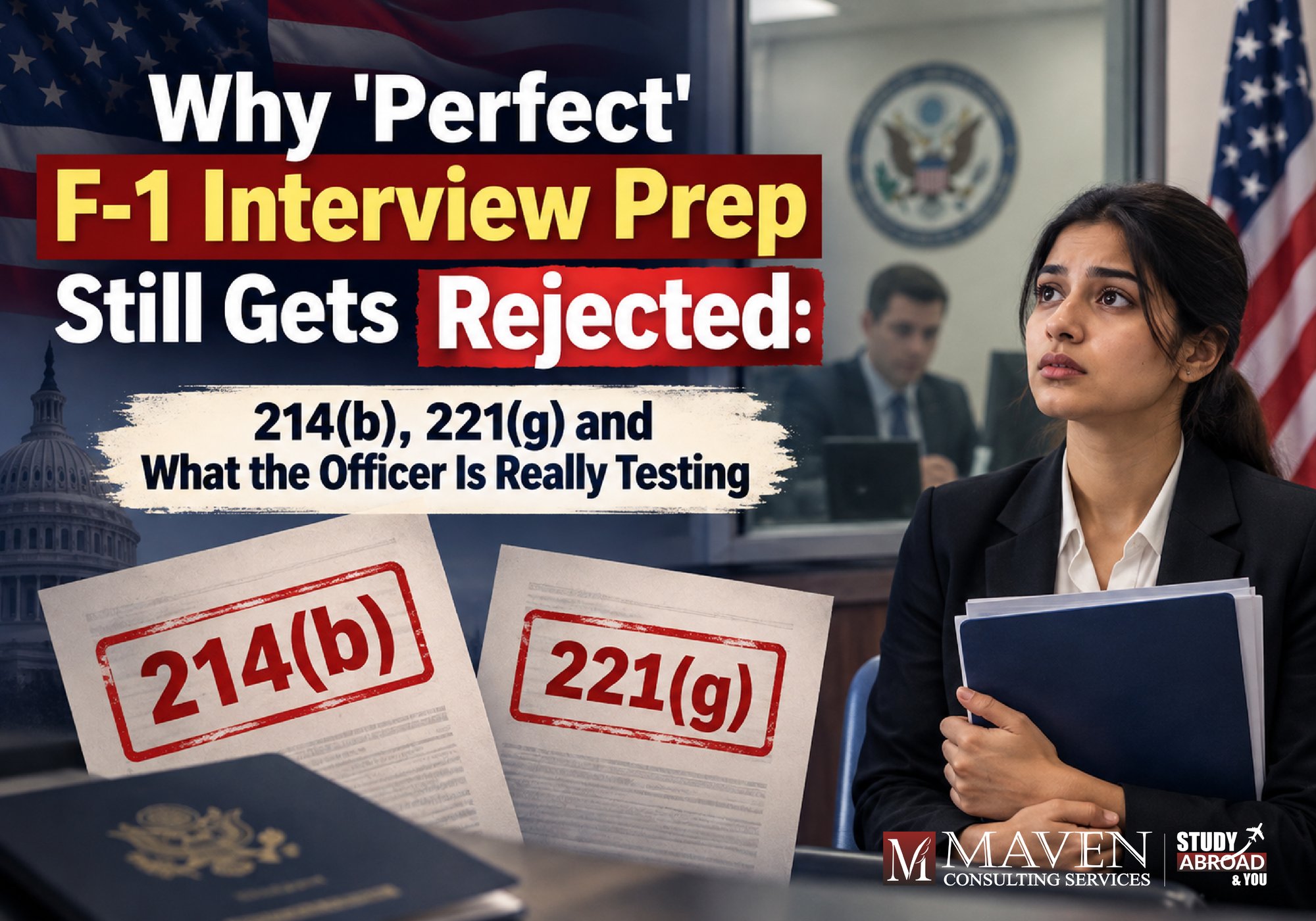
The interview lasted about ninety seconds. Two questions, a passport slid back under the glass, and a slip of paper with a paragraph on it. The student had an admit from a well-known public university, a sanctioned education loan, a folder of original documents in plastic sleeves, and answers she had rehearsed forty times. None of it was looked at.
If that sounds familiar, you are in the right place. This guide explains the real F-1 visa rejection reasons behind that slip: what Section 214(b) and Section 221(g) actually say, what the consular officer is testing in those two minutes, and why a perfectly memorised answer so often does more harm than good. It also covers what has changed since 2025, what happens at the airport after an approval, and what a second attempt has to look like to have a different result.
It matters now because the room has changed. From September 2025 almost every student has to interview in person, applications made outside India are discouraged, and every F-1 applicant is told to set social media profiles to public. For a Fall 2027 cohort booking slots from early 2027, the interview is a harder, faster, more document-aware conversation than the one most prep material still describes. If you are still weighing the destination itself, start with our Study in USA guide and come back to this page once the US is settled.
Almost every refusal an Indian student receives falls under one of two sections of the Immigration and Nationality Act. The State Department’s own visa denials page describes them in one line each.
| Section | What the State Department says it means | What it means for you |
|---|---|---|
| 214(b) | You did not sufficiently demonstrate to the consular officer that you qualify for the visa category you applied for | The officer was not persuaded. There is nothing to submit afterwards. The only route is a fresh application. |
| 221(g) | The consular officer did not have all of the information required to conclude you are eligible | Something is missing or needs checking. You have one year to supply it without paying a new application fee. |
Notice what neither slip says. It does not tell you which answer went wrong. It does not say you lied. It does not say you are banned. A 214(b) slip is a standard printed paragraph, and the officer who handed it to you will usually not add anything.
That silence is the reason so much bad advice circulates. Students fill it with guesses: the officer was in a bad mood, the counter was unlucky, the queue ahead was all refused so the quota was full. None of those explanations helps you, and the quota theory in particular is wrong. There is no daily refusal quota for F-1 visas. There is a legal test, and the file either met it on the day or it did not.
Here is the sentence that decides most F-1 interviews. Section 214(b) says that every applicant for most nonimmigrant visas shall be presumed to be an immigrant until they establish, to the satisfaction of the consular officer, that they are entitled to the nonimmigrant status they are applying for.
Read that slowly, because it reverses the way most families think about the interview. The officer does not start neutral and look for a reason to refuse. The law starts from the assumption that you intend to stay in the United States, and the interview is your chance to displace that assumption. If the officer is not persuaded, the presumption simply stands, and the slip says 214(b).
For a student, “qualifying” has three parts. The State Department’s student visa page lists what you must be able to demonstrate: your academic preparation, your intent to depart the United States when your studies end, and how you will pay all educational, living and travel costs. The underlying definition of an F-1 student also requires a residence in a foreign country which you have no intention of abandoning.
That is why 214(b) is not a punishment and not an accusation. It is the default outcome when the applicant has not carried the burden. It is also why there is no appeal. The State Department says plainly that there is no appeal process, and that if there is additional information or a significant change in circumstances, you may reapply.
Maven Note: A 214(b) refusal is not a permanent mark in the sense most families fear. It does not create a bar on future visas. But it is recorded, the next officer will see it, and the next application has to answer the question the first one did not. Reapplying with the same file and a new set of rehearsed lines is the most common way to collect a second 214(b).
Many Indian students are told that 221(g) “is not a rejection”. That is comforting and legally wrong. The State Department’s administrative processing page states that a refusal under section 221(g) means the applicant did not establish eligibility for a visa. It is a refusal. What makes it different is that it can be reversed without a new application.
A 221(g) usually arrives in one of two forms:
The rule that matters is the clock. According to the State Department, you have one year from the date of refusal to submit the additional information. After that, you must reapply and pay the application fee again.
Three practical points follow. First, your online case status may show “Refused” while the case is in fact still under processing, and that is normal for a 221(g). Second, a 221(g) can end in an issuance or in a 214(b) once the officer has the missing information, so the documents you submit need to be complete and consistent with everything else in your file. Third, if your programme start date is approaching, contact your university’s international office early so they can issue a deferral or a new I-20 if needed, rather than waiting until the week before classes.
| 214(b) | 221(g) | |
|---|---|---|
| Is it a refusal? | Yes | Yes, but it can be reversed |
| Can you submit documents afterwards? | No | Yes, as the letter directs |
| New application fee? | Yes, if you reapply | Not within one year of refusal |
| Appeal? | No appeal process | No appeal; reconsideration on the same case |
| Typical trigger | Officer not persuaded on intent, funding, academics or fit | Missing or unclear document, or further checks needed |
| What to do next | Fix the file, then reapply | Submit exactly what was asked, promptly, and wait |
An F-1 interview looks like a conversation about your degree. Underneath, the officer is checking four things, and every question maps to at least one of them. Once you see the four, the interview stops feeling random.
| What is tested | The question underneath | What holds up | What falls apart |
|---|---|---|---|
| Funding coherence | Does the money story add up, and does it match the paperwork? | One clear source that matches the I-20, the loan sanction letter and the sponsor’s income | Large recent deposits, a sponsor who cannot explain the figures, amounts that do not match the I-20 |
| Academic progression | Is this degree a logical next step from what you have done? | A bachelor’s, work or project history that leads naturally to this master’s | A switch of field with no bridge, or a second master’s with no reason |
| Programme fit | Do you know what you are going to study, and why here? | Specific courses, a lab or a focus area, and a reason this university fits | Rankings, “good exposure”, “best university”, or a course you cannot describe |
| Intent | Is this a study plan, or a migration plan with a university attached? | A career plan you can describe in concrete terms, with a reason to return | Vague plans, or an answer that sounds like the United States is the destination rather than the degree |
The four overlap. A funding answer that does not match the loan letter damages funding coherence and, because it suggests someone else wrote your story, it damages intent too. A programme-fit answer built on rankings suggests you chose the country first and the degree second, which is exactly the pattern 214(b) presumes.
If you have not yet settled the money side, our guide to funding a 2027 master’s from India explains how a sanction letter, collateral and the TCS on remittances fit together, and how a visa officer reads a loan as proof of funds.
This is the part most families find hardest to accept, because rehearsal feels like preparation. It is. But the particular kind of rehearsal most students do, memorising polished answers to a list of fifty questions, fails in a specific way.
A memorised funding answer tends to be a sentence rather than a fact: “My father is sponsoring my education and we have sufficient funds.” The officer asks the natural next question: what does he do, what does he earn, how much is the loan? A student who memorised the sentence but never looked at the numbers pauses. The pause is the problem.
The most rehearsed answer in India is some version of “The university has a world-class faculty, excellent research facilities and great industry exposure.” Officers hear it all day. It names nothing, and it could be said about any university on earth. It tells the officer you have not engaged with the programme, and it invites the obvious follow-up: which course, which professor, which lab?
This is the most damaging one. An officer is trying to work out whether the plan is yours. A script that sounds identical to the last twenty applicants’ suggests the plan came from somewhere else. When the answers are polished but the applicant cannot go one layer deeper on any of them, the officer has no evidence that there is a real plan underneath. The presumption stands.
The fourth area, academic progression, usually survives rehearsal because transcripts speak for themselves. That is exactly why students with strong academics are often surprised by a refusal. The file was strong on the one test that rehearsal cannot damage and weak on the three it can.
Maven Note: The fix is not to stop preparing. It is to prepare facts, not sentences. Know your numbers, your courses and your plan so well that you can answer any follow-up in your own words. If you can explain your plan to an uncle at a family function without notes, you can explain it to an officer.
Before you reach the window, the officer has usually already seen your DS-160, your SEVIS record and whatever your I-20 says. The interview is often a check of whether the person matches the paper.
Three consistency checks cause more refusals than any single answer:
Fill the DS-160 yourself, slowly, and keep a copy. Every answer on it is something you may be asked about. If an agent or relative filled it, read every line before the interview and correct anything that is wrong before your date, not after.
A great deal of interview advice circulating in India was written before 2025. Three changes make it out of date.
| Change | Official position | What it means for a 2027 applicant |
|---|---|---|
| Social media set to public | Announced 18 June 2025: all F, M and J applicants are instructed to set the privacy settings on all social media profiles to “public” | What you have posted is part of your file. Every handle you list on the DS-160 must be accurate. |
| Interview waivers narrowed | From September 2025, nearly all nonimmigrant applicants must appear in person, with narrow exceptions | Plan for an in-person interview even if you held a US visa before. Dropbox routes cannot be assumed. |
| Apply where you live | Applicants should interview in their country of nationality or residence; fees for applications elsewhere are not refunded, and qualifying may be more difficult | Booking a slot in Dubai, Singapore or Bangkok is no longer a workaround for Indian students living in India. |
The State Department’s June 2025 screening announcement put the thinking in one line: “Every visa adjudication is a national security decision.” Its guidance on applying in your country of residence warns that fees for out-of-country applications will not be refunded or transferred.
Two more items are worth knowing about, with honesty about how settled they are. Congress created a USD 250 visa integrity fee in July 2025, payable when a visa is issued and described as refundable to visa holders who comply with their terms. Reports on how and when it is collected at individual consulates have been inconsistent, so check the current fee list on the US Embassy and Consulates in India site when you book. The base application fee remains USD 185, and the SEVIS I-901 fee is USD 350. Our US student visa cost guide breaks those fees down in rupees.
Maven Note: Setting profiles to public is not an invitation to delete your history the night before. Suddenly empty or recently scrubbed accounts can raise their own questions. Review what is there, remove nothing that is simply ordinary life, and make sure every handle on your DS-160 is complete and correct.
Some of the most common refusal triggers are things students do not think of as problems at all.
These are composites built from patterns we see across our counselling desks. They are illustrative, they do not describe real students, and the exact questions will differ at every window.
A computer science graduate with an 8.6 CGPA and an admit to a large public university. Asked “Why this university?”, she said it has world-class faculty and excellent research opportunities. Asked “Which faculty?”, she paused and named the department. Asked who was funding her, she said her father. Asked what he earns, she gave a monthly figure that did not match the income tax returns in her folder. Refused under 214(b). Nothing she said was untrue. None of it was evidence.
A mechanical engineer with two years of work experience. The interview went smoothly, and the officer asked for a detailed CV and a description of the thesis he planned to write. Issued a 221(g) letter listing both. He submitted them within a week, consistent with his SOP and DS-160, and the visa was issued. The refusal was real, but it was a request, and he treated it as one.
A commerce graduate with a 7.1 CGPA and a master’s in supply chain management at a mid-ranked university. Asked why this programme, she named two courses and said her family’s distribution business in Hubballi needed someone who understood cold-chain logistics. Asked who was paying, she said a sanctioned education loan plus her father’s savings, and gave both figures without looking at her folder. Asked what she would do after, she described the business. Issued. The answers were short, specific and hers.
The pattern across all three is the same. The officer was never testing polish. The officer was testing whether the file and the person were telling one consistent, specific story.
After a 214(b), most students want to rebook immediately. Sometimes that is right. More often it produces a second refusal, because nothing the officer saw has changed.
The State Department’s position is simple: reapply if there is additional information or a significant change in circumstances. Before you rebook, you should be able to answer yes to at least one of these:
If the honest answer to all five is no, a new appointment is a new fee for the same outcome. Use the time instead to fix the file. And prepare for the question that almost always comes on a second attempt: “You were refused before. What has changed?” That question deserves a factual answer, not a speech.
If the timeline has slipped past your programme start, talk to your university about deferral early. Our Fall 2027 US application deadline map shows how much room the calendar leaves, and our USA vs Canada comparison for 2027 is worth reading if you are reconsidering the destination.
Founder Perspective
“Every year I meet students who come to us after a refusal carrying a printed list of 150 interview questions with perfect answers typed underneath. They know the answers better than they know their own course.
“What I tell them is uncomfortable: the officer is not grading your English and not grading your confidence. The officer is checking whether you understand your own plan. A student from a small town who says, in plain words, which two courses matter and how the loan works will do better than a student from a top college reciting a paragraph. Our job is not to write your answers. It is to make sure the file is honest and consistent, and then make sure you understand it well enough that you never need a script.”
Rajshekar Tubachi, Founder, Maven Consulting Services
An approved visa is permission to travel to a US port of entry and ask to be admitted. The State Department is explicit that a visa does not guarantee entry: the final decision is made by US Customs and Border Protection when you land.
At the airport, the CBP officer typically confirms that you are the person the visa was issued to, that you are travelling to study at the school on your I-20, and that you are arriving within the permitted window. Students may be admitted no more than 30 days before the programme start date on the I-20. Carry these in your hand luggage, not your checked bag:
The answers CBP hears should match the answers the consulate heard. A student who told the consulate they are studying data science and tells CBP they are joining a cousin’s company has created a problem at the one point where it is hardest to fix. Our Fall 2027 pre-departure guide covers the full travel checklist.
Your electronic Form I-94 is the record of your admission, and you should download it from the CBP I-94 website after every entry and check it against your I-20.
What it says has been in flux. DHS published a final rule on 17 July 2026 replacing “duration of status” with a fixed admission period, due to take effect on 15 September 2026. On 14 September 2026, the US District Court for the District of Massachusetts granted a nationwide preliminary injunction blocking the rule. According to the Presidents’ Alliance litigation tracker, duration of status remains in place while the case continues. F-1 students are still being admitted for duration of status, marked “D/S” on the I-94.
This is a preliminary order, not a final judgment, and the government may appeal. For a student flying in 2027, the practical advice is the same either way: check the admit-until entry on your I-94 after every arrival, and ask your international student office if it does not read D/S or a date you expect. Our duration of status explainer sets out what the fixed-period rule would change if it is ever reinstated.
Here is how we prepare students, in the order we do it. None of it involves memorising answers.
If you are still earlier in the process, the same principle applies to your application itself. Our piece on why a 9.0 CGPA gets rejected and a 7.2 gets admitted makes the same point about admission committees: specific evidence beats polished claims.
Most refusals are under Section 214(b), which means the officer was not persuaded that the applicant qualifies as a student and intends to leave the United States after studying. The usual underlying reasons are a funding story that does not match the documents, a weak or generic reason for choosing the programme, an unclear career plan, and inconsistencies between the DS-160, the I-20 and what the applicant says at the window.
Section 214(b) of the Immigration and Nationality Act presumes every applicant for most nonimmigrant visas is an intending immigrant until they establish otherwise to the consular officer’s satisfaction. A 214(b) refusal means the officer was not satisfied on the day. It is not a ban, there is no appeal, and you may reapply, but a new application should show additional information or a significant change in circumstances.
Legally it is a refusal. The State Department states that a refusal under section 221(g) means the applicant did not establish eligibility for a visa. The difference is that it can be reversed on the same application: you have one year from the date of refusal to submit the information requested without paying a new application fee.
The State Department does not publish a fixed timeframe and says the duration varies with the individual circumstances of each case. Submit what is requested promptly and completely, and if your programme start date is approaching, speak to your university’s international office about a deferral or a new I-20.
There is no mandatory waiting period after a 214(b) refusal. You can book a new appointment and pay a new fee. Reapplying quickly only makes sense if something material has changed, such as clearer funding, a better-matched programme, or corrected inconsistencies. Otherwise the most likely result is a second refusal.
Yes. Since 18 June 2025, the State Department has instructed all F, M and J visa applicants to set the privacy settings on all their social media profiles to public. You must also list your social media handles accurately on the DS-160.
The State Department now expects nonimmigrant visa applicants to interview in their country of nationality or residence. Fees paid for applications made elsewhere are not refunded or transferred, and the State Department warns that it may be more difficult to qualify. For students living in India, the interview should be booked at a US post in India.
No. Memorised answers tend to fail at the first follow-up question and suggest that the plan is not the applicant’s own. Prepare facts instead: your funding figures, your specific courses and reasons for the programme, and a concrete career plan. Then practise answering in your own words with someone who interrupts.
No. A visa allows you to travel to a US port of entry and request admission. US Customs and Border Protection makes the final decision on arrival. F-1 students may be admitted no earlier than 30 days before the programme start date on their I-20.
Not at the moment. DHS published a final rule to replace duration of status with a fixed admission period from 15 September 2026, but on 14 September 2026 a federal court in Massachusetts granted a nationwide preliminary injunction blocking it. Duration of status remains in place while the litigation continues, and the position could change if the order is appealed.
The real F-1 visa rejection reasons are rarely about English or confidence. A 214(b) refusal means the officer was not persuaded on funding, academics, programme fit or intent, and the law presumed you were an immigrant until you showed otherwise. A 221(g) is also a refusal, but one you can fix within a year by supplying what was asked. Rehearsed answers fail because they damage three of the four things being tested. Prepare facts, make your file consistent, answer in your own words, and reapply only when something has actually changed.
Send us your DS-160, I-20, funding documents and, if you have one, your refusal slip. We will read the file the way an officer does, tell you honestly what it says, and prepare you on facts rather than scripts. Maven Consulting Services has guided more than 10,000 students across 700-plus university partners in 20-plus countries, with a 99.8 per cent visa success rate and a commission-free model.
WhatsApp | Bengaluru, Karnataka · Instagram · LinkedIn · YouTube
<< Previous Blog | Next Blog >>
Sources: US Department of State, Visa Denials; US Department of State, Administrative Processing Information; 8 U.S.C. § 1184(b) (INA § 214(b)); US Department of State, Student Visa page; US Department of State, Announcement of Expanded Screening and Vetting for Visa Applicants, 18 June 2025; US Department of State, Adjudicating Nonimmigrant Visa Applicants in Their Country of Residence; US Department of State, Interview Waiver Update, September 2025; US Customs and Border Protection, I-94 website; Presidents’ Alliance, duration of status litigation tracker (order of 14 September 2026, US District Court for the District of Massachusetts). Figures current as of 23 September 2026. This article is general information for Indian students and families, not legal advice.

Sunday, October 26, 2025 | The Taj MG Road, Bangalore | 10 AM – 4 PM