






The Real Cost of a US Student Visa in 2026: SEVIS, MRV, Visa Integrity Fee & the $100K H-1B Question, Explained
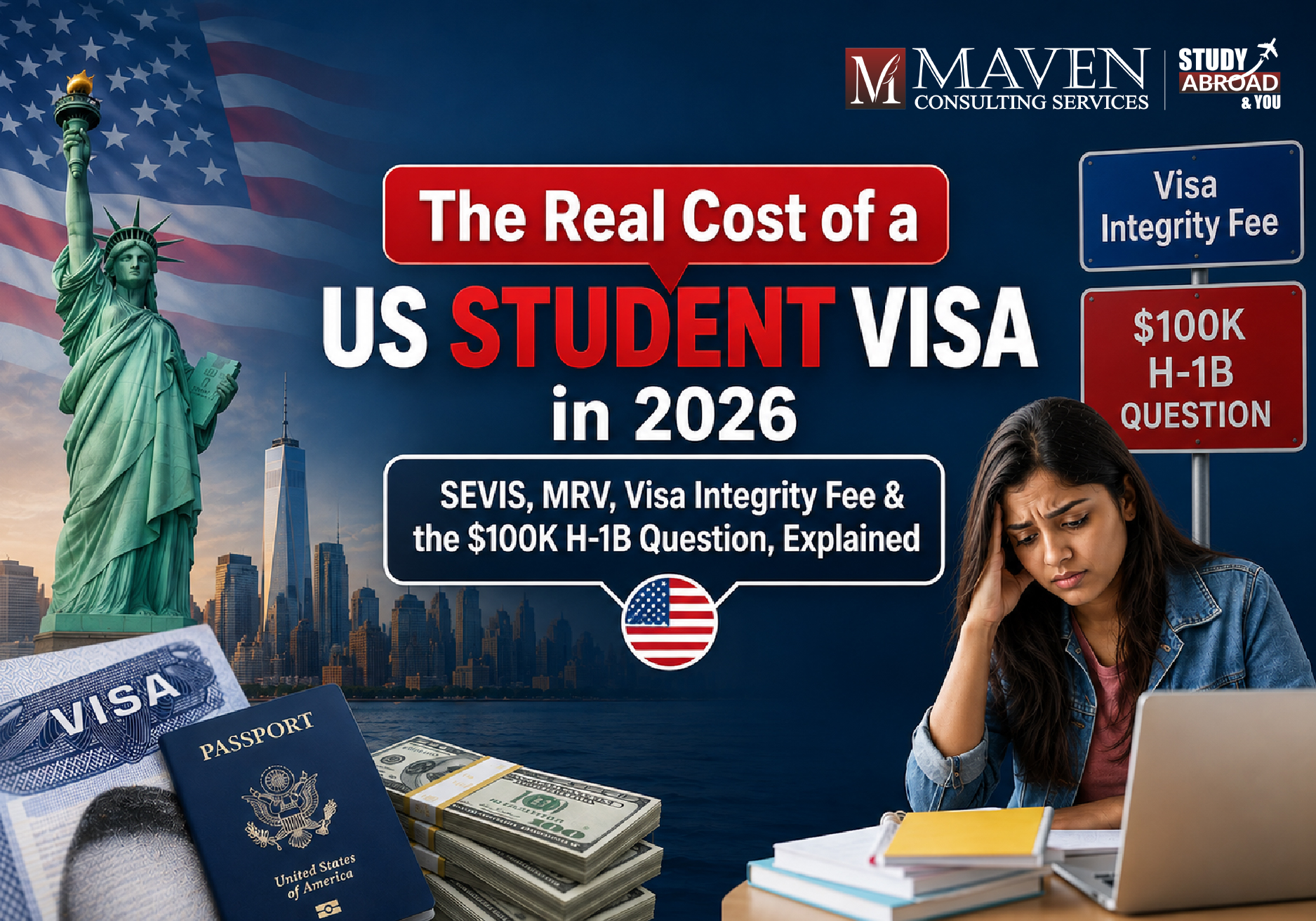
Ask five Indian students what a US student visa costs and you’ll get five different numbers — because most of them are only counting one fee out of three. In 2026, getting an F-1 visa stamped in your passport involves the SEVIS I-901 fee, the MRV application fee, and — for the first time — a new Visa Integrity Fee that most competitor blogs still haven’t updated their numbers for. And once you’re past the visa stage and thinking about post-study work, there’s the small matter of the $100,000 H-1B fee that made headlines last year and has been tangled in court ever since.
This blog lays out every fee, in order, in plain numbers — and tells you honestly which parts are settled and which parts are still moving.
Who This Blog Is For:
- Indian students who’ve received or are expecting a US F-1 visa interview slot for Fall/Spring 2027
- Parents budgeting the pre-departure visa costs, separate from tuition and living expenses
- Students who’ve heard about the “$100K H-1B fee” and want to know if it affects them
What This Blog Covers:
- The SEVIS I-901 fee — amount, when it’s paid, and why it’s non-refundable
- The MRV (visa application) fee and how it differs from SEVIS
- The new Visa Integrity Fee — what it is, and the honest state of its rollout
- Your total US student visa cost, in a simple table, in both USD and INR
- Why “my university waived a fee” doesn’t mean “my visa is cheaper”
- The $100,000 H-1B fee — who it actually applies to, and its current legal status
Fee #1: The SEVIS I-901 Fee
Every F-1 applicant pays the I-901 SEVIS fee before their visa interview. It funds the Student and Exchange Visitor Information System (SEVIS) — the database that tracks your status once you’re admitted. As of 2026, the F-1 SEVIS fee is $350 (₹33,425 approx.), unchanged since a 2019 fee rule raised it from $200.
A few things students get wrong about this part of their US student visa cost:
- It’s paid to ICE/SEVP directly through FMJfee.com — not to the US embassy, and not through your university.
- It is non-refundable, even if your visa is later denied.
- Continuing students generally don’t pay it again unless they change SEVIS records, get a new I-20 for a fresh program, or return to F-1 status after a long absence.
- Only pay through the official portal — SEVP has repeatedly warned about phone scammers posing as fee collectors.
Fee #2: The MRV (DS-160) Visa Application Fee
The Machine Readable Visa (MRV) fee is the separate, standard nonimmigrant visa application fee paid to the US Department of State when you schedule your interview. For F-1 applicants, it’s currently $185 (₹17,668 approx.). Like the SEVIS fee, it’s non-refundable — you pay it whether your visa is approved or denied, because it covers the cost of processing the application, not the outcome.
Fee #3: The New Visa Integrity Fee
This is the fee most students haven’t budgeted into their US student visa cost, because it’s genuinely new. Created under the “One Big Beautiful Bill Act” signed in July 2025, the Visa Integrity Fee adds $250 (₹23,875 approx.) on top of the MRV fee for most nonimmigrant visas, including F-1. Unlike the other two fees, it’s collected at the point your visa is issued, not when you apply — so if your visa is denied, you don’t pay it.
Maven Note: Here’s what most blogs get wrong about this fee. Its rollout has genuinely been uneven — some consulates have been collecting it since late 2025, others took longer to bring their payment systems online. By mid-2026, most posts processing F-1 visas — including in India — are collecting it as a standard part of visa issuance.
The law also allows for a refund if you fully comply with your visa terms and depart on time, but DHS has not yet published the actual refund process. Until that process exists, budget the fee as a real, non-recoverable cost — treat any future refund as a bonus, not a plan.
Your Total US Student Visa Cost Breakdown
Put together, here’s what an F-1 applicant is realistically paying the US government before ever boarding a flight:
| Fee | Amount (USD) | Approx. INR* | Refundable? |
|---|---|---|---|
| SEVIS I-901 Fee | $350 | ₹33,425 | No |
| MRV / DS-160 Application Fee | $185 | ₹17,668 | No |
| Visa Integrity Fee | $250 | ₹23,875 | Possibly, later — process not yet published |
| Total | $785 | ₹74,970 | — |
*INR conversion approximate at ~₹95.5/USD (August 2026); exchange rates fluctuate — check the live rate before you pay. This table doesn’t include VFS Global service charges, courier fees, or SEVIS-linked bank transfer charges, which add a few thousand rupees more depending on payment method.
Admission Fees vs. Visa Fees — Don’t Confuse the Two
This is a distinction we keep coming back to at Maven when families ask us to break down their real US student visa cost, because it trips up so many families: a university waiving your application fee, or offering a scholarship, has nothing to do with what the US government charges you for the visa.
Your I-20 fee, tuition deposit, and enrollment confirmation deposit are paid to your university. SEVIS, MRV, and the Visa Integrity Fee are paid to the US government. Getting a full scholarship doesn’t reduce your SEVIS fee by a rupee — the two budgets are completely separate, and treating them as one is the single most common cost-planning mistake we see. For more on separating these two budgets properly, see our Forex, SIM, Bank & Insurance Pre-Departure Guide.
The $100,000 H-1B Question: Does It Affect You?
In September 2025, a presidential proclamation introduced a headline-grabbing $100,000 fee on certain new H-1B petitions. It triggered panic among students who assumed it meant their entire post-study work plan just got $100,000 more expensive. It didn’t — for most F-1 students, this fee was never the threat the headlines suggested.
Maven Note — the part everyone gets wrong: The $100,000 fee was written to apply only to new H-1B petitions for workers based outside the US, filed through consular processing. USCIS guidance issued in October 2025 explicitly confirmed that a change of status — the pathway almost every F-1 student uses, moving from F-1/OPT to H-1B without leaving the country — is exempt. If your employer files your H-1B petition while you’re still in the US on OPT or STEM OPT, this fee does not apply to you.
There’s also a second layer worth knowing: the fee has been in and out of legal limbo since it was announced. A federal court in Massachusetts struck it down as unlawful in June 2026, and a federal appeals court declined to reinstate it while the government’s appeal continues — meaning that, as of this writing, the fee is not currently being enforced even for the consular-processing cases it was designed to target. A separate case in another circuit has gone the opposite way, so this is genuinely unsettled law, not a closed chapter. Verify the current status with your employer’s immigration counsel before assuming either outcome.
The practical takeaway for an incoming F-1 student: this fee, in its current form, is not something you need to factor into your visa-stage budget at all. It’s an employer-side, post-OPT, consular-processing issue — and even there, its future is being decided in court, not on a fixed timeline. For the fuller post-study work picture, see our PR After Study Abroad guide.
Founder Perspective — Rajshekar Tubachi: Every intake, I see students do one of two things with US student visa cost news like this: panic and assume the worst-case number applies to them, or ignore it completely because “it’s probably not relevant.” Neither is right. The honest answer is almost always more specific and more boring than the headline — read past the number to who it actually applies to before you let it change your plans.
Frequently Asked Questions
Is the Visa Integrity Fee refundable?
Potentially, as part of your overall US student visa cost, if you fully comply with your visa terms and depart the US on time — but DHS has not yet published the process for claiming that refund. Treat the $250 as a real cost when budgeting, not a deposit you’ll get back.
Does the $100,000 H-1B fee apply to me if I’m on OPT?
No. It applies only to new H-1B petitions filed for beneficiaries outside the US through consular processing. A change of status filed from inside the US — the standard OPT-to-H-1B route — is exempt. The fee is also currently blocked in court pending appeal, adding a further layer of “not applicable right now” on top of the exemption.
How much does an F-1 visa cost in total, in INR?
Your total US student visa cost — SEVIS, MRV, and the Visa Integrity Fee combined — is roughly $785, or approximately ₹74,970 at current exchange rates. Add VFS service charges and courier/bank fees, and the real out-of-pocket figure runs a little higher.
Do I need to pay the SEVIS fee again if I renew my visa?
Generally no — this part of your US student visa cost applies only once, as long as you’re continuing on the same SEVIS record. You would typically pay it again only if you get a new I-20 for a different program, change status, or return to F-1 after a significant absence.
The Bottom Line
Your US student visa cost in 2026 is higher upfront than it was two years ago — mainly because of the new Visa Integrity Fee stacking on top of SEVIS and MRV. That’s a real, budgetable number: roughly $785 in government fees alone. What it doesn’t cost more of, despite the headlines, is your post-study H-1B plan — for the overwhelming majority of F-1 students moving through OPT to a change of status, the $100,000 fee simply doesn’t apply, and right now it isn’t even being enforced for the cases it does target. Budget the real numbers, not the scariest ones.
Want an honest, line-by-line cost breakdown for your specific US visa timeline?
WhatsApp | Bengaluru, Karnataka | Instagram | LinkedIn | YouTube
Read More
- US Ends “Duration of Status”: What DHS’s New 4-Year F-1 Rule Means for Indian Students
- Is the US Still Worth It for Indian Students in 2026?
- Student Visa Interview Prep: What Indian Applicants Need to Know
- Forex, SIM, Bank & Insurance: The Pre-Departure Checklist
Previous Blog: Common App Opens August 1: The Fall 2027 US Undergrad Roadmap | Next Blog: UK January 2027 Intake: What Changed Under HC 259