WhatsAppCHAT
CALL US& CONNECT

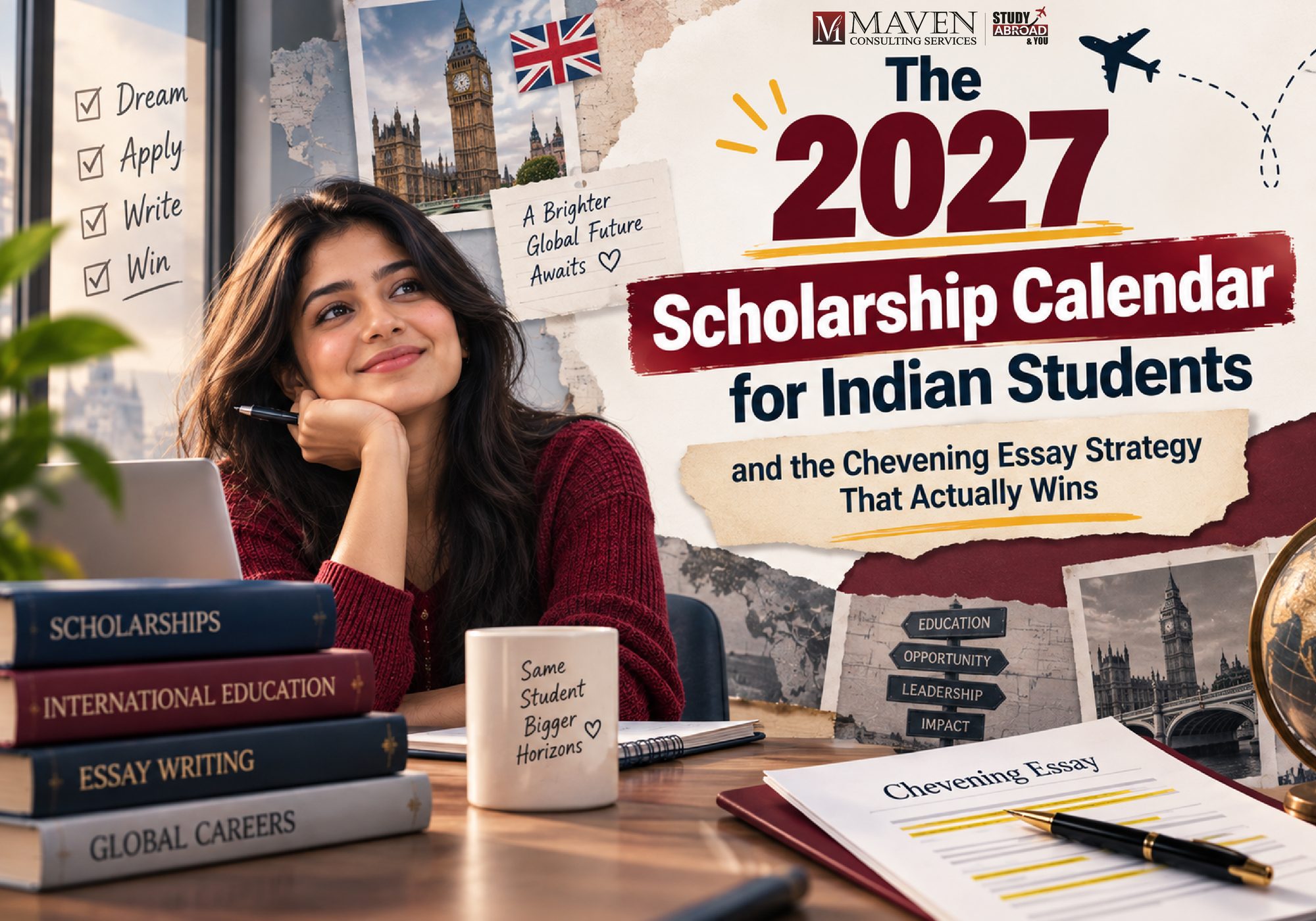
Chevening 2027/28 closes on 6 October 2026 at 11:00 UTC, which is 4:30 pm in India. If you are reading this on the day it goes live, you have eleven days. Stanford’s Knight-Hennessy Scholars programme closes the same day. After that, the next big group of deadlines arrives between December and January.
This guide covers the scholarships for Indian students 2027 applicants can still realistically win, set out as a dated calendar: what opens when, what closes when, and which awards have already closed for a 2027 start. The second half is about Chevening in particular, because it is the award most Indian professionals ask us about and the one where the essays decide almost everything.
It matters now because the scholarship calendar runs about a year ahead of the admissions calendar. A student who starts looking for funding after the admits arrive in March has already missed most of it. If the UK is on your list, our Study in UK guide and our UK vs Ireland comparison for 2027 cover the country decision itself.
Jump to: The 2027 scholarship calendar · The Chevening essay strategy
Chevening is the UK government’s international scholarship programme. It pays for a one-year master’s at any UK university: tuition, a monthly living allowance, a return economy flight and visa costs. India has the largest Chevening programme in the world. According to the British High Commission’s announcement of 4 August 2026, more than 4,000 Indians have received the award since 1983, and in the 2026 cohort 68 per cent of scholars were women and more than 75 per cent came from tier 2 and tier 3 cities. Karnataka is one of the state governments that partners with Chevening in India.
The 2027/28 round opened on 4 August 2026 and closes on 6 October 2026 at 11:00 UTC. With eleven days left, be clear about what can and cannot be fixed in that time.
| Can still be fixed by 6 October | Cannot be fixed by 6 October |
|---|---|
| Your four essays, which is where most of the marks are | A shortfall in the 2,800 hours of work experience |
| Your three UK course choices | Your citizenship or eligibility to return to India for two years |
| The clarity of your employment history and dates | A degree that does not qualify you for UK postgraduate study |
| Proofreading every field before you submit | An ineligibility such as current or recent UK government employment |
Source: Maven summary of the eligibility criteria on chevening.org, checked 22 September 2026.
If you are eligible and have a draft, use the time on the essays. If you are short of the work experience, do not force an application. Use the year to build the evidence the essays need, and apply for 2028/29, which on past patterns will open in early August 2027.
Maven Note: Submit by 4 October, not 6 October. The deadline is 4:30 pm IST, not midnight, and the application portal is at its slowest in the last 48 hours. We have seen good applicants miss the deadline over a failed upload on the final afternoon.
The table below lists the major awards Indian students ask us about, with the dates that apply to a 2027 start where they have been published. Where an award has not yet announced its 2027 dates, we say so and show the last cycle’s pattern instead. Always check the official page before you plan around a date. Scholarship bodies can and do move their deadlines.
| Award | Where you study | Application window | For which intake | What it pays |
|---|---|---|---|---|
| Chevening | UK, one-year master’s | Opened 4 Aug 2026; closes 6 Oct 2026, 4:30 pm IST | Sept/Oct 2027 | Tuition, monthly stipend, return flight, visa costs |
| Knight-Hennessy Scholars | Stanford, any graduate degree | Closes 6 Oct 2026, 1:00 pm Pacific (1:30 am IST, 7 Oct) | Autumn 2027 | Full funding for the Stanford degree |
| DAAD EPOS | Germany, development-related master’s | Set by each course; many close between August and October 2026 | Winter 2027 | €992 a month for graduates, plus allowances |
| Commonwealth Master’s | UK | 2027/28 dates not yet confirmed; apply through the Ministry of Education and the CSC | Sept 2027 | Tuition, stipend, flights |
| Erasmus Mundus Joint Masters | Two or more European countries | Set by each programme; most between October 2026 and January 2027 | Sept 2027 | Tuition, a monthly allowance, travel and visa costs |
| Gates Cambridge | Cambridge | 8 Dec 2026 or 6 Jan 2027, depending on the course | Oct 2027 | Full cost of study |
| Clarendon Fund | Oxford | No separate form; apply to the course by its December or January deadline | Oct 2027 | Full cost of study |
| France Excellence Eiffel | France | Nominated by the French institution; last cycle’s deadline was 8 Jan 2026 | Sept 2027 | Monthly allowance and other benefits |
| GREAT Scholarships | UK, participating universities | Set by each university, usually spring | Sept 2027 | At least £10,000 towards tuition |
| Government of Ireland IES | Ireland | Last call closed 12 Mar 2026 | Sept 2027 | €10,000 stipend and a full fee waiver |
| Inlaks Shivdasani | Top universities in the UK, Europe and the US | 2026 round closed; the next window usually runs in the first months of the year | Autumn 2027 | Up to USD 120,000 |
| K. C. Mahindra | Any recognised postgraduate course abroad | Last deadline 30 Apr 2026 | Aug 2027 to Feb 2028 | Interest-free loan scholarship, up to ₹10 lakh |
| J. N. Tata Endowment | Any recognised postgraduate course abroad | Usually early in the year | 2027 | Merit-based loan scholarship |
| Fulbright-Nehru Master’s | USA | No 2027/28 master’s round listed as of 22 Sept 2026 | Fall 2028 at the earliest | Tuition, living costs, J-1 visa, airfare |
| Rhodes Scholarship for India | Oxford | 2027 round closed 23 Jul 2026 | Oct 2028 (next round) | Full cost of study |
Source: Official pages of each scholarship body, checked 22 September 2026. Rows marked ‘last cycle’ show the previous pattern, not a confirmed 2027 date.
Two things stand out. First, 6 October is a double deadline: Chevening and Knight-Hennessy close on the same day. Second, the two awards families most often mention first, Fulbright-Nehru and Rhodes, are not available for a Fall 2027 start. We explain why further down.
Maven Note: The Swedish Institute’s Scholarships for Global Professionals are left out on purpose. Eligibility depends on a country list that changes from year to year, and we could not confirm from the official page that India is on the 2027 list. If Sweden is on your shortlist, check that list first.
Scholarship deadlines sit on top of admissions deadlines, so this plan runs alongside our Fall 2027 US application deadline map. If you are applying to both the UK and the US, keep the two calendars side by side.
That 8 July date surprises many applicants. A Chevening award is conditional on an unconditional offer, so final transcripts, English test scores and degree certificates have to reach the university in time. Plan for that in January, not in June.
Many scholarship lists online still show these awards as open for 2027. They are not, and applying for them is the most common planning mistake we see.
The USIEF page for the Fulbright-Nehru Master’s Fellowships still describes the 2026–2027 round, which closed on 14 May 2025. As of 22 September 2026, USIEF has listed 2027–2028 rounds for its doctoral and professional fellowships but not for the master’s fellowship. Those rounds closed in July 2026. In practice, this means there is no Fulbright-Nehru master’s route for a Fall 2027 start. It requires at least three years of full-time paid work experience, so if you qualify, plan for the next announced round, which on past patterns would mean applying about fifteen months before you start.
The Rhodes Trust’s India page shows that the round for Oxford 2027 opened on 1 June 2026 and closed on 23 July 2026. There are five Rhodes Scholarships for India each year. The next round, for 2028, should open around June 2027.
The opposite mistake also happens. The Inlaks Foundation says its 2026 round has closed, which some websites report as ‘closed for 2027’. Inlaks funds study that starts in the same year you apply, so a Fall 2027 applicant applies in the 2027 round, early next year. The 2026 round required applicants to be born on or after 1 January 1996. Check the age limit again when the 2027 round opens.
Maven Note: A simple test for any scholarship you find online: open the official page and look for the academic year. If it says 2026–27 and today’s date is past the deadline, you are looking at last year’s round, not this year’s.
A family that hears ‘scholarship’ usually imagines a free degree. Some awards do pay for everything. Many pay a fixed sum towards tuition, and a few Indian ‘scholarships’ are loans you repay. The distinction matters because it changes how much you still need to borrow.
| Type | Examples | What it usually covers | What you still pay |
|---|---|---|---|
| Fully funded | Chevening, Commonwealth, Gates Cambridge, Clarendon, Knight-Hennessy, Rhodes | Tuition, living stipend, flights, often visa costs | Pre-arrival costs, and anything above the stipend in an expensive city |
| Stipend and fee waiver | Erasmus Mundus, Government of Ireland IES, DAAD EPOS | Tuition or a fee waiver, plus a fixed monthly amount | Any gap between the stipend and your actual rent |
| Partial tuition award | GREAT Scholarships, most university merit awards | A fixed amount, for example £10,000 off tuition | The rest of the tuition and all living costs |
| Loan scholarship | K. C. Mahindra, J. N. Tata Endowment | A sum lent on favourable terms | The full amount, repaid later |
Source: Maven classification from each scholarship body’s published terms, checked 22 September 2026.
For the full cost that a partial award is taken off, see our line-by-line cost of a master’s abroad in 2027. A £10,000 GREAT award is worth a great deal, but on a UK master’s that costs well over ₹50 lakh in total, most of the bill remains.
Most money for international master’s students comes from universities, not from governments, and it follows a rule many applicants do not know: you are considered for most university scholarships only if you apply for the course by an early deadline. Apply in March and the course may still have places, but the scholarship money is usually gone.
A strong academic profile helps with all of these, but a high CGPA is not the whole story. Our post on why a 9.0 CGPA gets rejected and a 7.2 gets admitted explains what selection committees weigh besides the number.
DAAD’s Development-Related Postgraduate Courses (EPOS) fund master’s programmes at German universities with a development focus: public policy, environmental governance, public health, engineering for developing economies and similar fields. You apply to the course, not to DAAD, and each course sets its own deadline. One example: Freiburg’s Environmental Governance programme took applications for its 2027/28 intake from 15 June to 15 October 2026. EPOS requires at least two years of relevant work experience after your first degree, and graduates receive €992 a month. The current list of courses is in the DAAD scholarship database.
A DAAD scholarship does not remove Germany’s other steps. You will still need your APS certificate and, for many courses, the new admission test. Our dMAT or APS for Germany 2027 guide covers both.
An Erasmus Mundus Joint Master’s is taught by a group of universities in at least two European countries, and the programme itself awards the scholarships. According to the European Commission’s Erasmus+ page, most applications are due between October and January for programmes starting the following autumn. The scholarship covers participation costs and contributes to travel, visa and living costs. The programme pages we checked list a monthly allowance of €1,400. There are more than a hundred programmes, so shortlisting two or three that match your degree is better than applying widely.
Chevening’s reading committees only see applications that pass an eligibility check first. For 2027/28, the check runs from October 2026. These are the points where Indian applications most often fail.
| Requirement | What it means in practice | Where applicants go wrong |
|---|---|---|
| 2,800 hours of work experience | About two years of full-time work. Part-time work, internships and voluntary work can count. | Counting college internships the portal will not accept, or giving vague dates |
| Return to India for two years | You must commit to living in India for at least two years after the course. | Planning a UK Graduate Route job at the same time. The two plans conflict. |
| Three different UK courses | You apply with three eligible one-year master’s choices. | Picking three near-identical courses, or courses longer than one year |
| Unconditional offer by 8 July 2027 | Your final transcripts and test scores must reach the university in time. | Waiting until after the interview to apply to universities |
| Indian citizenship | The Chevening India programme is for Indian citizens. | Applying as an OCI cardholder, which is not Indian citizenship |
Source: Chevening eligibility guidance and the 2027/28 application timeline, checked 22 September 2026.
The full 2027/28 timeline is on Chevening’s application timeline page: reading committees assess applications from mid-October 2026 to January 2027, shortlists are published in mid-February 2027, interviews run from March to April 2027, and results follow from mid-June 2027.
Chevening’s essay answers used to be up to 500 words each. The limit is now 300. The Institute of Development Studies at the University of Sussex, which hosts Chevening scholars, pointed out the change in September 2025. Chevening does not publish the exact questions or limits on its public pages. They appear in the application form, so check the limit shown in your own form.
Losing 200 words changed what a good essay looks like:
A structure that fits into 300 words: about 40 words of context, 160 to 180 words on what you did, 60 words on the result with a number, and a final 20 to 30 words linking it to what comes next.
The application asks about four areas. Read each as a question the committee is really asking, not as a topic to write about.
Chevening is not looking for a job title. It wants a moment when you moved people who did not report to you: a supervisor, a village panchayat, a client team, a group of volunteers. The strongest answers show resistance and how you overcame it. An essay where everyone agreed with you from the start shows administration, not leadership.
This is the essay Indian applicants find hardest, because ‘networking’ sounds like collecting LinkedIn contacts. Chevening wants to see a relationship you built, what it produced, and how you would use the Chevening network the same way. Name the kind of people you would seek out in the UK and why. Avoid the vague promise to ‘connect with like-minded leaders’.
Each of your three choices should be justified by modules, faculty or a specific feature of the course, and all three should point to the same career goal. A committee that sees an MBA, an MSc in Data Science and an MA in Public Policy will conclude you do not yet know what you want. Three versions of the same subject at different universities are what they expect to see.
This essay is tested hardest because of the two-year return commitment. A good career plan has a short-term step you can take within two years of returning, a named sector or organisation type, and a long-term aim that follows from it. ‘I want to contribute to India’s growth’ does not count as a plan. ‘I want to lead the groundwater subsidy audit in my district’ does.
The difference between a shortlisted essay and a rejected one is rarely the story. It is whether the story is told as a claim or as evidence. Both examples below are composites written for this guide, not real applicants’ essays.
Before (claim)
I am a natural leader who is passionate about driving change. At my company I have led several initiatives and always motivated my team to deliver excellent results. I believe true leadership is about inspiring people to reach their potential.
After (evidence)
In 2024, our Hubballi foundry was rejecting one casting in nine. As the most junior engineer on the floor, I asked to lead a four-person fix. The shift supervisors refused to add an inspection step until I showed them six weeks of scrap data broken down by shift, which traced most defects to one furnace changeover. By March 2025 rejections were down to one in twenty-five, and the plant now uses our checklist on two more lines.
The first version uses about 45 words and proves nothing. The second uses about 80 and shows a problem, resistance, a method, a number and a lasting change. It never uses the word ‘leader’.
Before (claim)
After completing my Chevening scholarship, I will return to India and contribute to sustainable development. I want to help my country grow and make a positive impact on society.
After (evidence)
I process around 400 solar-pump subsidy claims a year for my district’s agriculture office in Karnataka, by hand. Nobody measures whether the pumps reduce groundwater use. Within two years of returning, I aim to lead an audit that does. A one-year MSc in Environmental Economics would give me the cost-benefit methods to show which subsidies work. In ten years, I want to advise the state on water pricing.
The second version gives the committee something to test at interview. It is specific enough to be wrong, which is exactly why it is believable.
Founder Perspective
“Every Chevening season we read drafts from people with remarkable careers who describe themselves in words anyone could have written. ‘Passionate’, ‘driven’, ‘a natural leader’. The committee has read those words thousands of times. What it has not read is your foundry, your district, your 400 claims. I tell every applicant the same thing: if a sentence could appear in someone else’s essay, cut it. Keep the sentences only you could write. And please, do not let a chatbot write your first draft. It produces exactly the polished, generic prose that reads as a claim, not evidence, and at interview the panel can tell within minutes whether the essay and the person match. Write it badly in your own words first. We can make it tight. We cannot make it yours.”
Rajshekar Tubachi, Founder, Maven Consulting Services
| Stage | Dates for 2027/28 |
|---|---|
| Applications close | 6 October 2026, 11:00 UTC (4:30 pm IST) |
| Eligibility checks | From October 2026 |
| Reading committees assess applications | Mid-October 2026 to January 2027 |
| Shortlisted candidates invited to interview | Mid-February 2027 |
| Interviews | March to April 2027 |
| Documents uploaded | At least seven working days before your interview |
| Results | From mid-June 2027 |
| Deadline for an unconditional UK offer | 8 July 2027, 17:00 UK time |
| Course starts | September or October 2027 |
Source: Chevening application timeline, checked 22 September 2026.
Use the months between October and February well. Apply to your three universities by December, book your English test if your courses need one, and prepare for the interview as soon as the application is in. The interview tests whether the person matches the essays, so re-read yours before you prepare anything else.
Most Indian students who win an award still need other funding, either because the award is partial or because the stipend does not cover a year in London. The timing is awkward. Many partial awards are decided between March and June, while an education loan for a Fall 2027 intake is usually sanctioned between March and May.
The practical answer is to apply for a loan sanction that covers the full cost and draw only what you need once the scholarship is confirmed. You pay interest only on what the lender actually disburses. Our guide to funding a 2027 master’s from India explains the sanction, the visa rules and the 2 per cent TCS in detail.
Maven Note: Scholarship income and a visa application interact. A UK visa file should show the scholarship letter for what it covers and other funds for the rest, with no gaps. Keep every award letter, with its amount and dates, in one place from the day it arrives.
For a 2027 start, the main fully funded options are Chevening (UK, closes 6 October 2026), Knight-Hennessy (Stanford, closes 6 October 2026), Gates Cambridge and Oxford’s Clarendon Fund (course deadlines in December and January), Commonwealth Master’s Scholarships, and Erasmus Mundus Joint Masters in Europe.
Chevening 2027/28 applications close on 6 October 2026 at 11:00 UTC, which is 4:30 pm in India. Applications opened on 4 August 2026. The course starts in September or October 2027.
Not if you are eligible and apply before 6 October 2026. If you do not yet have 2,800 hours of work experience, apply for 2028/29, which on past patterns will open in early August 2027.
Chevening requires at least 2,800 hours of work experience, which is roughly two years of full-time work. Part-time work, internships and voluntary work can count towards the total.
Chevening essay answers are now limited to 300 words each, down from 500. Chevening shows the exact limits inside the application form rather than on its public pages, so check the limit in your own form.
No. The last Fulbright-Nehru Master’s round listed by USIEF was for 2026–27 and closed on 14 May 2025. As of 22 September 2026, no 2027–28 master’s round had been listed, so Fall 2028 is the earliest realistic start.
Each Erasmus Mundus programme sets its own deadline. According to the European Commission, most applications are due between October and January for programmes starting the following autumn.
Yes. DAAD’s EPOS programme funds development-related master’s courses in Germany. Applicants need at least two years of relevant work experience, apply directly to the course, and graduates receive €992 a month.
No. You apply to Chevening with three UK course choices. But you must hold an unconditional offer for one of them by 8 July 2027, so apply to universities early.
Yes. Most students with partial awards also take a loan. Apply for a sanction that covers the full cost, then draw only what you need once the scholarship is confirmed, since interest is charged only on the amount disbursed.
The scholarships for Indian students 2027 intakes can still win follow a calendar that runs a year ahead of admissions. Chevening and Knight-Hennessy close on 6 October. Gates, Clarendon and most Erasmus Mundus programmes close in December and January. Irish, Inlaks and loan-scholarship windows follow in spring. Fulbright-Nehru Master’s and Rhodes are already closed for 2027. For Chevening, the essays decide the outcome: one piece of evidence per answer, a number where you can, and a career plan specific enough to be tested at interview.
Maven Consulting Services has guided more than 10,000 students across 700-plus university partners in 20-plus countries, with a 99.8 per cent visa success rate and a commission-free model. We will read your Chevening draft for what it is, not for what a university would like us to say.
WhatsApp | Bengaluru, Karnataka · Instagram · LinkedIn · YouTube

Sunday, October 26, 2025 | The Taj MG Road, Bangalore | 10 AM – 4 PM