WhatsAppCHAT
CALL US& CONNECT

Last verified: 30 September 2026. No start date has been announced. We will re-check Home Affairs on the morning of 5 October and update this page the same day if anything changes.
By Rajshekar Tubachi, Founder, Maven Consulting Services, Bengaluru · 15+ years in international education
The Short Answer
Can Indian students bring their spouse to Australia in 2027?
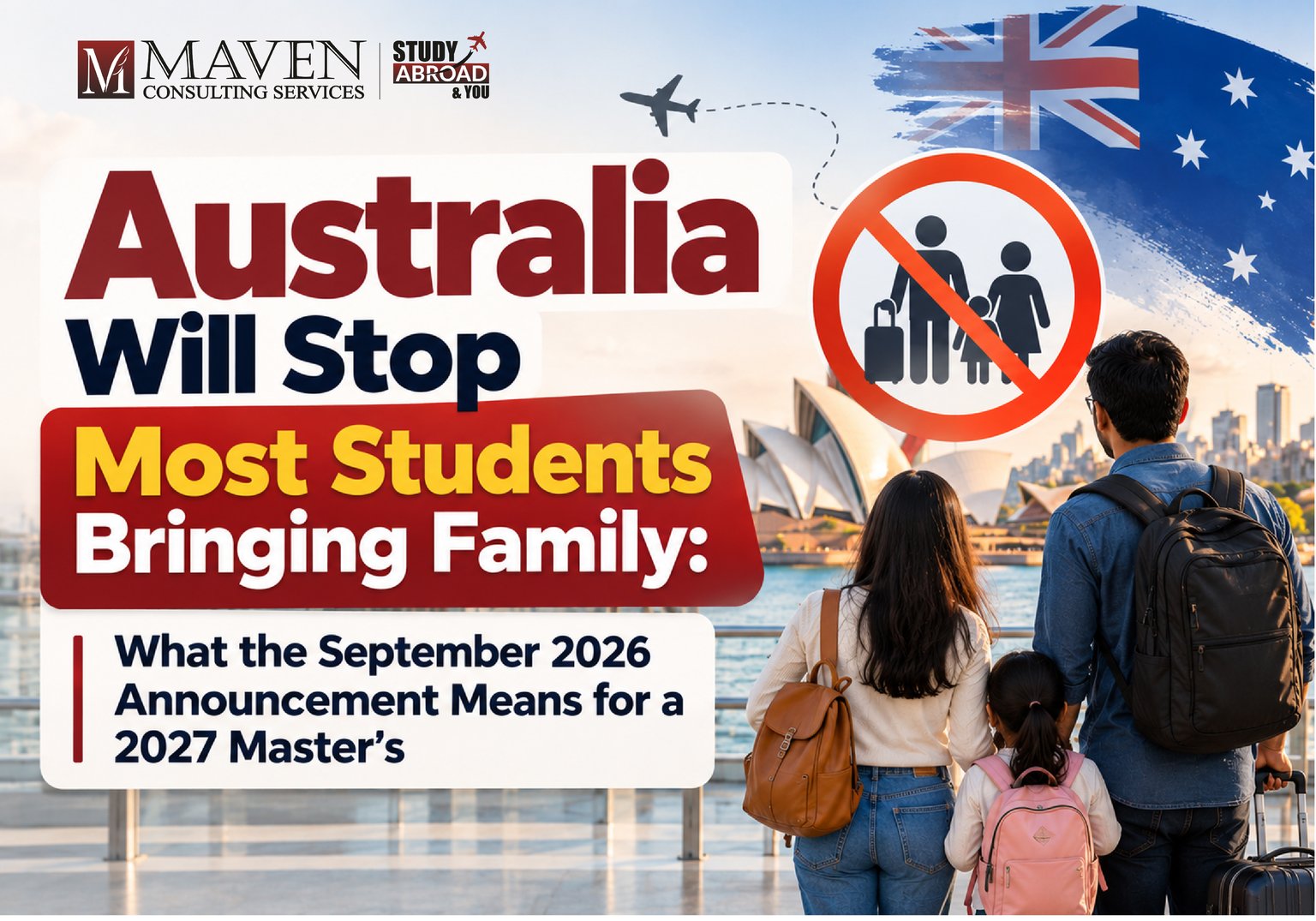
For most master’s students, no, once the new Australia student visa dependants rule starts. On 17 September 2026, Home Affairs Minister Tony Burke announced that most student and graduate visa holders will lose the right to bring partners or children. PhD students and Pacific and ASEAN nationals are exempt; India is not. As of 30 September, no start date has been set.
Every married applicant we have met since 17 September has asked us the same question, usually before they say hello. Can my husband still come? Can I take my wife and our daughter? And if I apply now, am I safe?
This guide answers those questions as honestly as the official record allows. The Australia student visa dependants 2027 change is real and was announced by the Minister himself, but it is not yet law. The start date, the legal instrument and the full list of exemptions have not been published. Anyone telling you exactly how it will apply to your file is guessing.
It matters now because families are making February and July 2027 decisions this month: which offer to accept, how much to deposit, and whether one partner should resign from a job. Those decisions should rest on what has actually been said, not on reels. We separate the announcement from the law, explain who is exempt, walk through three real-world scenarios and give you a checklist for the weeks before the date is known.
If you are new to Australia as a destination, start with our Study in Australia guide and our Australia 2027 guide to the 485 visa and the Genuine Student test.
The announcement came in a speech by Home Affairs Minister Tony Burke at the National Press Club in Canberra. The full text is on the Minister’s website, and the key sentence is short: “for international students, we will no longer be allowing the attaching of family members for international students or for graduate visas.”
Three changes matter for Indian students:
The same speech covered visitor visas, the Working Holiday programme and the government’s lower net overseas migration targets. We focus here only on what affects a student planning a 2027 master’s.
This is the most important part of understanding the Australia student visa dependants change, and the one most coverage skips. An announcement by a Minister is a statement of policy. It becomes binding when the government changes the regulations or issues a legal instrument, and that has not happened yet.
| Question | Status on 30 September 2026 |
|---|---|
| Has the policy been announced? | Yes, by the Minister, on 17 September 2026 |
| Is there a start date? | No. None has been announced |
| Has the legal instrument been published? | No |
| Is the full exemption list published? | No. Only examples were given in the speech |
| Do official visa pages show the change? | No. The Home Affairs subclass 500 page and the Study Australia family page still describe the current rules |
| Can students include family today? | Yes, under the current rules, with the usual evidence and funds |
| Are families already in Australia protected? | Yes, according to the Minister |
| Is guidance on lodged applications published? | No |
Maven Note: Until Home Affairs publishes a start date, today’s rules apply. Be wary of anyone who quotes you a precise cut-off date, promises that a spouse is ‘guaranteed’ if you apply this week, or claims the rule has been dropped. None of those statements is supported by anything the government has published.
The Minister named three groups who will still be able to bring family:
Trade reporting after the speech adds students sponsored by the Department of Foreign Affairs and Trade (DFAT), by Defence or by a foreign government. The Group of Eight universities welcomed the PhD exemption, and the Council of Australian Postgraduate Associations has asked for all research master’s students to be included. Whether a Master of Philosophy or a research master’s counts is not yet confirmed.
India is not in the exempt list. The Pacific and ASEAN exemptions reflect Australia’s regional agreements, and there is no equivalent carve-out for South Asia. So, for an Indian applicant, the only realistic way to keep a family together on a student visa after the change will be a doctoral programme or a research degree, if research master’s degrees are included.
Maven Note: Do not switch to a PhD just to keep your family together. A doctorate is three to four years of full-time research, and Australian universities look hard at your research proposal, publications and fit with a supervisor. It suits some applicants very well. For others it is the wrong degree for the wrong reason.
Nobody can promise that yet. The government has said families already in Australia are protected. It has not said what happens to applications lodged before the start date but decided after it, or to families whose visas are granted but who are still in India.
When the UK brought in its own dependants restriction, it announced the rule in May 2023 and applied it to courses starting on or after 1 January 2024, which gave families a clear planning window. Australia may take a similar approach, or it may not. We will not guess on your behalf.
What we can say:
Many Indian students go first and bring a spouse in the second semester as a subsequent entrant, once they have found housing and part-time work. It is a common, sensible plan, and it is the plan most at risk.
Adding a family member after the student’s visa is granted is, by definition, attaching family to a student visa. That is precisely what the Minister said will stop. Some trade reporting says the restriction will apply to subsequent entrants for current and future visa holders, including exempt groups. Other reporting says guidance on subsequent entrants is still to come. Home Affairs has not published anything either way.
Our advice is simple: do not build a plan that depends on a subsequent entrant visa until official guidance says it is still possible. If your partner is coming, they should be in your application, with the documents the Australian High Commission’s dependant checklist asks for.
The Australia student visa dependants restriction covers graduate visas as well as student visas. Most future applicants for the Temporary Graduate visa (subclass 485) will not be able to include a partner or children. For many Indian families, this matters as much as the student visa change, because the post-study years are when a spouse would expect to work full time and the household would begin to recover the cost of the degree.
The 485 has already become more expensive and more demanding over the past two years, with a lower age limit from 1 July 2024 and higher visa charges in 2026. We covered those changes in our Australia 2027 guide and our 485 visa guide. The dependants rule adds one more question to that calculation: if your partner cannot join you on the 485, the income case for staying on after graduation gets weaker.
Families already attached to a visa and living in Australia are protected. What is not yet clear is whether a partner already in Australia on your student visa can move across with you when you apply for the 485. The Minister’s ‘not breaking up families onshore’ wording suggests they can, but wait for the detail.
The second change announced alongside the Australia student visa dependants rule is about ‘visa hopping’, where students arrive for one course and quickly move to a cheaper or easier one. The Minister described three kinds of change:
| Type of change | Example | Under the announced rules |
|---|---|---|
| Extension | You fall seriously ill and need an extra semester to finish | Continues as now |
| Transfer at the same level | Master of IT at one university to Master of IT at another | Tested for legitimacy; generally needs a new visa |
| Moving up | Bachelor’s (AQF 7) to master’s (AQF 9) | Allowed, but only up the qualification scale |
| Moving sideways or down | Master’s to a graduate diploma (AQF 8) or to a VET diploma | Ends, except in extenuating circumstances |
His words were blunt: “You can go up the qualification scale, but only up the qualification scale.” The existing rule that you must usually complete six months of your principal course before changing provider still applies alongside this.
For an Indian master’s applicant, the practical lesson is to choose the right course and the right university before you leave. The option of ‘I’ll start here and move later’ is closing.
The government’s reasoning for the Australia student visa dependants change is about migration numbers, not students’ behaviour. These are the figures that shaped the debate, with their sources:
| Figure | Number | Source |
|---|---|---|
| Student visas granted, July 2025 to June 2026 | 337,400 | ICEF Monitor, from Home Affairs data |
| Of which, visas for dependants | About 46,000 | ICEF Monitor |
| Student and graduate secondary visa holders in Australia, 31 July 2026 | 67,549 | Andrew Norton analysis of Home Affairs data |
| Secondary visas granted to groups now exempt, 2025-26 | 11,564 | Andrew Norton analysis |
| Net overseas migration target, 2026-27 | 245,000 | Government, as reported by ICEF Monitor |
| Net overseas migration target, 2027-28 | 225,000 | Government, as reported by ICEF Monitor |
| National Planning Level for new international students, 2027 | 295,000 | Government, unchanged |
Two things stand out. First, the 295,000 figure for new students is unchanged, and it is a planning level, not a cap or a quota. Australia still wants international students. Second, dependants are one of the few parts of temporary migration the government can cut without cutting student numbers. That explains why this policy was chosen.
There is no official published figure for Indian dependants alone, so we have not quoted one.
Her husband works in IT and planned to join her in the second semester. Under the Australia student visa dependants announcement, that plan is the one most at risk. Her realistic options are to apply with her husband included in the same application and have him travel with her, accepting that the treatment of pre-start-date applications is not yet known; to go alone and plan for a year or two apart; or to compare a destination where he can come and work. We would not advise her to pay a large non-refundable deposit until Home Affairs publishes the start date and transition rules.
His wife and four-year-old son can still come with him, because PhD students are exempt from the Australia student visa dependants rule. He should still check the final exemption list when it is published, budget for the partner and child living-cost evidence and school fees, and confirm that his scholarship covers dependants or that he can show the funds. Our 2027 scholarship calendar lists the Australian research scholarships and their deadlines.
This plan is effectively over. A transfer at the same level would need a fresh visa and a legitimacy test, and moving down to a graduate diploma would not be allowed. Kiran should choose the university he actually wants to finish at, and compare total costs properly before accepting. Our cost of a master’s abroad guide does that line by line.
The Australia student visa dependants change is not the first restriction of its kind. For a married Indian student on a coursework master’s, this is the broad picture on 30 September 2026. Rules change often, so confirm each one on the official page before you decide.
| Country | Can a coursework master’s student bring a partner? | Can the partner work? |
|---|---|---|
| Australia (after the rule starts) | No, for most Indian students. PhD students are exempt | Not applicable |
| United Kingdom | No, since January 2024, except for PhD and research students (GOV.UK) | Only for research students’ dependants |
| Canada | Yes | Open work permit only for programmes of 16 months or more, doctoral and some professional degrees (IRCC) |
| United States | Yes, on an F-2 visa | No. F-2 spouses cannot work |
| New Zealand | Yes, for postgraduate students | Generally yes at master’s and doctoral level; check Immigration New Zealand |
For the full trade-offs, see our USA vs Canada comparison for 2027, our UK vs Ireland guide and our round-up of underrated study destinations. The honest summary is that no major destination is now simple for a married coursework student, and that Canada’s longer master’s programmes and the United States, where a spouse can come but cannot work, are the clearest alternatives.
Until the Australia student visa dependants rule has a confirmed start date, these nine steps keep your options open and your money safe.
For a single applicant, the Australia student visa dependants rule changes very little. The degree, the 295,000 planning level and the 485 visa are all still there, and the course-change rule mainly affects students who were not planning to finish where they started.
For a married applicant on a coursework master’s, the answer depends on one question: can you study without your partner? If yes, Australia remains a strong choice, especially for fields where Australian employers hire graduates. If no, Australia will shortly stop being an option for you unless a research degree fits. It is far better to reach that conclusion now than after paying a deposit.
Founder Perspective
“I have sat across from couples this month who had already told their employers they were leaving. One wife had planned to follow her husband in March. When I explained that this plan is the one the announcement closes, the room went quiet. My advice is not to panic and not to rush. If you are ready and your file is strong, apply with your family included. If your plan depends on a spouse joining later, stop and rethink before you pay anything. And if Australia no longer fits your family, that is not failure. It is a better decision made at the right time.”
Rajshekar Tubachi, Founder, Maven Consulting Services
Probably not, for most master’s and bachelor’s students, once the new Australia student visa dependants rule starts. On 17 September 2026 Home Affairs Minister Tony Burke announced that most student and graduate visa holders will no longer be able to bring partners or children. India is not in the exempt group. No start date has been announced, so today’s rules still apply until the government publishes one.
As of 30 September 2026 the government has not announced a start date, and Home Affairs has not published the legal instrument or the full exemption list. The Home Affairs and Study Australia websites still describe the current rules, under which students can include family members.
The Minister named PhD students, students from Pacific nations and students from ASEAN countries. Trade reporting also lists students sponsored by DFAT, Defence or a foreign government. Whether research master’s students are covered has not been confirmed. Indian nationals studying a coursework master’s or bachelor’s degree are not exempt.
No. The Minister said the government will not break up families who are already onshore with family members attached to a visa. Those arrangements continue under the current rules.
Do not plan on it. The announcement stops family members being attached to student and graduate visas, and adding a family member after grant is exactly that. Home Affairs has not yet published guidance on subsequent entrant applications, so treat this route as closed until official guidance says otherwise.
Yes. The Minister said the change covers graduate visas as well as student visas, so most future 485 applicants will not be able to include partners or children. Families already attached to a visa and living in Australia are protected.
Under the announced changes, only if you move up the qualification ladder, such as from a bachelor’s to a master’s, and you will generally need a new visa to do it. Moving sideways between institutions or down to a lower level will end, except in extenuating circumstances. Extensions for genuine reasons such as illness continue.
Applying early does not guarantee protection, because the government has not said how applications lodged before the start date will be treated. If you are ready, applying for the February or July 2027 intake with your partner included in the same application is reasonable, but avoid paying large non-refundable amounts that only make sense if your partner can come.
It depends on whether you can study without your partner for one to two years, or whether a research degree suits you. If living together is non-negotiable, the United States and New Zealand currently offer clearer routes for a coursework master’s student’s partner, and Canada does for longer master’s programmes.
No. The government has kept the National Planning Level of 295,000 new international student commencements for 2027. The dependants rule reduces the number of family members, not the planning level for students.
The Australia student visa dependants 2027 change was announced on 17 September 2026 but has no start date yet. Once it applies, most Indian master’s and bachelor’s students will not be able to bring a partner or children on a student or 485 visa, and course changes will need a new visa and must move up the qualification ladder. PhD students and Pacific and ASEAN nationals are exempt, and families already in Australia are protected. If your partner must come, include them in your original application, do not rely on a later subsequent entrant visa, and hold large deposits until the rules are published.
Tell us your course, your intake and whether your partner or children need to come with you. We will tell you honestly whether Australia still works for your family, and which alternatives do. Maven Consulting Services, Bengaluru, has guided more than 10,000 students across 700-plus university partners in 27 countries, with a 99.8 per cent visa success rate and a commission-free model, so our advice follows your interests, not a university’s.
WhatsApp | Bengaluru, Karnataka · Instagram · LinkedIn · YouTube
<< Previous Blog | Next Blog >>
Sources: Minister for Home Affairs, Tony Burke, speech to the National Press Club, 17 September 2026 (minister.homeaffairs.gov.au); Department of Home Affairs, Student visa (subclass 500) and Temporary Graduate visa (subclass 485) pages; Study Australia, Bringing your family; Australian High Commission India, dependant checklist; ICEF Monitor, ‘Australia moves to reduce net migration with new restrictions on student family members and visa-hopping’, September 2026; Andrew Norton, analysis of Home Affairs secondary visa data, September 2026; The PIE News, September 2026; GOV.UK, Student visa family members; IRCC, spouse open work permits. Status current as of 30 September 2026.
This article is general information for Indian students and families, not migration or legal advice. For advice on your own case, speak to a registered migration agent.

Sunday, October 26, 2025 | The Taj MG Road, Bangalore | 10 AM – 4 PM