WhatsAppCHAT
CALL US& CONNECT

By Team Maven | Published 4 September 2026 | 16 minute read
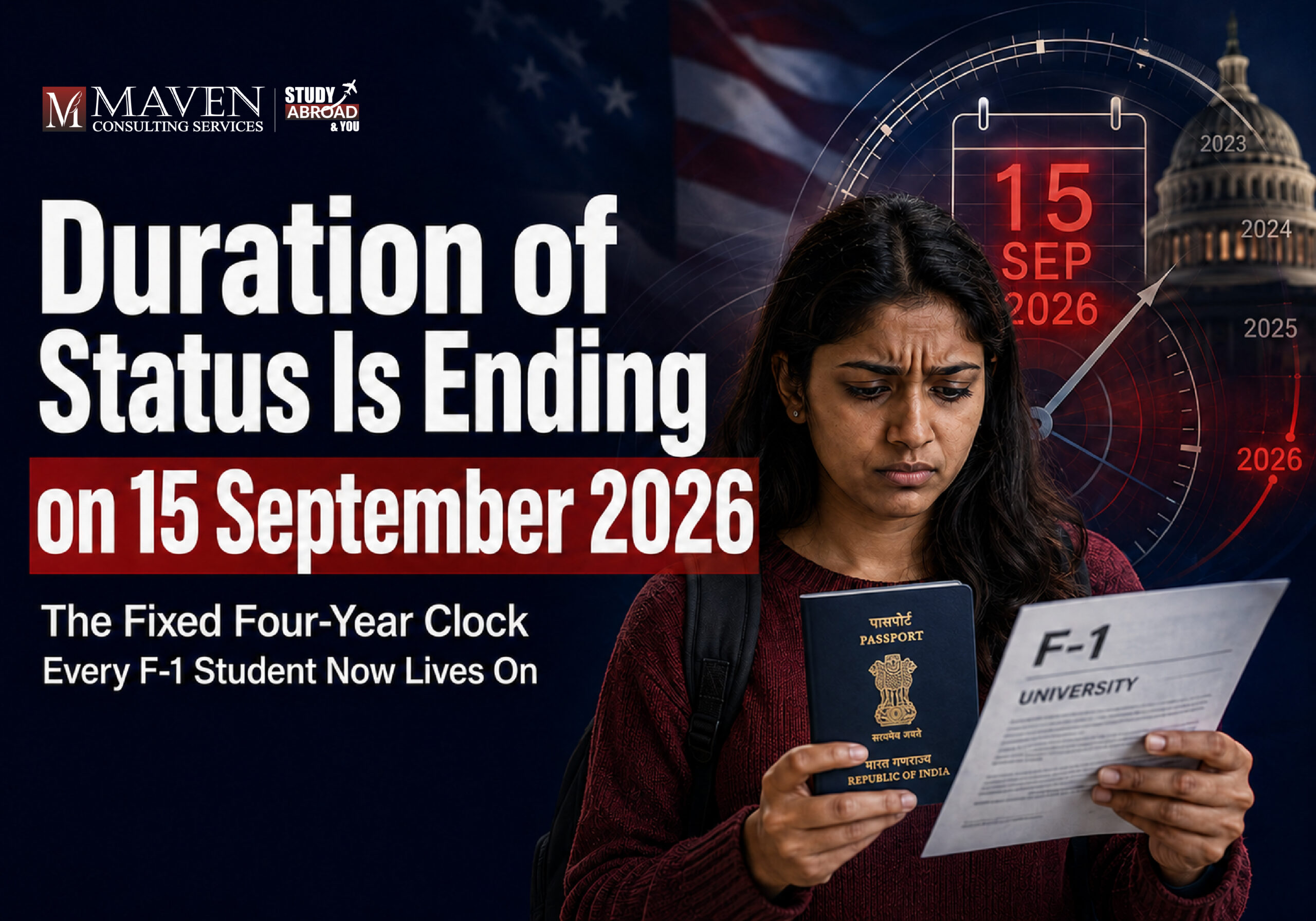
On 15 September 2026, the rule that has governed how long an international student may stay in the United States since 1978 stops applying. Duration of status is ending, and F-1 students admitted from that date will carry a fixed expiry date on their I-94 instead of an open-ended permission tied to being enrolled. If you are already in America, most of you do not have to do anything this month. If you are flying out for Fall 2027, this changes the shape of your entire degree.
For nearly fifty years, an F-1 student was admitted for “D/S” — duration of status. It meant your permission to remain lasted as long as you were doing what your visa said you would do: enrolled full time, making progress, following the employment rules. There was no date to watch. You could take an extra semester, switch from a master’s to a PhD, or add a STEM OPT extension, and your legal stay simply stretched to accommodate it.
That framework is gone. The Department of Homeland Security published the final rule ending duration of status on 17 July 2026, at 91 FR 44976, under DHS Docket No. ICEB-2025-0001. It takes effect on 15 September 2026. From that date, an F-1 student is admitted for the length of the programme shown on the Form I-20, capped at four years, plus thirty days to leave the country. When that date passes, the permission ends — whether or not you are still enrolled, still writing your thesis, or still waiting on a decision from a university committee.
India has more at stake in this than any other country. Open Doors 2025 counted 363,019 Indian students in the United States in 2024/25, roughly 31 per cent of all international students there. This rule lands on that population first.
Strip away the noise and the change is one sentence long. Your right to be in the United States used to be a condition. It is now a date.
Under duration of status, the “Admit Until Date” on your Form I-94 read D/S. There was nothing to expire. If you fell out of compliance, a school official or an immigration officer had to make a formal finding before your stay became unlawful, and there were procedures around that finding.
From 15 September 2026, the I-94 carries an actual date. Customs and Border Protection sets it when you enter. USCIS sets it when it approves an extension or a change of status. After that date passes, you are out of status automatically. No finding, no notice, no letter. The calendar does it.
| Duration of status (until 14 September 2026) | Fixed period of admission (from 15 September 2026) | |
|---|---|---|
| What the I-94 says | D/S — no end date | A specific Admit Until Date |
| How long you may stay | As long as you maintain status | Programme length on the I-20, capped at four years, plus 30 days |
| Extra semester or delayed thesis | Handled by your DSO with a new I-20 | Requires an extension of stay application to USCIS |
| Grace period after completion | 60 days | 30 days |
| Adding OPT or STEM OPT | Form I-765 only | Form I-765 plus, in most cases, Form I-539 |
| When unlawful presence starts | Generally only after a formal finding by USCIS or an immigration judge | The day after the Admit Until Date passes |
| Who controls the clock | You and your school | USCIS |
This is where almost every reel, WhatsApp forward and YouTube thumbnail has misled people over the last six weeks, and it is worth being precise about because the mistake runs in the wrong direction. Students are hearing “four years” and feeling reassured. Most of them are not getting four years.
The rule admits an F-1 student for the length of the programme listed on the Form I-20, not to exceed four years, plus a thirty-day departure period. The four years is an upper limit that only bites on long programmes. A two-year master’s gets roughly two years. A one-year master’s gets roughly one.
| Programme | Admission period granted | Does the four-year cap bite? | What it means in practice |
|---|---|---|---|
| One-year master’s | Programme end date on the I-20, plus 30 days | No | Very little slack. One delayed semester and you are filing an extension |
| Two-year master’s — the typical Indian profile | Programme end date on the I-20, plus 30 days | No | Roughly 24 months. OPT is not inside it and must be applied for separately |
| Four-year bachelor’s | Up to four years, plus 30 days | At the edge | Any repeat semester, internship year or change of major pushes you past the date |
| PhD, typically five to seven years | Four years, plus 30 days | Yes, hard | An extension of stay in year four is not a risk, it is a certainty |
| English language training | Aggregate limit of 24 months, breaks and vacations included | Separate cap | A hard lifetime ceiling on language study |
Read the PhD row and the bachelor’s row together and you can see who this rule was actually written for. It was not written to stop two-year master’s students. It was written to put a federal checkpoint in the middle of every long degree, and it catches everyone else on the way past.
Three documents, three different jobs, and confusing them is the most common way an otherwise careful student falls out of status.
Retrieve your I-94 from the CBP I-94 website after every single entry into the United States, print it, and check the date against your I-20. Officers make data-entry errors, and under duration of status a wrong entry was usually harmless because the field said D/S. Under a fixed date, a typo is the difference between lawful presence and an overstay you did not know you were accruing. If the date is wrong, take it to your international student office in the same week, not the same semester.
If you were admitted for duration of status before 15 September 2026, you are not thrown onto a fixed date overnight. DHS built a transition provision, and for most current Indian students it is generous. The official DHS FAQ on the final rule sets it out in full.
You may remain under your existing D/S admission until the earliest of: the programme end date on your Form I-20, the end date of your post-completion OPT, or the end date of your STEM OPT — and in no case beyond 14 November 2030, which is four years from the effective date plus a sixty-day departure period. You keep the sixty-day grace period, not the new thirty-day one. You do not need a corrected I-94 and you do not need to file anything.
That does not mean nobody should travel. It means travel becomes a decision with an immigration consequence attached, and it should be taken with your international student office rather than around them. For a student finishing in 2027 or 2028, converting to a fixed date is often harmless, because the fixed date will simply mirror your programme end date. For a PhD student in year two, or anyone whose completion date is genuinely uncertain, converting early costs you the cushion the transition rule was designed to give you.
If you need more time than your Admit Until Date allows, you file Form I-539, Application to Extend or Change Nonimmigrant Status, with USCIS. This is the single largest new burden the end of duration of status creates, and it is worth understanding before you need it rather than during the week you need it.
| Item | Detail |
|---|---|
| Form | Form I-539, filed with USCIS — not with your university, and not with SEVP |
| Filing fee | $420 filed online, $470 on paper. There is no separate biometric services fee for I-539 applicants |
| Biometrics | USCIS may require biometrics, and may require an interview. The agency has not published where or how these will be scheduled at student volume |
| Deadline | The application must be received by USCIS before your current I-94 expires. A postmark is not a filing |
| School step first | Your DSO must recommend the extension and issue an updated I-20 before your programme end date. Start the internal process months ahead |
| While it is pending | A timely-filed application lets you continue a full course of study until USCIS decides, and auto-extends on-campus and off-campus employment authorisation for up to 240 days |
| If it is denied | There is no grace period. Departure is immediate and unlawful presence begins to accrue |
| Dependants | F-2 spouses and children get an admission period that cannot exceed the principal’s, and file their own extensions |
DHS did not leave the standard open. An extension may be approved for a compelling academic reason, a documented medical illness, or circumstances genuinely beyond the student’s control. The rule then names what will not work, and the language is blunt: a delay in completing the programme by the end date on the I-20, “including but not limited to delays caused by academic probation or suspension or a student’s repeated inability or unwillingness to complete his or her course of study,” is generally an unacceptable reason.
Translate that into the situations that actually occur. A supervisor leaving mid-thesis, a laboratory closure, a documented hospitalisation, a visa-related delay in returning from a family emergency — these are the shape of a fundable case, and each of them needs paperwork created at the time it happens, not reconstructed a year later. Two backlogs and a repeated semester are not. That is a new and permanent reason to take academic performance seriously in the first year, and it is the part of this rule Indian students most consistently underestimate.
OPT survives. The rule does not shorten it, does not remove the twenty-four month STEM extension, and does not touch the cap-gap provision that carries a graduate from an expiring OPT into an H-1B start date. What it changes is the paperwork around it, and there is a dated window that current students should not miss.
The transition window. A student admitted for duration of status before 15 September 2026 who files Form I-765 for post-completion OPT or for the STEM OPT extension on or before 18 March 2027 — six months after the effective date — does not need to file a separate extension of stay. That is a real saving of a fee, a biometrics appointment and an unknown processing wait. It is forfeited if you travel abroad and re-enter on or after 15 September 2026, because you are no longer a D/S student when you come back.
After that window, and for everyone admitted under the new rule. An OPT application generally means two filings, not one: Form I-765 for the work authorisation and Form I-539 to extend the admission period to cover it. When it is approved, your authorised stay runs to the end date on your EAD plus thirty days.
| Stage | Under duration of status | Under the fixed period of admission |
|---|---|---|
| Completing the degree on time | No USCIS filing | No USCIS filing |
| One extra semester | New I-20 from your DSO | Form I-539, fee, possible biometrics |
| Post-completion OPT | Form I-765 | Form I-765 plus Form I-539 |
| STEM OPT extension | Form I-765 | Form I-765 plus Form I-539 |
| Typical number of USCIS applications | Two | Four or five |
| Indicative government fees, filed online | About $940 | About $1,780, before attorney costs |
The money is not the problem. The queue is. Every one of those filings is a decision you are waiting on, made by an agency that has published no processing time for student extensions at this volume, and each one is a point at which a request for evidence can arrive in your final semester.
The headlines have been about four years. The provisions that will affect more Indian students in practice sit further down the rule and have barely been reported here.
If your plan involved starting somewhere affordable and moving up, or arriving undecided and choosing a specialisation once you had seen the department, that plan needs rebuilding before you apply. Under the new rule, the programme and the school you name on your first I-20 are close to final. Choose them as if they are.
Everything above is administrative. This part is not, and it is the reason to take the rest seriously.
Unlawful presence is the count of days a person remains in the United States after their authorised stay ends. Accrue more than 180 days and depart, and you face a three-year bar on returning. Accrue a year or more, and the bar is ten years. Those bars are statutory and they apply to any future US visa, including a work visa, a business visa or a tourist visa fifteen years later.
Under duration of status this was, for most students, a remote risk. Because there was no end date on the I-94, unlawful presence generally began only when USCIS or an immigration judge formally found a status violation. A student who made a mistake usually had a chance to discover it and fix it.
With a fixed Admit Until Date, the count starts by itself on the day after that date. Nobody tells you. A student who misreads the I-94, whose extension is filed a week late, or who assumes the new I-20 from their department extended their stay, can be six months into a three-year bar before anyone notices. That is the single change in this rule with consequences that outlast the degree by a decade.
Take a student flying to the United States for a two-year MS beginning 23 August 2027, with a programme end date of 15 May 2029 on the I-20. Every date below follows from the rule as it currently stands.
| When | What happens | What it costs you |
|---|---|---|
| From 24 July 2027 | Earliest entry, 30 days before the programme start date. This pre-arrival period does not count against your admission | Nothing |
| 23 August 2027 | Programme begins. Your I-94 Admit Until Date reads on or about 14 June 2029 — programme end plus 30 days | Check the I-94 in week one |
| September 2028 | The point at which a delayed thesis, a repeated course or a changed graduation date must be raised with your DSO, not in your final semester | Nothing, if you are early |
| Around 14 February 2029 | Earliest OPT filing, 90 days before programme end. File Form I-765 and, in most cases, Form I-539 together | About $890 in government fees, filed online |
| 15 May 2029 | Programme ends. Grace period is now 30 days, not 60 | Housing and job-search planning tightens by a month |
| June 2029 to May 2030 | Post-completion OPT. Once approved, your admission runs to the EAD end date plus 30 days | Nothing further |
| Around March 2030 | STEM OPT extension filing, if your programme is STEM-designated. Form I-765 and Form I-539 again | About $890 again |
| June 2030 to May 2032 | STEM OPT, 24 months, running alongside up to four H-1B lottery attempts | Nothing further |
Notice what the example does not contain: a crisis. A student who finishes on time, files early and checks the I-94 goes through this without a single emergency. The end of duration of status does not make a well-run degree impossible. It removes the margin for a badly run one, and it converts every academic slip into a federal application.
Notice also what sits at the end of it. Those four lottery attempts run straight into the H-1B system as it now works, which we covered separately in our piece on the proposed $103,265 cap-subject H-1B fee and the wage-weighted lottery. The admission clock and the sponsorship arithmetic are the same decision viewed from two ends.
On 18 August 2026 a coalition filed suit in the United States District Court for the District of Massachusetts seeking to stop the rule before it takes effect. The plaintiffs include NAFSA: Association of International Educators, the Presidents’ Alliance on Higher Education and Immigration, the Association of Independent Colleges and Universities in Massachusetts, the American Federation of Teachers, the United Auto Workers and the NewsGuild-CWA. The case is before Judge F. Dennis Saylor IV.
The claims are made under the Administrative Procedure Act: that DHS failed to assess the rule’s costs and benefits adequately, did not meaningfully respond to public comments, did not consider less burdensome alternatives, allowed an inadequate comment period, and exceeded its statutory authority. DHS itself put the annualised cost of the rule at roughly $443 to $449 million.
A motion for a preliminary injunction was heard on 3 September 2026, twelve days before the rule is due to take effect. As this article goes live no decision has been published. There are three possible outcomes and it is worth holding all three: the rule is blocked before 15 September and nothing below changes for now; it is allowed to take effect while the case continues; or it takes effect and is set aside later, which would leave a cohort of students who were admitted under it in an unclear position. The Presidents’ Alliance litigation tracker is the fastest public source for what the court actually does.
Duration of status is being replaced by a fixed period of admission. F-1 students admitted on or after 15 September 2026 receive an Admit Until Date on their Form I-94 equal to the programme end date on their Form I-20, capped at four years, plus a 30-day departure period. The final rule was published on 17 July 2026 at 91 FR 44976, under DHS Docket No. ICEB-2025-0001.
No. Four years is a maximum, not a grant. Your admission period is the length of your programme as shown on the Form I-20, capped at four years. A two-year master’s receives roughly two years plus 30 days. Only programmes longer than four years, such as most PhDs, hit the cap.
Generally no. Students admitted for duration of status before 15 September 2026 may remain until their programme end date, post-completion OPT end date or STEM OPT end date, and in no case beyond 14 November 2030, without filing an extension of stay and without a corrected I-94. They also keep the 60-day grace period.
Your transition protection ends. On re-entry, Customs and Border Protection issues a new Form I-94 with a fixed Admit Until Date under the new rule, and your grace period drops from 60 days to 30. Speak to your international student office before booking any international travel, and download your new I-94 immediately after each entry.
You file Form I-539, Application to Extend or Change Nonimmigrant Status, with USCIS, and it must be received before your current I-94 expires. The fee is $420 filed online or $470 on paper, with no separate biometric services fee, though USCIS may require biometrics and an interview. Your designated school official must recommend the extension and issue an updated I-20 before your programme end date.
A compelling academic reason, a documented medical illness, or circumstances beyond the student’s control. The rule states that delays in completing a programme by the end date on the Form I-20, including delays caused by academic probation or suspension or a student’s repeated inability or unwillingness to complete the course of study, are generally unacceptable reasons.
Yes, if it was filed on time. A timely-filed extension of stay allows an F-1 student to continue a full course of study after the admission period expires, until USCIS adjudicates the application, and on-campus and off-campus employment authorisation is auto-extended for up to 240 days. If the application is denied there is no grace period, departure is immediate and unlawful presence begins to accrue.
OPT and the 24-month STEM OPT extension are not shortened, and the cap-gap provision is unchanged. What changes is the paperwork. Students admitted for duration of status who file Form I-765 for post-completion OPT or STEM OPT on or before 18 March 2027 do not need a separate extension of stay. After that date, and for students admitted under the new rule, an OPT application generally requires Form I-765 and Form I-539 together.
F-2 spouses and children receive a fixed period of admission that may not exceed the principal F-1 student’s authorised stay, and they must file their own extension applications when the principal does. Dependants admitted for duration of status before 15 September 2026 come under the same transition provisions as the principal student.
Not as freely. Undergraduates must complete the first academic year at the school that admitted them before transferring, absent an SEVP exception. Graduate students cannot change their educational objective during the programme and cannot transfer schools except in defined extenuating circumstances. A student who has completed a degree cannot then pursue a degree at the same or a lower level, which closes off a second master’s in the United States.
It is being challenged. A coalition including NAFSA, the Presidents’ Alliance on Higher Education and Immigration, AICUM, the AFT, the UAW and the NewsGuild-CWA filed suit in the US District Court for the District of Massachusetts on 18 August 2026 under the Administrative Procedure Act, and a preliminary injunction motion was heard on 3 September 2026. Until a court orders otherwise, the rule takes effect on 15 September 2026 and students should plan on that basis.
Duration of status ending for F-1 students is not the catastrophe it has been sold as, and it is not the non-event that a few reassuring posts have made it out to be. It is a structural change in who controls the clock. For fifty years, a student and their university managed the length of a degree between them. From 15 September 2026, USCIS does, one application at a time.
For a student who finishes a two-year master’s on schedule, downloads the I-94 after every entry, and files OPT on time, the practical effect this decade is a couple of extra forms and about $890 in fees. For a PhD student, a student who repeats a year, a student who wanted to transfer, or a student who assumed a second master’s was available as a fallback, this rule removes options that were quietly load-bearing in a lot of plans.
And for everyone, the risk profile has shifted in a way that is worth stating plainly one more time. Under duration of status, a mistake was usually recoverable. Under a fixed date, an unnoticed overstay of 180 days is a three-year bar on returning to the United States for anything at all. The four minutes it takes to read your I-94 is now the highest-return administrative habit in international education.
Send us your I-20, your I-94 and your intended graduation date and we will map your actual admission clock, tell you whether the 18 March 2027 OPT window applies to you, and flag every point in your degree where a filing will be needed. If you are still choosing a country for 2027, we will run the same arithmetic against the UK, Canada, Germany and Ireland before you pay a deposit.
Book a Free ConsultationSources: Federal Register, “Establishing a Fixed Time Period of Admission and an Extension of Stay Procedure for Nonimmigrant Academic Students, Exchange Visitors, and Representatives of Foreign Information Media,” final rule published 17 July 2026, 91 FR 44976, DHS Docket No. ICEB-2025-0001, RIN 1653-AA95, effective 15 September 2026; DHS Study in the States, final rule FAQ and quick facts; US Citizenship and Immigration Services, Form I-539 and current fee schedule; US Customs and Border Protection I-94 website; NAFSA, “Coalition Files Federal Lawsuit Challenging Rule Ending Duration of Status,” 18 August 2026, and the Presidents’ Alliance duration of status litigation tracker, US District Court for the District of Massachusetts; Institute of International Education, Open Doors 2025. Figures current as of 3 September 2026. This article is general information for Indian students and families, not legal advice. Immigration rules change and are being litigated; confirm every date and fee with your designated school official or a licensed US immigration attorney before acting.
Maven Consulting Services
Bangalore — Jayanagar 9th Block | Malleshwaram | St Marks Road · Belagavi · Dubai

Sunday, October 26, 2025 | The Taj MG Road, Bangalore | 10 AM – 4 PM