WhatsAppCHAT
CALL US& CONNECT

By Team Maven | Published 11 September 2026 | 14 minute read
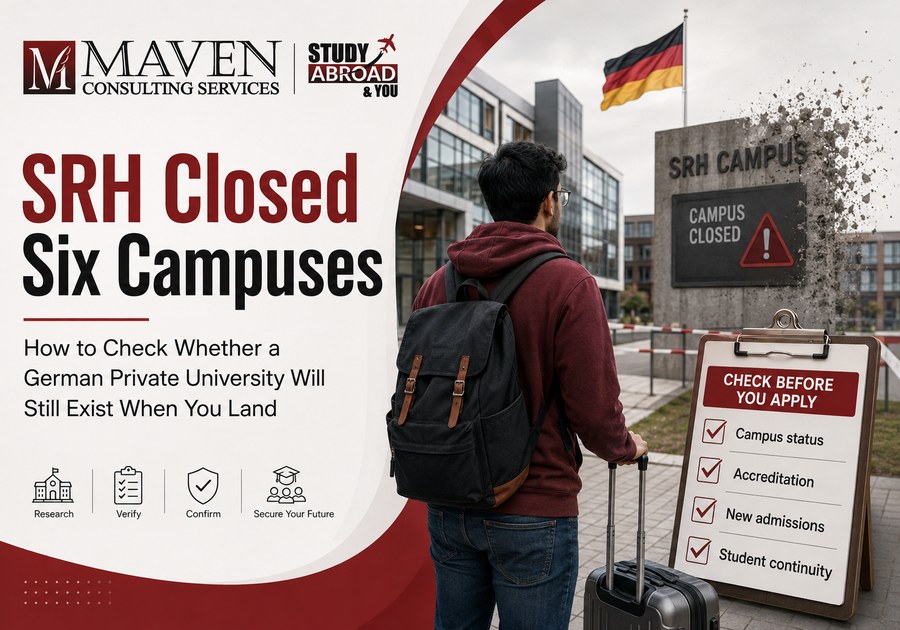
On 4 August 2026, SRH University confirmed it will close six of its German campuses — Bremen, Fürth, Hamburg, Cologne, Munich and Stuttgart — by the end of 2027 or spring 2028, alongside roughly 200 job cuts. It is one of Germany’s largest private higher education providers, and it is retrenching. This article is not about SRH specifically. It is about the six questions every family should be able to answer, in one evening, before paying a deposit to any German private university.
If you already hold an offer from SRH, or from any other German private university, nothing here is designed to alarm you. Students currently enrolled at the affected SRH locations have been told they can complete their studies as planned. But an offer letter is a promise about the next two to four years, and this is the year a fairly large promise turned out to be conditional.
The honest response is not to avoid a German private university as a category — many are excellent, stable, and genuinely well suited to a profile that struggles with the public system’s German-language and Numerus Clausus barriers. The honest response is to run the same six-point check on every one of them, including the one that already has your money.
SRH University — the presence-based teaching arm of SRH, a large German non-profit foundation active in both education and healthcare — announced a strategic realignment on 4 August 2026. In a statement from managing director Stefan Bolle, the university said it is stepping back from an expansion strategy that had taken it to roughly 11,000 students across a wide network of campuses, and will instead concentrate on five core sites.
| Status | Locations |
|---|---|
| Closing by end 2027 / spring 2028 | Bremen, Fürth, Hamburg, Cologne, Munich, Stuttgart |
| Remaining as core sites | Berlin, Dresden, Gera, Heidelberg, Leipzig |
SRH’s own reasons, in Bolle’s words, are worth reading exactly because they are not unique to SRH: changing skill requirements driven by AI, the broader geopolitical climate, tougher competition from tuition-free public universities, and tightened visa rules for international students. Enrolled students at the affected sites are told they can finish their programmes properly, and the university says it will negotiate the workforce reduction with its works council rather than through abrupt layoffs.
Two more things are worth separating out, because “SRH” gets used loosely online. First, this August announcement is a distinct event from an earlier one: SRH had already confirmed in April 2026 that its much smaller Hamm campus would wind down, around 300 students, by 30 September 2027 with no new admissions from the 2026/27 winter semester — a separate decision, on a separate timeline, announced four months before the six-city restructuring.
Second, SRH’s statement is explicit that its other higher education entities are not affected by these particular measures. “SRH” is a large group; a headline about one part of it is not automatically a headline about all of it, and that distinction is exactly the kind of thing a worried family glosses over under pressure.
SRH is not a struggling fringe operator. It is one of the largest private higher education providers in Germany, backed by a decades-old non-profit foundation with a substantial healthcare arm alongside its universities. If an institution with that scale and that backing is closing six locations in one announcement, the pressures behind it are structural, not particular to one management team.
The reasons SRH itself gave map onto forces affecting private higher education across Germany: a wave of new AI-related scrutiny on what a degree actually needs to teach, competition from tuition-free public universities that has only sharpened as household budgets tighten, and visa and immigration rules for international students that have moved in a stricter direction across several intakes. None of that is exclusive to one institution or one city. It means a family evaluating any German private university in 2027 should treat “is this specific campus financially stable” as a standing question, not a one-time check done at the offer stage and then forgotten.
Anabin is the German government’s own database of foreign and domestic higher education institutions, maintained by the Central Office for Foreign Education (ZAB) on behalf of the Kultusministerkonferenz, the standing conference of state education ministers. It is the reference German administrations, employers, and universities themselves use to check whether an institution is recognised. For a prospective student at a German private university, it answers a narrower but critical question: is this institution treated as equivalent to a German Hochschule at all.
| Rating | What it means | What it does not mean |
|---|---|---|
| H+ | The institution is recognised as equivalent to a German Hochschule | It does not confirm every individual programme is accredited, and it says nothing about financial stability |
| H+/- | Recognition applies only to specific named programmes; the rest of the institution’s offerings are not covered | An H+/- rating on the wrong programme is functionally the same problem as H- |
| H- | Not currently rated as equivalent to a German institution of higher education | — |
The check itself takes about five minutes: search the institution by exact name on Anabin, confirm the H+ rating, and — this is the step most guides skip — confirm that the specific degree programme you are being offered appears in the listing, not just the institution as a whole. An H+/- institution can carry excellent recognised programmes and weaker unrecognised ones side by side, and the difference matters enormously if you later apply for a job, a Blue Card, or further study in Germany.
This is the distinction Indian applicants confuse most often, and it is the one that actually determines what happens if a campus closes. They are two separate layers of German quality control, granted by two different authorities, and a German private university can hold one without the other.
| Credential | Granted by | What it protects |
|---|---|---|
| State recognition (staatliche Anerkennung) | The state (Land) ministry where the institution is based | The institution’s legal right to exist as a Hochschule and award degrees at all. This is the foundation everything else sits on. |
| Programme accreditation (AQAS, FIBAA, ASIIN, or via the Akkreditierungsrat) | An independent accreditation agency, overseen by the Accreditation Council | Whether a specific degree programme meets defined quality standards. Renewed periodically, programme by programme. |
| Wissenschaftsrat system accreditation | The German Science Council | A broader institutional quality seal some private universities hold in addition to state recognition |
Here is why the distinction is not academic. State recognition is what protects you if a campus closes: a state-recognised German private university operates under the same higher education law (Landeshochschulgesetz) as public universities in that state, which is what obliges it to guarantee currently enrolled students a path to finish their degree even if a programme or location is discontinued. Programme accreditation, by contrast, is a quality signal for employers and for onward study — valuable, but it does not by itself create a legal obligation to teach out existing students. Ask for both, and ask which one covers your specific degree, not just the institution’s homepage badge.
Universities rarely announce a closure with no warning. Enrolment decline, unfilled intake targets, and a shrinking course catalogue tend to show up years before a formal announcement — SRH’s own five-core-site plan was reportedly under discussion internally well before the August statement became public. The trouble is that a German private university is not required to publish per-campus enrolment figures the way listed companies publish revenue, so you cannot simply look it up on demand.
What you can do: check the institution’s entry in Destatis (Germany’s Federal Statistical Office), which publishes annual student numbers by institution at a national level; check whether the CHE Ranking — an independent German university ranking body — still lists the programme and campus you are considering, since CHE drops entries that stop reporting data; and, most directly, ask the admissions office in writing how enrolment at your specific campus has moved over the last three intakes. A confident, specific answer is reassuring. A vague or deflected one is itself the data point.
SRH is owned by SRH Holding, a non-profit foundation active in education and healthcare since the 1960s — one reason its individual campus closures are being handled with a formal wind-down and teach-out commitment rather than a sudden shutdown. That governance structure matters, and it is not universal across the German private higher education sector. Some institutions are single-site operations with a much thinner balance sheet behind them; others are owned by private equity groups running multiple brands, where a decision to exit German higher education could move faster and with less institutional memory than a large non-profit foundation’s board process.
Before accepting an offer, find the parent entity — it is usually disclosed in the institution’s imprint (Impressum) page, a legal requirement for any German website — and do a five-minute search on that parent’s other closures, mergers, or financial press coverage. A large, diversified non-profit owner closing one underperforming site is a very different risk profile from a single-purpose operator with no other assets to draw on.
This is the section families skip because it feels like planning for failure. Do it anyway. German enrolment contracts and offer letters vary significantly between institutions, and the clause that actually matters is what happens to fees already paid if the university, the specific programme, or the campus is discontinued before you complete — not the standard cooling-off period most offer letters lead with.
German higher education law generally requires an institution discontinuing a programme or a location to formally guarantee currently enrolled students — those already admitted and registered — a path to finish, typically through a published wind-down order (an Auslaufordnung) that keeps the teaching and examination schedule running for a defined transition window beyond the standard programme duration. This obligation attaches to state-recognised institutions specifically, which is one more reason Point 2 matters as much as it does: it is state recognition, not programme accreditation alone, that puts a German private university inside this legal framework in the first place.
What this typically means in practice, based on how German institutions have structured teach-outs in comparable cases: students already enrolled at the time of the closure announcement continue on the existing curriculum, sometimes at the same campus for a transition period and sometimes with lectures consolidated onto a sister campus, until the standard programme duration plus a grace period has run.
What it does not automatically mean: a guarantee that every elective, staff member, or campus facility remains unchanged for that entire window, or that a brand-new applicant admitted after the closure announcement receives the same protection as someone already enrolled. If you are choosing between an offer at a stable-looking programme and one at an institution that has just announced site closures elsewhere in its network, ask specifically whether your target programme and campus are inside or outside the ring of protection — the answer is rarely obvious just from the headline.
Print this, or save it, and run it on any German private university offer before you pay a deposit — including one you already hold.
None of this is a reason to rule out German private universities as a category. For many Indian students — particularly those without German-language proficiency, or applying outside the narrow public-university intake windows, or wanting a specific English-taught specialisation a public Hochschule does not offer — a well-chosen German private university remains a genuinely strong route into Germany. SRH itself is not disappearing; it is consolidating onto five sites it judges more sustainable, and that is a materially different story from an institution collapsing outright.
The point of the six-point check is not to find a reason to say no. It is to make sure your yes is informed by the same facts an experienced counsellor would insist on seeing, rather than by a campus tour, a glossy brochure, and a deadline pressure to confirm your seat.
An institution that passes all six checks cleanly is not a risk to avoid — it is a well-vetted decision. One that cannot answer two or three of them plainly deserves a harder conversation before you commit, regardless of how attractive the campus or the course description looks. If an agent is pushing you towards one specific campus without answering these questions, the questions to ask a study abroad consultant before you pay are worth reading alongside this list.
SRH’s six-campus consolidation is real, it is confirmed directly by the institution, and it reflects pressures — AI-driven changes in what a qualification needs to prove, tuition-free public competition, and tighter visa rules — that are not unique to one university group. That makes this less a story about SRH specifically and more a signal about how to evaluate any German private university admission from here forward: Anabin and H+ status, state recognition versus programme accreditation, enrolment trend, ownership structure, the refund clause, and your legal position if a closure happens mid-programme. Run all six before you pay a deposit, on any institution, including the one you already like the most.
Bring your offer letter and we will verify the Anabin listing, the state recognition and accreditation status, and read the refund clause with you line by line — before you transfer a single rupee.
Book a Free ConsultationNo. SRH University announced on 4 August 2026 that it is closing six of its locations — Bremen, Fürth, Hamburg, Cologne, Munich and Stuttgart — by the end of 2027 or spring 2028, while consolidating its programmes onto five core sites: Berlin, Dresden, Gera, Heidelberg and Leipzig. The university continues to operate at those core sites, and SRH’s other higher education entities are stated to be unaffected by this particular restructuring.
SRH’s own statement says enrolled students at the affected sites will be able to complete their studies as planned. As a general rule under German higher education law, a state-recognised institution discontinuing a programme or campus must guarantee a path for currently enrolled students to finish, usually through a formal wind-down order. Ask the institution directly for the specific document covering your programme and admission date.
H+ means the German government’s Anabin database — maintained by the Central Office for Foreign Education on behalf of the state education ministers’ conference — recognises the institution as equivalent to a German Hochschule. Search the exact institution name on Anabin’s own site and confirm both the institution’s H+ status and that your specific degree programme is listed, since an H+/- rating can mean only some programmes at that institution are recognised.
No, and this is the most commonly confused distinction. State recognition (staatliche Anerkennung), granted by the state ministry, is what allows a German private university to legally exist and award degrees, and it is what puts the institution inside the legal teach-out obligations discussed above. Programme accreditation, granted separately by an agency such as AQAS, FIBAA or ASIIN under the Accreditation Council, certifies that a specific degree programme meets quality standards. An institution can hold one without the other, and both matter for different reasons.
There is no single public dashboard for this. Practical steps include checking whether the institution’s enrolment figures appear in Destatis’s annual higher education statistics, whether an independent body like the CHE Ranking still lists the campus and programme, identifying the parent ownership entity through the institution’s legally required Impressum page and searching that parent’s recent news, and asking the admissions office directly how enrolment at your specific campus has trended over the last three intakes.
Look specifically for what happens to fees already paid if the institution discontinues your campus or programme before you finish — not just the standard cooling-off period most offer letters lead with. Ask whether the contract names a specific teach-out or transfer commitment in writing, and check how far in advance you are required to pay semester fees, since a shorter advance-payment period reduces your exposure if circumstances change.
SRH’s managing director cited several factors in the 4 August 2026 announcement: changing skill and qualification requirements driven by AI, the broader geopolitical situation, intensified competition from tuition-free public universities, and tightened visa requirements for international students. These pressures are not specific to SRH and are worth treating as a general signal for the German private higher education sector rather than a one-off event.
No, this is a separate issue. dMAT and APS are admission and visa-clearance requirements that apply regardless of which recognised German university you are admitted to. Institutional stability checks like the ones in this article are a parallel due-diligence step, not a substitute for or a change to the dMAT and APS process.
No. Many are financially stable, well-governed, and a strong fit for students who need English-taught programmes or cannot meet a public university’s German-language or Numerus Clausus requirements. The lesson from SRH’s announcement is to run a consistent six-point check on any German private university offer — Anabin status, recognition and accreditation, enrolment trend, ownership, the refund clause, and your legal protection if a closure happens — not to rule out the category.
Sources: SRH University, official press statement “SRH University richtet sich neu aus,” published 4 August 2026; SRH University press release on the Hamm campus wind-down, published April 2026; Anabin database (Zentralstelle für ausländisches Bildungswesen, on behalf of the Kultusministerkonferenz); German Accreditation Council (Akkreditierungsrat) and accreditation agencies AQAS, FIBAA and ASIIN; German Science Council (Wissenschaftsrat) system accreditation framework; general provisions on programme discontinuation and teach-out (Auslaufordnung) under state higher education laws (Landeshochschulgesetze), illustrated by published wind-down orders at several German public institutions.
Figures current as of 11 September 2026. SRH’s own announcement covers the six named locations only; verify the current status of any specific campus or programme directly with the institution before relying on this article for an active application decision.
Maven Consulting Services
Bangalore — Jayanagar 9th Block | Malleshwaram | St Marks Road · Belagavi · Dubai

Sunday, October 26, 2025 | The Taj MG Road, Bangalore | 10 AM – 4 PM