WhatsAppCHAT
CALL US& CONNECT


This blog is written for:
By the end, you’ll clearly understand:
For Indian students planning to study abroad in 2026–27, understanding the safest countries for Indian students is important, especially when combined with the student visa process and timelines.
The conversation has changed. It is no longer just about rankings, salaries, or university names. The first question most families now ask is simple:
“Is it actually safe?“
This concern comes from real shifts. Costs have increased. Policies in countries like Canada, the UK, and Australia are being more strictly enforced. Housing shortages are becoming common. And students today are far more aware of real experiences shared online, not just brochures.
At the same time, there is a deeper realisation:
The safest countries are not always the smartest choices, and the smartest choices are not always the safest.
The best destination today is one that balances:
This ranking combines:
The goal is simple:
Not just the safest country, but the safest outcome.
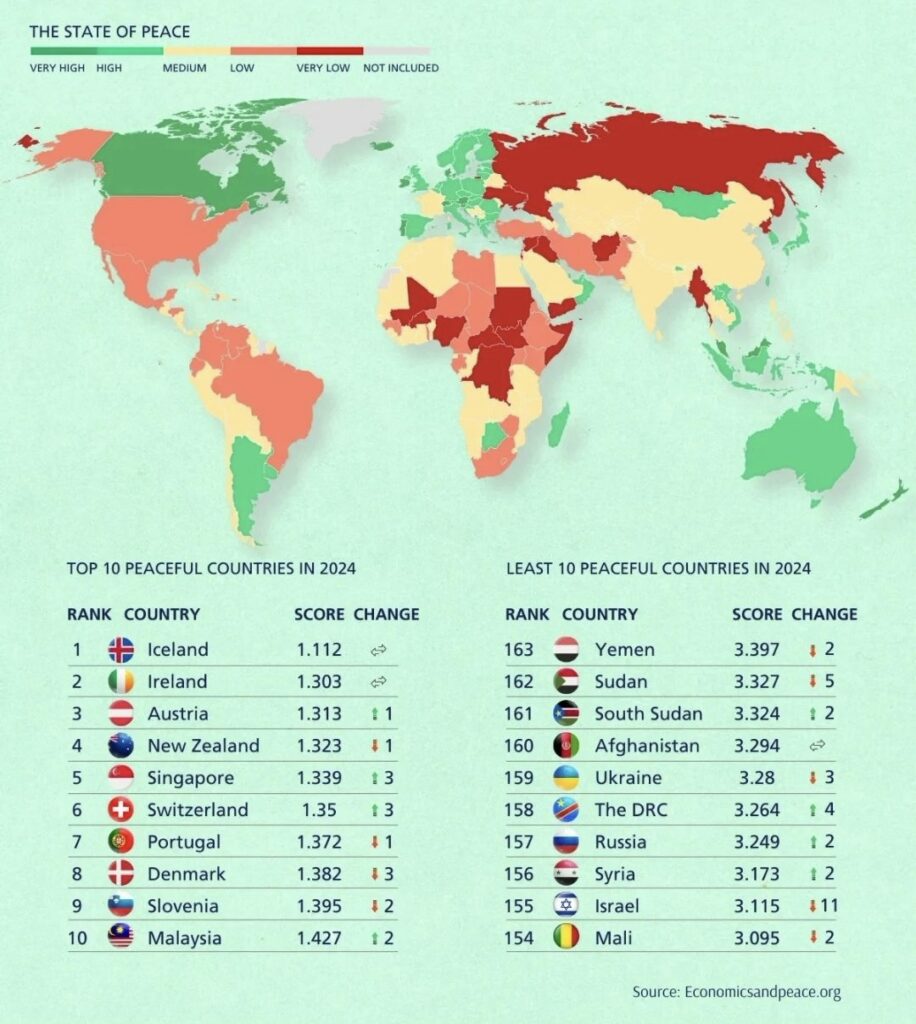
Fun fact: The Global Peace Index (GPI) ranks over 160 countries based on safety, stability, and conflict levels worldwide.
If you look at the map below, you’ll notice that Europe and parts of Asia-Pacific consistently rank among the safest regions. This is one of the reasons countries like Germany, New Zealand, and Singapore keep coming up as strong choices for Indian students.
But here’s the catch: a country being “safe globally” does not always mean it is the right fit for Indian students. Factors like jobs, visas, and cost matter just as much.
Safety today is layered. It is not just about crime, it is about your entire experience abroad.
What do we want? Low Crime + Walkable Cities…right?
This is the traditional definition:
Countries like Singapore, New Zealand, and the UAE consistently rank high here.
Simply put, we are talking about Clear Visas + No Sudden Changes
This is where things have changed the most.
Students today are asking:
Countries like New Zealand and Germany currently offer more predictable frameworks. This is why many students are now prioritising countries with stable rules and predictable approvals, including the fastest student visa processing countries.
Even a safe country can become stressful if:
Ireland and Australia, for example, are safe, but financially demanding.
Before choosing a country, it is important to understand the real cost of living abroad and how it impacts your long-term planning.
If the main goal is career growth (which it should be)
You have definitely looked into: Jobs + Stay-Back Pathways
A country is not “safe” if you cannot build a future there.
You need clarity on:
Understanding the best post-study work visa options becomes essential before choosing a destination.
Community + Inclusivity is arguably the most important aspect of surviving abroad.
This is often underestimated.
A good destination should offer:
| Layer | What to Check | Example |
|---|---|---|
| Physical | Crime rate, transport safety | Singapore, UAE |
| Policy | Visa stability | New Zealand |
| Financial | Rent + part-time balance | Germany |
| Career | Stay-back + jobs | Ireland |
| Social | Indian community | Australia |
Here is a practical ranking based on safety + stability + outcomes (not just rankings).
| Rank | Country | Avg Monthly Cost (₹) | Stay-Back Option | Best For |
|---|---|---|---|---|
| 1 | Germany | 80K–1.2L | 18 months of job search | ROI + Stability |
| 2 | New Zealand | 1.2L–1.6L | 1–3 years | Low stress + safety |
| 3 | Singapore | 1.5L–2L | Work pass-based | Premium education |
| 4 | Australia | 1.5L–2.2L | 2–4 years | Big market |
| 5 | Ireland | 1.4L–2L | 1–2 years | English + jobs |
| 6 | UAE | 1L–1.8L | Limited | Proximity + safety |
Germany offers one of the most balanced options today.
Why it works:
Best fit:
Students looking for long-term ROI and career stability
Watch-outs:
Closing note:
Germany is one of the safest and most practical destinations if you are willing to invest in language skills alongside your degree.
New Zealand stands out as a calm and destination, supportive particularly for families prioritising safety and wellbeing.
Why it works:
Best fit:
Students prioritising safety and peace of mind and a less competitive, more balanced lifestyle.
Watch-outs:
Singapore is consistently ranked among the safest countries in the world and offers a highly structured, efficient environment.
Why it works:
Best fit:
Students aiming for elite education
Watch-outs:
Closing note:
Singapore is best suited for students who can afford a premium experience and are prepared for a highly competitive ecosystem.
Australia remains a strong choice with structured pathways.
Why it works:
Best fit:
Students with clear goals and strong budgets anf financial records.
Watch-outs:
Ireland offers a strong balance for English-speaking students.
Why it works:
Best fit:
Students targeting tech, pharma, or business roles and want an English-speaking country.
Watch-outs:
The UAE offers one of the safest urban environments, combined with proximity to India.
Why it works:
Best fit:
Students want proximity and a standard of living
Watch-outs:
Some countries are very safe but require careful planning:
These are strong options, but not default choices.
A few years ago, the advice was simple:
Pick Canada, the UK, or Australia, you’ll be fine.
That assumption is weaker today.
Countries like Canada are still physically safe, but:
This does not make them unsafe. It makes them less predictable, which matters when families invest ₹20–40 lakhs.
This shift is why:
This shift has made many students question whether their choice is truly future-proof, which is why asking is studying abroad still worth it in 2026 has become more common.
Even in safe countries, risks exist.
Most top destinations are safe, but:
Simple takeaway:
For female and solo students, safety is less about the country itself and more about awareness, preparation, and everyday choices. Another important thing finding community wherever you go is of utmost importance and will make or break your experience.
Common issues include:
Always verify before paying or sharing personal information.
Examples:
Here are actionable steps every student should follow:
Yes, most top destinations are safe. However, safety depends on the city, university, and your lifestyle. Isolated incidents do happen, but they are not the everyday reality for most students.
You can get a job, but it is not guaranteed. Your chances depend on your course, skills, networking, and the country you choose.
Part-time work can help with daily expenses, but it usually cannot cover full tuition and living costs. You should not rely on it completely.
Most Indian students do not face daily discrimination. However, occasional incidents can happen anywhere. Choosing the right city and university makes a big difference.
This depends on the university and country. Some offer partial refunds, while others may deduct fees. Always check refund policies before applying.
It can be worth it if your course leads to strong job opportunities. Without clear career outcomes, the risk becomes higher.
PR is not automatic. Each country has different rules, and it usually depends on your job, salary, and long-term eligibility.
Many students feel this initially. It usually improves once you build a routine, make friends, and join student communities.
Yes, but only if they have the right skills and preparation. Jobs are not automatic, and outcomes vary by field and country.
Yes, but it can be challenging. Good time management is important to avoid affecting your academics.
This is a common issue in some countries. You may need temporary housing initially, so it is important to plan early.
In some cases, yes. However, many companies still hire international students who have the right skills and experience.
Yes, in some countries policies are becoming more structured. This is why choosing a stable destination is important.
You may get a chance to retake it, but repeated failures can affect your visa status. Universities usually provide academic support.
Waiting does not guarantee better conditions. If your profile and plan are ready, it is usually better to move forward.
In 2026–27, the safest country is not just the one with the lowest crime. It is the one where your journey is stable, manageable, and realistic.
For most Indian students:
At Maven, our focus is simple:
We help students choose destinations where they can actually succeed, not just go.
If you are planning your study abroad journey and if long-term settlement is part of your plan, understanding the best countries for PR after study abroad becomes equally important.
Need help choosing the safest country for your profile?
Let’s figure it out with clarity, not guesswork.