WhatsAppCHAT
CALL US& CONNECT

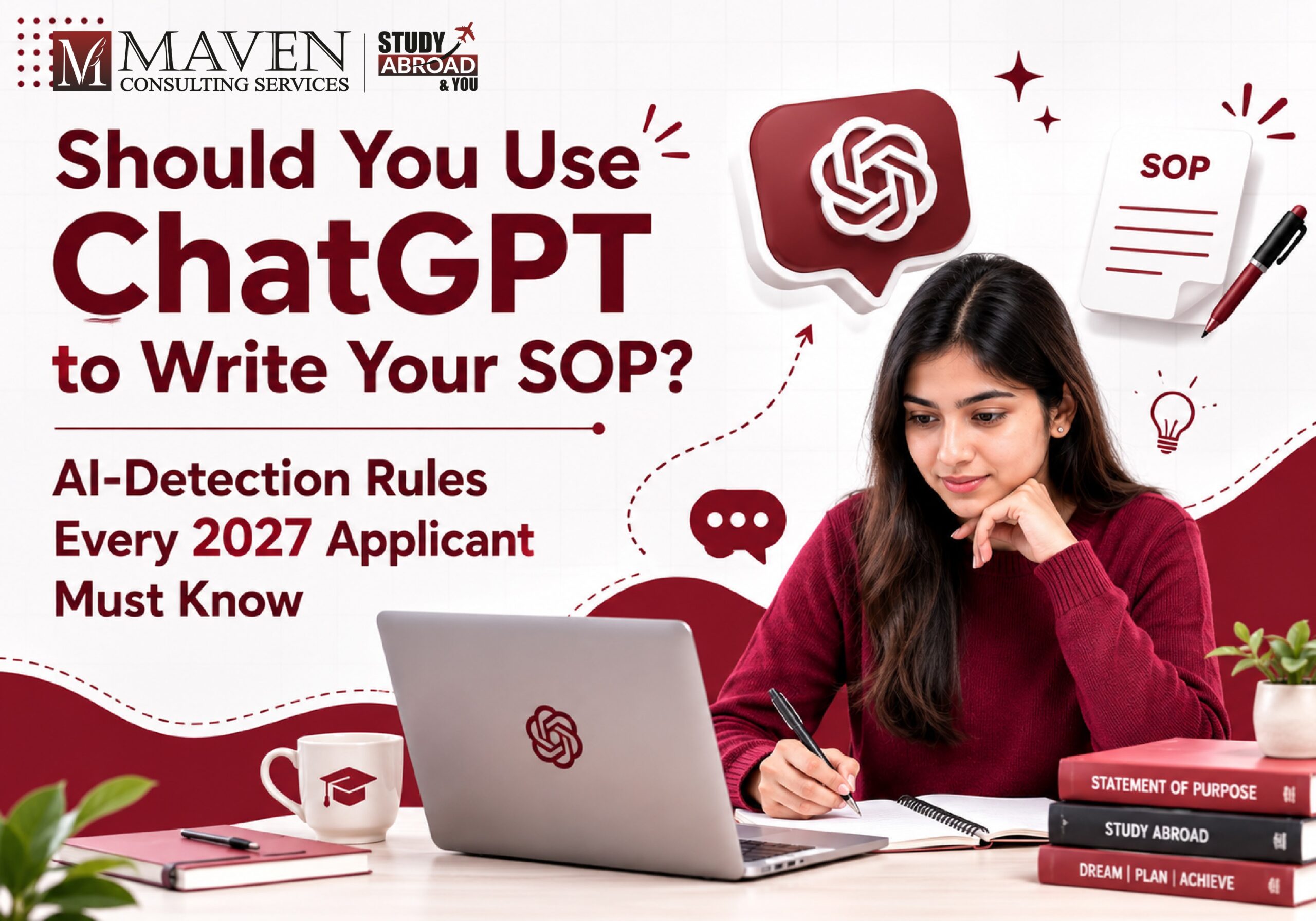

Here’s a statistic that should stop every Indian applicant in their tracks: in a Stanford study, seven popular AI detectors wrongly flagged 61.3% of human-written essays by non-native English speakers as AI-generated — even though real students wrote every word. So the question of whether to use ChatGPT to write your SOP isn’t as simple as “will the university catch me?” For Indian students, a 100% original Statement of Purpose can still get false-flagged — and a ChatGPT-written one usually fails for a completely different reason.
This guide on whether you should use ChatGPT to write your SOP cuts through the noise. We’ll look at what AI detection in admissions actually does, why it disproportionately misjudges Indian and other non-native English writers, what real universities say in their 2026–2027 policies, and the genuinely safe way to use AI without sabotaging your application. If you’re planning a 2027 intake to the USA or a UK university, this matters now, because policies and detection tooling are tightening for exactly your cycle.
Before we go deeper, two related reads worth keeping open: our profile-building guide and our breakdown of the most common reasons study abroad applications get rejected.
Using ChatGPT to brainstorm, structure, and grammar-check your SOP is usually fine and often explicitly allowed. Using it to generate the actual statement is a mistake on three fronts: it can breach university policy, it can trigger false-positive AI flags (a special risk for Indian writers), and — most importantly — it produces a generic SOP that a human reader sees through instantly. Write the substance yourself; let AI assist, not author.
AI detectors don’t “know” a text was written by a machine. They estimate it. Tools like Turnitin, GPTZero, and Originality.ai measure statistical patterns — most importantly perplexity (how predictable the word choices are) and burstiness (how much sentence length and rhythm vary). AI text tends to be smooth and predictable; human text tends to be messier. The detector then outputs a probability, not a verdict.
Turnitin, the most widely used tool in education, publicly claims roughly 98% accuracy with a stated false-positive rate of under 1% for documents containing at least 20% AI text. That sounds reassuring. But independent testing tells a more cautious story: false positives appear in roughly 2–5% of human-written texts in real-world use, and accuracy drops sharply — into the 20–63% range — on edited, paraphrased, or hybrid text. Turnitin itself now suppresses low scores and labels them less reliable.
In the UK, UCAS runs verification checks on every personal statement for similarity and AI patterns, and individual universities frequently run statements through Turnitin or GPTZero independently. In the US, practice varies widely by program: some run plagiarism and screening tools (the University of California system runs Personal Insight Question responses through plagiarism software), while many have no automated screening at all and rely on experienced human readers. The common thread everywhere: a flag triggers human review, not an automatic rejection.

This is the part generic “don’t use AI” articles skip — and it’s the part that matters most for you. AI detectors are measurably biased against non-native English writers.
In a 2023 Stanford study (Liang, Zou et al., published in Patterns), researchers ran 91 human-written TOEFL essays by non-native English speakers and 88 US eighth-grade essays through seven widely used GPT detectors. The detectors were near-perfect on the US students — under 10% false positives. But they wrongly flagged 61.3% of the human-written TOEFL essays as AI-generated. At least one detector flagged 97.8% of those non-native essays.
| Writer group (human-written essays) | False-positive rate (flagged as “AI”) |
|---|---|
| US-born students (native English) | Under 10% |
| Non-native English speakers (TOEFL essays) | 61.3% average |
| Non-native essays flagged by at least one detector | 97.8% |
Why does this happen? Detectors equate “predictable, lower-complexity language” with “machine-written.” Non-native writers typically score lower on the exact measures detectors use — lexical richness, syntactic complexity, and perplexity. In other words, the very features of careful second-language English get mistaken for AI.
The cruellest twist: in the same study, when researchers used richer, more native-like vocabulary, the false-positive rate dropped from 61.3% to 11.6%. So “polishing” your English to sound more sophisticated can actually make a human-written essay look more human to a detector — while a plainly written, honest SOP by an Indian student sits in the danger zone. This is why a real, self-written statement still deserves a careful, authenticity-focused review before submission.
There is no single global rule. Policies range from outright bans to “disclose it” to “grammar only.” Here’s a verified snapshot of named institutions for the current cycle — always confirm directly on the official admissions page, as these are updated frequently.
| Institution / system | Stated position on AI in applications |
|---|---|
| Harvard (Griffin GSAS) | Prohibits AI-generated application content; requires attestation the work is the applicant’s own, not created by generative AI |
| Columbia (GSAS, SIPA, Law) | Prohibit AI use in application materials; some require formal attestation |
| Brown University | Explicitly prohibits AI use; submissions must be entirely the student’s own work |
| Cornell University | Permits brainstorming and grammar checks; prohibits AI-drafted essays. Cornell Tech requires AI use to be disclosed and cited |
| Caltech | Permits AI but asks applicants to disclose how AI tools were used; disclosure does not penalise the application |
| Dartmouth College | “Use AI to think, not to write” — brainstorming and mechanics only |
| University of California (system) | Permits line-level editing for clarity and grammar; runs responses through screening software; content must be the student’s own |
| UCAS (UK, all universities) | AI-generated statements may be treated as cheating; applicants must now declare the statement was not copied or provided by AI software |
Two patterns are worth internalising. First, graduate programs are often stricter than undergraduate admissions at the same university — Columbia’s undergraduate stance differs from its GSAS and Law positions, and Duke Law bans AI entirely while undergraduate Duke is permissive. Always check your specific program. Second, the safest universal behaviour — write it yourself, use AI only for mechanics — complies with essentially every policy above.
The decision to use ChatGPT to write your SOP involves more than detection risk alone.
Suppose you decide to use ChatGPT to write your SOP and beat every detector. Your AI-written statement still loses — because of what it is, not whether it’s caught.
Admissions readers see thousands of statements. A generated SOP has a recognisable signature: confident but hollow. It says you are “passionate about leveraging cutting-edge technology to drive impactful solutions” without naming a single real project, professor, paper, or moment. UCAS puts it bluntly — a bland AI-generated personal statement is not what universities are looking for. The 2026 UCAS format even split the personal statement into three focused questions specifically because specific, reflective answers are harder to fake.
An AI model does not know:
Those specifics are exactly what separates an admit from a reject. A generic statement signals a generic candidate. (We go deeper on this in our guide to how universities evaluate Indian student applications.)
“In fourteen years of placing students, I have never seen a strong SOP that someone else — human or machine — could have written. The whole point of the statement is that only you can write it. When a student hands me a ChatGPT draft, my first question isn’t ‘will this get flagged?’ It’s ‘where are you in this?’ Usually, the honest answer is: nowhere. That’s the real failure.”
AI is a legitimate, useful tool when it assists your thinking instead of replacing it. Here’s the clear line.
| Generally safe (AI as a tool) | Risky or prohibited (AI as author) |
|---|---|
| Brainstorming themes and what to include | Generating the full SOP and submitting it |
| Asking for a sensible structure or outline | Asking AI to “write my statement about X” |
| Checking grammar, spelling, clarity after you draft | Letting AI rewrite paragraphs in its own voice |
| Getting feedback on a draft you wrote | Inventing achievements, internships, or motivations |
| Understanding what an SOP should accomplish | Paraphrasing AI output to “beat the detector” |
The real question isn’t just about using ChatGPT to write your SOP. It comes down to four things, none of which a model can supply for you:
If your SOP nails these four in your own honest voice, the question of whether to use ChatGPT to write your SOP largely takes care of itself — and a false flag becomes a defensible misunderstanding rather than an exposed shortcut.
They use tools like Turnitin and GPTZero plus experienced manual review, and UCAS runs verification checks on every statement. But detection is probabilistic, not proof — even Turnitin acknowledges false positives, and no tool reliably confirms a specific document was AI-written. The bigger practical risk is that a generic AI-written SOP simply reads as generic to a human.
It depends on the institution. Programs like Harvard GSAS, Columbia GSAS, and Brown prohibit AI-generated content and may require an attestation; others permit grammar editing only. A substantially AI-written SOP where it’s prohibited can be treated as misconduct and lead to rejection or a withdrawn offer.
A 2023 Stanford study found seven detectors misclassified 61.3% of human-written TOEFL essays by non-native English speakers as AI — versus under 10% for native US students — because non-native writing scores lower on the “perplexity” measures detectors use. A fully original SOP by an Indian applicant can still be false-flagged.
As a tool, yes — brainstorming, structuring, and grammar-checking are generally fine and often explicitly allowed. As a ghostwriter, no — it risks policy violations, false-positive flags, and a hollow statement with no real specifics or fit.
Increasingly, yes. UCAS now requires you to declare the statement wasn’t copied or provided by AI software, and some US programs (Caltech, Cornell Tech) explicitly require disclosure. Always check each institution’s specific policy.
Experienced readers spot generic motivation, missing specifics, an overly polished but impersonal tone, and clichés. UCAS itself warns a bland AI-generated statement isn’t what universities want, and the 2026 shorter-answer formats make generic text easier to catch.
Grammar and spelling tools that correct your own writing are generally accepted, and many programs explicitly permit line-level editing. The line is crossed when a tool generates or rewrites substantial content rather than correcting what you wrote.
Write the substance yourself with specific, verifiable details; use AI only to brainstorm structure and check grammar after drafting; read each university’s AI policy; keep your drafts as evidence; and have a human advisor review for authenticity rather than polish.
At Maven, we help Indian students write Statements of Purpose that are genuinely theirs: specific, honest, and built to pass both the human reader and the detector. No AI ghostwriting, no templates — just real guidance from 14+ years of placing 10,000+ students across 700+ university partners.
Book a Free ConsultationConclusion: Should you use ChatGPT to write your SOP? Use it to think, never to write. Detection tools are real but imperfect — and for Indian applicants, they carry a documented false-positive risk that punishes honest, plainly-written English. The deeper truth is simpler: a machine can’t write a statement that’s authentically yours, and “authentically yours” is exactly what wins admits. Let AI brainstorm and proofread. Let your own voice, specifics, and motivation do the rest.