WhatsAppCHAT
CALL US& CONNECT

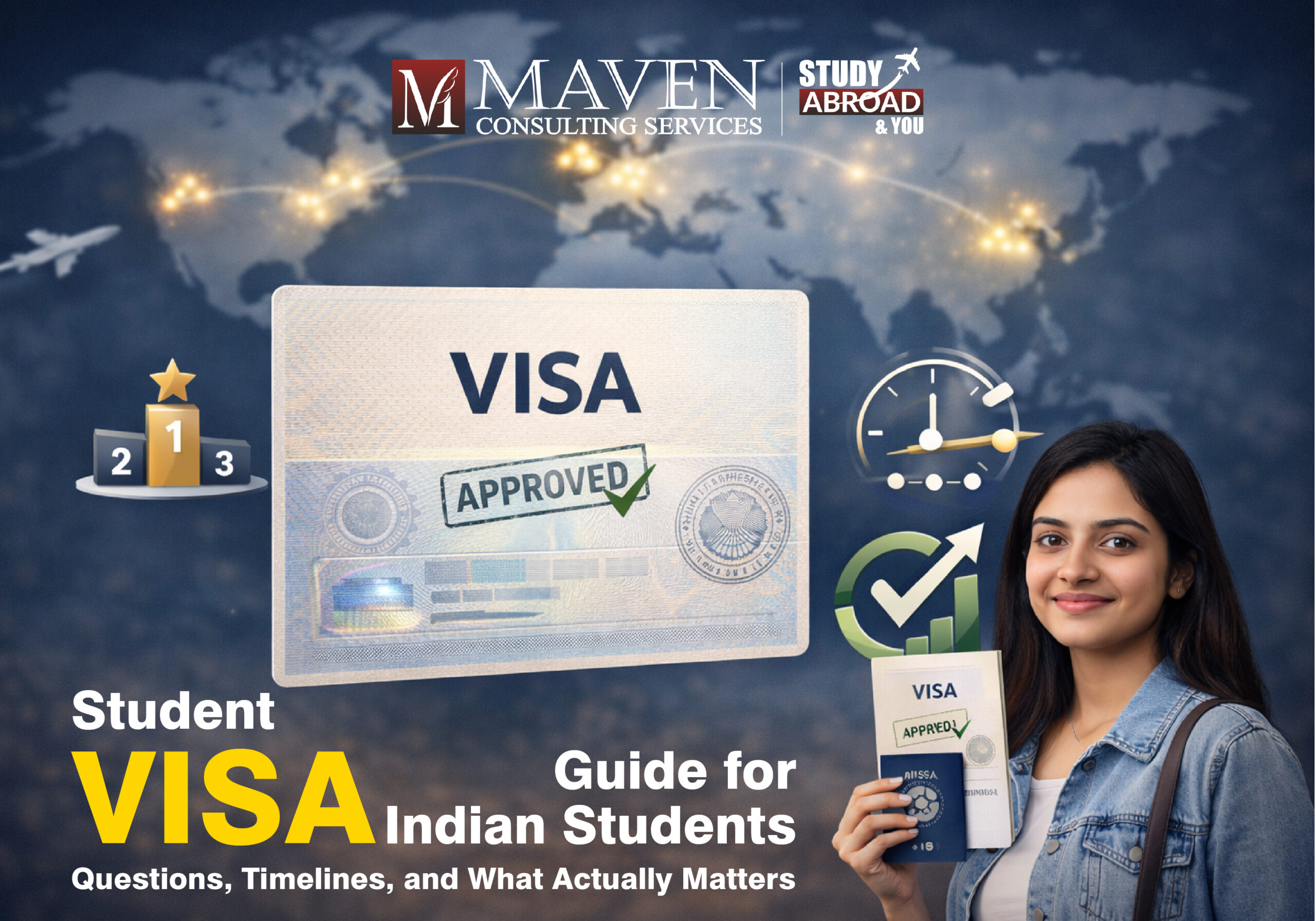
Once you decide to study abroad, the next big question usually isn’t about universities or courses anymore.
It’s about the student visa.
For many Indian students and families, this stage feels overwhelming. Not because the rules are impossible to understand, but because there is too much conflicting information. Some sources talk only about speed, others focus on approval rates, and many repeat outdated or incomplete advice. That uncertainty creates stress.
By the end of this guide, you should be able to:
The goal is clarity.
What Is a Student Visa and Who Needs One?
A student visa is a temporary permission that allows you to enter and stay in another country for education.
If you are an Indian citizen planning to study abroad for:
You will need a student visa or a student residence permit.
Short-term language programs or exchange semesters sometimes follow different rules, but most degree-seeking students fall under the standard student visa category.
Is a Student Visa Easy to Get?
This is one of the most common questions students ask. The honest answer is simple.
A student visa is not difficult, but it is strict.
Most countries approve a large percentage of genuine student applications. When refusals happen, they are usually due to:
When people talk about “easy” student visas, they usually mean countries where:
Speed and ease are often confused, but they are not the same thing.
Why Is My Student Visa Taking So Long?
Delays are very common, especially during peak application months.
Some typical reasons include:
A longer processing time does not automatically mean rejection. In most cases, it simply means your application is under review or waiting its turn.
Which Country Has the Highest Student Visa Success Rate?
Over the years, certain countries have shown consistently strong approval rates for Indian students, including:
That said, approval rates depend more on the quality of the application than on nationality. A clear offer letter, solid financial proof, and a logical study plan matter far more than choosing a “popular” country.
How Can I Apply for a Student Visa from India?
While details vary by country, the overall process usually looks like this:
Each country has its own system and portal, but the structure is broadly similar.
Where Do I Apply and Track My Student Visa?
Most countries allow you to:
Examples include:
It is always safest to rely on official government websites for updates.
What Documents Do I Need for a Student Visa?
Exact requirements vary, but most student visa applications ask for:
Clear and accurate documents matter more than submitting extra paperwork.
Student Visa Interviews: Do All Countries Have Them?
No. Interview requirements differ by country.
Interviews are usually meant to check:
Preparation is about being clear and honest, not memorising answers.
Can I Track My Student Visa Application Online?
Yes, in most cases.
You can usually see updates such as:
Tracking is done through official portals or VFS/TLS dashboards.
What Improves Student Visa Approval Chances?
Across countries, a few factors consistently help:
Last-minute applications are one of the biggest causes of avoidable problems.
What Are the Fastest Services for Student Visa Approval?
Some countries offer:
For example:
These services reduce processing time, but they do not reduce scrutiny.
Can a Student Visa Be Revoked?
Yes, though it is uncommon.
Revocations usually happen due to:
Following the rules after arrival is just as important as getting approval.
How to Think About Student Visas
A student visa is not something to rush through or fear. It is a screening process.
Countries that process visas quickly are not automatically more lenient. And countries that take longer are not necessarily risky.
The most reliable approach is simple:
When handled calmly and correctly, student visas are predictable. Most stress comes from misinformation, not from the process itself.
If you approach the visa as a system to understand rather than an obstacle to fight, the entire journey becomes far more manageable.

Sunday, October 26, 2025 | The Taj MG Road, Bangalore | 10 AM – 4 PM