/
Study Abroad for Working Professionals (25+): The Best Options for You

Study Abroad for Working Professionals (25+): The Best Options for You

Written byMaven
onDecember 17, 2025
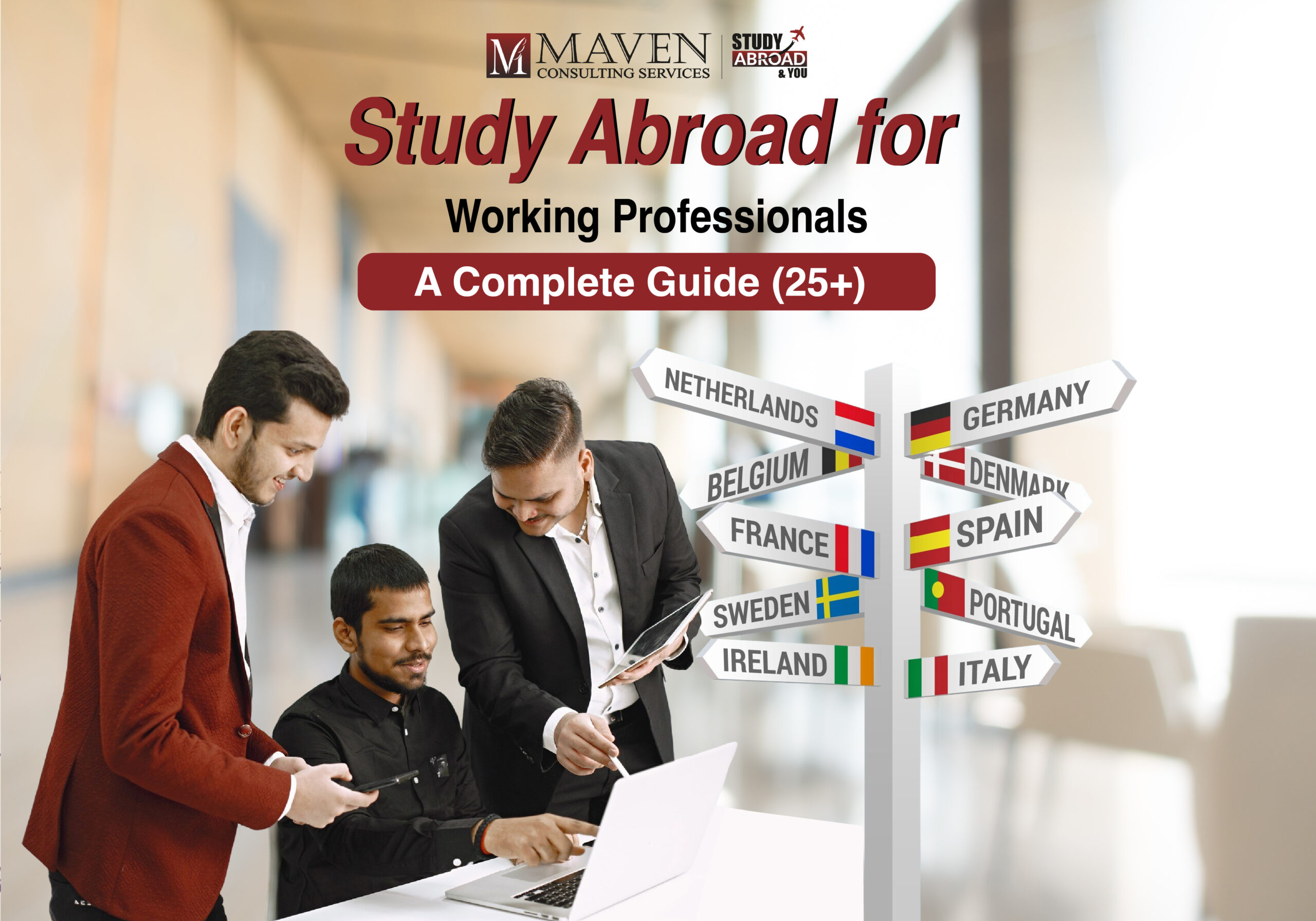
Indian working professional planning to study abroad for working professionals, reviewing global education options for career growth

If you’re an Indian professional Googling study abroad for working professionals, chances are you’re not doing it for “campus life” or cute autumn photos.

You’re doing it because something feels stuck.

Maybe you’ve hit a ceiling. Maybe your role is stable but not growing. Maybe you want a career switch (without starting from zero). Or maybe you’re simply tired of guessing your future one appraisal cycle at a time.

And then the doubts kick in:

  • “Am I too old?”
  • “Is this the worst time because the job market is messy?”
  • “What if I spend all that money and still don’t get a job?”
  • “Which country actually fits my budget and goals?”
  • “Who can help me end-to-end without pushing random universities?”

This guide is meant to be your one-stop page for the practical “which, where, how, what next, WHO” questions—especially if you’re 25+ and care about ROI and clarity.

What most guides about Study Abroad for Working Professionals don’t tell you (and why you feel confused)

A lot of study abroad content is written for freshers. For professionals, it misses the hard stuff:

1) Country selection is usually fluffy, not decision-grade

Most articles say: USA/UK/Canada/Australia/Germany are great.
But they don’t help you choose based on what actually matters to you:

  • Career switch vs career acceleration
  • Total cost vs realistic earning potential
  • Legal work rights during studies (this varies a lot and affects budgeting)

2) Program fit is rarely mapped for experienced profiles

Working professionals who want to study abroad need clarity on:

  • Which programs value work experience (specialised MS vs MBA vs MiM)
  • Executive vs full-time vs part-time formats
  • How to justify a pivot without sounding random

3) The admissions strategy for professionals is missing:

  • Positioning work impact into SOP/LORs
  • Explaining gaps and transitions cleanly
  • Shortlisting for “employability fit,” not just rankings

4) Finance + compliance info is often outdated

This is where people accidentally plan illegal work or work under budget.

So below, I’m going to be very specific and cite official sources for work rules, because those are the most commonly misquoted online.

Step 1: Decide what you want next (this is the real starting point)

Before tests, before shortlists, before “best country,” answer this:

Are you trying to switch careers… or grow in the same track?

If you want a career switch

You need:

  • A program with a strong practical curriculum + internships
  • A country where student work + post-study work is realistic
  • A story that makes your pivot feel intentional, not impulsive

If you want career acceleration

You need:

  • Strong industry ecosystem in your domain
  • Programs that respect experience and push you into better roles
  • Clear post-study work rights (or employer pathways)

A lot of professionals on forums say something like:

“There’s no rush to do a master’s… timing matters… but preparation meets opportunity.”

That’s the truth. You don’t need to panic. You need a plan.

Step 2: Pick countries using rules you can verify (not opinions)

Below are major destinations across the West + East/South-East Asia + Australia/NZ, with fact-checked student work rules.

1. Canada (stable + popular for Indian professionals)

Canada is often chosen for a reason: it’s structured.

  • Off-campus work during studies: up to 24 hours/week (as of Nov 8, 2024) 
  • Big emotional reality: housing pressure is real in many cities; plan deposits + rent carefully.

Best for: professionals wanting stability, structured pathways, and solid part-time work.

2. Australia (high employability energy, but budget matters)

Australia can work well for professionals who want fast momentum.

  • Work cap during course sessions: 48 hours per fortnight 
  • (Some research students may have different conditions—always verify your visa condition.)

Best for: people who want a straightforward study + part-time work setup and are prepared for high rent in big cities.

3. UK (fast degree, but rules are sponsor/program dependent)

The UK is attractive because many master’s programs are 1 year, which feels safer for professionals.

  • Work limits are governed by the Student route conditions and sponsor/course specifics (it’s not “one-size-fits-all”).
  • Many universities summarise typical limits as 20 hours/week during term time for degree-level students, but you must check your visa/BRP conditions.

Best for: professionals who want speed + strong brand value and can handle an intense timeline.

3. Germany (low tuition headlines are true, but integration is the real game)

Germany is brilliant for engineering, applied sciences, research, and increasingly tech—but it rewards preparation.

  • Non-EU international students can work 140 full days / 280 half days per year, or alternatively up to 20 hours/week (rules updated March 1, 2024).

Best for: professionals comfortable with planning, paperwork, and (ideally) learning German for better job access.

4. USA (high reward, high uncertainty—especially emotionally)

The USA still offers huge upside, but it’s not the easiest “part-time work” destination during study.

  • Many students can work on campus; off-campus work is restricted and typically needs specific authorisation (CPT/OPT routes—don’t DIY this without checking official guidance).
    I’m not adding exact CPT/OPT rules here because they’re often misinterpreted, and your university’s international office is the most accurate authority.

Best for: strong profiles in high-demand fields who can handle complexity and long-term uncertainty.

5. Singapore (premium brand, strict rules, expensive living)

Singapore is attractive for proximity to India, strong universities, and a solid industry reputation—but don’t assume you can freely work.

  • Singapore’s Ministry of Manpower warns it’s an offence to work without meeting eligibility conditions; Student’s Pass holders can work only if requirements are met. 
  • NUS guidance commonly states up to 16 hours/week during term time and unlimited hours during vacation (institution-specific but useful). 

Best for: professionals who can fund most costs and want a strong Asia career angle.

6. Taiwan (cost-friendly, semiconductor ecosystem interest, clearer hour cap)

Taiwan comes up a lot for engineers (especially semiconductors). The emotional theme you see online is: “Where can I grow and save long-term?”

  • Many university international offices in Taiwan state a 20 hours/week cap during the semester (except breaks) for students with work permits.

Best for: professionals targeting Taiwan’s specific industries (e.g., hardware/semicon supply chain) and wanting a more affordable study environment.

7. Japan (structured, rule-based, requires proper permission)

Japan is popular for safety and quality of life, but students must follow the process carefully.

  • Students generally need “Permission to Engage in Activity other than that Permitted,” and the common cap is up to 28 hours/week.

Best for: professionals who value structure, are open to language/culture adaptation, and have a clear field fit.

8. South Korea (possible, but permissions + language requirements matter)

Korea can work—especially if you’re in tech/design/innovation ecosystems—but part-time work is permission-led and often tied to language/proficiency.

  • University guidance referencing Korea Immigration Service materials highlights the required confirmation and conditions for student part-time work permission.

Best for: candidates who plan language readiness and don’t rely on part-time income as the only funding plan.

9. Hong Kong (policy has been changing—check this carefully)

Hong Kong is interesting because of the evolving work flexibility for non-local students.

  • Hong Kong’s official government news notes that with a No Objection Letter (NOL), full-time non-local postgraduate students can take part-time employment with no restriction on hours/location, and the policy has been expanding.
  • Universities also explain NOL-based arrangements for internships / on-campus part-time / summer jobs.

Best for: those targeting HK’s finance/business corridor and who will verify the NOL conditions for their exact program.

10. New Zealand (recently increased work hours)

NZ is smaller, calmer, and often preferred by people wanting a simpler environment—plus work hours increased recently.

  • From 3 Nov 2025, eligible student visa holders can work up to 25 hours/week (new visas include it; some current holders need a variation of conditions).

Best for: professionals who value lifestyle + clarity and want legitimate part-time work flexibility.

Comparison table (quick decision-grade snapshot)

DestinationTerm-time work rule (fact-checked)“Best for” signalNotes you must plan for
Canada24 hrs/week off-campusStability + structured pathwaysHousing costs vary widely
Australia48 hrs/fortnightEmployability + straightforward rulesRent can be high
UKOften 20 hrs/week (verify visa)Fast 1-year master’sSponsor/course conditions matter
Germany140 full / 280 half days or 20 hrs/weekLow tuition + strong engineeringLanguage + housing + paperwork
SingaporeEligibility-based; common uni guidance 16 hrs/weekPremium Asia hubVery strict compliance
TaiwanCommon guidance 20 hrs/week during semesterCost-friendly + niche industriesWork permit discipline
JapanCommon cap 28 hrs/week with permissionStructured environmentPermission required; restricted sectors
Hong KongWith NOL, postgrads may have no hour restrictionFinance/business corridorPolicy-based; verify NOL terms
New ZealandFrom 3 Nov 2025: 25 hrs/weekLifestyle + claritySome need a variation of conditions

Two quick case examples (because this is what it feels like in real life)

Case 1: “The market is bad. Should I wait?”

Profile: 26, IT, 3.5 years exp, Mumbai
Emotion: “Counsellors only tell me positives. What if I regret it?”
Better approach: shortlist programs with employability fit + build a timeline where you don’t quit your job too early.

Reality: timing matters, yes—but the bigger lever is: skills in demand + targeted program + clean execution.

Case 2: “I’m 34. Is it too late?”

Profile: 34, policy + research experience
Emotion: “Will employers abroad view me as too old?”
Reality: Many countries and classrooms don’t mind age; what matters is your narrative and how the degree connects to your next role (not the degree alone).


FAQs: Study Abroad for Working Professionals (25+)

1) Am I too old at 28, 32, or 35 to study abroad?

No. In most countries, universities don’t evaluate “age” the way families do. They evaluate fit: your goals, your experience, and whether the program makes sense for your next step. In many international classrooms, it’s normal to see students in their late 20s and 30s—especially in career-focused master’s programs.

2) Should I do IELTS/GRE/GMAT first, or shortlist first?

Shortlist first (at least roughly). Otherwise, you may waste time and energy preparing for tests you don’t need or aiming for score thresholds that don’t match your target programs.
A clean professional approach is:

  • Goal clarity → country fit → program fit → shortlist → tests → applications

3) Can I apply without quitting my job? What timeline works?

Yes, many working professionals who want to study abroad apply while employed. In fact, it’s often smarter because:

  • You stay financially stable while applying
  • You can build stronger SOP/LORs with ongoing impact at work
  • You avoid panic decisions
    A practical timeline is usually 9–15 months before intake, depending on the country and your readiness.

4) How do I write SOP/LORs if I’ve been out of college for years?

You shift the weight to your work story:

  • Projects, impact, leadership, results
  • What you learned and what you now lack
  • Why is this program/country the logical bridge
    For LORs, many universities accept professional recommendations from managers/leads, especially for experienced candidates.

5) Which is better for me: specialised MS, MiM, or MBA?

A simple way to decide:

  • Specialised MS: upskill or pivot into a specific role (data, AI, cybersecurity, engineering mgmt, etc.)
  • MiM: early-career management track (often better for 0–2 years; less ideal for 5+ years exp)
  • MBA: leadership/management track, usually stronger for 4–6+ years of experience
    The right answer depends on your goal, not your job title.

6) Which are the best countries to study abroad and work part-time?

If you care about legal part-time work as a budget lever, always verify term-time work rules on official portals (because they change). In general:

  • Some countries have clear caps (e.g., weekly/fortnightly)
  • Some are permission-driven (often in Asia)
  • Some depend on program + sponsor rules
    Your budget should never assume part-time income as guaranteed — it should be a support, not the backbone.

7) What about PR and long-term settlement? Is it still realistic?

Realistic, yes — “easy,” no. A lot of people online say it well: there’s no truly “easy PR” anymore in most Western countries. The smarter approach is:

  • Choose based on career demand + employability + compliance
  • Treat PR as a long-term outcome, not the only purpose
  • Don’t bet everything on one pathway—build options

8) Can I take my spouse/dependents?

This depends heavily on country rules, your course level, and visa policies (which are time-sensitive). It’s possible in many cases, but it changes often — so treat this as an “official-source-only” topic and plan early.

9) What if I don’t get a job after graduating?

This is the fear almost every working professional has, and it’s valid. The best risk-control steps are:

  • Don’t pick a generic program just because it’s easy
  • Choose a destination with a job market that matches your field
  • Build employability early: projects, internships, networking, language (where needed)
  • Keep a buffer fund so you’re not forced into desperate decisions

Conclusion

If you’re 25+ and considering this move, you’re not confused because you’re indecisive. You’re confused because most online content doesn’t answer professional-grade questions.

You’re not looking for inspiration.
You’re looking for clarity:

  • Which country fits my goals and budget?
  • What’s legal, what’s realistic, what’s risky?
  • Which program actually values work experience?
  • How do I apply without messing it up?
  • What happens after admission and after graduation?

And here’s the truth:
Study abroad for working professionals who want to study abroad works brilliantly when it’s planned like a career move—not like a gamble.

Now, the “WHO” part: Where Maven Consulting Fits In

Official portals should always be your source of truth for rules (work rights, visa conditions, compliance). But rules alone don’t get you results.

That’s where Maven comes in.

What Maven helps you do (without forcing choices)

  • Evaluate your profile through a structured, self-assured process
  • Identify strengths + gaps (and what to do about them)
  • Help you shortlist countries and programs based on your goals and ROI, not “popular picks”
  • Guide you through SOP/LOR strategy, so your work experience becomes your advantage
  • Support end-to-end execution so you don’t keep guessing “what next?”

If this guide made you think, “Okay… I need a real plan now,” then your next best move is a profile evaluation. So you stop relying on generic advice and start making decisions based on your reality.

Click here to art your journey today!
Found it useful?
Don't forget to share this article
[addtoany]
0 0 votes
Article Rating
Subscribe
Notify of
guest
0 Comments
Oldest
Newest Most Voted
Inline Feedbacks
View all comments

Subscribe to Maven's WhatsApp broadcast list.

And stay updated with important updates & guidance.

    Your Full Name

    Your Whatsapp No.

    Your Email

    Country Interested

    Get FreeApplication Timeline Chart

    Instantly in your Mailbox

      Explore Your Study Abroad Dream: Meet Top Universities in Bangalore!

      Sunday, October 26, 2025 | The Taj MG Road, Bangalore | 10 AM – 4 PM