WhatsAppCHAT
CALL US& CONNECT

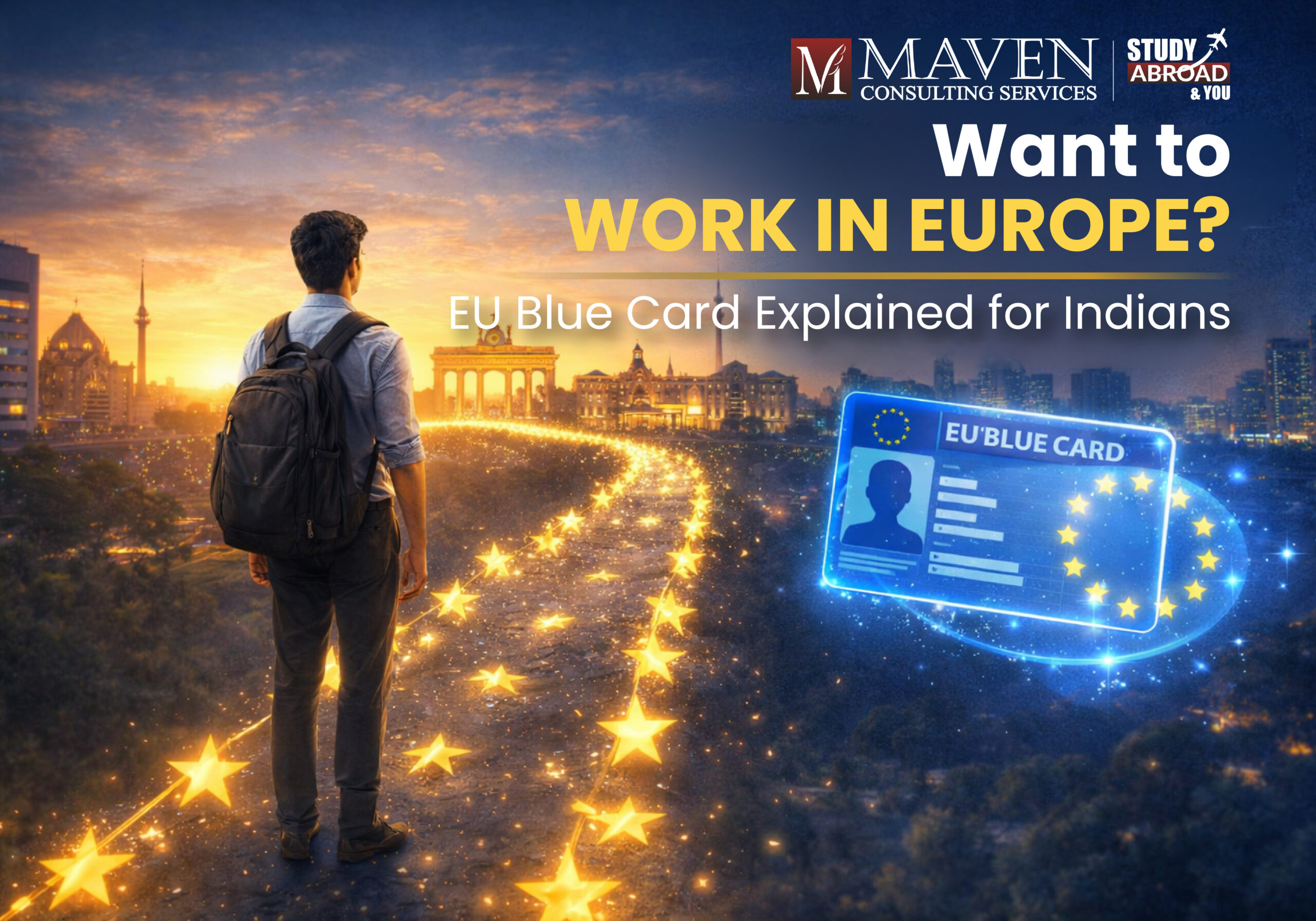
If you’re planning to work in Europe, you’ve probably come across the EU Blue Card for Indians— often described as the fastest route to jobs and PR.
But here’s the catch: most students misunderstand how it actually works.
The EU Blue Card is not a job search visa. You only qualify for it after securing a job that meets specific salary requirements.
By the end of this guide, you should have a clear understanding of whether the EU Blue Card is a realistic option for your profile, which European country aligns best with your career goals and salary expectations, and the exact steps required to move from studying to working in Europe.
The EU Blue Card is a residence permit designed to attract highly skilled workers from outside the European Union. It allows qualified professionals to live and work in a participating EU country if they have a job offer that meets specific salary and qualification criteria.
The program was introduced by the European Union to address shortages in specialised industries such as technology, engineering, research, and healthcare.
The Blue Card system exists to help European economies recruit professionals in sectors where there is a shortage of qualified workers. It also provides a structured migration pathway for skilled workers from countries outside the EU, including India.
A regular work permit and an EU Blue Card both allow foreign nationals to work in Europe, but they differ in a few ways:
The Blue Card is typically issued to professionals in fields where Europe experiences talent shortages. These commonly include:
Most EU countries participate in the Blue Card program. Some of the most common destinations for Indian professionals include:
Each country has its own salary thresholds and employment conditions.
Eligibility for the EU Blue Card depends on several factors, including education level, salary, and the nature of the job offer.
Most EU countries require applicants to hold a recognised university degree. This typically means:
In Germany, for example, degrees are often checked through the Anabin database to confirm recognition.
The EU Blue Card cannot be obtained without employment. Applicants must have:
Degrees from Indian universities are often accepted, but recognition may depend on the institution and program. If the degree is not recognised automatically, applicants may need a credential evaluation such as WES, ECE, or ACEI evaluation (A Comprehensive Guide on WES Evaluation)
Some countries allow highly experienced professionals to qualify without a traditional degree, particularly in IT roles. However, this option is less common and typically requires substantial experience.
Fresh graduates from European universities sometimes qualify for the EU Blue Card if they secure a job that meets the salary requirement. However, entry-level salaries do not always meet these thresholds, which means some graduates initially work under other permits before transitioning to the Blue Card.
One of the most important eligibility criteria for the EU Blue Card is the minimum salary requirement. This threshold ensures that the Blue Card is issued only for highly skilled employment.
Salary thresholds were updated in January 2026 and vary by country.
Below is a simplified comparison of salary thresholds in several major EU countries.
| Country | Minimum Salary (2026) |
|---|---|
| Germany | €50,700 per year |
| Netherlands | €71,304 per year |
| France | €59,373 per year |
| Spain | €40,077 per year |
These figures are subject to change, so applicants should always verify them with official sources before applying.
Germany remains one of the most accessible countries for Indian professionals.
Industries where Blue Card holders commonly work include automotive engineering, manufacturing, software development, and data science.
The Netherlands has one of the highest thresholds, which makes entry more difficult for fresh graduates. Many professionals instead use the Highly Skilled Migrant visa.
France calculates its threshold based on national averages, but the practical requirement aligns around this level.
Spain has one of the lowest salary thresholds among major EU countries, but job availability in English-speaking roles may be limited.
The EU Blue Card is available in most European Union member states.
Countries commonly issuing Blue Cards include:
Germany currently issues one of the largest numbers of EU Blue Cards, particularly to professionals from India working in engineering and IT.
Indian students who complete a degree in Europe sometimes transition to the EU Blue Card after graduation.
However, the process typically involves a few steps:
The exact process depends on the country.
Germany allows graduates from German universities to stay in the country for up to 18 months after graduation to search for employment.
Once eligible, you can apply for the EU Blue Card.
Click here to access that Germany Federal Government Skilled Immigration Portal.
The Netherlands offers a one-year Orientation Year visa.
France allows graduates to obtain temporary work authorisation after completing certain degrees. This period helps in securing a job that meets Blue Card eligibility.
Spain allows graduates to remain in the country for a limited period after completing their studies to search for employment.
Certain sectors are far more likely to meet the salary thresholds required for the EU Blue Card.
Common examples include:
Europe has an increasing demand for specialists in:
Some healthcare and research positions also qualify for the Blue Card, depending on salary and qualifications.
Many international companies operating in Europe sponsor highly skilled employees for Blue Cards. These can include:
In Germany, large automotive and industrial firms frequently hire international engineers. Technology companies across Europe also recruit software engineers and data specialists from outside the EU.
The application process typically follows these steps.
The most important requirement is obtaining a job offer that meets the salary threshold.
Applicants should ensure their degree is recognised in the host country.
The job contract must meet the minimum salary requirement.
Depending on the country, applicants may first receive a work visa allowing them to enter the country.
After arrival, the applicant typically applies for the Blue Card residence permit with the local immigration authority.
Commonly required documents include:
Additional documents may be required depending on the country.
Processing times vary depending on the country and the specific immigration office.
Typical timelines include:
Costs may include:
Applicants should check the latest fees with the immigration authority of the destination country.
One of the reasons professionals pursue the EU Blue Card is the potential pathway to permanent residency.
In Germany, Blue Card holders may apply for permanent residency after:
Permanent residency is typically possible after five years of legal residence, though other permit types may apply.
Spain may allow permanent residency after five years of residence, though rules can vary.
France generally requires several years of residence and may also require language proficiency.
One advantage of the EU Blue Card is mobility within Europe.
After working in one EU country for a period (often around 12–18 months), Blue Card holders may be able to move to another participating country for employment.
However, they still need to meet the requirements of the new country, including salary thresholds.
EU Blue Card holders are typically allowed to bring their families to the host country.
Family members may include:
In many countries, spouses are allowed to work without needing a separate work permit.
The EU Blue Card is a residence permit issued to highly skilled professionals from outside the EU who have a qualifying job offer with a salary above the required threshold.
It is possible if the graduate secures a job meeting the salary requirement, though many entry-level jobs do not reach the threshold immediately.
The threshold varies by country, but it typically ranges between approximately €40,000 and €60,000, depending on the destination and occupation.
Germany generally requires a salary of around €45,000, with lower thresholds for shortage occupations such as IT and engineering.
Yes, but they must still apply for authorisation in the new country and meet its specific eligibility criteria.
The EU Blue Card can be a practical pathway for Indian students and professionals who plan to build a long-term career in Europe—but it only works if the fundamentals are in place: the right degree, a qualifying job, and a salary that meets the threshold.
For some, especially those in IT, engineering, or high-demand fields, it can lead to faster stability and even permanent residency. For others, the path may take longer—starting with post-study work options before transitioning to the Blue Card.
The key is not just understanding the process, but knowing how it applies to your profile, target country, and career goals.
If you’re unsure where you stand or how to plan your move from studies to a job in Europe, getting clarity early can make a significant difference. Maven Consulting Services works with students and professionals to map out realistic study-to-work pathways based on current visa rules, job markets, and long-term opportunities.

Sunday, October 26, 2025 | The Taj MG Road, Bangalore | 10 AM – 4 PM