WhatsAppCHAT
CALL US& CONNECT


Planning to study in Germany in 2027? For Indian students, Germany offers a rare mix:
Zero Tuition • 18-Month Job Seeker Visa • EU Blue Card Pathway
This guide covers the essentials: top universities, real costs, APS certificate, blocked account, visa process, scholarships, part-time work, PR pathway, and whether Germany is the right choice for your profile.
| €0 Tuition at public universities | €11,904 Blocked account required | 18 mo. Post-study job seeker visa | 400+ English-taught programmes | APS Certificate mandatory |
Germany has quietly become one of the most rational study abroad destinations for Indian students, particularly for engineering, sciences, and technology. While the UK raises fees and Canada tightens immigration pathways, Germany’s public universities continue to offer world-class education at near-zero tuition cost, backed by a structured post-study work pathway into Europe’s largest economy.
| €0 Tuition at public unis | 42,000+ Indian students in Germany | 400+ English-taught programmes | 33 mo. To permanent residency |
| MAVEN INSIGHT |
|---|
| In 14+ years of sending students abroad from Karnataka, the most common regret I hear is not “I should not have gone to Germany” — it’s “I wish I’d gone sooner.” The APS certificate, blocked account, and early application timelines trip students up. |
| Start planning 12-18 months before your intended intake. |
Before committing to Germany, every Indian family deserves a side-by-side view of what each destination offers in 2027. This is the table we use in every Maven consultation:
| Factor | Germany | USA | UK | Canada | Australia |
|---|
| Avg. MS Tuition/yr | €0 – €3,000 | $25,000 – $60,000 | £18,000 – £30,000 | CAD 18,000 – 35,000 | AUD 28,000 – 48,000 |
| Living Cost/month | €900 – €1,400 | $2,000 – $3,500 | £1,200 – £2,000 | CAD 1,800 – 2,800 | AUD 2,000 – 3,000 |
| Part-time work | 120 days/year | 20 hrs/wk (on campus) | 20 hrs/week | 20 hrs/week | 48 hrs/fortnight |
| Post-study work | 18 months | 12–36 mo. OPT/STEM | 24 months (PSW) | 3 yrs PGWP | 2–4 years |
| PR pathway | 33 months (21 with B1) | H-1B lottery | 5 years (Skilled) | Express Entry 1–3 yrs | 2–7 years |
| Total 2-yr MS cost (INR) | ₹20 – 40 lakhs | ₹1.2 – 2.5 Cr | ₹60 – 90 lakhs | ₹70 – 100 lakhs | ₹85 – 120 lakhs |
| IMPORTANT CAVEAT |
|---|
| Germany’s €0 tuition applies to PUBLIC universities only. Private universities in Germany (e.g., IU International, EU Business School) charge €10,000–€20,000/year. Baden-Württemberg additionally charges non-EU students €1,500/semester. Always verify whether your target institution is public or private before applying. |
Germany has over 400 state universities and universities of applied sciences (Fachhochschulen). For Indian students, the strongest choices by discipline are listed in the table below.
| University | QS Rank | Semesterbeitrag | English Programmes | Strengths |
|---|
| TU Munich (TUM) | #37 globally | ~€162/semester | 60+ | CS, Robotics, Mech, Data Science |
| RWTH Aachen | #106 globally | ~€300/semester | 40+ | Mech Eng, Electrical, Materials |
| LMU Munich | #59 globally | ~€162/semester | 30+ | AI, Data Science, Physics |
| KIT Karlsruhe | #116 globally | ~€175/semester | 25+ | Chemical Eng, Physics, CS |
| TU Berlin | #154 globally | ~€310/semester | 35+ | CS, Electrical Eng, Architecture |
| Univ. of Mannheim | Top 5 Germany (Mgmt) | ~€175/semester | 20+ | MBA, Finance, Marketing |
| Course | Duration | Starting Salary | Top Employers |
|---|
| M.Sc. Computer Science | 2 years | €52,000 – €72,000/yr | SAP, Siemens, Deutsche Telekom |
| M.Sc. Data Science / AI | 2 years | €55,000 – €75,000/yr | BMW, Bosch, Allianz, fintech |
| M.Sc. Mechanical Eng. | 2 years | €48,000 – €65,000/yr | BMW, Volkswagen, Mercedes-Benz |
| M.Sc. Electrical Eng. | 2 years | €48,000 – €64,000/yr | Siemens, BASF, Infineon |
| MBA (Mannheim / WHU) | 1–2 years | €65,000 – €90,000/yr | Consulting, finance, FMCG |
The Academic Evaluation Centre (APS) certificate is MANDATORY for Indian students applying to German universities. APS verifies the authenticity of your academic documents (10th, 12th, and degree marksheets, transcripts). Without it, your application will not be processed.
| APS APPLICATION PROCESS |
|---|
| Where: | APS India offices in New Delhi and Chennai |
| Timeline: | 4–6 weeks after submitting documents; interview scheduling adds 2–4 weeks |
| Fee: | Approximately Rs. 22,000 (subject to change) |
| Documents: | All original marksheets, degree certificate, photo ID |
| Maven tip: | Apply for APS as your very first step — before finalising your university list. |
| Requirement | Typical Standard | Notes |
|---|
| Bachelor’s CGPA | 7.0–7.5+ for top unis; 6.5+ for mid-tier | Converted using Modified Bavarian Formula |
| IELTS | 6.5–7.0 overall | English-medium instruction certificate may substitute |
| TOEFL iBT | 90–100 | Accepted by most German universities |
| GRE | Not required (most programmes) | Some US-modelled programmes request it |
| German language | TestDaF 4 or DSH-2 (if German-taught) | English-taught MS does NOT require German |
| Statement of Purpose | 1–2 pages, structured | #1 rejection reason at TUM and RWTH is poor SOPs |
| Letters of Recommendation | 2–3 academic/professional | From professors or direct supervisors only |
| GERMAN GRADE FORMULA |
|---|
| German Grade = | 1 + 3 x (Maximum Grade – Your Grade) / (Maximum Grade – Minimum Pass) |
| Example: | CGPA 7.5/10, minimum passing grade = 4.0 = 1 + 3 x (10 – 7.5) / (10 – 4.0) = 2.25 (Good — acceptable for most universities) |
| CGPA 8.0/10 converts to approximately 1.83 (Very Good) — significantly improves your competitiveness at TUM and RWTH Aachen. |
You can use the grade converter by official sources their website. For example:
Germany’s near-zero tuition is real, but total cost of attendance varies significantly by city, lifestyle, and programme. Here is an honest breakdown.
| Expense | Munich (Expensive) | Berlin (Moderate) | Dresden/Leipzig (Budget) |
|---|
| Tuition (public uni) | €0 + €162 Semesterbeitrag | €0 + €310 Semesterbeitrag | €0 + €200 Semesterbeitrag |
| Accommodation/ month | €800–€1,100 (dorm: €500) | €600–€900 (dorm: €400) | €350–€550 (dorm: €280) |
| Food & groceries/month | €250–€350 | €220–€300 | €180–€250 |
| Health insurance/month | €110–€160 | €110–€160 | €110–€160 |
| Transport | Included in Semesterbeitrag | Included in Semesterbeitrag | Included in Semesterbeitrag |
| TOTAL Annual (approx.) | €15,000–€20,000 | €12,000–€17,000 | €8,000–€12,000 |
| In INR (approx.) | Rs. 13.5–18 lakhs | Rs. 10.8–15.3 lakhs | Rs. 7.2–10.8 lakhs |
The Semesterbeitrag covers your semester registration AND a public transport pass (Semesterticket) valid on all local transport. In Munich this saves €85+/month. Health insurance is mandatory. Students under 30 qualify for the statutory student rate of ~€110–€130/month with providers like TK, AOK, or Barmer.
| BADEN-WUERTTEMBERG TUITION ALERT |
|---|
| Baden-Wuerttemberg is the only German state that charges non-EU students €1,500/semester (€3,000/year) in tuition. If you are applying to KIT, University of Freiburg, or University of Stuttgart, factor this into your budget. |
A blocked account (Sperrkonto) is a German bank account that holds your living cost funds for the year. The German embassy requires proof of this account before issuing a student visa. You cannot access the funds freely — only €992/month is released monthly after arrival.
| €11,904 Total blocked amount 2027 | €992/mo Released monthly post-arrival | 3–4 wks Typical setup time | 3 Main approved providers |
| Provider | Setup Fee | Monthly Fee | Setup Time | Notable Feature |
|---|
| Coracle | €89 (one-time) | €0 | 3–5 business days | Fastest; popular with Indian students |
| Fintiba | €89 (one-time) | €4.90/month | 3–5 business days | Digital-first; SEPA account included |
| Expatrio | €89 (one-time) | €0 | 3–5 business days | Bundles with health insurance options |
| Deutsche Bank | €0 | €0–€3.90 | 4–6 weeks | Traditional bank; may need in-person verification |
| MAVEN’S BLOCKED ACCOUNT RECOMMENDATION FOR INDIAN STUDENTS STUDYING IN GERMANY |
|---|
| For most Indian students, Expatrio or Coracle are the fastest options. Deutsche Bank is free but takes 4–6 weeks — a timeline that has caused students to miss visa appointments. |
| Set up your blocked account at least 8 weeks before your VFS appointment date. Download the official blocked account certificate immediately after setup and verify the amount matches exactly what the embassy requires. |
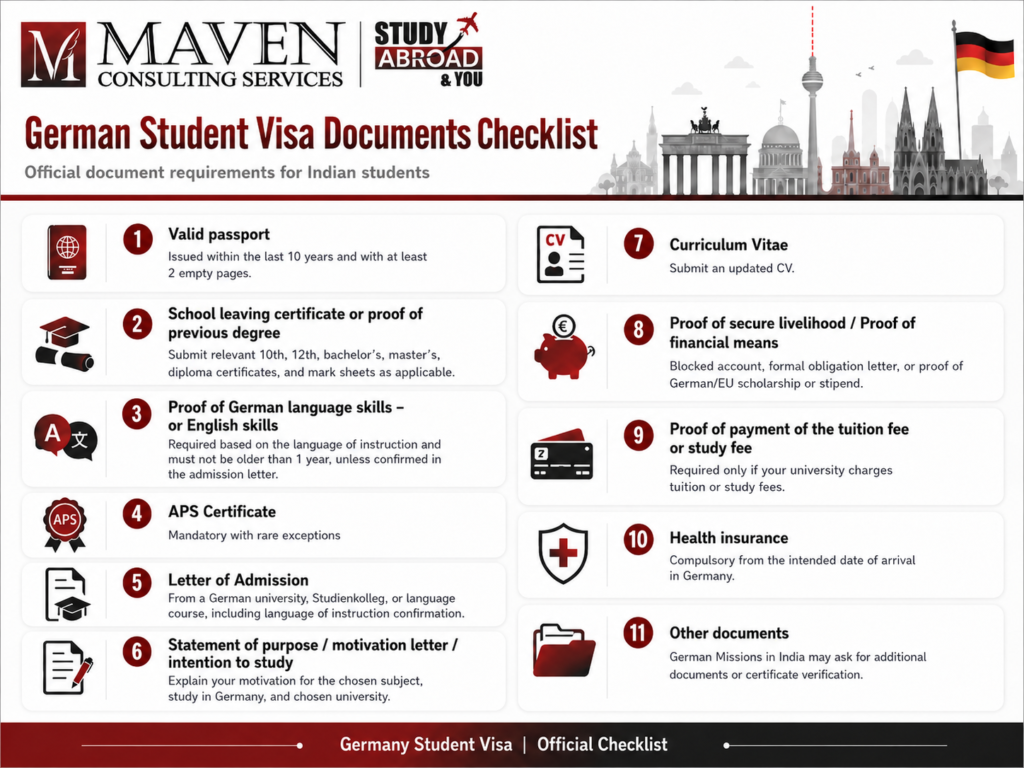
The German student visa (National Visa, Type D) is issued by the German Embassy in New Delhi and Consulates in Mumbai, Chennai, Kolkata, and Bengaluru.
| Step | Action | Key Requirement |
|---|
| Step 1 | Receive University Admission Letter | Unconditional offer (Zulassung) required — conditional offers not accepted |
| Step 2 | Set Up Blocked Account | Sperrkonto with Coracle/Expatrio/Deutsche Bank — transfer €11,904 |
| Step 3 | Book VFS Appointment | Book IMMEDIATELY after admission — slots book 3–5 months in advance |
| Step 4 | Prepare Document Package | Originals + certified copies; regional language docs need certified English translation |
| Step 5 | Attend VFS Appointment | Biometrics collected; consular interview possible — be prepared |
| Step 6 | Visa Processing | 6–12 weeks processing; convert to residence permit at Auslaenderbehoerde on arrival |
Roughly 1 in 8 Indian applicants receives a consular interview call. Questions focus on:
1. Why Germany (and not another country)?
2. Why this university and programme?
3. What do you plan to do after graduation?
“I want to settle in Germany permanently” stated too bluntly can raise flags.
Maven’s mock visa interview sessions prepare you to answer naturally and confidently. Over 99.8% of our visa applicants have been successful.
Germany offers more publicly funded scholarship support than most destinations. Here are the programmes most relevant for Indian students:
| Scholarship | Amount/Month | Level | Application Window |
|---|
| DAAD Research Grants | €861–€1,200 + travel | PhD / Postdoc / MA Research | September–November |
| DAAD Helmut Schmidt Programme | €934 + travel | Master’s (public policy, dev. econ.) | September–November |
| Deutschlandstipendium | €300 (non-taxable) | Master’s / Bachelor’s | Via enrolled university |
| Erasmus Mundus Joint Master’s | €1,400 + tuition waiver + travel | Master’s | 12–14 months before programme |
| Heinrich Boell Foundation | €850 + €300 book allowance | Master’s / PhD | March & September |
| Konrad-Adenauer-Stiftung | €861–€1,200 | Master’s / PhD | Year-round (then interview) |
Yes, and the rules are among the most practical of any study destination for Indian students.
| Rule | Detail |
|---|
| Permitted work hours | 120 full days OR 240 half days per year (more flexible than UK/Canada 20 hrs/week) |
| Average student wage | €12–€15/hour (minimum wage €12.82/hour in 2027) |
| Tax-free income threshold | ~€11,784/year (Grundfreibetrag 2027 estimate) |
| Steuernummer (Tax number) | Required once earning above threshold; obtained from local Finanzamt |
| University Hiwi jobs | Research assistant roles €12–€16/hour; excellent for profile building |
| Curriculum internships | Mandatory internships = unlimited hours; not counted in 120-day limit |
An Indian student working 80 full days at €13/hour (8-hour days) can earn approximately €8,320/year — covering most living expenses in cities like Dresden or Leipzig, significantly reducing the burden on families.
Germany’s post-study pathway is structured, transparent, and unlike the H-1B lottery, it does not leave you at the mercy of chance.
| Stage | Requirement | Timeline |
|---|
| Job Seeker Visa | Valid German degree + proof of financial means | 18 months to find employment |
| EU Blue Card | Job offer salary ≥ €45,300/yr (general) or €41,041 (STEM shortage — 2027 estimates) | Issued upon employment |
| Permanent Residency (PR) | EU Blue Card + 33 months contributions (or 21 months with B1 German) | ~3 years from graduation |
| German Citizenship | 8 years legal residence (5 years for outstanding contribution under 2024 reforms) | ~10–12 years from study start |
| GERMAN LANGUAGE — WORTH LEARNING EVEN FOR ENGLISH PROGRAMMES |
|---|
| B1 German reduces your PR timeline from 33 to 21 months — saving an entire year. German-speaking professionals earn 10–20% more than English-only peers in local industry. Maven recommends starting German (at least A1) during your first semester (if possible). |
| ✗ MYTH __–___–_–__ vs _____–___ ✓ REALITY |
|---|
| MYTH 1 |
|---|
| All universities in Germany are completely free — no fees at all. | Most public universities charge no tuition, but all charge a Semesterbeitrag (€150–€350/semester). Baden-Wuerttemberg additionally charges non-EU students €1,500/semester tuition. |
| MYTH 2 |
|---|
| You need to learn German before you can study in Germany. | Germany has 400+ fully English-taught Master’s programmes. IELTS or TOEFL is sufficient. German is optional — but learning it accelerates PR and salary prospects. |
| MYTH 3 |
|---|
| Getting a job in Germany after MS is very difficult without German fluency. | In tech, data science, and engineering, English-only roles are plentiful in Munich, Berlin, and Hamburg. SAP, BMW, Bosch, and most DACH multinationals use English as their working language. |
| MYTH 4 |
|---|
| Germany’s blocked account means I cannot bring extra money. | The blocked account is the minimum the embassy requires. You can carry additional funds and maintain other accounts freely. The Sperrkonto simply proves minimum financial capacity. |
| MYTH 5 |
|---|
| German universities do not have good global rankings — looks weak on a resume. | TU Munich is globally top-40. RWTH Aachen, LMU Munich, and Heidelberg are in QS top 150. For European employers and global tech firms, a German engineering degree often outranks a mid-tier US degree. |
Germany is not the right choice for every Indian student. Here is the framework we use at Maven to help families decide:
| Choose Germany If You: | Consider Alternatives If You: |
|---|
| ✓ Pursuing M.Sc. in Engineering, CS, Data Science, or Sciences | ✗ Want MBA with strong global finance/consulting placements (consider UK/USA) |
| ✓ Have budget constraint — want to minimise loan burden | ✗ Targeting North American tech firms directly (USA STEM OPT may be better) |
| ✓ Comfortable with ₹8–15 lakhs/year total cost | ✗ Cannot start planning 12–18 months in advance |
| ✓ Open to learning basic German over 2 years | ✗ Prefer English-speaking daily life with no language adaptation |
| ✓ Want structured European PR without lottery systems | ✗ Have very low CGPA (below 6.5/10) with no compensating factors |
| ✓ Have strong CGPA (7.5+/10) for top universities | ✗ Need faster PR pathway (Canada’s PGWP may suit you better) |
| ✓ Value manufacturing, automotive, engineering networks |
| Student | Programme & University | Current Role | Outcome |
|---|
| Priya S. — Bengaluru | M.Sc. CS, TU Munich (2023) | Software Engineer, SAP Munich | €68,000/year package |
| Aditya R. — Mysuru | M.Sc. Mech Eng., RWTH Aachen (2022) | Development Engineer, Mercedes-Benz | EU Blue Card; PR application 2026 |
| Keerthi M. — Hubli | M.Sc. Data Science, LMU Munich (2024) | BMW Group AI team intern | DAAD Deutschlandstipendium recipient |
| Rohan T. — Bengaluru | M.Sc. Electrical Eng., KIT (2023) | Power Systems Engineer, Siemens | Total education cost: Rs. 26 lakhs |
1. Do Indian students pay tuition fees in Germany?
At most public German universities, Indian students pay no tuition fees — only a Semesterbeitrag (semester contribution) of €150–€350 per semester, which typically includes a public transport pass. Baden-Wuerttemberg charges €1,500/semester additionally for non-EU students.
2. How much money do I need in a blocked account for Germany in 2027?
The blocked account (Sperrkonto) requirement for 2027 is approximately €11,904 (€992/month x 12), updated annually. This must be in an approved provider like Coracle, Expatrio, or Deutsche Bank before your visa appointment.
3. Is APS certificate mandatory for Indian students?
Yes. The APS certificate is mandatory for Indian students applying to German universities. APS verifies your academic documents and typically takes 4–6 weeks. Apply early — APS delays can push back your entire timeline.
4. How long does the German student visa take from India?
Processing takes 6–12 weeks after document submission. However, VFS appointment slots in Indian cities are booked 3–5 months in advance. Plan your total timeline as 5–7 months before your intended start date.
5. Can Indian students work while studying in Germany?
Yes. Students can work 120 full days or 240 half days per year. Average wages are €12–€15/hour. Income up to ~€11,784/year is tax-free. Mandatory curriculum internships are unlimited and do not count toward this cap.
6. What is the post-study work visa for Germany?
After your degree, you get an 18-month Job Seeker Visa. Once employed above the EU Blue Card salary threshold (~€45,300/year), you can apply for the EU Blue Card and permanent residency within 33 months (21 months with B1 German).
7. Which are the best German universities for Indian students?
For engineering and CS: TU Munich (QS #37), RWTH Aachen, TU Berlin, KIT Karlsruhe. For data science/AI: LMU Munich, University of Stuttgart. For management: University of Mannheim, WHU Otto Beisheim. Most offer 30–60+ English-taught Master’s programmes.
8. What DAAD scholarships are available for Indian students?
Key DAAD options include: Research Grants (€861–€1,200/month for PhD/research), Helmut Schmidt Programme (€934/month for development-related Master’s), and Deutschlandstipendium (€300/month via enrolled university). Applications typically open September–November.
Get personalised guidance from Rajshekar Tubachi and the Maven team, from APS to admission, blocked account to visa. Commission-free. No hidden charges.
| What Maven Offers | Detail |
|---|
| Free Germany Consultation | One-on-one session with Rajshekar Tubachi, personalised to your profile |
| University Shortlisting | Based on your CGPA, discipline, budget, and career goals |
| APS Guidance | Document preparation and timeline planning for APS certificate |
| SOP & LOR Support | Structuring your statement of purpose for German universities |
| Blocked Account Assistance | Step-by-step setup support with Expatrio |
| Mock Visa Interview Prep | Role-play sessions with consular-style Q&A |
| Post-Landing Support | Accommodation, Anmeldung, bank account, health insurance in Germany |
| 99.8% Visa Success Rate | 14+ years of experience | 10,000+ students placed | 700+ university partners |
Maven Consulting Services | Bengaluru, Karnataka | ETS TOEFL Power House of Karnataka