WhatsAppCHAT
CALL US& CONNECT


The Real Cost of Living in Top Countries – Before You Move to Study Abroad in 2026, Read This:
The biggest budgeting mistake in overseas education for Indian students is not choosing the wrong country. It is trusting the wrong number. Official maintenance funds look clean.
Real student life does not, there’s definitely a hidden cost of study abroad. Rent jumps. Deposits come early. Insurance quietly adds up. One airport run, one bedding purchase, one winter jacket, one phone plan, and one grocery reset can distort an otherwise “safe” budget in the first two weeks.
That pattern appears consistently across study abroad from India enquiries in 2026. Families compare tuition carefully, then underestimate recurring living costs, setup charges, and country-specific admin costs. The result is avoidable stress.
The sharper way to read the market is through a custom hidden-cost comparison of the five countries Indian students most often shortlist together: the USA, UK, Canada, Australia, and Germany.
This guide helps:
India remained the leading place of origin in the US with 363,019 students in 2024/25, Indian nationals were the top nationality for UK sponsored study visas in the year ending September 2025, and Germany had 59,419 Indian students in winter 2024/25. Globally, internationally mobile students were estimated at 6.9 million.
By the end, the goal is simple: a cleaner, calmer, more realistic 2026 study-abroad game plan.
Yes, but only when the decision is built around employability, affordability, and immigration reality. The old “go anywhere abroad and it will work out” logic is weaker in 2026. Canada is tighter than before. The US still offers outstanding salaries, but visa uncertainty matters more. Germany continues to gain ground because public education remains low-cost and job pathways remain attractive.
Students usually do well when three conditions are true:
That leads to the next critical question: how much does study abroad really cost once tuition is no longer the only number on the page?
For most Indian students, full overseas education budgets still land around ₹20 lakh to ₹60 lakh depending on course, city, and country. But the hidden cost of study abroad sits mostly inside living expenses, visa admin, insurance, setup spending, and weak first-semester cash planning. India’s Union Budget 2026 did reduce TCS on education remittances above the threshold to 2%, which helps cash flow, but it does not make expensive destinations magically affordable.
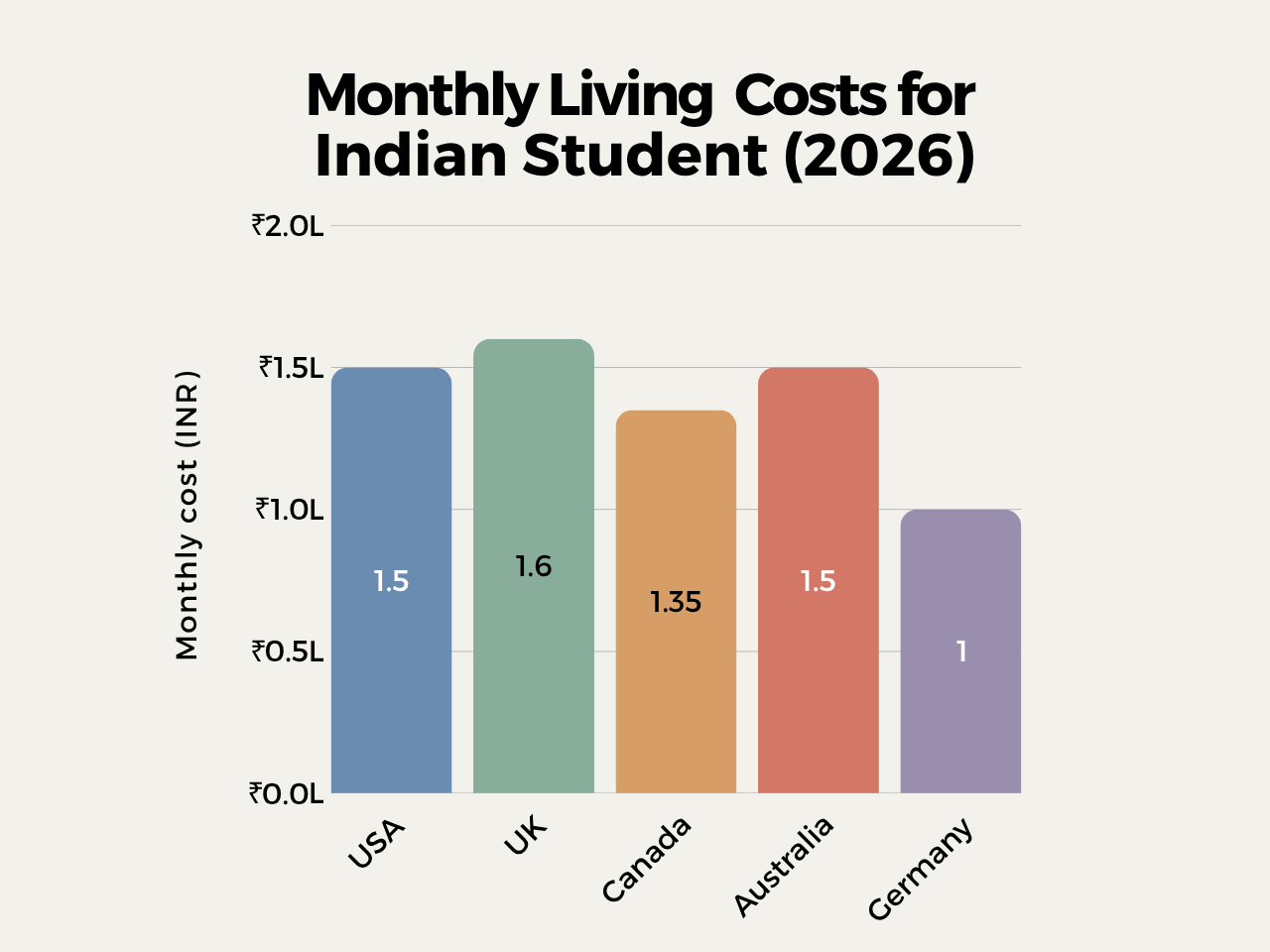
The table below focuses only on recurring and first-year living costs, because that is where families most often underestimate.
| Country | Rent | Food | Transport | Utilities | Total Monthly | Hidden Year 1 |
|---|---|---|---|---|---|---|
| USA | ₹90k | ₹25k | ₹10k | ₹25k | ₹1.5L | Flights ₹1L, SEVIS, health insurance, books |
| UK | ₹1L | ₹22k | ₹15k | ₹23k | ₹1.6L | TV licence, NHS surcharge, deposit, setup |
| Canada | ₹75k | ₹22k | ₹12k | ₹26k | ₹1.35L | Winter gear ₹50k, deposit, insurance |
| Australia | ₹85k | ₹25k | ₹12k | ₹28k | ₹1.5L | OSHC, visa fee, setup cash |
| Germany | ₹55k | ₹18k | ₹8k | ₹19k | ₹1L | Blocked amount about ₹10L+, APS, visa |
These are not luxury budgets. They reflect shared accommodation, controlled spending, and realistic student life. Official rules still underline the same pattern: the UK maintenance figure is not a London comfort budget, Canada’s proof-of-funds floor is not enough for Toronto or Vancouver without sharing, Australia warns that actual living costs may be much higher than the visa minimum, and Germany remains the cheapest recurring option despite its front-loaded blocked-account requirement. (GOV.UK)
For a structured breakdown of how to plan these costs effectively, read our guide on financial planning for studying abroad in 2026.
The big five remain the same: the USA, UK, Canada, Australia, and Germany. Roughly speaking, Canada and the US still absorb a large share of Indian mobility interest, but the direction of student demand is shifting. Germany is no longer a niche option. It is now a mainstream value destination, especially for engineering and technical Master’s programs. (IIE Open Doors)
Each of these destinations attracts Indian students for a different reason:
The smart comparison is no longer “best country overall.” It is “best country for this profile, budget, and field.”
Among the major destinations, Germany is still the cleanest low-cost answer. Public institutions generally do not charge standard tuition fees for most Bachelor’s and many Master’s routes, though semester contributions, insurance, and living costs still apply. Students also need to show €11,904, or €992 per month, as financial proof, and Indian applicants typically need APS processing before the visa stage. (DAAD)
For English-speaking options, the cheapest answer depends on city choice more than country branding:
Students choosing Berlin over Toronto or Manchester over London often save several lakhs in year one. That is the hidden cost of study abroad in action.
“Free” in study abroad usually means one of two things: very low tuition or meaningful scholarships. Germany remains the strongest example of low-tuition public higher education among the major destinations, while DAAD, Fulbright, and Chevening stay relevant for funded pathways. (DAAD)
Students usually make this work through a mix of strategies:
The practical rule is simple: do not treat scholarships as rescue money. Treat them as a core application strategy.
This is one of the most searched questions for a reason. Post-12th planning is emotionally appealing, but financially it is often harder than postgraduate planning. UG students usually face longer total duration, higher living-cost exposure, and in some countries a pathway or foundation year that quietly adds another expensive layer. PG students, by contrast, usually enter with stronger clarity and a sharper ROI pathway.
A simple decision framework helps:
For many families, the answer to how to study abroad after 12th from India is not “leave immediately.” It is “choose the timing that protects both career and cash flow.”
The simplest ROI method is this: total cost divided by the annual salary gain over a comparable India path. If the break-even stays close to three years, the decision looks healthy. If it drifts toward six or seven years, more caution is needed. That is the practical overseas MS ROI calculator 2026 approach serious applicants should use.
Here is the country-level MS picture.
| Country | Total Cost ₹L | Avg Salary USD | Break-Even Years | PR Odds |
|---|---|---|---|---|
| Germany | 15–18 | $65–72K | 2.5–3 | Strong job seeker visa |
| Australia | 32–40 | $78–90K | 3–4 | Good PSW |
| Canada | 38–45 | $70–82K | 3.5–4.5 | 40–50% |
| UK | 35–42 | $55–68K | 4–5 | Mixed |
| USA | 50–65 | $90–105K | 4–5 | Salary high, visa uncertain |
Germany still wins on value. Australia remains strong in selected fields. Canada is still viable, but the margin for error is smaller. The UK depends heavily on institution and specialization. The US still has the biggest salary upside, but not the simplest immigration path.
If you’re considering the US specifically, here’s a detailed USA Master’s cost breakdown for Indian students in 2026 to understand the full budget.
And if you are considering Europe for long-term work and PR pathways, understanding the EU Blue Card route for Indian students in 2026 is essential.
The field-level matrix matters even more.
| Field | Best Country | Why | Avg ROI |
|---|---|---|---|
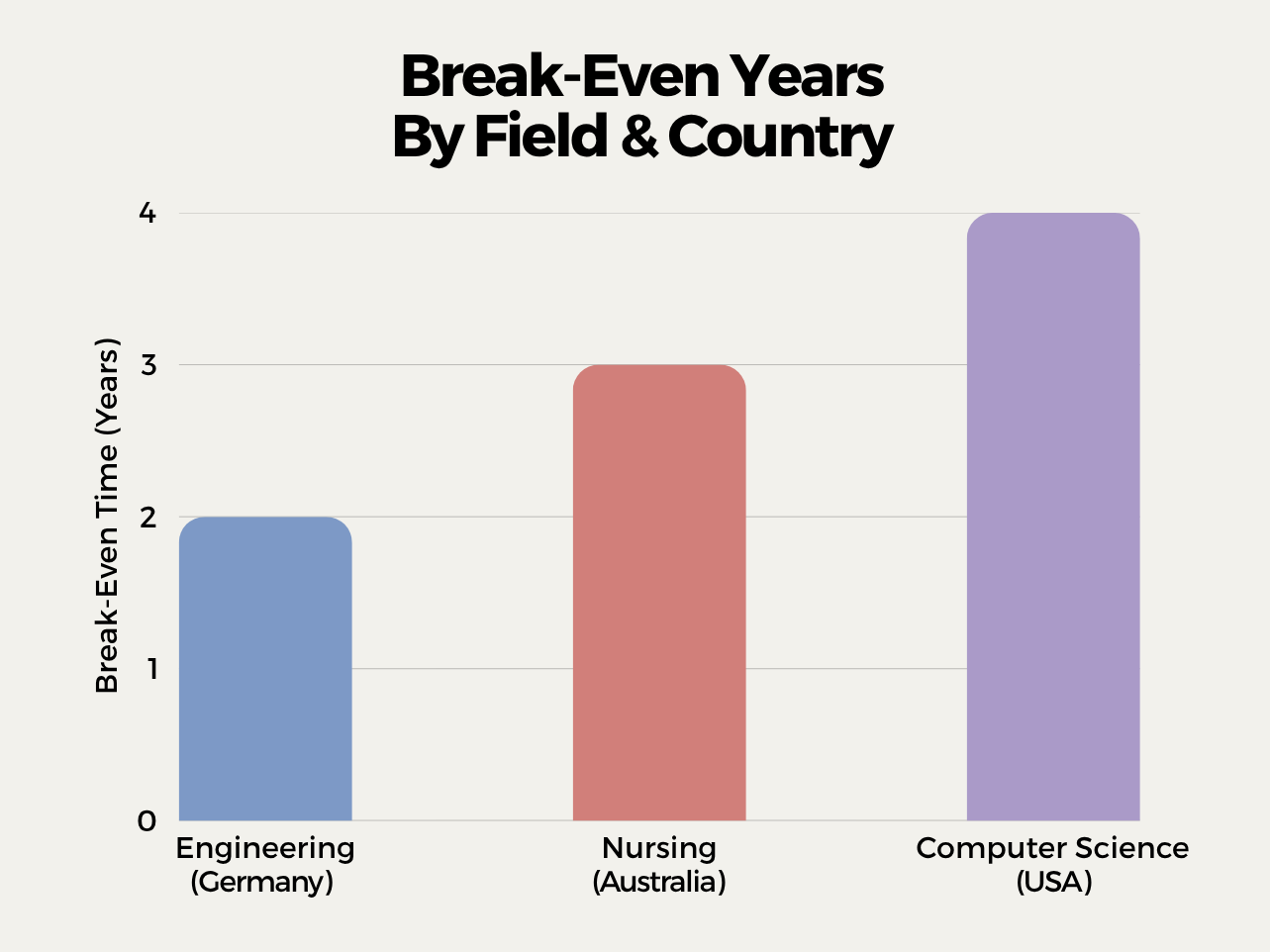
| Engineering | Germany | Tuition-free + jobs | 2–3 years |
| CS | USA | Highest salaries | 3–4 years (H1B risk) |
| Nursing | Australia | High demand | 2.5–3.5 years |
| Medicine / allied pathways | Australia / Germany by route | Licensing-driven, long horizon | Case-specific |
A quick sensitivity check improves decision quality:
There is no single national Fall 2026 deadline by country. Universities set their own calendars. Still, serious applicants should plan by country-style timelines, not by last-minute panic. Typical windows below are useful planning anchors for UG and PG applicants, especially for those managing tests, SOPs, loans, and visa sequencing together.
| Country | UG Early | UG Regular | PG Regular |
|---|---|---|---|
| US | Nov 2025 | Jan 2026 | Dec 2025–Jan 2026 |
| UK | Oct 2025 onwards | Jan–Jun 2026 rolling | Jan–Jun 2026 rolling |
| Canada | Nov 2025–Jan 2026 | Jan–Mar 2026 | Dec 2025–Mar 2026 |
| Australia | Intake-based | Intake-based | 4–8 months before start |
| Germany | Rolling by university | Jul 2026 common for winter | Mar–Apr 2026 common |
The planning lesson is straightforward:
Canada still matters for best countries for study abroad PR 2026 Indian students. But it is no longer a low-friction route. Canada’s international student cap remains in force for 2026, and IRCC has said the cap limits the number of study permit applications accepted into processing. Students who are eligible can still work up to 24 hours per week off campus during regular terms.
Why does Canada still attract attention?
When students search Canada student visa to PR pathway success rate 2026, the 40–50% band is best read as a planning estimate, not a guarantee. Program choice, province, language profile, and work experience change the outcome sharply. The bigger message is this: Canada rewards planning, not assumptions.
Read more on PR: Best countries for PR after study abroad and their real requirements.
This is now one of the most important reality-check sections in any US counselling conversation. USCIS completed the FY2027 H-1B cap registration cycle in March 2026, and FY2027 is the first season using a wage-weighted selection process rather than the old fully random structure. That means salary level and wage tier now influence odds more than before. (USCIS)
That changes the way Indian students should think about ROI:
Many students still search US H1B lottery odds vs study cost for Indians 2027 (15-30%). That 15–30% band remains a useful caution lens for lower-wage or entry-level profiles, but the new wage-weighted system means outcomes now vary much more by salary level. Students should stop treating the H-1B as a flat-probability lottery and start treating it as a compensation-linked immigration filter. (Kodem Law)
Yes, when the degree has measurable earning power. No, when debt is being used to buy vague prestige. In 2026, loan rates remain manageable for strong profiles, but the EMI still needs to fit the post-study salary story. Avanse advertises international education loan rates starting at 10.25% and Propelld emphasizes APR clarity and profile-based pricing for study-abroad loans.
| Provider | Interest Rate | EMI ₹20L loan | Processing Fee |
|---|---|---|---|
| Avanse | 10.25%+ | ₹20k–35k | 1–2% |
| Propelld | 8–11%+ typical market range | ₹25k–40k | 0.5–1.5% |
Students should apply the following loan test:
Debt should fund outcomes, not optimism.
Exchange programs are underrated. They can give international exposure, credits, and resume value at a fraction of the cost of a full degree abroad. For students uncertain about migration or ROI, exchange may be the smarter first step.
A clear comparison helps:
This is why study abroad vs exchange program should never be framed as “which is better.” The right question is “which one fits the goal?”
Visa success is rarely just about documents. It is about sequencing. Students usually face trouble when they start financial proof too late, apply without a city-level budget, or underestimate country-specific checks.
Useful study abroad visa tips for 2026:
Country rules reinforce the same idea. UK students must meet the formal maintenance test, Canada continues to process permits under the cap system, Australia enforces 48 hours per fortnight during study periods, and Germany remains documentation-heavy but predictable when sequenced well.
Too few applications create avoidable risk. Too many create weak applications. For most serious Fall 2026 applicants, 8–12 total applications remain the smart middle path.
A balanced strategy usually looks like this:
That mix protects both admissions probability and financial flexibility. It also prevents one common mistake: falling in love with a country before understanding whether the overall shortlist works.
1. Is study abroad worth it in 2026?
Yes, when course choice, city costs, and post-study opportunities align.
2. Where do most Indian students studying abroad?
Mostly in the USA, UK, Canada, Australia, and Germany.
3. What test scores do I need in 2026 if planning study abroad?
That depends on country, level, and university; strong English scores remain essential.
4. Application deadlines for Fall 2026?
Plan from mid-2025, with many key windows opening from late 2025 onward.
5. How many study abroad programs should I apply to?
Around 8–12, with ambition, safety, and budget balance.
6. Are study abroad programs expensive?
Yes, many are. That is why living costs and ROI matter as much as tuition.
7. How much does study abroad usually cost?
Most Indian students land in the ₹20–60 lakh all-in band.
8. What is optimal timeline for international graduate programs?
Roughly 9–15 months before intake works best for tests, essays, funding, and visas.
9. Canada student visa to PR pathway success rate 2026?
Still meaningful, but no longer automatic; planning assumptions around 40–50% are more realistic than old easy-PR narratives.
10. Study abroad vs exchange program?
Exchange is lower-cost and lower-risk; full degree is stronger for salary-reset or migration goals.
Good counselling is not brochure reading, and it is not generic motivation. It is structured filtering. It helps students cut weak-fit countries, compare real budgets, estimate ROI, and sequence tests, loans, and visa steps in the right order.
That is where a grounded counselling process matters. For families working through the hidden cost of study abroad, an experienced second opinion can prevent expensive errors. Maven Consulting’s value sits best in that space: shortlist quality, financial realism, and cleaner decision-making.
The hidden cost of study abroad is rarely one giant shock. It is a collection of smaller misses: deposits, insurance, blocked funds, setup purchases, city rent, weak buffers, and overconfident planning. The students who handle 2026 well are not always the ones with the highest budgets. They are usually the ones with the clearest numbers.
For affordability, Germany still leads. For straightforward English-speaking planning, the UK works better outside London. Canada still rewards careful route design. Australia demands stronger first-year liquidity. The US can still be worth it, but only when salary upside justifies visa risk.
So the practical sequence is simple. Choose the field first. Choose the city next. Build the budget honestly. Test the ROI. Then apply with discipline. That is how serious study abroad from India planning should look in 2026.