WhatsAppCHAT
CALL US& CONNECT

| COUNTRY | MINIMUM (INR APPROX.) | HOLDING PERIOD | DIFFICULTY |
|---|---|---|---|
| 🇺🇸 USA (F-1) | ₹50L – ₹80L+ | No fixed period; assessed at interview | High |
| 🇬🇧 UK (Student Visa) | ₹25L – ₹35L | 28 consecutive days | Moderate |
| 🇨🇦 Canada (Study Permit) | ₹18L – ₹30L+ | Recent statements (3–6 months) | Moderate |
| 🇦🇺 Australia (Subclass 500) | ₹22L – ₹40L | Evidence of genuine funds | Moderate |
| 🇩🇪 Germany (Blocked Account) | ₹10.5L (fixed by law) | Full amount deposited upfront | Structured |
| 🇮🇪 Ireland (Study Visa) | ₹12L – ₹20L | 6 months bank statements | Moderate |
| 🇳🇱 Netherlands (MVV) | ₹9L – ₹15L | Proof of financial guarantee | Lower |
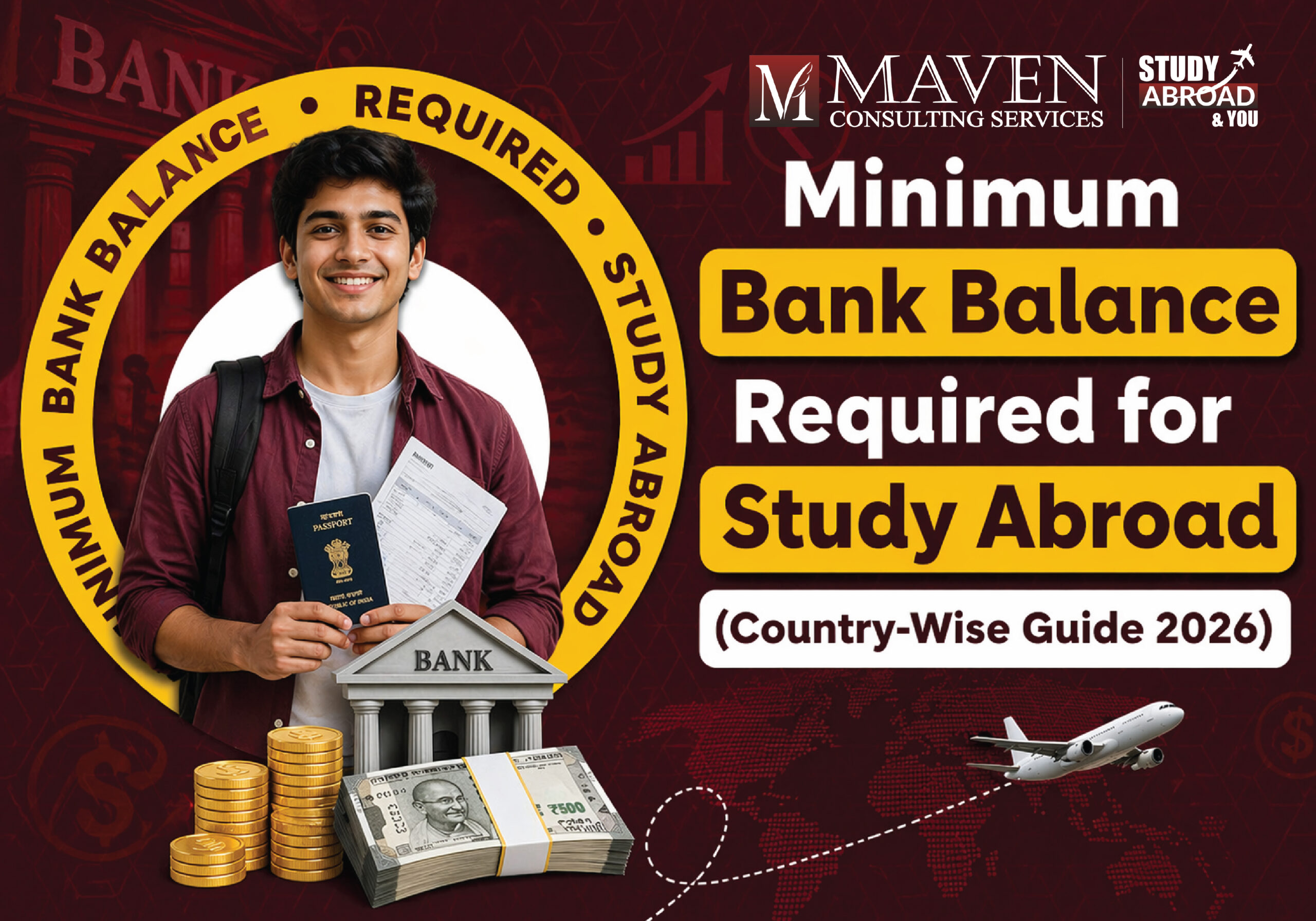
Every year, families approach Maven Consulting Services having researched tuition fees, scholarships, and accommodation — only to be blindsided by the bank balance requirement at the visa stage. This guide provides a country-by-country breakdown of exactly what Indian families need to show, and critically, how the evidence must be structured.
| IMPORTANT DISCLAIMER |
| Visa financial requirements are set by each country’s immigration authority and are updated periodically. The figures in this guide reflect the best available 2026 data. Always verify the exact current threshold with the official embassy or consulate before submitting your application. Maven Consulting Services verifies all requirements as part of our visa filing support service. |
Student visa financial requirements exist for one reason: immigration officers need to be satisfied that you can sustain yourself through your entire programme without becoming a public burden or dropping out mid-course. Officers assess the quality of your financial evidence — not just the quantity.
The common mistake Indian families make is assuming that having the money is enough. In reality, how long the money has been in the account, where it came from, and whether it is liquid all matter just as much as the amount itself.
| TYPICAL MINIMUM ₹50L – ₹80L First year cost coverage | FOR IVY / TOP 20 ₹80L – ₹1.2Cr Including living costs | VISA TYPE F-1 I-20 required |
Unlike UK or Germany, the US does not prescribe a single fixed amount. The key document is the I-20, issued by your university, which states the estimated cost of attendance (COA) for one academic year. You must demonstrate funds sufficient to cover this amount — at minimum for Year 1, ideally for the full programme.
Source: U.S. Embassy & Consulates in India, SEVIS requirements 2025–26
| MAVEN’S OBSERVATION ON US VISA INTERVIEWS |
|---|
| The single biggest cause of financial-ground rejections is inconsistency between declared funds and lifestyle or income indicators. A ₹60L balance is convincing when the family owns a business and files ITR accordingly. The same balance looks suspicious when the family shows a ₹5L annual salary. Officers cross-reference. Prepare all documents cohesively. |
| LONDON — 1ST YEAR £2,530/mo × 9 months = £22,770 | OUTSIDE LONDON £2,030/m × 9 months = £18,270 | HOLDING PERIOD 28 Days Consecutive, mandatory |
The UK has one of the most structured financial requirements for students. You must hold the UKVI-prescribed living cost amount plus tuition fees (if applicable) for a minimum of 28 consecutive calendar days before your application date. The balance must not fall below the threshold at any point during those 28 days.
Source: UKVI (UK Visas and Immigration), Student visa financial requirement — updated 2025
| SINGLE APPLICANT CAD 20,635 ≈ ₹12.5L per year living | WITH SPOUSE +CAD 4,000 Additional per dependent | PLUS TUITION Full fees First year, on top |
IRCC requires you to demonstrate funds to cover tuition for your first year plus living expenses for yourself and any accompanying family members. The living expense threshold was revised upward in 2024 and is calculated using the LICO (Low Income Cut-Off) measure.
Source: IRCC (Immigration, Refugees and Citizenship Canada), 2025–26 financial requirements
| MAVEN’S CANADA TIP — GIC IS YOUR BEST FRIEND |
|---|
| Of all the financial instruments accepted by IRCC, a GIC from an approved bank remains the single most persuasive tool for Indian applicants. It signals commitment, structures the fund release, and can significantly improve your processing timeline through SDS. We help families set up GICs as part of our Canada package. |
| LIVING COSTS AUD 29,710 ≈ ₹16.5L per year | SPOUSE/PARTNER +AUD 10,370 Additional per year | SCHOOL-AGE CHILD +AUD 4,449 Per child, per year |
Australia’s Department of Home Affairs assesses financial capacity as part of the Genuine Student test. You must demonstrate funds to cover tuition fees for the full duration of your course, annual living costs, and return airfare.
Source: Department of Home Affairs, Australia — Student visa financial requirements, 2025–26
| ANNUAL AMOUNT (2025) €11,904 ≈ ₹10.5L (fixed by law) | MONTHLY RELEASE €992 Released each month | ACCOUNT TYPE Blocked Sperrkonto — mandatory |
Germany’s system is the most clearly structured of all study destinations. The Sperrkonto (blocked account) requires you to deposit the full annual living cost before your visa is issued. Once in Germany, the bank releases €992 per month. There is no ambiguity — you either have the funds or you don’t.
Source: German Embassy India, DAAD Germany, Fintiba/Expatrio provider documentation 2025
| WHY GERMANY IS INCREASINGLY ATTRACTIVE |
|---|
| The blocked account requirement sounds restrictive, but it is actually a relief — the rules are explicit, compliance is clear, and the total investment to fund a world-class Masters in Germany is a fraction of what the US or Australia costs. We are seeing growing interest from Bengaluru families for STEM and engineering programmes. |
| MINIMUM THRESHOLD €7,000–€10,000 Living costs estimate | PLUS TUITION Full Year 1 €10,000–€20,000 typical | BANK STATEMENTS 6 Months Preferred by officers |
Ireland’s study visa financial requirements are assessed holistically. Officers expect to see evidence of funds needed to pay tuition plus support yourself for the full course duration. Realistic minimum: approximately €17,000–€30,000 (≈ ₹16L–₹28L).
Source: INIS (Irish Naturalisation and Immigration Service), Study in Ireland guidelines 2025
A balance that has been stable and growing over 3–6 months is dramatically more persuasive than a large sum that appeared 2 weeks before your application. Immigration officers call sudden deposits ‘parking’ — and they are trained to identify them.
Every significant deposit must be explainable. Property sale deed, business income statements, signed sponsorship affidavits — unexplained large deposits are consistently flagged and queried by officers.
An approved education loan from an Indian scheduled bank is accepted as evidence of financial capacity in virtually every country. The sanction letter must clearly state the sanctioned amount and disbursement terms.
A merit scholarship letter, TA/RA offer, or departmental fellowship formally reduces the liquid funds you need to demonstrate. Always include scholarship award letters in your financial evidence portfolio.
| COMMON MYTH | REALITY |
|---|---|
| I just need to show the minimum balance on the day of application. | UK requires 28 consecutive days; US and Canada assess historical patterns. Point-in-time balance is often insufficient. |
| If I have an education loan, I don’t need savings. | An education loan is evidence of funding — but many countries still want to see your own savings alongside the loan sanction. |
| My relative abroad will support me — I don’t need to show Indian funds. | Overseas sponsor funds require extensive documentation: their income proof, sponsor letter, bank statements, and relationship proof. |
| FD receipts are as good as bank balance statements. | FDs with premature withdrawal restrictions may not count as liquid funds for some visa categories. Always verify. |
| The amount my university says I need is all I need to show. | University cost-of-attendance figures are minimum estimates. Officers may require more, especially for high-cost cities. |
| COUNTRY | VISA | FUNDS (INR) | HOLDING PERIOD | KEY DOCUMENTS | LOANS |
|---|---|---|---|---|---|
| USA | F-1 | ₹50L – ₹1.2Cr | No fixed rule | I-20, ITR, bank statements | Yes |
| UK | Student Visa | ₹25L – ₹45L | 28 consecutive days | Bank stmts, CAS, sponsor docs | Yes |
| Canada | Study Permit | ₹18L – ₹35L | 6 months preferred | GIC, bank stmts, loan letter | Yes + GIC |
| Australia | Subclass 500 | ₹22L – ₹65L | Genuine funds test | Bank stmts, loan, scholarship | Yes |
| Germany | National Visa D | ₹10.5L (fixed) | Upfront deposit | Sperrkonto proof, insurance | Partially |
| Ireland | Study Visa C/D | ₹16L – ₹28L | 6 months stmts | Bank stmts, sponsor letter | Yes |
| Netherlands | MVV + Residence | ₹9L – ₹15L | Financial guarantee | Bank stmts, IND sponsor form | Partially |
| ☐ Bank statements for all active accounts — at least 6 months, certified by the bank |
| ☐ Fixed deposit receipts with premature withdrawal clause confirmed |
| ☐ Education loan sanction letter and/or disbursement certificate |
| ☐ Income Tax Returns (ITR) for the last 2–3 years — for you and/or your sponsor |
| ☐ Salary slips (last 3–6 months) or business income proof for sponsors |
| ☐ Property documents or investment statements if cited as source of funds |
| ☐ Scholarship award letters or assistantship offer letters |
| ☐ Sponsorship affidavit and relationship proof (if funds are from a third party) |
| ☐ GIC confirmation (Canada SDS applicants) |
| ☐ Sperrkonto confirmation (Germany applicants) |
| ☐ University Confirmation of Acceptance / I-20 / CAS document showing cost of attendance |
1. Can education loans replace personal savings?
No. Education loans are accepted, but they don’t fully replace savings. Visa officers prefer seeing both a loan sanction and 3–6 months of bank balance to confirm financial stability.
2. Can scholarships reduce the bank balance requirement?
Yes. Scholarships or assistantships directly reduce the funds you need to show. Always include official award letters in your visa documents.
3. Do fixed assets like property count as financial funds proof?
No. Property is not considered liquid funds. It can support your case as a source of funds, but you still need cash, FDs, or loans.
4. How long should money be maintained in the bank for a student visa?
Ideally 3–6 months. The UK requires 28 consecutive days, while other countries assess overall financial history and consistency.
5. Can I use my parents’ bank account for a student visa?
Yes. You’ll need a sponsorship letter, relationship proof, and their income documents (ITR, salary slips).
6. What happens if I deposit a large amount just before applying?
It raises red flags. Sudden deposits are seen as “fund parking” and can lead to queries or rejection if not properly explained.
7. Is the amount mentioned by the university enough for visa approval?
Not always. It’s a minimum estimate. Showing slightly higher funds improves credibility and approval chances.
8. Does the UK require a specific holding period for funds?
Yes. Funds must be held for 28 consecutive days without dropping below the required amount before applying.
9. Do I need to show funds for the entire course duration?
Usually first-year funds are enough, but showing ability to fund the full course (via loans/sponsors) strengthens your case.
10. What is a GIC and is it mandatory for Canada?
A GIC is a fixed deposit with a Canadian bank proving living expenses. It’s mandatory for SDS and strongly recommended otherwise.
11. When should I start preparing my finances for studying abroad?
Start 12–18 months in advance. This helps build a strong financial history and avoids last-minute issues.
Ideally, begin building and maintaining your study abroad fund at least 12–18 months before your target visa application date. This creates the natural account history that consulates want to see. Last-minute fund parking, especially large lump sums in the 4–6 weeks before application, is one of the most common reasons for financial evidence queries and refusals.
| Not Sure What Your Family Needs to Show? |
|---|
| Financial documentation is one of the most nuanced parts of a study abroad visa application. Maven Consulting Services reviews your full financial profile, identifies gaps, and helps you build a documentation package that visa officers trust. |
| Information in this article is for general guidance only. Verify all visa financial requirements with the respective embassy before applying. |
|---|

Sunday, October 26, 2025 | The Taj MG Road, Bangalore | 10 AM – 4 PM