WhatsAppCHAT
CALL US& CONNECT


Every year, a very large number of Indian students apply overseas.
Bureau of Immigration data shows how mainstream overseas study has become for Indian students. Departures rose to 8.95 lakh in 2023, before easing to 7.60 lakh in 2024. At the same time, the total number of Indian students enrolled abroad reached about 13.3 lakh in early 2024, and stands at roughly 12.5 lakh in 2025 as per MEA data.
At this scale, admissions teams in the US, UK, Canada, Australia, Germany, and beyond no longer see Indian applicants as exceptions. They evaluate them as a major, recurring pool, and that changes how universities abroad evaluate Indian students.
Many Indian families fail to recognise the difference in how applications are applications are compared, contextualised, and scrutinised — nationally and internationally, which might lead to unnecessary delays and hurdles.
That is why it is not enough to be an exam-taker, your application has to read like a candidate.
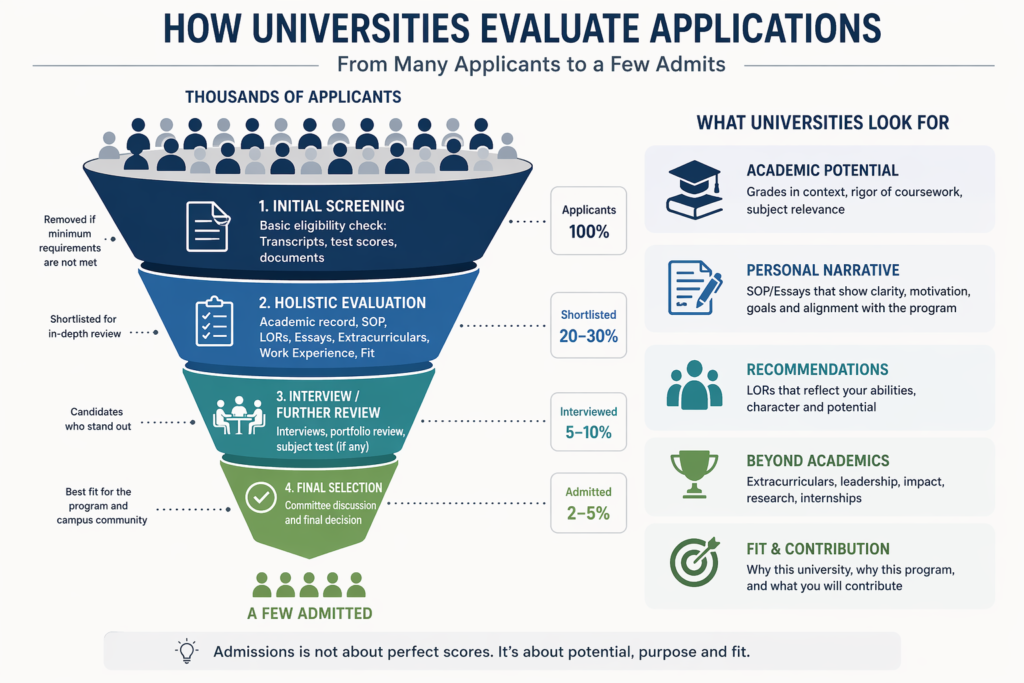
Many Indian families assume overseas admissions work like a more refined version of the domestic system. They don’t. While India still prioritises marks, ranks, and cut-offs, most foreign universities are asking a broader question:
Is this student prepared, purposeful, and a good fit for the program?
India’s education system trains students to compete through examinations — JEE, NEET, and board percentages. High scores feel like the goal, and for domestic admissions, they largely are. Universities abroad operate on an entirely different logic.
When a university in the US, UK, Canada, or Australia reads your application, they are not asking “how well does this student perform on tests?” They are asking a far more layered set of questions: Who is this person? What have they built? Why do they want to be here? And what will they contribute to our campus?
This is not a minor distinction. It is the central reason why students with 95%+ boards and 330+ GRE scores get rejected from mid-ranked universities while students with lesser scores gain admission to top ones.
A marks-focused system like that of India’s rewards maximisation. A holistic system rewards interpretation.
This means two important things:
“A top-40 US university is not filling seats. It is assembling a community. Every admitted student is expected to add something to the room — intellectually, culturally, creatively.”
| Indian applicants are also not evaluated in isolation. |
Admissions teams have already reviewed thousands of applications from CBSE, CISCE, state boards, IITs, NITs, BITS, Delhi University, Mumbai University, Anna University, VTU, Pune University, and more.
In other words, they’re not just reading your marks, they’re interpreting them:
| The application is your portrait, not your report card. |
Across countries and program types, most strong admissions reads come back to eight core dimensions. Indian families often obsess over the first two. Competitive admissions teams usually look across all eight.
| Factor | What the committee is really trying to understand |
|---|---|
| Academic performance | Can this student handle the classroom rigor? |
| Trend and consistency | Is the student stable, improving, or slipping? |
| Subject relevance | Do the right courses support the target program? |
| Tests | Does the student meet or strengthen the academic threshold? |
| SOP / essays | Does the student make sense on paper as a candidate? |
| Recommendations | Do credible adults validate the student’s strengths specifically? |
| Activities / research / work | Has the student built depth beyond marks? |
| Fit | Why this program, institution, and next step? |
The key takeaway from this table is simple: admissions is rarely a one-document decision. A transcript can open the file, but the rest of the file often decides the outcome.
This reflects how top universities evaluate applicants holistically, as seen on the official MIT admission process page.

This is where Indian applicants often want a clean formula and universities often refuse to give one. That mismatch creates a lot of confusion.
Foreign universities do not all convert Indian marks the same way. Some rely on internal academic readers. Some use credential evaluators. Some read percentages directly. Some interpret class rank or institutional reputation alongside marks.
WES, ECE, and ICES all exist because international credentials need structured interpretation across systems, but even then, the evaluation type and destination use case can differ. WES evaluates credentials for US and Canada use cases, ICES is a credential service in British Columbia, and ECE provides foreign credential evaluations used by universities and other institutions in the US and Canada.
That means Indian students should stop asking, “What is my exact GPA?” as if there is one universal answer. The better question is, “How will my marks be interpreted for this country, this university, and this type of application?”
The table below is a planning guide, not an official conversion chart. It reflects how admissions teams often think directionally about Indian performance bands, not how every evaluator calculates.
| Indian academic range | Rough international read | How it is often perceived |
|---|---|---|
| 80%+ or 8.5+ CGPA | Strong to very strong | Usually competitive, depending on institution and rigor |
| 70–79% or 7.5–8.4 CGPA | Solid | Often admissible at many good universities with strengths elsewhere |
| 60–69% or 6.5–7.4 CGPA | Borderline to acceptable | Needs better fit, stronger SOP, relevant coursework, or work experience |
| Below 60% | Risk zone | Possible in selected institutions, but limited for competitive programs |
What should readers take from this? Not that 70 percent is “equal” to a precise GPA. Rather, that universities are usually asking whether the performance is competitive in context, not whether it can be mathematically forced into one global scale.
Most countries do not have one national cut-off for all institutions, but broad patterns are visible.
| Country | Typical academic expectation for Indian students |
|---|---|
| USA | Varies widely; strong universities often expect solid upper-second-class equivalent or better |
| UK | Course pages often map Indian degree classes or institution tiers to country-specific requirements |
| Canada | Many Master’s programs look for roughly B-equivalent performance, often around 70%+ or better |
| Australia | Entry requirements are often stated as equivalent Australian bachelor results or GPA bands |
| Germany | Strong academics matter, but subject fit and degree recognition are equally important |
To get a clearer picture, you can review detailed country-wise breakdowns.
This is where tier matters. A 68 percent from a rigorous institution with strong subject alignment can sometimes be read more favourably than a higher score from a weaker academic environment. Universities abroad may not “penalise” students simply for coming from tier-2 or tier-3 institutions, but stronger institutional familiarity can reduce uncertainty in evaluation.
Admissions readers do notice whether marks are improving, flat, or declining. A weak first semester followed by steady improvement can be framed positively. A strong start followed by a repeated slide without explanation creates concern.
This is especially true in graduate admissions. Committees want to know whether the student is ready now, not just whether the student once scored well. An upward trend often reads as maturity. A downward trend demands context.
For Master’s admissions, the file is often read at the course level, not just the headline percentage level.
A student applying for Data Science may be read more closely on:
A student applying for Finance may be read more closely on:
This is one of the most misunderstood parts of admissions. A strong overall score with weak core subjects can be less convincing than a moderate overall score with very strong program-relevant coursework.
This section deserves attention, but not obsession. Tests matter, though less than many Indian applicants assume once thresholds are met.
Most universities set their own minimums, but common ranges still hold. TOEFL scores at many strong graduate schools often fall around 90 to 100+, with some departments preferring or expecting 100+. MIT, for example, recommends at least 100 for graduate admission, while other institutions such as Rice and Illinois also publish program-specific English requirements.
IELTS expectations at many universities commonly sit in the 6.5 to 7.5 band range depending on level and competitiveness. Duolingo remains widely accepted, but institutional acceptance still varies.
| Test | Common competitive band |
|---|---|
| IELTS | 6.5–7.5 |
| TOEFL iBT | 90–110 |
| PTE | Often equivalent to IELTS expectations but selective universities or embassies accept it. |
| Duolingo | Increasingly accepted, but check institution policy carefully |
The real takeaway is that English tests are usually threshold tools, not the heart of your candidacy. A 7.5 IELTS does not rescue a weak SOP. It simply assures the university that language readiness is likely adequate.
GRE remains relevant in parts of the US, especially for quantitative graduate fields and some research-oriented programs, though many schools are test-optional or test-blind. GMAT continues to matter for many business programs, and GMAC positions the current GMAT as a business-school admissions test aligned to analytical and data-focused readiness. For undergraduate applicants, SAT and ACT still matter where required or strategically helpful, but many US institutions continue to operate test-optional or test-free models.
A simple rule works well here:
If marks get the file opened, the way an SOP is written (or essay) often determines how the file is remembered.
Indian applicants often make three mistakes:
The best SOPs do not begin with “Since childhood, I have been passionate about…” They begin with a serious academic or professional reason for the next step. They show movement. They explain why the target program fits that movement.
| Strong SOP move | Why it works |
|---|---|
| Starts with a concrete problem, project, observation, or turning point | Feels real, not templated |
| Builds a clear academic or career thread | Shows progression, not random ambition |
| Explains field switch honestly if relevant | Reduces committee doubt |
| Names specific labs, faculty, modules, or methods | Signals fit |
| Addresses one weakness briefly if needed | Builds trust |
| Ends with direction, not flattery | Keeps tone mature |
For UK undergraduate applicants, this looks a little different because UCAS now uses a structured three-question personal statement for 2026 onward, supported by a total 4,000-character framework. That means students cannot rely on older free-form UCAS advice. Structure has become more explicit.
You can refer to the official UCAS website here for the exact format and expectations.
For US undergraduate applicants, the Common App essay remains a separate, more personal piece, traditionally capped at 650 words.
This last point matters more now. Turnitin’s AI-writing report is already designed to help educators identify text that may have been generated by AI tools, and even where a university does not formally “AI-detect” essays, inconsistent voice and templated structure are easier to spot than many students assume.
Recommendation letters are still one of the most misunderstood parts of the file.
Indian students often chase seniority. Universities usually prefer specificity.

For most students:
A good LOR does three things:
A bland “hardworking and sincere” letter does almost nothing. A letter that says, “She ranked in the top 5% of my database systems class and independently redesigned the project architecture after early failure” is far more powerful.
Institutional letterhead, official email submission, and verification steps also matter. Many universities now expect recommendations to come through official systems and may contact recommenders or flag irregularities if details do not line up.
This is where Indian applicants often undersell themselves or oversell weak activity lists.
Admissions readers are usually not looking for ten club names. They are looking for evidence of depth.
Strong profile signals can include:
The key is quantification. “Part of NSS” is thin. “Led a 40-student literacy drive across two local schools and built volunteer tracking that improved weekly attendance by 30%” reads far better.
Universities also verify claims. That may happen through recommendation letters, document checks, interview questions, portfolios, supervisor references, or simple plausibility review. Inflated extracurricular claims are one of the easiest ways to damage credibility.
For graduate applicants, especially in business and career-linked Master’s programs, work experience is rarely read as mere time served.
Admissions teams are asking:
| Weak framing | Strong framing |
|---|---|
| “Worked at startup for 2 years” | “Owned analytics reporting for 3 client accounts and reduced monthly reporting time by 25%” |
| “Managed family business” | “Handled vendor negotiations, cash flow tracking, and customer retention initiatives in a 12-person business” |
| “Software engineer at MNC” | “Built backend modules used across X transactions / led release coordination / moved from testing to product-facing development” |
For MBA and EMBA-type programs, 2–5 years of meaningful experience is often a healthier range than applying too early. For fresher-friendly Master’s degrees, the experience can be shorter, but relevance still matters.
Field switchers are not penalised automatically. They are penalised when the switch is poorly explained.
This was missing in the earlier draft, so it deserves a proper section.
Not every program interviews. But when interviews do appear, they are often decisive because they test something the rest of the file cannot: clarity under pressure.
Oxford notes that not all graduate courses interview, and where they do, the course page usually indicates whether the interview will be by phone, video call, or in person. Kira Talent, meanwhile, is used by hundreds of programs for timed video and written assessments.
They are usually testing you to see your:
A useful shorthand:
Common rejection reasons in interview rounds include vague goals, weak program knowledge, over-rehearsed answers, and inability to explain one’s own CV confidently.
Not all universities evaluate the same file the same way.
Top-20 or highly selective institutions often have more applicants who are already academically qualified. That means non-academic differentiation becomes more important.
Mid-tier institutions may still care about the whole application, but the academic threshold and fit logic can be broader.
Research-intensive universities also read differently from teaching-focused institutions. Research programs care more about:
Teaching-focused or professional coursework programs may care more about:
Indian institutional background can help or complicate interpretation. IIT, NIT, BITS, top central universities, top commerce colleges, elite liberal arts institutions, and well-known private universities may be more familiar to reviewers. That familiarity can be an advantage, but it is not a substitute for fit. Students from lesser-known colleges can absolutely win, but they often need clearer evidence elsewhere.
This area is discussed badly too often, so it is worth being precise.
Most universities do not publish an “Indian quota” in the simplistic sense families imagine. But institutions do care about class composition, nationality mix, discipline needs, and sometimes gender balance or cohort diversity. MIT explicitly says it does not use state or regional quotas in its selection process, though it still reads applications contextually and holistically.
What this means in practice for Indian applicants:
Regional identity within India can matter when it is meaningfully expressed. A student from a smaller town, a student who studied in multiple languages, a woman in a male-dominated engineering area, or a student who navigated financial or infrastructural limits may all carry forms of context that strengthen the application when handled thoughtfully.
No serious university publishes one universal formula that applies everywhere. But families still need a planning model. So the table below is best read as a practical synthesis, not an official rulebook.
| Component | Typical weight in holistic review |
|---|---|
| Academics and rigor | 40–50% |
| Tests | 10–20% where applicable |
| SOP / essays | 20–30% |
| LORs | 10–15% |
| Activities / work / research | 10–20% |
| Interview / portfolio / proposal | highly variable |
For PhD applications, research fit and proposal quality may matter much more. For design, architecture, and arts, the portfolio can overtake almost everything else. For MBA applications, work experience and interview performance can rise significantly.
The main takeaway is this: Indian students with lower percentages often compensate best not through motivational language, but through fit, subject relevance, work depth, or a very strong recommendation ecosystem.
This section is boring, which is exactly why students ignore it until it becomes urgent.
AIU also remains relevant on the Indian side for equivalence questions involving foreign qualifications in India. Its evaluation division handles academic equivalence for foreign degrees under defined criteria.
This is not a small issue. Fraud and inconsistency can lead to application rejection, rescinded offers, or longer-term blacklisting risk.
Many of these problems also show up during visa review later, so it is worth understanding the most common student visa mistakes Indian applicants make before the process moves forward.
If you want a broader view of what applicants can do to reduce avoidable risk, we had our counsellors give us their top tips to help students survive visa season.
Applications are not just judged on quality. They are judged in a sequence.
Common App’s admission-plan definitions include Early Decision, Early Action, restrictive early action, rolling admission, and regular decision. That matters because timing changes not only deadlines, but often the strength and shape of the pool you are entering. Some graduate schools also permit deferral under defined circumstances, but deferrals are not automatic. Columbia, for instance, notes that graduate deferral requests must be justified and approved.
| Timeline | What should actually happen |
|---|---|
| 18–24 months out | Build projects, research, internships, relationships with recommenders |
| 12–15 months out | Test planning, shortlist building, profile audit, gap identification |
| 8–10 months out | SOP drafting, recommender briefing, document collection |
| 4–6 months out | Final applications, financial docs, interview prep |
| Post-submission | Updates, interviews, offer review, deposit decisions |
What this table shows is that applications are won early. By the time most Indian students “start applications,” many decisive pieces should already exist.
This deserves bluntness.
The most common reasons are not usually “too little passion.” They are more concrete:
A surprisingly common error is what might be called over-application syndrome. Students apply to too many universities, which reduces customisation quality and weakens the entire set.
A strong Indian application usually does three things well.
India is a high-competition environment. That can be a strength if framed properly. Scale, rigour, exam pressure, multilingual learning, and constrained opportunities can all be part of the context.
Do not just state what was done. Explain why it matters in your environment.
Read up on how to write a strong statement of purpose.
The strongest applications are not written into existence. They are built.
This is where a Maven-style process genuinely helps:
A student with ordinary marks but very clear subject fit, better-than-expected writing, and a strong explanation of career goals can outperform stronger scorers with vague files. In such cases, the SOP becomes the turning point.
A profile with 4 years of real responsibility, measurable outcomes, and mature post-MBA logic often fares better than a fresher with a good score but little management evidence.
One of the most useful patterns in counselling is the one-year turnaround: poor shortlist, generic documents, disappointing outcomes, then a rebuilt strategy with narrower goals, sharper recommendations, and stronger course alignment.
The second cycle often succeeds because the application finally makes sense. This is your sign to not give up and stay strong.
1. What Percentage Is Required for Top Universities Abroad for Indian Students?
There is no single universal cut-off. Competitive universities often expect strong academics, but how your marks are interpreted depends on board, institution, course rigor, and subject relevance.
2. Does test-optional mean GRE or SAT does not matter?
No. It means the score may not be mandatory. A strong score can still help, especially in quantitative or highly selective contexts.
3. How to explain low 12th marks?
Briefly, honestly, and only if needed. Do not over-explain or over-dramatise. One paragraph of context with high intent is usually enough.
4. Does work experience matter for freshers or undergraduate applicants?
Not in the same way it matters for MBA or professional Master’s programs. For fresh applicants, internships, projects, competitions, and evidence of initiative matter more.
5. How do Indian percentages or CGPA convert to GPA?
There is no universal formula. Universities may read marks directly or use evaluators such as WES, ICES, or ECE depending on destination and process.
6. What Are WES, ICES, and ECE Credential Evaluations?
WES is widely known for US and Canada-related use cases. ICES and ECE are also recognized services in relevant contexts. Always follow the institution’s own requirement, not general internet advice.
7. What English Scores — IELTS or TOEFL — Is Required for Study Abroad?
Many universities commonly expect IELTS around 6.5–7.5 or TOEFL around 90–110, though exact thresholds vary by institution and department.
8. Who should write my LORs?
Choose professors or managers who know your work specifically. Avoid status-only recommenders who cannot write in detail.
9. How Much Work Experience Is Needed for MBA Abroad?
For many MBA and similar programs, 2–5 years of meaningful experience is a healthier range than applying too early.
10. What Interview Formats Do Universities Abroad Use?
Live Zoom or Teams interviews, faculty interviews, alumni interviews, and timed video platforms such as Kira are all common depending on the program.
Foreign universities do not evaluate Indian students by marks alone, and they do not reject or admit based on one magic number. They read context, consistency, fit, subject readiness, writing quality, credibility, and future potential together.
That is the central shift Indian families need to understand.
A high score is useful. It is not the whole application. A weak college brand can be offset. A weak story cannot. A lower percentage can sometimes be managed. A generic file rarely can.
The families that navigate this process best are usually the ones who stop treating admissions as a form-submission exercise and start treating it as a positioning exercise. They build earlier. They choose recommenders carefully. They stop confusing consultant polish with real narrative quality. And they understand that universities abroad are not trying to reward the most “perfect” applicant. They are trying to admit the most convincing one.
This is exactly where Maven can create real leverage:
The right first step is not a rushed application. It is an honest profile assessment.
Book a free initial assessment with Maven Consulting Services to understand how your application would likely be read by universities abroad, where the real risks are, and what needs to improve before submission.