WhatsAppCHAT
CALL US& CONNECT


| 70–80% of Indian students Choose Fall intake | 20–30% of Indian students Go for Spring |
And here’s the part most people don’t tell you, there is no long-term career difference between the spring vs fall intake for USA.
That’s where the confusion starts.
You’ll often hear that Fall is “better.” It is—but not for the reasons most people think. This is not a question of good vs bad. It’s a question of timing, readiness, and strategy.
If you understand that clearly, the decision becomes much simpler.
| Factor | Fall Intake | Spring Intake |
|---|---|---|
| Start Date: | Aug–Sept | Jan–Feb |
| Course Availability: | Full range | Limited options |
| Scholarships: | Highest availability | Fewer opportunities |
| Competition: | High | Moderate |
| Internship Timing: | Well-aligned | Slightly tight |
Fall is the default system. Everything from courses, funding, hiring cycles, is built around it.
Spring exists as a secondary entry point. It’s not weaker, just narrower. What this means for you is simple: Fall gives you more flexibility. Spring demands more planning.
For most students, Fall is the safer and more straightforward choice.
Assistantships and fellowships are often 2–3x more available in Fall compared to Spring. This matters more than most students realise, especially if you are looking to reduce costs.
Fall is not “better” because everyone chooses it. It’s better because the system itself is built around it.
Spring becomes a strong option when your timing is off, but your goals are still clear.
| ✗ THE MYTH: Spring is a backup for weak students | ✓ THE REALITY: Spring works best for students who plan deliberately instead of rushing unprepared |
A strong Spring application will always outperform a weak Fall application. That’s the part most people ignore.
| Stage | Fall Intake | Spring Intake |
|---|---|---|
| Prep Start | Apr–Jun (previous year) | Apr–Jun |
| Exams | Jul–Sept | Jul–Sept |
| Applications | Oct–Jan | Aug–Oct |
| Offers | Mar–May | Oct–Nov |
| Intake Begins | Aug–Sept | Jan |
Fall gives you more breathing room. Spring compresses everything slightly.
If you’re already late in your preparation cycle, forcing Fall can actually hurt your chances.
Universities allocate most of their funding at the start of the academic year. That’s when departments have budgets, assistantships, and fellowships available.
Spring still offers funding, but you’re competing for what’s left—not what’s planned.
Internships are where timing matters.
Fall students complete two semesters before summer internships. Spring students may not always meet that timeline comfortably.
This does not block opportunities, but it does mean you need to be more proactive. Networking, early applications, and planning become more important.
At this point, the decision usually comes down to honesty about your situation.
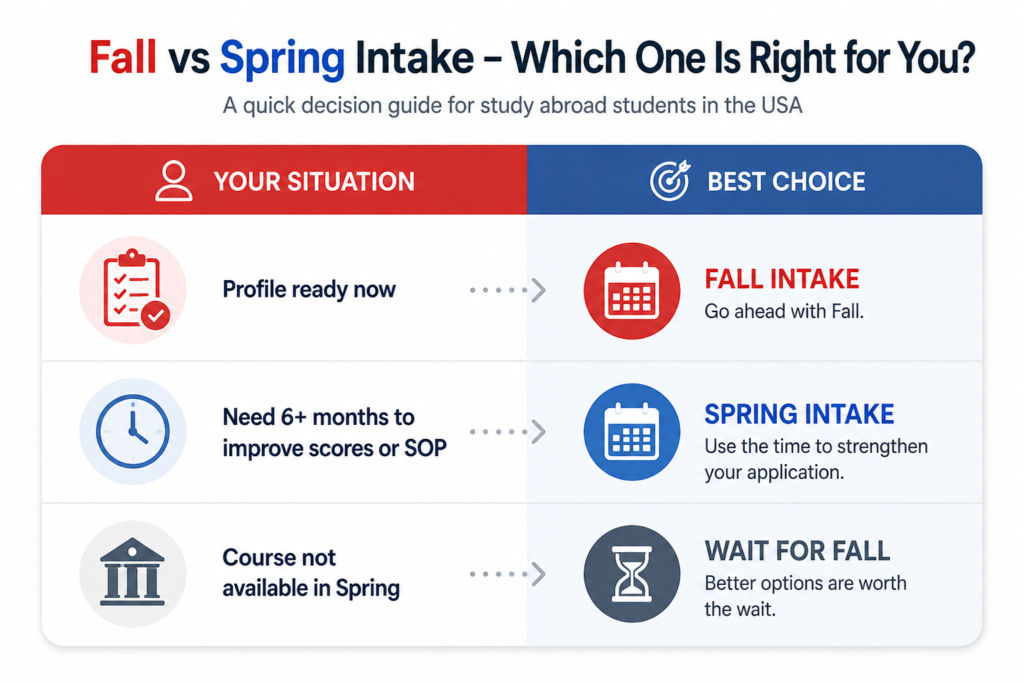
There’s no advantage in forcing the wrong timeline.
1. Does spring vs fall intake affect job outcomes in the US?
No. Long-term career outcomes depend on your skills, internships, and networking—not your intake.
2. Can I get scholarships in the Spring intake?
Yes, but fewer compared to Fall. You need to be more selective and realistic.
3. Is visa approval harder in the Spring intake?
No. Visa decisions depend on your profile and documentation, not the intake.
4. Is Spring intake bad for STEM students?
Not at all. You just need to plan internships more carefully.
5. Should I wait for Fall instead of going in Spring?
Only if waiting significantly improves your profile. Otherwise, Spring is a perfectly valid option.
Fall is better—for most students, most of the time.
But that does not make Spring a compromise.
A strong Spring applicant beats an unprepared Fall applicant every single time.
This is not about chasing the “better intake” in spring vs fall intake. It’s about choosing the right moment to apply with your strongest possible profile.
If you’re unsure which intake fits your situation, it’s worth stepping back and evaluating your timeline properly. A small decision here can shape the next few years much more than you expect.
And getting it right is less about information, and more about clarity.