WhatsAppCHAT
CALL US& CONNECT

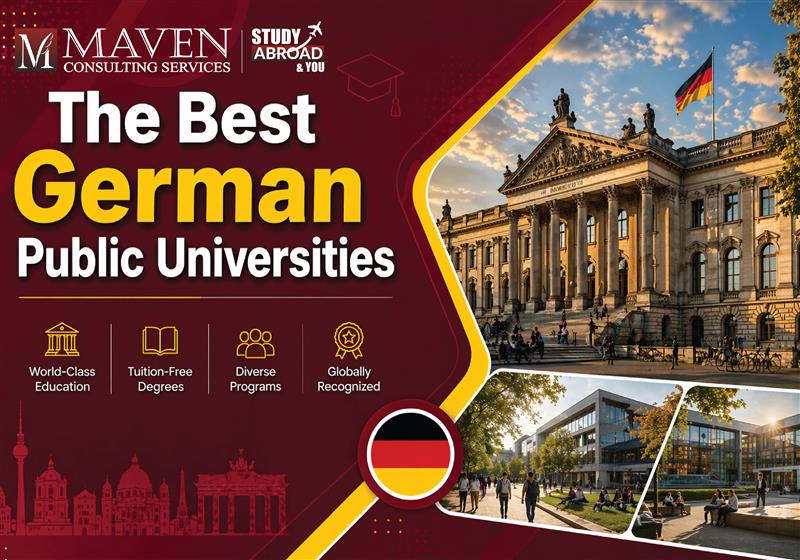
A ranked guide covering QS rankings, real fee structures, APS requirements, field-by-field recommendations, and the 18-month post-study work permit — everything Indian families need to according to the best German public universities.
| 59,419 Indian Students | #1 Source Country | 313 Public Universities | ₹0 Tuition (Most) | 18 months Post-Study Work |
| India has overtaken China to become Germany’s single largest source of international students. With 59,419 Indian students enrolled today, and projections of 114,000 by 2030, the German university system has become India’s most serious competitor to the US and UK, not on prestige alone but on economics and outcomes. |

For an Indian family weighing study-abroad options, the Germany proposition is unusually robust. While US tuition climbs toward ₹50–80 lakh per year and UK costs track close behind, most of the best German public universities continue to charge zero tuition to all students regardless of nationality.
Beyond the cost argument, Germany’s post-study work rights are among the world’s most generous. Graduates of German public universities receive an 18-month job seeker visa —
no lottery, no employer sponsorship required upfront
Compare that to the US H-1B lottery (25% selection rate for FY 2026) and the contrast is sharp.
Germany also now permits dual citizenship after naturalisation in as few as five years under the 2024 law change. The country has over one million skilled worker vacancies in engineering, IT, and healthcare — sectors where Indian graduates are highly competitive.
| IMPORTANT: TWO MAJOR FEE EXCEPTIONS TO NOTE: — TU Munich (TUM): Introduced tuition fees of €4,000–€6,000 per semester for non-EU Master’s students from 2024/25. — Bachelor’s programs: €2,000–€3,000/semester. TUM scholarships (fee waiver) are available for high achievers. Baden-Württemberg State Universities: All public universities in this state, including Heidelberg, KIT, Freiburg, Stuttgart, and Tübingen, charge €1,500/semester for non-EU students. This is a state-level policy. |
The following rankings combine QS World University Rankings 2026, actual fee structures for Indian (non-EU) students, English-taught programme availability, Indian student community size, and employment outcomes.
| 01. Technical University of Munich • QS #22 World TUM · Munich, Bavaria |
|---|
| Tuition: €4,000–€6,000/semester (Masters) Fields: Engineering · AI · Robotics · Management City: Munich Germany’s highest-ranked university and the only one in the QS global top 25. TUM is an outlier — it has introduced significant tuition fees for non-EU students, making it financially closer to a UK university. Its employability rank is the highest in Germany. BMW, Siemens, and Allianz are headquartered nearby and actively recruit from TUM. The TUM Tuition Support Scholarship (fee waiver) and DAAD Master’s scholarships are available. MAVEN VIEW: Recommended for students with a CGPA above 8.5 who apply for the fee-waiver scholarship simultaneously. For STEM students who cannot access the scholarship, RWTH Aachen or TU Berlin offer comparable outcomes at zero tuition. |
| 02. Ludwig Maximilian University of Munich • QS #54 World LMU Munich · Munich, Bavaria |
|---|
| Tuition: €0 Tuition + ~€148/semester Fields: Sciences · Medicine · Economics · Humanities City: Munich LMU is TUM’s historic academic rival and Germany’s second-ranked university — with €0 tuition. Particularly strong in natural sciences, medicine, and economics. Munich’s startup ecosystem makes LMU excellent for entrepreneurially-minded students. The Deutschlandstipendium scholarship (€300/month) is available to international students on merit. MAVEN VIEW: Outstanding value. Zero tuition, top-54 global ranking, Munich location. Indian students targeting Economics, Life Sciences, or Computer Science should strongly consider LMU alongside TUM. |
| 03. Heidelberg University • QS #47 World Universität Heidelberg · Heidelberg, Baden-Württemberg |
|---|
| Tuition: €1,500/semester (Baden-Württemberg state fee) Fields: Medicine · Biosciences · Law · Humanities City: Heidelberg Germany’s oldest university (founded 1386) and among its most selective. Heidelberg ranks #47 globally and is a world leader in biomedical research. The Baden-Württemberg non-EU surcharge applies (€1,500/semester), but this remains far more affordable than UK or US equivalents. Affiliations with Max Planck and the DKFZ German Cancer Research Centre are unmatched for PhD research. MAVEN VIEW: Best suited for students with a clear research trajectory in biomedical sciences. The state fee is a real cost, but the research infrastructure and global recognition justify it for the right profile. |
| 04. RWTH Aachen University • QS #88 World RWTH Aachen · Aachen, North Rhine-Westphalia |
|---|
| Tuition: €0 Tuition + ~€330/semester Fields: Mechanical Engineering · Automotive · Electrical · CS City: Aachen RWTH Aachen is Germany’s largest technical university and the gold standard for Mechanical Engineering and Automotive Technology. It hosts over 2,400 Indian students and maintains direct recruitment pipelines with Volkswagen, Mercedes-Benz, Continental, and Bosch. Over 150 English-taught Master’s programmes are available. MAVEN VIEW: Maven’s top recommendation for Indian engineers targeting the European automotive or manufacturing sector. Zero tuition, the strongest industry ties in German engineering education, and a large established Indian student network. |
| 05. Karlsruhe Institute of Technology • QS #116 World KIT · Karlsruhe, Baden-Württemberg |
|---|
| Tuition: €1,500/semester (Baden-Württemberg state fee) Fields: Energy Technology · CS · Mechanical Engineering · Physics City: Karlsruhe KIT is a merger of a university and a national research centre — Germany’s elite destination for Energy Technology and Computer Science. Industry links in the technology sector (Karlsruhe Technology Park) are exceptional. DAAD and internal research assistantships partially offset the state fee. MAVEN VIEW: Strongly recommended for students targeting energy sector roles or CS research. The state fee is manageable relative to the career ROI. |
| 06. Technical University of Berlin • QS #154 World TU Berlin · Berlin |
|---|
| Tuition: €0 Tuition + ~€306/semester Fields: Computer Science · Electrical Engineering · AI · Urban Planning City: Berlin TU Berlin combines strong STEM credentials with the advantages of Berlin — Germany’s technology startup capital with 700+ tech companies. For Indian students interested in software or AI, Berlin’s ecosystem is unrivalled. English-speaking professional environments are the most common in Germany here, easing post-graduation job search for students without advanced German. MAVEN VIEW: Recommended for CS and AI students who want a strong academic programme and an immersive tech startup environment. Berlin’s job market for software engineers is internationally oriented. |
| 07. TU Dresden • QS #201–250 World Technische Universität Dresden · Dresden, Saxony |
|---|
| Tuition: €0 Tuition + ~€269/semester Fields: Electrical Engineering · Biotech · Materials · Computer Science City: Dresden TU Dresden is an Excellence University and TU9 member with strong programmes in Electrical Engineering, Biomedical Technology, and Materials Science. Dresden’s cost of living is 30–40% cheaper than Munich. Admission acceptance rates are somewhat higher than TUM or RWTH Aachen. MAVEN VIEW: Excellent value play — Excellence University status, zero tuition, lowest cost of living, realistic admission prospects. A strong secondary choice for profiles targeting RWTH or TU Berlin. |
| 08. University of Hamburg • QS #201–250 World Universität Hamburg · Hamburg |
|---|
| Tuition: €0 Tuition + ~€380/semester Fields: International Business · Law · Climate Science · Physics City: Hamburg Hamburg is Germany’s primary port city and a major hub for international business, logistics, media, and renewable energy. Particularly well-regarded for International Business, Law, and Climate Sciences. Hamburg has the highest concentration of international companies in Germany after Frankfurt. MAVEN VIEW: Best suited for students targeting Business, International Law, or sustainability-related fields. Hamburg’s industry connectivity gives graduates an advantage in commercial careers. |
| University | QS 2026 | Tuition (Non-EU) | Semester Fee | Best For | City |
|---|---|---|---|---|---|
| TU Munich (TUM) | #22 | €4,000–€6,000/sem | ~€62 | Engineering, AI, Management | Munich |
| LMU Munich | #54 | €0 | ~€148 | Sciences, Medicine | Munich |
| Heidelberg University | #47 | €1,500/sem* | ~€180 | Biosciences, Research | Heidelberg |
| RWTH Aachen | #88 | €0 | ~€330 | Mechanical Eng, Auto | Aachen |
| KIT Karlsruhe | #116 | €1,500/sem* | ~€224 | Energy, CS, Physics | Karlsruhe |
| TU Berlin | #154 | €0 | ~€306 | CS, AI, Electrical Eng | Berlin |
| TU Dresden | #201–250 | €0 | ~€269 | Electrical Eng, Biotech | Dresden |
| University of Hamburg | #201–250 | €0 | ~€380 | Business, Law, Climate | Hamburg |
First Choice: TU Munich (QS #22) or TU Berlin (#154).
TUM leads on research prestige; TU Berlin leads on ecosystem access. Both are well-regarded by German tech employers. If TUM fees are a barrier, TU Berlin at zero tuition is the pragmatic choice.
First Choice: RWTH Aachen (#88).
Unambiguously the best choice for Indian engineers targeting European automotive OEMs and Tier-1 suppliers. The Indian student community of 2,400+ at RWTH provides practical support for new arrivals.
First Choice: TU Munich or TU Dresden.
TUM carries the highest prestige; TU Dresden offers near-identical employability with zero tuition and significantly lower living costs.
First Choice: Heidelberg University or LMU Munich.
Heidelberg for students with a clear PhD trajectory; LMU for broader flexibility in taught Masters. Both have exceptional research infrastructure.
First Choice: University of Mannheim or LMU Munich.
Mannheim is Germany’s top business school (Baden-Württemberg state fee applies). LMU offers strong Economics at zero tuition with Munich’s professional ecosystem.
First Choice: KIT Karlsruhe or RWTH Aachen.
KIT’s national research centre integration gives it a genuine edge. The state fee applies to KIT; RWTH is zero-tuition for comparable engineering quality.
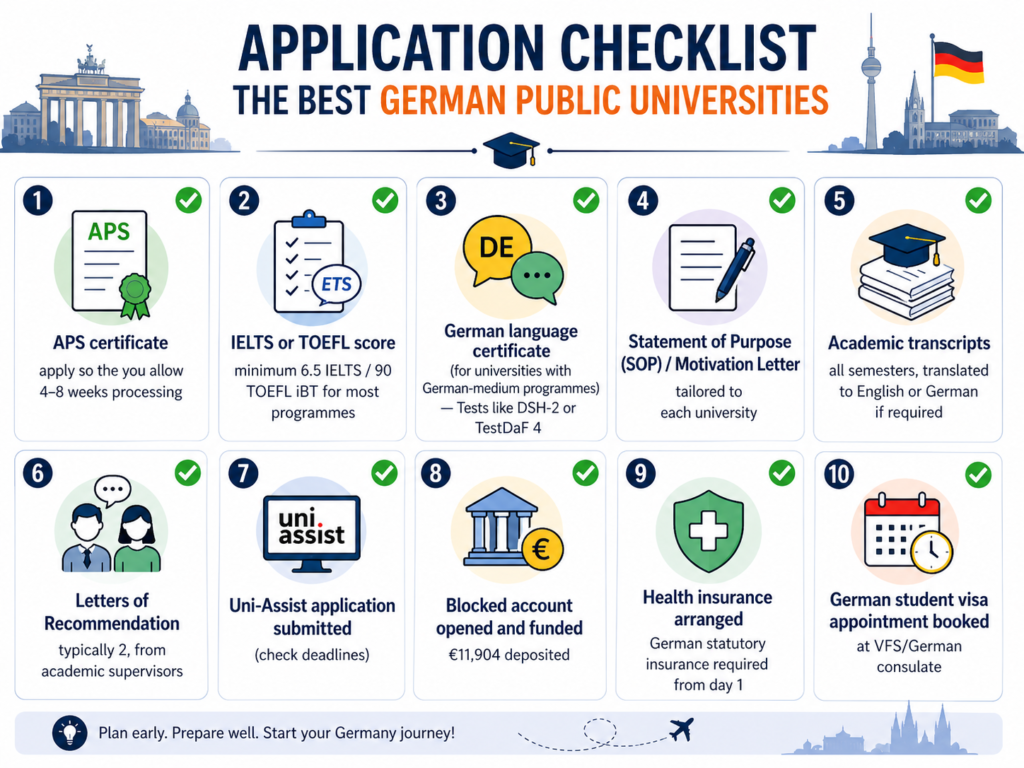
Since November 2022, Indian students applying to any German university must obtain an APS (Akademische Prüfstelle) certificate before their application can be processed.
APS India is a joint body of the German Embassy in New Delhi and the DAAD. Effective from Winter Semester 2026/27, a minimum of 70% overall marks in Class 12 is required for undergraduate applicants.
The APS certificate is essential for a German student visa and is valid for life; it is a one-time process.
| 1 | Register online on the APS India portal Complete the application form at the APS India website. Ensure all personal details match your passport exactly. |
| 2 | Pay the fee: ₹18,000 (non-refundable) This is the mandatory processing fee via the specified bank transfer. Keep the payment receipt carefully. |
| 3 | Compile and courier your documents For Master’s applicants: printed application form with photo, passport, Class 10 and 12 marksheets and certificates, all semester marksheets, and degree certificate. For currently enrolled Bachelor’s students, submit all completed semester transcripts. |
| 4 | Attend an academic interview (if called) Students still enrolled in their undergraduate degree may be called for a 20-minute academic interview verifying subject knowledge and document authenticity. Be prepared to discuss your coursework. |
| 5 | Receive your APS certificate Processing: 3–4 weeks under normal conditions, up to 3 months during peak season (May–July). Apply at least 4–5 months before your planned visa application. For Winter Semester 2026/27, begin APS in March/April 2026 at the latest. |
Every Indian student applying for a German student visa must deposit €11,904 per year (approximately ₹10.6–11.5 lakh) in a German blocked account. This allows monthly withdrawals of €992 upon arrival in Germany. The blocked account must be with an approved provider (Fintiba, Expatrio, or Deutsche Bank). Without this, the visa application will not proceed regardless of your admission status.
| EXPENSE ITEM | AMOUNT (2026) | IN INR (APPROX.) | WHEN |
|---|---|---|---|
| APS Certificate Fee | ₹18,000 | ₹18,000 | Before applying |
| Blocked Account Deposit | €11,904/year | ~₹10.6–11.5 lakh | Before visa |
| Semester Contribution | €150–€400/semester | ~₹14K–36K | Per semester |
| Health Insurance | ~€110/month | ~₹9,900/month | Monthly |
| Living Costs | €700–€1,200/month | ~₹63K–1.08L/month | Monthly |
| POST-STUDY WORK PERMIT: Graduates of German public universities automatically qualify for an 18-month job seeker visa after graduation. This permit grants unlimited work rights, work any job while searching for qualified employment. No lottery, no employer sponsorship required to apply. This can be a direct pathway to the EU Blue Card (minimum salary for shortage occupations: €45,934 for 2026) and permanent residency. Germany naturalisation after 5 years (3 years in special cases) under the 2024 law change. |
Germany now has over 1,800 English-taught Master’s programmes at public universities. Technically, it is possible to study without German language proficiency. However, German language (B1–B2 level) measurably improves post-graduation employment outcomes. Most German companies operate internally in German. Students who reach B2 level during studies qualify for permanent residency as fast as 21 months under Germany’s skilled worker fast-track pathway.
Maven’s recommendation: begin German language training at A1–A2 level before departure, targeting B1 by the end of your first year in Germany.
1. Is education really free at German public universities for Indian students in 2026?
Most German public universities charge €0 tuition regardless of nationality, you only pay a semester contribution of €150–€400 covering administration and a public transport pass.
Two main exceptions: Baden-Württemberg state universities charge €1,500/semester for non-EU students, and TU Munich introduced €4,000–€6,000/semester fees from 2024/25.
2. What is the APS certificate and is it mandatory?
The APS (Akademische Prüfstelle) certificate is a mandatory academic verification document issued by the German Embassy in New Delhi. Introduced in November 2022, it verifies Class 10, 12, and degree documents. The fee is ₹18,000 and processing takes 3–8 weeks. It is valid for life once issued.
3. Which German university is best for Indian engineering students?
RWTH Aachen (#88 QS 2026) is Maven’s top recommendation for Mechanical and Automotive Engineering, zero tuition, 2,400+ Indian students, direct industry pipelines. TU Munich (#22) leads on prestige but charges tuition. TU Berlin and TU Dresden offer strong engineering at zero tuition with excellent employability.
4. How much money do Indian students need for the German student visa in 2026?
Students must deposit €11,904 (approximately ₹10.6–11.5 lakh) in a German blocked account (Sperrkonto). This allows monthly withdrawals of €992. Without this, the visa application will not proceed regardless of admission status.
5. Can Indian students work after graduating in Germany?
Yes — graduates of German public universities receive an 18-month job seeker visa with unlimited work rights. No lottery, no employer sponsorship required upfront. This leads directly to the EU Blue Card and permanent residency pathway.
6. Do I need to know German to study in Germany?
Not for many programmes.
Germany has over 1,800 English-taught Master’s programmes. However, German language proficiency (B1–B2) significantly improves post-graduation employment outcomes and accelerates permanent residency. Maven recommends beginning German language training before departure.
7. Are public universities better than private universities in Germany?
Read our in-depth blog: Public Universities vs. Private Universities in Germany for Indian Students.
Maven Consulting Services has guided students from Bengaluru and across Karnataka through German university admissions, from APS certificate to visa to arrival. Maven is the ETS TOEFL Power House of Karnataka, recognised for student outcomes.
This guide is for informational purposes. University fee structures, visa requirements, and APS policies are subject to change. Last updated April 2026.