







This Fall 2027 US undergrad roadmap starts now: the Common App went live three days ago, on August 1, 2026 — and if you’re an Indian student aiming for a US undergraduate seat in Fall 2027, the clock on this cycle has already started.
Students who submit strong Early Action and Early Decision applications in November typically get more scholarship consideration and far less waiting-room anxiety than those who scramble in December. This guide breaks the entire cycle into a month-by-month roadmap, so you know exactly what needs to happen and when — including a genuinely new wrinkle this year: the first Fall 2027 cohort will land in the US under a completely different visa admission rule than every batch before them.
Before the roadmap, one quick orientation: for the full destination picture — costs, best courses, work rights, and outcomes — start with our Study in USA: Complete Guide. This piece assumes you’ve already decided on the US and need the practical application-to-visa sequence.
Who This Fall 2027 US Undergrad Roadmap Is For
- Indian students in Class 12 (or gap year) following this Fall 2027 US undergrad roadmap toward a US undergraduate start
- Parents trying to map application deadlines against school exams and board results
- Students deciding between Early Decision, Early Action, and Regular Decision
- Applicants confused about how visa timing now differs from what an older sibling or cousin experienced
What This Fall 2027 US Undergrad Roadmap Covers
- This Fall 2027 US undergrad roadmap: the full admissions calendar, month by month, from August 2026 to move-in in 2027
- Early Decision vs Early Action vs Regular Decision — and what each really commits you to
- The current SAT/ACT testing landscape school by school
- Where “getting admitted” ends and “getting a visa” begins — two separate processes with two separate clocks
- The new DHS rule ending Duration of Status, and why it applies to this exact cohort
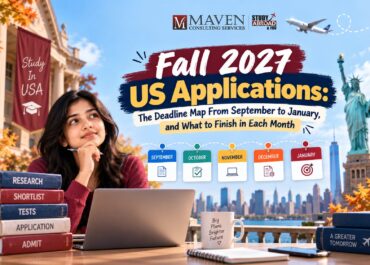
The Fall 2027 Admissions Calendar at a Glance
These are typical windows, not universal rules — always confirm each target school’s exact deadline on its own admissions page.
| Milestone | Typical Window |
|---|---|
| Common App opens | August 1, 2026 |
| Early Decision / Early Action deadlines | November 1–15, 2026 |
| ED / EA decisions released | Mid-December 2026 |
| Regular Decision deadlines | January 1–15, 2027 (some later, into Feb/March) |
| RD decisions released | March–April 2027 |
| Enrollment deposit (Decision Day) | May 1, 2027 (most selective schools) |
| I-20 issued, SEVIS fee + visa process | May–July 2027 |
| Program start / move-in | August 2027 |
Fall 2027 US Undergrad Roadmap: Month-by-Month
August–September 2026: Build and Draft
Create your Common App account if you haven’t. Finalize a balanced college list — reach, match, and safety schools. Start your personal statement; the 2026-27 prompts are unchanged from last cycle, so any drafting you’ve already done still applies. Begin requesting recommendation letters now — Indian school terms mean teachers need more lead time than a US-based recommender would.
October 2026: Lock In Early Applications
Decide which single school (if any) gets your Early Decision application — remember, ED is binding. Finalize supplemental essays for your EA/ED schools. Register for or confirm SAT/ACT scores if your target schools require them. Confirm recommenders have submitted or are on track.
November 2026: Early Deadlines
Most ED and EA deadlines land here, typically November 1 or 15. Submit early, not at 11:59 PM on deadline day — Common App and school portals slow down under load, and Indian time-zone math (most US deadlines run on the applicant’s local time or Eastern time) has caught out students before.
December 2026: Decisions and Continued Applications
ED/EA decisions typically arrive in mid-December. If admitted ED, you withdraw all other applications and begin the I-20 process (see below) much earlier than RD admits. If not applying early, or if deferred/denied, continue building out Regular Decision applications.
January 2027: Regular Decision Deadlines
Most RD deadlines fall January 1–15. Financial aid forms (CSS Profile, school-specific aid applications) are often due around the same window — don’t let admissions paperwork eclipse the aid paperwork, since many merit and need-based awards are first-come within a fixed pool.
February–April 2027: Wait, Compare, Decide
RD decisions typically release across March and April. This is also when to compare financial aid offers side by side — sticker price rarely equals what you’ll actually pay.
May 2027: Commit
May 1 remains the informal industry standard for enrollment deposits at most selective schools, even though it is no longer a mandatory rule under NACAC’s code of ethics. Confirm your chosen school’s exact deadline. Once you commit and pay your deposit, your university’s international office will begin preparing your I-20.
June–July 2027: I-20, SEVIS, and the Visa Interview
This is the visa clock, and it runs on a completely different track from admissions. See the dedicated section below — this is also the stage where this year’s cohort meets a genuinely new rule.
August 2027: Departure and Arrival
Travel, orientation, and move-in. Most programs allow entry up to 30 days before the I-20 program start date.
Early Decision vs Early Action vs Regular Decision
This is the single most consequential early choice in the whole cycle, and it’s worth getting straight:
- Early Decision (ED): Binding. If admitted, you must enroll and withdraw every other application. Only apply ED if the school is a genuine first choice and you’re comfortable committing to its financial aid offer before comparing others.
- Early Action (EA): Non-binding. You get an early answer but keep every option open, including applying RD elsewhere. Some EA programs are “restrictive” (Harvard, Yale, Princeton, among others) and limit where else you can apply early — check each school’s specific rules.
- Regular Decision (RD): The standard round, no early commitment either way, but the longest wait for an answer.
For Indian families weighing financial aid heavily, ED’s binding nature is worth real caution — you commit before you can compare aid packages across schools.
The Testing Landscape for Fall 2027
This Fall 2027 US undergrad roadmap also tracks a fast-moving testing landscape: testing policy has shifted meaningfully since the pandemic-era test-optional wave, and this cycle is the tipping point at the most selective schools:
| Policy | Schools (2026-27 cycle) |
|---|---|
| SAT/ACT required | Harvard, Yale, Dartmouth, Brown, Cornell, Penn, MIT, Caltech, Stanford, Georgetown |
| Test-optional (final year before requiring) | Princeton, Columbia — both require scores starting the following cycle |
| Test-optional, no announced end date | Majority of ranked four-year US colleges |
Maven Note: “Test-optional” describes whether you must submit a score — it doesn’t mean the score won’t count if you do. For a competitive Indian applicant pool, a strong SAT/ACT score is still one of the clearest ways to stand out, even at schools where it’s technically optional. Don’t skip the test just because a school allows it.
Admission Requirement vs Visa Requirement — They Are Not the Same Process
This is where a lot of families lose weeks unnecessarily. Getting admitted to a US university and getting an F-1 visa are two separate systems, run by two separate authorities, on two separate timelines:
- Admission is decided by the university — based on your application, essays, tests, and (for aid) financial forms.
- The visa is decided by the US Department of State and Department of Homeland Security — based on your I-20, SEVIS record, DS-160, financial proof, and interview.
A university admitting you and issuing an I-20 does not guarantee a visa. Build your visa timeline as its own project, starting the moment you have your I-20 in hand — not after you’ve mentally “finished” the process at decision day.
Visa Timeline After Admission
Once you commit, this Fall 2027 US undergrad roadmap moves into the visa phase — after your university issues your I-20:
- Pay the SEVIS I-901 fee ($350) before scheduling your visa interview
- Complete the DS-160 online visa application and pay the MRV fee ($185)
- Book your F-1 interview at a US consulate in India (New Delhi, Mumbai, Chennai, Hyderabad, or Kolkata — you can interview at any of them regardless of home state)
- Gather financial proof, admission and I-20 documents, and academic records for the interview
- Attend the interview and await visa issuance
Interview wait times vary by consulate and season and have ranged from a few weeks at faster posts to two or three months at busier ones during the May–August peak. Always check current wait times at travel.state.gov and book through the official ustraveldocs.com/in/en portal — never a third-party agent.
The Rule Change This Cohort Should Know About
Every F-1 student before this cohort was admitted for “Duration of Status” (D/S) — an open-ended admission tied to staying enrolled, with no fixed expiry date on the I-94. That changes on September 15, 2026, when a new DHS rule takes effect replacing D/S with a fixed period of admission, capped at four years and tied to the program length on your I-20, plus a 30-day grace period on either side for arrival and departure.
Because Fall 2027 students generally travel to the US in August 2027 — nearly a year after the rule takes effect — this is the first undergraduate intake cohort that will be admitted entirely under the new fixed-period system rather than D/S. For a standard four-year bachelor’s degree finished on time, this shouldn’t create extra paperwork. But if your program is likely to run longer than four years — a dual degree, a change of major, or an extended course of study — you may need to file for an extension of stay with USCIS before your admission period expires, something D/S students never had to do.
We’re tracking this rule’s implementation closely and will publish a dedicated, fully updated guide as USCIS issues further procedural guidance — check back or ask us directly if this applies to your specific program length.
Recommendation Letters: Start Earlier Than You Think
As this Fall 2027 US undergrad roadmap emphasizes, request letters at least 6–8 weeks before your earliest deadline — September or early October 2026 if you’re applying ED or EA. Indian school terms, board exam schedules, and teacher workloads mean recommenders often need more runway than the US norm assumes. Give your recommenders your resume, a short note on why you’re asking them specifically, and your target deadline in writing.
“Every year we see strong students lose their Early Decision shot not because the essay wasn’t ready, but because a recommendation letter was still pending on November 1. Build your recommender timeline before you build your college list.” — Rajshekar Tubachi, Founder & Managing Director, Maven Consulting Services
Frequently Asked Questions
When does the Common App open for Fall 2027 admissions?
The Common Application for the 2026-27 cycle opened on August 1, 2026 — the platform Indian students use to apply for Fall 2027 undergraduate entry — the starting point for this Fall 2027 US undergrad roadmap.
Is “Fall 2027” the same as “Class of 2027”?
No. “Fall 2027” is when you start college. “Class of 2027” is sometimes used loosely for current-year high school seniors, but your actual college graduating class will land around 2031 for a standard four-year degree. Go by the intake term when comparing deadlines.
What’s the difference between Early Decision, Early Action, and Regular Decision?
ED is binding — you must enroll if admitted. EA is non-binding — you get an early decision but keep your options. RD is the standard round with no early commitment. Most ED/EA deadlines fall around November 1 or 15, 2026; most RD deadlines fall around January 1 or 15, 2027.
Do I need to submit SAT or ACT scores for Fall 2027 applications?
It depends on the school. Six of eight Ivy League universities plus MIT, Caltech, Stanford, and Georgetown require scores this cycle. Princeton and Columbia are test-optional for one final year. Always confirm each school’s current policy directly.
How much does an F-1 visa cost for Fall 2027?
Budget at least $535 in mandatory US government fees — $350 SEVIS I-901 fee plus $185 MRV visa fee — separate from application fees and university-side costs.
Will Fall 2027 students be admitted under Duration of Status or the new fixed admission period rule?
The new fixed-period rule. It takes effect September 15, 2026, before most Fall 2027 students travel, making this the first undergraduate cohort admitted for a fixed period tied to their I-20 program length rather than open-ended D/S.
How early should Indian students request recommendation letters?
At least 6–8 weeks before your earliest deadline — September or early October 2026 for ED/EA applicants — since Indian school terms often need more lead time than the US norm assumes.
What is National College Decision Day and does it still apply?
May 1 is the traditional enrollment deposit deadline. It’s no longer a mandatory NACAC rule for every school, but most selective universities still observe it — plan around May 1, 2027 unless a school states otherwise.
How long does the F-1 visa interview wait take in India?
It varies by consulate and season, ranging from a few weeks at faster posts to two or three months at busier ones during peak demand. Check live wait times at travel.state.gov rather than relying on a fixed figure.
Can I start my Common App essay before August 1?
Yes — create your account and draft your personal statement; it carries over when the cycle opens, and the 2026-27 prompts are unchanged from last cycle.
The Maven Takeaway
The Common App opening is a starting gun, not a deadline — but the students who treat August and September as working months, not warm-up months, are the ones who submit calm, complete Early applications in November instead of rushed ones in January.
This cycle adds one more reason to start early: the visa side of your journey now runs under a materially different rule than any batch before you, which makes the gap between “admitted” and “visa in hand” worth planning for from day one, not discovering in July 2027. This Fall 2027 US undergrad roadmap is designed to help you avoid exactly that gap.
Planning Your Fall 2027 US Undergrad Roadmap?
Maven Consulting Services is commission-free — our advice isn’t tied to which university pays us. Book a free consultation to map your college list, timeline, and visa plan together.
WhatsApp | Bengaluru, Karnataka | Instagram | LinkedIn | YouTube
Read More
- Your Fall 2027 Application Timeline: A Month-by-Month Roadmap
- GRE, GMAT, IELTS — or None? The 2027 Test & Booking Strategy
- Student Visa Interview Prep for 2027 Applicants
- Visa Refusal Rates Country-Wise: The Honest Numbers
← Previous: Study With Low GPA, Backlogs, or a Gap Year | Next: (August Slot #2) →