WhatsAppCHAT
CALL US& CONNECT

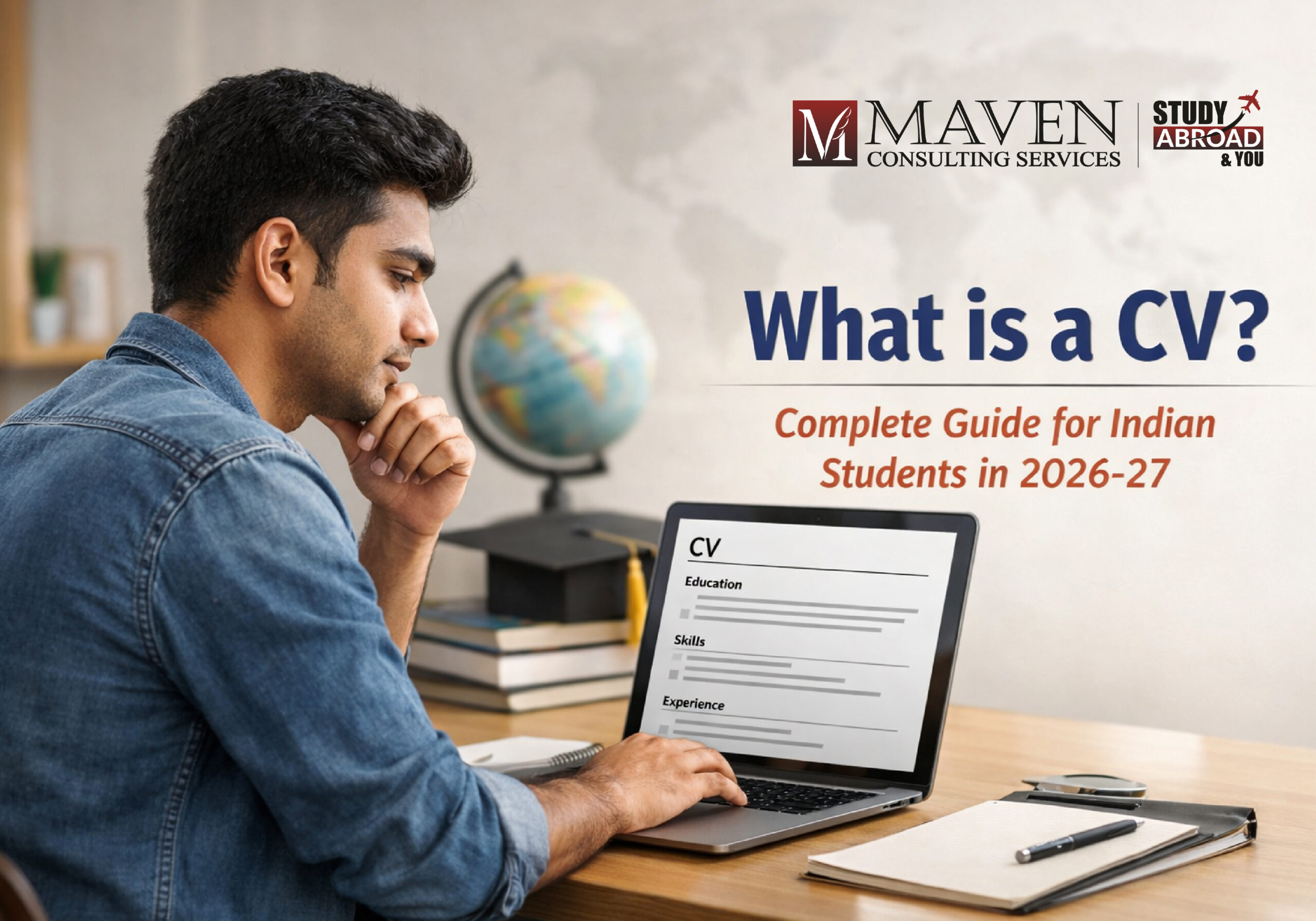
Applying to universities abroad can feel overwhelming—especially for Indian students preparing applications in 2026. Knowing how to write a strong CV for studying abroad is often the first challenge, but absolutely important because a well-structured study abroad CV format for Indian students plays a critical role in admissions, scholarships, and even visa credibility, making it essential to get right from the start.
This guide is written for:
In this blog, readers will learn to:
By the end of this guide, students will have a clear, practical framework to build a program-ready CV that supports their Statement of Purpose, strengthens scholarship applications, and adapts smoothly across international university requirements.
CV stands for Curriculum Vitae, a Latin term meaning “course of life.” Most international universities—including those in the UK, Europe, and Canada—use the CV to assess academic readiness rather than employability, as it includes — what a student has studied, explored, built, researched, and learned.
For universities abroad, a CV offers a quick yet comprehensive view of a student beyond grades. It helps admissions committees understand context—how academic choices, projects, and experiences connect to the program being applied for.
Universities use the CV to assess:
This is why a CV quietly reinforces other documents like the SOP. When aligned well, the application reads as cohesive rather than fragmented.
| Resume | Study Abroad CV |
| Common in the USA & Canada | Common in the UK, Europe, and Australia |
| 1 page, ATS-focused | 1–2 pages (longer for PhD) |
| No photo, no personal details | Photo only if the country asks |
| Job & skill-driven | Academics, projects, research |
| Optimised for ATS (What is an ATS resume?) | Read by admissions committees |
Some countries, especially the USA, use the word resume even for academic contexts, while the UK and Europe clearly prefer CVs. Always follow the terminology used by the university. If unclear, reviewing country-specific expectations is essential.
Not every university explicitly lists a CV as mandatory. However, many do—especially for:
Even when optional, submitting a CV often strengthens applications for research roles, teaching assistantships, internships during the program, and merit-based funding.
For Indian students applying abroad, the safest and most accepted format is reverse chronological order, particularly for education and experience. This format allows admissions committees to quickly assess progression and relevance.
Creativity in layout rarely adds value in academic admissions. Clarity does.
Keep reading for a detailed breakdown on how to write a CV.
The ideal length depends on academic level:
Length should reflect depth. Adding pages without substance weakens credibility.
Keep reading to know exactly how it’s differs based on country and course.
A clean, readable format improves both human and AI readability:
Always name files clearly, such as:
FirstName_LastName_CV_Program.pdf
Before we jump into the Step-by-Step, here are 5 simple, powerful tips for you to keep in mind even before you start writing.
A strong study abroad CV is built in layers. Each section must earn its place on the page, and the order matters more than most students realise.
Begin with a clear skeleton that works across most countries and universities.
A strong base structure includes:
Not every CV needs every section. If a section does not support academic goals or program alignment, it should be removed.
The final format of the CV depends on the country, course and work experience of the candidate. Maven eases this process for enrolled students by evaluating your profile and assessing your needs.
The education section establishes credibility immediately and should be easy to scan.
Include:
Admissions teams should understand academic background within seconds.
For many Indian students, especially undergraduates and freshers, projects are the strongest evidence of capability.
For each project, clearly state:
Projects should demonstrate application, not just completion.
Avoid listing job descriptions or company overviews. Admissions committees are evaluating learning, not employers.
Focus on:
Titles matter far less than what was learned and applied.
Skills should reinforce—not repeat—the rest of the CV.
Group them into:
If a skill cannot be traced back to a project or role, it is better omitted.
This section adds strength when used thoughtfully.
Strong entries include:
Avoid listing participation without contribution.
The summary should guide the reader, not repeat the CV.
In 2–3 lines, include:
A focused summary frames the CV effectively.
A lack of internships does not weaken an application when academic effort is presented well.
Replace work experience with:
Indian students can also include:
Certifications only add value when applied through projects.
| Country | CV Expectation |
| USA | Resume-style, ATS-friendly, no photo |
| UK | Academic CV, profile summary at top |
| Canada | Resume/CV hybrid, clean format |
| Germany | Europass CV (only if asked) |
| Europe | Structured academic CV |
Never assume—always follow program instructions.
If you are aiming for the UK, here is the UCAS guidance on CVs for UK universities.
Read more: UCAS Undergraduate Scholarships 2025–2028
Scholarship CVs require stronger evidence of impact.
They prioritise:
For scholarships like Chevening, DAAD, or Erasmus, CVs should clearly align with leadership goals, academic merit, and community impact. Ensure achievements match what referees mention in recommendation letters.
Participation alone is not enough. Outcomes matter.
This section shows you how to write strong CV bullet points, not just what to include. It helps turn projects, internships, and coursework into clear, outcome-focused statements that international admissions teams can scan and understand easily.
This bullet format is also ATS-safe for US and Canadian applications, as it avoids tables, icons, and decorative formatting.
Action → Tool/Method → Outcome
This approach helps universities quickly understand:
Template 1:
Project-Based Work –
Built / Designed / Analysed X using Y to achieve Z
Template 2:
Leadership or Teamwork –
Led a team of N to deliver X, improving metric by %
Template 3:
Research and Academic Work –
Conducted research on topic using method, producing outcome
1. Engineering Student (UG / MS in USA, Germany, UK):
Built a machine learning model using Python to improve prediction accuracy by 18% in a final-year project.
2. Business or Management Student (MS / MBA Abroad):
Analysed market entry strategies using Excel and SWOT analysis, presenting recommendations that reduced projected costs by 12%.
3. Design or Architecture Student (Europe / UK):
Designed a user-centric mobile interface using Figma, improving task completion time by 25% based on usability testing.
4. Research-Focused Profile (PhD / MS Research):
Conducted research on renewable energy storage using regression analysis, contributing to a paper submitted for conference review.
Include them only if the scores are strong and final. If scores are average, pending, or already entered in the application portal, leave them out.
Yes, a small overlap is normal because both documents talk about your background. The CV lists facts, while the SOP explains motivation and goals.
Start at least 6–8 months before deadlines. Indian students often need the CV early for scholarships, recommenders, and planning internships or projects.
No, universities care more about content than design. However, following country norms helps avoid unnecessary mistakes.
Yes, if the work shows responsibility or skills. Clearly explain your role and what you learned from it.
Not directly, but inconsistencies between your CV, SOP, and visa interview answers can raise concerns. A clear and honest CV supports credibility.
No, especially for undergraduate and fresher applicants from India. Strong projects, coursework, and academic focus are enough.
Yes, scholarships rely heavily on CVs to assess merit and leadership. A clear, well-structured CV can significantly strengthen funding applications.
Only if they are relevant or show leadership, teamwork, or initiative.
Yes, especially for master’s and PhD applicants, if it is professional and up to date.
Updated for 2026 | Reviewed by Maven Study Abroad Counsellors
At Maven, CV guidance is personalised by profile, country, and program. Students receive structured feedback and realistic samples, but ownership remains with them. We guide, review, and prepare students through every step—ensuring they understand the process and are ready for what comes next.
A strong CV doesn’t come from templates alone. It comes from clarity, structure, and intention. When done right, it quietly strengthens every part of a study abroad application—and lays the foundation for future academic and professional success.
Book a free consultation with Maven to review your profile and get personalised guidance on study abroad CV format for Indian students for 2026-27 applications.

Sunday, October 26, 2025 | The Taj MG Road, Bangalore | 10 AM – 4 PM