WhatsAppCHAT
CALL US& CONNECT

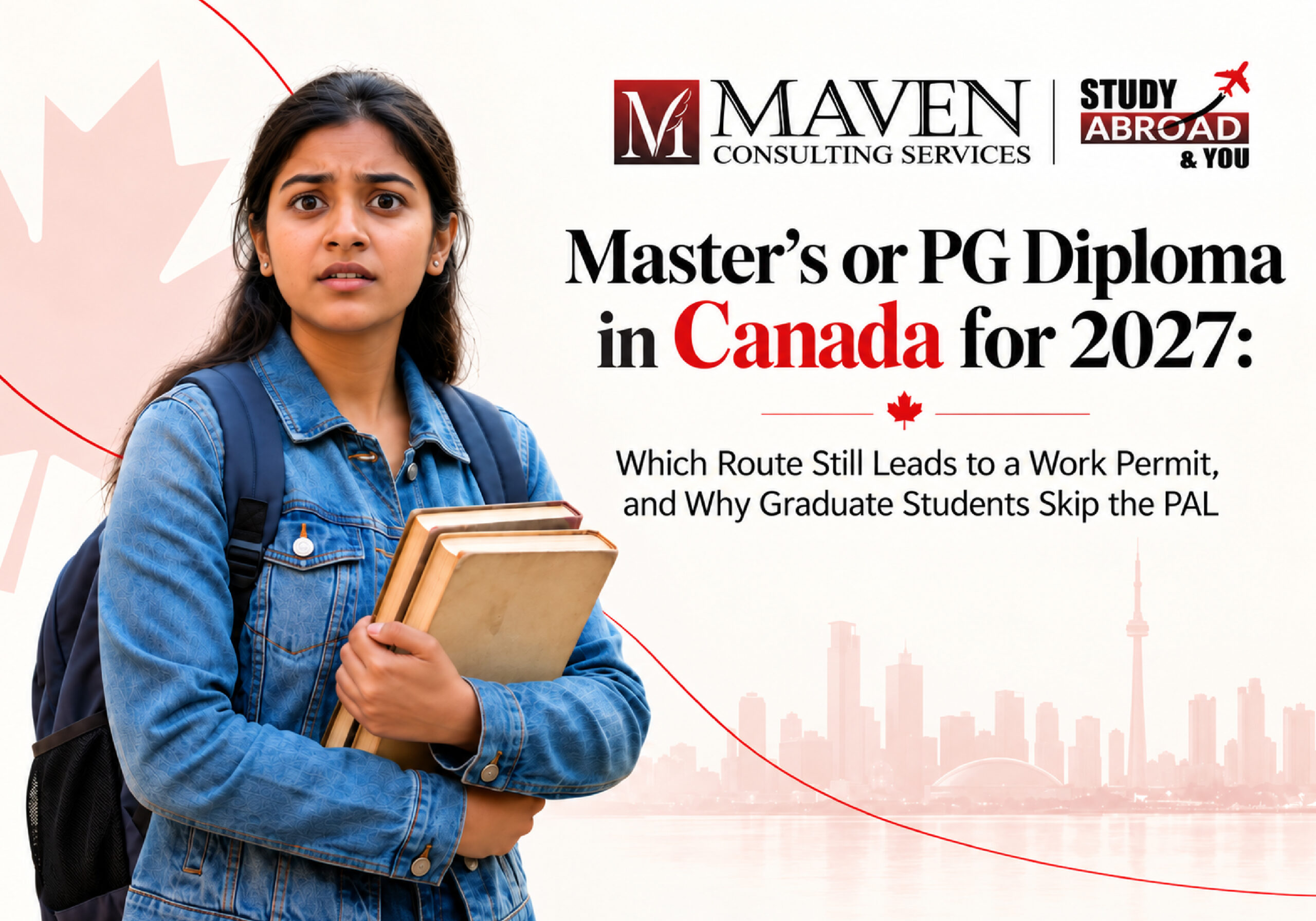
Last verified: 15 October 2026, against IRCC’s PAL, PGWP, field-of-study, language and proof-of-funds pages and the 25 November 2025 allocations notice. We update this page, with the date, whenever a figure changes, and on the day the 2027 to 2029 levels plan is tabled.
By Rajshekar Tubachi, Founder, Maven Consulting Services, Bengaluru · 15+ years in international education
The Short Answer
Do master’s students need a PAL for Canada in 2027?
No, if the programme is a degree-granting master’s or doctorate at a public institution. IRCC removed the PAL requirement for that group from 1 January 2026. A one-year master’s can still earn a three-year PGWP. A PG diploma needs a PAL, an eligible field of study, and earns a work permit only as long as the course.
Two offer letters on the table. One is a one-year PG diploma in Canada at an Ontario college, cheaper and with an easier admission. The other is a one-year master’s at a public university, costlier and harder to get. Five years ago most families would have picked the diploma. In 2027 that choice can cost a student two years of Canadian work rights.
This guide sets out the master’s vs PG diploma in Canada decision for 2027 the way an immigration officer will see it: which route needs a Provincial Attestation Letter, which one sits inside the study permit cap, how long the post-graduation work permit (PGWP) lasts, what English test counts, and whether your spouse can work. For the wider picture of the country, start with our Study in Canada guide.
It matters now because January and September 2027 applications are being planned this month, and Canada’s next three-year immigration levels plan is due by 1 November 2026. The rules below are the ones in force today, and we have marked clearly where 2027 could change them.
Not if you are going to a degree-granting master’s or doctoral programme at a public institution. In its notice on the 2026 provincial and territorial allocations, dated 25 November 2025, IRCC confirmed that from 1 January 2026 master’s and doctoral students enrolled at a public designated learning institution (DLI) do not need a PAL or TAL with their study permit application. IRCC also expected to issue about 49,000 permits to this group in 2026, outside the provincial allocations that cap everyone else.
The exemption is narrower than many agents suggest. IRCC’s PAL/TAL page lists the exempt category in precise words: a degree-granting graduate programme at the master’s or doctoral level at a public DLI. Three groups fall outside it.
| Programme | PAL needed for a 2027 application? | Why |
|---|---|---|
| Master’s or PhD at a public university | No | Exempt since 1 January 2026 |
| Master’s at a private institution | Yes | The exemption covers public DLIs only |
| Graduate certificate or PG diploma at a university | Yes | Not a degree-granting master’s programme |
| Graduate certificate or PG diploma at a college | Yes | Inside the cap and provincial allocations |
| Extension at the same DLI and same level | No | Existing exemption for in-Canada students |
If you are exempt, you still have to prove it. IRCC asks applicants who do not include a PAL to show that they meet one of the exceptions, and it confirms the exemption only when it reviews the file. Your letter of acceptance should name the programme and the degree clearly.
The PAL itself is tied to a cap year. IRCC says a PAL issued in 2026 is valid until 31 December 2026 for the 2026 cap year, and you cannot apply with a PAL from a previous cap year. A diploma student applying in early 2027 will need a 2027 PAL, issued under 2027 allocations that have not yet been announced.
Maven Note: If your offer letter says “Graduate Certificate”, “Graduate Diploma” or “Postgraduate Diploma”, the master’s exemption does not apply to you, even if the institution is a university and the course is taught alongside master’s students. Read the credential name on the letter, not the brochure.
Here are the two routes against the rules that decide what happens after graduation. Every row is drawn from IRCC’s current pages.
| Rule | Master’s at a public university | PG diploma at a college | PG diploma at a university |
|---|---|---|---|
| PAL/TAL | Not required | Required | Required |
| Counted in provincial allocations | No | Yes | Yes |
| Field-of-study list for PGWP | Does not apply | Must be on the list | Must be on the list |
| Language level for PGWP | CLB 7 in all four skills | CLB 5 in all four skills | CLB 7 in all four skills |
| PGWP after a one-year programme | Up to 3 years | Up to about 1 year | Up to about 1 year |
| Spouse open work permit | Yes, if the master’s is 16 months or longer | No | No |
| Canadian education points in Express Entry | Higher band | Lower band for a one or two-year credential | Lower band for a one or two-year credential |
The table is the whole argument in miniature. The diploma looks cheaper on day one, but every rule after graduation points the same way: a master’s at a public university gives more time, more flexibility and fewer gates.
PGWP length is the single biggest gap between the two routes. IRCC’s About the PGWP page says that for master’s degree programmes you can apply for a three-year PGWP even if the programme was less than two years, as long as it was at least eight months long and you meet all other requirements. The same page adds that this does not apply to certificate or diploma programmes.
For everything else, the normal rule applies:
Put those rules next to each other and the arithmetic is stark. A 12-month master’s and a 12-month PG diploma take the same time in a classroom. One graduate leaves with up to 36 months to work. The other leaves with about 12.
| Programme | Time studying | Maximum PGWP | Total time in Canada |
|---|---|---|---|
| One-year master’s at a public university | 12 months | 36 months | About 4 years |
| One-year college PG diploma | 12 months | About 12 months | About 2 years |
| Two-year college PG diploma | 24 months | 36 months | About 5 years |
| Two-year master’s | 24 months | 36 months | About 5 years |
Twelve months of work rarely leads anywhere on its own. Most Canadian employers take a few months to hire, and permanent residence through the Canadian Experience Class needs at least a year of skilled, paid Canadian work. A one-year PGWP leaves almost no margin. You can only ever receive one PGWP, so there is no second attempt.
Maven Note: When an agent says “the diploma also gives you a PGWP”, ask how long. The honest answer for a one-year diploma is about one year. For a one-year master’s, it is up to three.
This is the detail most Indian content gets wrong, including some guides that rank well. Many people assume every PG diploma in Canada follows the college rules: CLB 5 and the field-of-study list. IRCC’s PGWP eligibility page splits non-degree programmes into two groups.
| Credential | Language level for PGWP | Field-of-study rule |
|---|---|---|
| Bachelor’s, master’s or doctoral degree | CLB 7 | None |
| Any other university programme, including graduate certificates and graduate diplomas | CLB 7 | Must be on the eligible list |
| College, polytechnic or other non-university programme | CLB 5 | Must be on the eligible list |
So a one-year graduate diploma at a university carries the strictest combination of all: the higher language bar of a degree and the field restriction of a college course, with only a one-year PGWP at the end. Students sometimes choose these programmes because the university name feels safer. In immigration terms it is the weakest of the three options.
Maven Note: Before accepting any “graduate diploma” or “PG diploma” offer, ask the school three things in writing: is this a degree-granting programme, what is its six-digit CIP code, and is that code on IRCC’s current PGWP field-of-study list. Keep the reply with your study permit file.
The field-of-study requirement links PGWP eligibility for non-degree programmes to occupations in long-term shortage. IRCC’s field-of-study page sets out how it works:
That lock-in rule is useful. If your diploma’s code is on the list on the day you apply for your study permit, you are protected even if the code is removed later. If it is not on the list that day, you are relying on it being added before you graduate.
For 2026, IRCC states that it will not add or remove any eligible fields of study. The freeze followed a turbulent 2025, when a June revision removed 178 programmes and added 119, and the removals were paused in July. IRCC has said nothing yet about the list for 2027. A student who applies for a diploma study permit in 2027 will be checked against whatever list exists on that date.
What to check before you pay a diploma deposit
We cover the list itself, and the June 2026 rule changes, in our Canada PGWP 2027 guide.
Since 1 November 2024, almost every PGWP applicant must submit an approved language test result. The catch is that the test you took for admission may not be the one IRCC accepts. For English, the accepted tests are IELTS General Training, CELPIP-General and PTE Core. IELTS Academic is not accepted for the PGWP, even though universities and colleges accept it for admission. Results must be valid on the day you apply.
IRCC’s language results page gives the score each test needs for each CLB level. The two levels that matter here:
| Test | CLB 7 (degrees and university programmes) | CLB 5 (college programmes) |
|---|---|---|
| IELTS General Training | 6.0 in reading, writing, listening and speaking | Reading 4.0, writing 5.0, listening 5.0, speaking 5.0 |
| CELPIP-General | 7 in each skill | 5 in each skill |
| PTE Core | Reading 60, writing 69, listening 60, speaking 68 | Reading 42, writing 51, listening 39, speaking 51 |
Two practical consequences. First, a master’s graduate needs 6.0 in every IELTS General Training band, so a single 5.5 in writing blocks the PGWP until you retake. Second, plan to sit the immigration test in your final semester, not before you leave India, because results need to be valid when you apply. Our guide to choosing an English test for 2027 explains the admission side of the same decision.
Maven Note: Many students arrive with an IELTS Academic score and assume they are done with English tests. For the PGWP you are not. Budget for one more test, in the General Training or Core format, in your last term.
For married applicants this rule often decides the whole plan. IRCC’s page on helping your spouse work in Canada says that, since 21 January 2025, a spouse or common-law partner may be eligible for an open work permit if the student holds a valid study permit and is in a master’s programme of 16 months or longer, a doctoral programme, or a listed professional or eligible programme.
| Student’s programme | Spouse open work permit while studying |
|---|---|
| Master’s of 16 months or longer | Eligible |
| Master’s shorter than 16 months | Not eligible |
| Doctoral programme | Eligible |
| College diploma or PG diploma | Not eligible |
| University graduate diploma or certificate | Not eligible |
The proof of enrolment must show the programme length clearly, and a spouse cannot apply when the student is already in the final term. If a working spouse matters to your budget, a 16-month or 2-year master’s is not a luxury. It is the only route that keeps two incomes possible.
Some colleges sell a “1 + 1” plan: two one-year graduate certificates back to back, so the student can claim a longer PGWP. IRCC does allow a combined PGWP, but only under strict conditions set out on its About the PGWP page:
The plan also has to survive the move between programmes. Since January 2025, changing schools needs a new PAL before you apply for the study permit. In June 2026 IRCC updated its officer instructions on study permit compliance, narrowing when a student can change programme without a new permit to changes at the same level of study. One helpful exception: IRCC’s PAL page says you do not need a new PAL when moving from post-secondary study to a degree-granting graduate programme at a public DLI.
So stacking works on paper. In practice it doubles your exposure to the cap, the field-of-study list and the compliance rules, and it costs two years of fees to reach a work permit that a one-year master’s could give you directly. We recommend it only when the student cannot get a master’s admission and both diploma codes are already on the list.
Tuition varies widely by school, city and programme, so treat these as examples from official fee pages rather than averages. All rupee figures use CAD 1 = ₹68, the approximate rate on 10 October 2026.
| Item | Example | CAD | Approx. INR |
|---|---|---|---|
| College graduate certificate, one year | Conestoga College, Ontario College Graduate Certificate, 2 terms, international, 2025-26 fees | 19,522 | ₹13.3 lakh |
| Master’s, first two terms | University of New Brunswick, MEng (Leadership in Design Innovation), international, 2026-27 fees | 26,056 | ₹17.7 lakh |
| Living-cost proof, single applicant | IRCC, applications from 1 September 2026 | 23,448 | ₹15.9 lakh |
| Living-cost proof, applicant plus spouse | IRCC, applications from 1 September 2026 | 29,192 | ₹19.9 lakh |
Master’s fees at large universities in Toronto and Vancouver run well above the UNB example, and some college programmes cost more than Conestoga’s. Check the fee page for your exact programme and intake.
The living-cost figure comes from IRCC’s proof of financial support page. It rose from CAD 22,895 to CAD 23,448 for applications submitted on or after 1 September 2026, and it covers living expenses only. You must also show first-year tuition and return travel, and explain how you will pay for later years.
When you compare the two routes, compare cost per year of work rights, not cost per year of study. A diploma that is about CAD 6,500 cheaper but gives two fewer years of PGWP is the more expensive choice for most families. For the full cross-country picture, see our cost of a master’s abroad comparison, and for loans and the TCS on remittances, our 2027 funding guide.
Neither route guarantees permanent residence, and no honest adviser should say otherwise. What the route changes is how much time and how many points you have to work with.
The diploma route still makes sense in a narrow set of cases: a two-year college programme in a listed healthcare, trades or technical field, for a student who wants to work in exactly that field and cannot secure a master’s admission. Outside that, the master’s is the more realistic path.
These are illustrative cases built from the questions we hear most often. The names are not real.
Arjun holds an offer for a one-year college graduate certificate in data analytics and an offer for a one-year MEng in electrical and computer engineering at a public university. The college programme is about CAD 6,500 cheaper in tuition.
His IELTS Academic score of 6.5 overall with 6.0 in writing gets him into both programmes. For the PGWP he will need a General Training or CELPIP result in his final term. We would advise the MEng. The tuition difference is recovered within the first few months of the extra two years of work rights.
Sneha is choosing between a 12-month master’s and a 16-month master’s in engineering management at two public universities. Both are PAL-exempt and both lead to a three-year PGWP.
The family must show CAD 29,192 for living costs for two people, plus tuition and travel. The four extra months of fees are outweighed by a second Canadian income, so the 16-month programme is the better plan. If her husband does not plan to move, the 12-month programme is the cheaper and equally strong choice.
Last checked 15 October 2026
Three things could shift this guide: a change to the student arrivals target, a decision on whether the master’s PAL exemption continues into 2027, and the 2027 field-of-study list. We will update this section on the day the plan is tabled. The structure of the decision is unlikely to change: the master’s route has been protected while the PG diploma in Canada route has been tightened, and every announcement since 2024 has pushed in that direction. Our study permit cap guide explains how allocations work.
| Choose a master’s at a public university if | A PG diploma can still make sense if |
|---|---|
| You want the longest possible PGWP from one year of study | The programme is two years long and its CIP code is on the list today |
| You want to avoid the PAL and the provincial cap | You want to work in exactly the listed field, such as a healthcare or trades role |
| You are married and want your spouse to work (choose 16 months or longer) | You cannot secure a master’s admission this cycle |
| You can reach 6.0 in every IELTS General Training band, or the CELPIP equivalent | Your language scores are closer to CLB 5 than CLB 7 |
| You may want to change fields after graduation | You are not relying on a spouse working in Canada |
If neither route fits your timeline for September, other countries still run January and February starts. Our upcoming January 2027 intake guide covers Canada alongside the UK, US, Ireland and Australia, and our USA vs Canada comparison sets the two North American options side by side.
Founder Perspective
“Every month a family brings us a college diploma offer and asks whether it is as good as a master’s because both say PGWP-eligible. The word is the same, but the outcomes are not. A one-year diploma is a one-year work permit, a PAL you have to win from a shrinking provincial allocation, and a field-of-study list nobody can promise for 2027. A one-year master’s at a public university is a three-year work permit with none of those gates.”
“I would rather a student spends six more months improving a profile for a master’s admission than takes the easy offer and runs out of work permit before the career has started. The diploma is not wrong for everyone. It is wrong for most of the students who are being sold it.”
Rajshekar Tubachi, Founder, Maven Consulting Services
Not if the programme is a degree-granting master’s or doctoral programme at a public designated learning institution. IRCC exempted this group from the PAL/TAL requirement from 1 January 2026. Master’s programmes at private institutions, and graduate certificates and diplomas, still need a PAL.
Yes. Graduate certificates and postgraduate diplomas, whether at a college or a university, are not covered by the graduate exemption. You need a provincial or territorial attestation letter from your school before you apply for the study permit.
Up to three years. IRCC allows a three-year PGWP for a master’s degree even if the programme was shorter than two years, as long as it lasted at least eight months and you meet every other requirement, including CLB 7 in all four language skills.
Usually up to the length of the programme, so about one year for a one-year diploma. The three-year rule for short master’s programmes does not apply to certificate or diploma programmes. A diploma of two years or more can lead to a three-year PGWP.
Yes. Only bachelor’s, master’s and doctoral degrees are exempt. A graduate diploma or certificate at a university must be on IRCC’s eligible field-of-study list and needs CLB 7. A college graduate certificate must be on the same list and needs CLB 5.
IELTS General Training, CELPIP-General and PTE Core, or TEF Canada and TCF Canada for French. IELTS Academic is not accepted for the PGWP, even if your university accepted it for admission. CLB 7 on IELTS General Training means 6.0 in every band.
In most cases, no. Since 21 January 2025, spouses qualify for an open work permit only if the student is in a master’s programme of 16 months or longer, a doctoral programme, or a listed professional or eligible programme. College and PG diploma programmes do not qualify.
For applications submitted on or after 1 September 2026, a single applicant outside Quebec must show CAD 23,448 for living expenses, plus first-year tuition and travel. With one family member the figure is CAD 29,192.
The current levels plan sets a notional target of 150,000 new international student arrivals in 2027. The 2027 to 2029 Immigration Levels Plan is due by 1 November 2026 and may revise it. Provincial allocations for 2027 have not been published.
For most Indian graduates, a master’s at a public university is the stronger route: no PAL, a three-year PGWP, no field-of-study restriction, and more Canadian education points in Express Entry. A diploma can still work in a listed shortage field, but it leaves less time to build work experience.
In the master’s vs PG diploma in Canada decision for 2027, the master’s at a public university wins on almost every rule that matters after graduation. It needs no PAL since 1 January 2026, sits outside the provincial allocations, carries no field-of-study restriction and can lead to a three-year PGWP after a single year of study. A PG diploma in Canada needs a PAL, an eligible CIP code and earns a work permit only as long as the course, and a university graduate diploma adds a CLB 7 bar on top. Check your offer letter, your CIP code and your English test before you pay any deposit.
Send us both letters. We will check the credential, the CIP code against IRCC’s current list, the PAL position, the PGWP length you can expect and whether your spouse can work, and tell you plainly which offer protects your work permit. Maven Consulting Services, Bengaluru, has guided more than 10,000 students across 700-plus university partners in 20-plus countries, with a 99.8 per cent visa success rate and a commission-free model, so our advice follows your interests, not a college’s.
WhatsApp | Bengaluru, Karnataka · Instagram · LinkedIn · YouTube
<< Previous Blog | Next Blog >>
Sources: IRCC, 2026 provincial and territorial allocations under the international student cap (25 November 2025); IRCC, Provincial attestation letter or territorial attestation letter (modified 2 September 2026); IRCC, Apply for a study permit as a graduate student; IRCC, About the post-graduation work permit (modified 9 March 2026); IRCC, PGWP Who can apply (modified 24 June 2026); IRCC, PGWP Field of study requirement (modified 9 March 2026); IRCC, PGWP language results (modified 27 May 2026); IRCC, Proof of financial support (modified 28 August 2026); IRCC, Help your spouse or common-law partner work in Canada; Conestoga College, Intercultural Leadership graduate certificate fee schedule; University of New Brunswick, 2026-2027 graduate tuition and fees, MEng Leadership in Design Innovation.
Current as of 15 October 2026. This article is general information for Indian students and families, not legal or immigration advice.