WhatsAppCHAT
CALL US& CONNECT

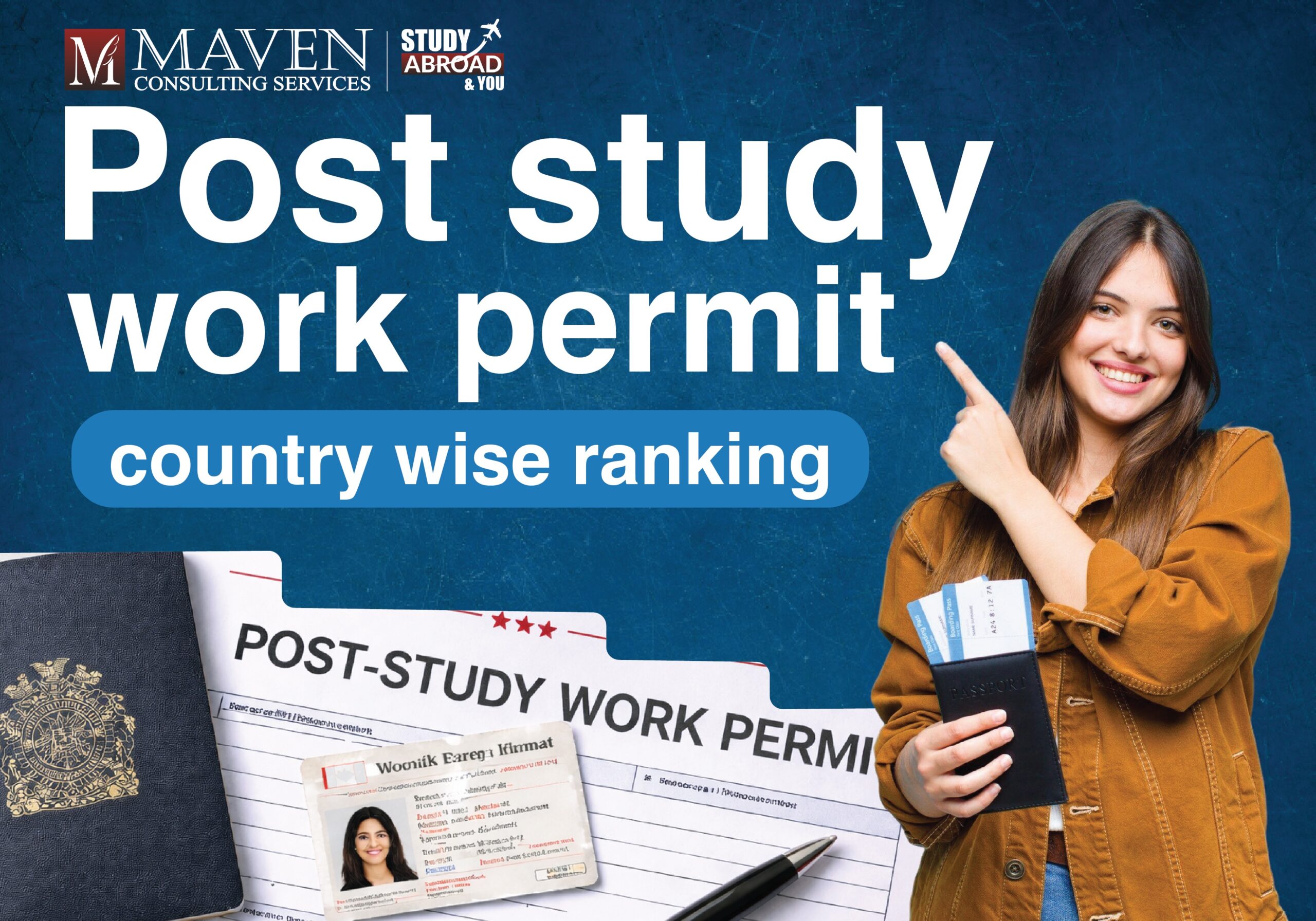
If you’re planning to study abroad, one question almost every student asks is:
“Which country will actually let me work after graduation?”
Because the truth is simple —
Choosing a country without understanding what post-study work permit 2026–2027 is or what country specific rules are can completely change your career plans.
This guide is written for you if you are:
By the end of this article, you will clearly understand:
• What a post-study work visa (PSW visa) actually means
• Which countries offer the longest post-study work permits in 2026–2027
• How PSW visas lead to permanent residency (PR)
• Country-wise eligibility and job opportunities
• Which destination is best for Indian students
Let’s start with the basics.
A post-study work visa (PSW) allows international students to stay and work in the country after completing their degree.
Instead of immediately returning home, graduates can:
Most countries introduced PSW visas because:
For Indian students, this visa is extremely important because it determines:
Before we go country by country, here is the answer most students want first: Canada, Australia, and New Zealand currently offer the longest and most flexible post-study work options for Indian students, while the UK remains strong for global job access and Germany stands out for affordability plus a practical Blue Card route. The table below gives you a cleaner comparison to start with.
The table below compares the best countries offering post-study work permits in 2026–2027, including visa duration, PR pathways, and key advantages for Indian students.
| Rank | Country | Post-Study Work Visa Duration | Visa Name | PR Pathway Available | Key Advantage for Indian Students |
|---|---|---|---|---|---|
| 1 | Canada | Up to 3 years | Post-Graduation Work Permit (PGWP) | Yes | Strong PR pathway and flexible work options |
| 2 | Australia | Usually 2–3 years after a degree; an extra 1–2 years possible in regional Australia | Temporary Graduate Visa (Subclass 485) | Yes | Strong employability and regional incentives |
| 3 | New Zealand | Up to 3 years | Post-Study Work Visa | Yes | Open work rights for many graduates |
| 4 | United Kingdom | 2 years if you apply by 31 December 2026; 18 months from 1 January 2027 | Graduate Visa | Yes | Large international job market |
| 5 | Germany | Up to 18 months after graduation from a German university | Residence permit to look for a job after studies | Yes | Low-cost education and Blue Card route |
| 6 | Ireland | 12 months at Level 8; up to 24 months at Level 9+ | Third Level Graduate Programme / Stamp 1G | Yes | Strong tech and pharma hiring |
| 7 | USA | 12 months OPT; 24-month STEM extension available | OPT / STEM OPT | Limited | High salaries in STEM-heavy sectors |
| 8 | Netherlands | 1 year | Orientation Year | Yes | Work freely for 1 year |
| 9 | France | 12 months | Job seeker / new business creator residence permit | Yes | Good route for Master’s graduates |
| 10 | Sweden | Up to 12 months | Residence permit to look for work after studies | Yes | Family can apply at the same time |
Canada, Australia, and New Zealand still lead on pure stay-back length. But if your goal is not just time, but time plus a realistic PR pathway, Canada and Australia usually stay at the top of the shortlist.
Now let’s break down each destination.
Canada consistently ranks #1 for post-study work visas.
Canada remains one of the strongest post-study work destinations because the PGWP can be valid for up to 3 years, depending on the length of your eligible study program.
In simple terms:
To qualify, students must:
If long-term settlement is a priority: Best Countries for PR After Study Abroad – Real Requirements Explained.
Australia’s post-study work route is strong, but it needs to be explained properly. Under the Temporary Graduate Visa (Subclass 485), degree-level graduates usually get 2 to 3 years on the Post-Higher Education Work stream, depending on the qualification.
| Degree | Work Visa Duration |
|---|---|
| Bachelor’s | 2–3 years |
| Master’s | 3 years |
| PhD | 4 years |
Australia remains a strong option because of its skilled migration routes, but costs matter too. The Subclass 485 application fee increased sharply in 2026, so budgeting is now even more important.
Read: Financial Planning for Studying Abroad in 2026: 8 Proven Strategies for Indian Students.
The UK Graduate Visa is now straightforward to explain.
The visa cannot be extended, but students may switch to another route, such as the Skilled Worker visa, if they secure the right job.
Click here to read up on UK Student Visa Requirements For Indian Students in 2026-27.
Indian graduates often work in:
New Zealand remains one of the more flexible post-study work options for Indian students because the Post-Study Work Visa can allow eligible graduates to stay for up to 3 years.
| Qualification | Work Rights |
|---|---|
| Level 7+ (Bachelor’s) | Up to 3 years |
| Master’s / PhD | Up to 3 years |
For degree-level qualifications at Level 7 or higher, students generally need:
For some lower-level qualifications, the visa may still be available, but:
Germany remains one of the smartest choices for Indian students who want affordability plus a serious long-term career path in Europe.
If you graduate from a German university, you can receive a residence permit for up to 18 months to look for a job. During that period, you may also work while searching for a role that fits your qualifications.
This is where many articles create confusion:
That makes Germany’s actual student pathway much clearer.
If Germany is on the shortlist, check out: German APS Certificate & Germany Student Visa Process – The One-Stop Guide for EVERYONE.
Ireland’s post-study route is especially attractive for students targeting tech, pharma, and business roles.
The Third Level Graduate Scheme allows students to stay and work in Ireland.
| Degree | Duration |
|---|---|
| Bachelor’s | 1 year |
| Master’s | 2 years |
Under the Third Level Graduate Programme:
Applications must be made within 6 months of being notified that the award has been achieved.
Why Ireland works well as a bridge option
In the United States, post-study work happens through Optional Practical Training (OPT).
| Category | Duration |
|---|---|
| Standard OPT | 12 months |
| STEM OPT Extension | An additional 24 months |
This is why the US can look excellent on paper for STEM students.
But the second step matters. OPT gives work experience, not a direct PR route. In most cases, the next big move is employer sponsorship into H-1B, and that route remains cap-based and highly competitive.
So the US remains a strong option for students focused on:
For students prioritising a more predictable stay-back and settlement pathway, Canada and Australia are usually easier to plan around.
If you compare countries only by stay-back length, Canada, Australia, and New Zealand lead the pack for the most Indian students. Canada can offer up to 3 years through the PGWP. Australia usually offers 2–3 years after a degree, with another 1–2 years possible in regional Australia. New Zealand can also offer up to 3 years for eligible graduates.
The UK remains competitive, but the timing matters now. Applications made by 31 December 2026 still get 2 years for bachelor’s and master’s graduates, while applications from 1 January 2027 move to 18 months. Germany offers up to 18 months to graduates of German universities, and Ireland offers 12 months at Level 8 and up to 24 months at Level 9+.
So the better question is not only, “Which country gives the longest visa?” It is, “Which country gives me enough time, enough job demand, and a realistic next visa after that?”
Although each country has different rules, the application process is similar.
| Country | Application Window |
|---|---|
| Canada | 180 days |
| Australia | 6 months |
| UK | Before the student visa expires |
| New Zealand | Within 3 months |
The ones who do well after graduation usually do not begin job hunting at the end.
Students should start job searching months before graduation.
The smartest approach is to combine:
The more practical point here is this: a post-study work visa gives you time, but it does not guarantee a job. Countries like the UK and the US especially reward students who start early, because the next visa step often depends on employer sponsorship or a quick switch into a skilled route.
So,
Most graduates secure their first job within 3–6 months.
Students often compare only duration and forget two practical filters: application cost and whether the family can stay with you.
On dependents, some countries are clearly more flexible than others. Australia states that you can include eligible family members in a Temporary Graduate visa application. The UK also allows eligible partners and children to apply to stay, depending on the rules that apply to your situation. Sweden’s post-study residence permit guidance also says that family members can apply at the same time.
On costs, exact visa fees can change, so students should always verify them before applying. As of the current official UK guidance, the Graduate visa costs £880 plus the healthcare surcharge. Ireland’s graduate permission registration fee is €300. Australia has become more expensive in 2026, with recent reports noting a sharp increase in the Subclass 485 application fee.
For many Indian students, the post-study work visa is valuable because it is a bridge, not the final goal. In most countries, the sequence is simple: study, gain local work experience, move into a skilled work route, then apply for permanent residency if eligible.
In Canada, the common path is
study → PGWP → skilled work experience → PR.
In Australia, many students move from Subclass 485 → skilled migration.
In Germany, the route is often graduate in Germany → 18-month job-search residence permit → EU Blue Card or work permit.
In the UK, the route is usually Graduate visa → Skilled Worker visa → ILR, provided the job and sponsorship line up.
That is why students should judge countries on all three layers together:
A post-study work visa allows international students to stay in the country after graduation and gain professional work experience.
Canada, Australia, and New Zealand currently offer the longest PSW visas (up to 3 years).
Some countries allow dependents, especially if the graduate secures skilled employment.
Canada and Australia currently offer the most structured pathways to permanent residency.
Yes. The UK Graduate Visa currently allows 2 years, but there are plans to reduce it to 18 months from 2027.
If we had to give one honest piece of advice to students planning their future abroad, it would be this:
Do not choose a country only for the university. Choose it for the full path that comes after graduation.
Look at three things together:
That is the difference between choosing a country that only sounds attractive and choosing one that actually fits your career plan.

Sunday, October 26, 2025 | The Taj MG Road, Bangalore | 10 AM – 4 PM