WhatsAppCHAT
CALL US& CONNECT

If you are searching for ‘study in Poland for Indian students’, you are probably comparing it with destinations like Germany, Hungary, or the Czech Republic.
And that makes sense.
Poland has quietly become one of the most affordable entry points into European higher education, especially for Indian students who want:
• A European degree without extremely high tuition
• English-taught programs in business, engineering, and medicine
• A relatively straightforward visa process
• Opportunities to build a career within the EU
This guide is written for:
By the end of this article, you will clearly understand:
• Why Poland is becoming popular among Indian students
• Top universities in Poland for Indian students
• Tuition fees and cost of living
• Poland student visa process from India
• Scholarships, jobs, and post-study opportunities
Poland may not yet be as famous as Germany or France for international education. But many students are beginning to realise that it offers a practical balance between affordability and European exposure.
Before you jump in, click here to get a country-wise ranking of Post study work visas for students as it is an important step in the research process and will help you choose countries according to your goals and requirements.
| Factor | Details |
|---|---|
| Average Tuition Fees | €3,500 – €8,000 per year |
| Medical Programs* | €10,000 – €15,000 per year |
| Living Costs | €500 – €900 per month |
| English-Taught Programs | 800+ across universities |
| Part-Time Work | Allowed for students |
| Post-Study Option | 9-month job search residence permit |
| Student Visa Type | Poland National Student Visa (Type D) |
| Major Intakes | February and September |
These numbers explain why Poland is increasingly viewed as one of the most affordable EU destinations for Indian students.
Over the last decade, Poland has transformed into a growing academic hub in Central Europe.
Several factors explain this shift.
First, tuition fees are significantly lower than many Western European countries. While studying in the UK or Netherlands may cost €15,000–€20,000 per year, many Polish universities charge much less.
Second, English-taught programs have expanded rapidly. Today there are more than 800 programs taught fully in English.
Third, Poland is part of the Schengen Area, which allows students to travel across most European countries during their studies.
Finally, Poland’s economy has grown steadily, particularly in industries such as:
For students seeking European exposure without extremely high costs, Poland has become a realistic option.
Yes — but mainly for students who value affordability and EU exposure over immediate PR opportunities.
Studying in Poland offers several benefits:
Students should also consider a few realities:
Even with these factors, many families find that Poland offers a strong cost-to-benefit ratio.
Poland has more than 400 higher education institutions, including several respected research universities.
| University | City | Popular Courses |
|---|---|---|
| University of Warsaw | Warsaw | Economics, International Relations |
| Jagiellonian University | Krakow | Medicine, Humanities |
| Warsaw University of Technology | Warsaw | Engineering, Computer Science |
| AGH University of Science & Technology | Krakow | Engineering |
| Wroclaw University of Science & Technology | Wroclaw | IT, Engineering |
| Medical University of Warsaw | Warsaw | Medicine |
| Warsaw School of Economics | Warsaw | Business, Finance |
| Kozminski University | Warsaw | Management, MBA |
These universities attract international students because they combine reasonable tuition with strong academic reputation.
Indian students typically choose career-oriented programs.
Many Polish universities are known for engineering.
Popular programs include:
MBA programs are offered in major cities such as:
Typical MBA tuition ranges between €4,000 and €10,000 per year.
Poland also offers English-taught medical degrees, typically lasting 6 years.
Students considering MBBS should confirm recognition with India’s National Medical Commission (NMC) before applying.
One of Poland’s biggest advantages is affordability.
| Program | Average Tuition |
|---|---|
| Bachelor’s Degree | €3,500 – €6,000 per year |
| Master’s Degree | €4,000 – €8,000 per year |
| MBA Programs | €5,000 – €10,000 per year |
| Medical Degrees | €10,000 – €15,000 per year |
Compared with Western Europe, Poland remains significantly cheaper.
Living costs vary depending on the city.
| City | Monthly Cost |
|---|---|
| Warsaw | €700 – €900 |
| Krakow | €600 – €850 |
| Wroclaw | €550 – €800 |
| Gdansk | €550 – €750 |
Typical monthly expenses include:
Many students manage with €600–€800 per month.
Several scholarship programs are available.
The Polish National Agency for Academic Exchange (NAWA) offers multiple scholarships.
Popular programs include:
These may cover:
Students should check deadlines because many scholarships close months before admission deadlines.
Polish universities typically have two major intakes.
| Intake | Application Period |
|---|---|
| September (Main) | March – July |
| February (Limited programs) | October – December |
Some universities may also conduct online interviews.
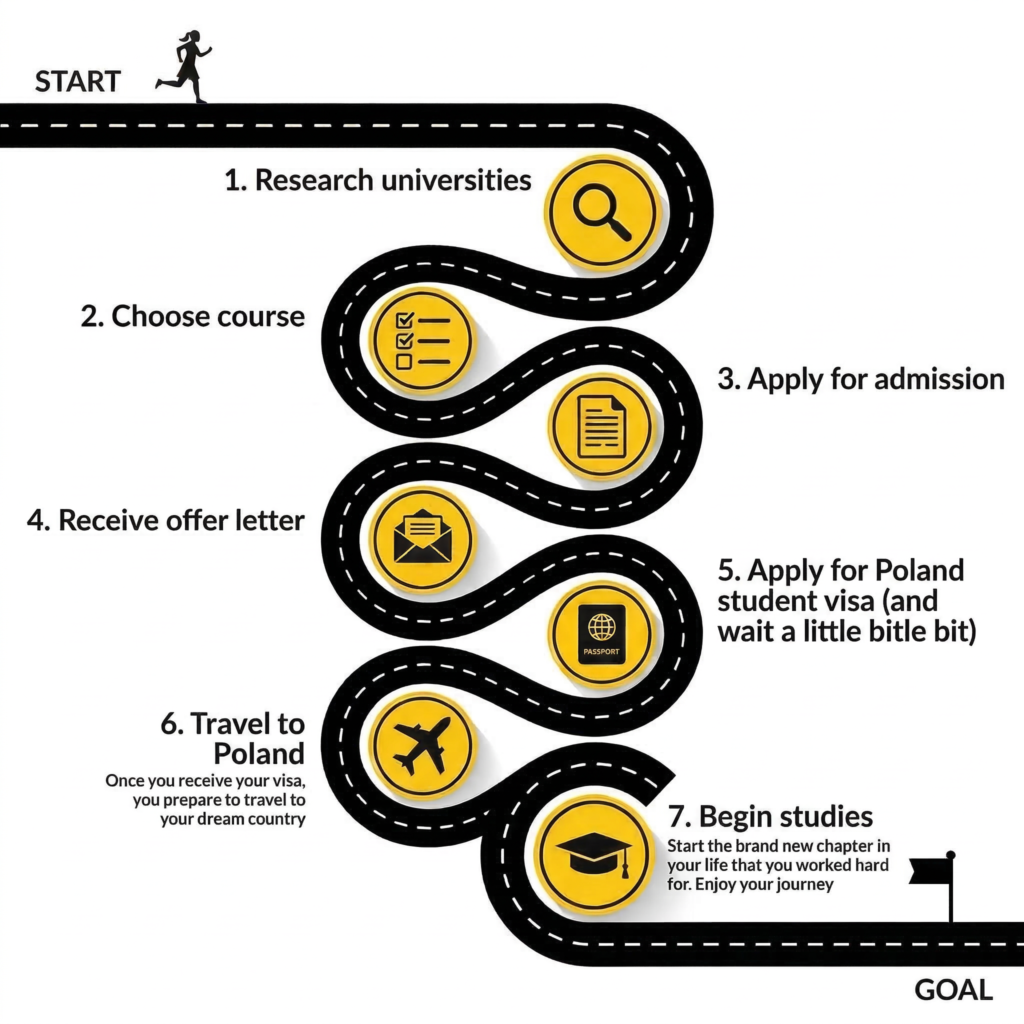
Indian students must apply for a Polish National Student Visa (Type D) and should follow the official visa guidelines published by the Polish Ministry of Foreign Affairs.
| Item | Cost |
|---|---|
| Visa Fee | €80 (~₹7,000–₹8,500) |
| VFS Service Fee | ₹2,000 – ₹3,000 |
Total visa processing usually costs ₹10,000–₹15,000.
Visa decisions typically take 4–6 weeks.
Students must show sufficient funds.
Typical requirements include:
For most Indian students, this translates to approximately ₹1.7–2 lakh minimum financial proof.
Yes.
Students can work part-time during their studies and full-time during holidays.
Common student jobs include:
Part-time work can help cover daily expenses, although tuition is usually funded separately.
Poland does offer a pathway for graduates to remain after their studies.
International students can apply for a 9-month residence permit to search for employment after graduation.
Once employed, graduates may transition to:
This allows students to begin building a career in Europe.
Student life in Poland is generally comfortable and safe.
Poland is considered relatively safe compared with many European countries.
Cities such as:
have growing Indian communities, Indian grocery stores, and restaurants.
Winters can be colder than what most Indian students are used to, so adjusting to climate is often the biggest lifestyle change.
| Factor | Poland | Germany |
|---|---|---|
| Tuition | €3.5k–€8k | Public universities are completely free |
| Living Costs | Lower | Higher |
| Job Market | Smaller | Stronger |
| English Programs | Growing | Limited |
Students looking for low tuition and easier admissions often consider Poland first.
1. Is Poland good for Indian students?
Yes, particularly for students seeking affordable European education.
2. How much does it cost to study in Poland?
Tuition usually ranges between €3,500 and €8,000 per year.
3. Is IELTS required for Polish universities?
Most universities require IELTS 6.0 or equivalent.
4. Can Indian students work while studying?
Yes, part-time work is permitted.
5. What is the Poland student visa cost from India?
The visa fee is about €80 plus service charges, typically ₹10k–₹15k total.
6. Are scholarships available for Indian students?
Yes, including NAWA and Erasmus+ programs.
7. Is MBBS in Poland recognised in India?
Students should confirm recognition with the National Medical Commission (NMC).
8. Can students stay in Poland after graduation?
Graduates can apply for a 9-month job search permit.
9. What are the main intakes in Poland?
September and February.
10. Is Poland cheaper than Germany?
Living costs are often lower, but Germany may offer lower tuition at public universities.
11. How long does the Poland visa take?
Usually 4–6 weeks.
12. Is Poland safe for international students?
Generally yes, with a growing international student population.
13. What English tests are accepted?
IELTS, TOEFL, or equivalent.
14. What jobs are common after graduation?
IT, business services, and engineering sectors.
15. Can students travel within Europe while studying?
Yes, Poland is part of the Schengen Area.
Poland may not be the first country students think of when researching Europe.
But it offers something many families value: a practical balance between cost and opportunity.
Students who approach Poland with the right expectations can gain:
For those looking for affordable European education without extremely complex immigration processes, Poland is increasingly worth serious consideration.
Sometimes the smartest study destinations are not the most famous ones — they are simply the ones that fit your goals and budget best.