

CALL US& CONNECT
Study abroad in USA 2026 Guide
- Cost: $35K–$70K/year
- Top fields: CS, Data Science, Engineering
- Work visa: Up to 3 years (STEM OPT)
- Intake: Fall preferred
- ROI: High
The cost of studying in USA ranges from $35,000–$70,000 per year. Students can work up to 3 years under STEM OPT. Fall intake is preferred, and top courses include Computer Science, Data Science, and Engineering.

Why study in USA?
For several decades, the United States has remained one of the most closely evaluated study abroad destinations for Indian students. While global rankings and brand reputation often dominate early discussions, the continued appeal of the USA lies in the way its higher education system actually functions.
Studying in the USA for Indian students is a long-term decision involving academic commitment, financial planning, and clarity about post-study outcomes. For students who approach the process with informed expectations and structured guidance, the USA can offer strong academic depth, professional exposure, and global mobility well beyond graduation.
Key advantages include:
- Flexible academic structures with majors, minors, and electives
- Strong research culture supported by public and private funding
- Wide range of institutions across budgets and academic goals
- Industry-linked curricula and applied learning models
- Post-study work options, especially for STEM graduates
Unlike rigid degree systems, US universities allow students to refine their academic focus over time. This flexibility benefits students who want exposure to multiple disciplines before committing to a specialisation.
Book Free Consultation to Study in USA
Study in USA for Indian Students 2026 Guide
POPULAR COURSES IN THE USA FOR INDIAN STUDENTS
Indian students who choose to study in USA can enroll across a broad range of disciplines, guided by career goals and market demand.
High-demand programmes include:
- Computer Science and Software Engineering
- Data Science, Artificial Intelligence, and Cybersecurity
- Engineering (Mechanical, Electrical, Civil, Electronics)
- Business Analytics, Management, and Finance
- Public Health, Life Sciences, and Healthcare
- Economics, Public Policy, and Social Sciences
STEM programmes remain particularly attractive due to stronger employment prospects and extended post-study work eligibility.
TOP UNIVERSITIES FOR INDIAN STUDENTS IN USA
Indian students studying in USA succeed across both public and private institutions. Outcomes depend more on programme alignment than institutional labels.
Popular Public Universities
- University of California system
- University of Texas system
- Arizona State University
- University of Illinois system
Popular Private Universities
- New York University
- Columbia University
- Northeastern University
- University of Southern California
Public universities generally offer lower tuition and strong research output, while private universities may provide smaller class sizes and targeted funding opportunities.
COST OF STUDYING IN USA FOR INDIAN STUDENTS
The cost of studying in the USA for Indian students varies by programme, university, and location. Families should plan beyond tuition alone.
Average Cost Structure
| EXPENSE CATEGORY | ANNUAL COST (USD) | APPROX. COST (INR) |
|---|---|---|
| Tuition (Public Universities) | 18,000 – 35,000 | 15 – 29 lakhs |
| Tuition (Private Universities) | 35,000 – 60,000 | 29 – 50 lakhs |
| Living Expenses | 10,000 – 18,000 | 8 – 15 lakhs |
| Health Insurance | 1,000 – 2,500 | 0.8 – 2 lakhs |
| Books & Academic Costs | 800 – 1,500 | 0.6 – 1.2 lakhs |
Students in large cities such as New York or San Francisco face higher living costs than those in university towns.
Proof of Funds and Financial Planning
For an F-1 visa, students must demonstrate financial capacity covering one full academic year.
Typical Financial Requirements
- Minimum bank balance generally aligned with I-20 estimate
- Usually between USD 40,000 and 65,000 (approximately Rs 33 – 65 lakhs) for most master’s programmes
- Total first-year cost including tuition and living often ranges from USD 35,000 to 70,000 (approximately Rs 32 – 64 lakhs)
Although only the first year must be shown during visa processing, families should plan for the full programme duration, typically two years for a master’s degree.
ELIGIBILITY REQUIREMENTS FOR STUDYING IN USA
Eligibility criteria vary by university and programme, but most institutions require:
- GPA of 3.0 or higher on a 4.0 scale
- Academic transcripts from recognised institutions
- English proficiency test scores (IELTS or TOEFL) or
- Medium of Instruction (MOI) certificate confirming your degree was taught in English
- GRE or GMAT scores for selected programmes
- Admissions are not granted with active backlogs, so students must ensure that all backlogs are cleared before applying
- Statement of Purpose
- Letters of Recommendation
- Proof of financial capacity
Many universities have waived GRE requirements, but academic strength remains critical.
How Maven helps you?
Maven Consulting Services is renowned for its industry expertise and start-to-end assistance. Our abroad education consulting service offerings are highly recommended for abroad studies in USA.
- Training for Standardized Global tests
- Personalized Counseling Sessions
- Guidance on Selection of the best-fit University
- Guidance for Application Preparation and Financial Aid
- Counselling & Intensive Interview Training for Visa
- Pre-departure Preparation and Orientation


Our Students Share Their Study Abroad Success Stories
Every year, Maven helps students from India successfully secure admissions to top universities with the right planning and guidance. These real stories highlight their journeys — from university selection and applications to visa approvals and career outcomes.


Aditya Kumar
George Washington University

Shreyas Babu
Indiana University–Purdue University Indianapolis

Prakruthi Gandasi Shivamurthy
University of Texas at Arlington

Shrinivas Shivaram Hegde
University of Texas at Arlington

Prakhar Abhichandani
Illinois Institute of Technology


Niharika Vittal
Northeastern University

Sujith Diwakar Namnidi
Eindhoven University of Technology

Shivani Parigi
University for the Creative Arts


Nihal Ahmed Kanvi
University of Strathclyde


Shreetoma Chakraborty
Uppsala Universitet

Rosina Dominic
University of Maryland -College Park

Riya Dorkadi
Concordia University

Vishal Arasu
Northeastern University

Shuvrangshu Mukhopadhyay
University of South Florida

Prathik Bharath Munvar
Hamburg University of Technology


Mahesh Kumar Chandarappa
Hamburg University of Technology

Adishesh Mysore Ananthan
University of Aberdeen

Roshan Krishna Muthyala
Chalmers University of Technology

Moulya Devaragudde
University College Dublin

Achyuth Dev Ramalingapura Devkumar
University of Michigan Ann Arbor

Royston Mascarenhas
University of Southern California


Shashank K Prasad
Portland State University

Pavithra Venkatesh
University of Ottawa


Roslin Jose
University of North Texas Health Science Center


Ankitha Shivanand
Arizona State University


Sindhu
University of Bonn


Shishir Mannur
McMaster University

Sonali Singha
University of Texas Dallas


Meghana Reddy
San Jose State University

Jason D Souza
Worcester Polytechnic Institute


Manu Srinath
Murray State University


Rashi Jayaswal (Student’s Mother)
University of Alberta


Harish Muralidhar
University of koblenz-Landau


Ahaan R
University of Texas at Arlington


Nischal Kashyap
North Carolina State University


Novonil Das
University of Texas at Dallas


Ramkumar R P
San Jose State University


Gayathri Manoharan
University of Illinois Chicago


Omkar Hunswadakar
RWTH Aachen


Navneeth
Chalmers University of Technology
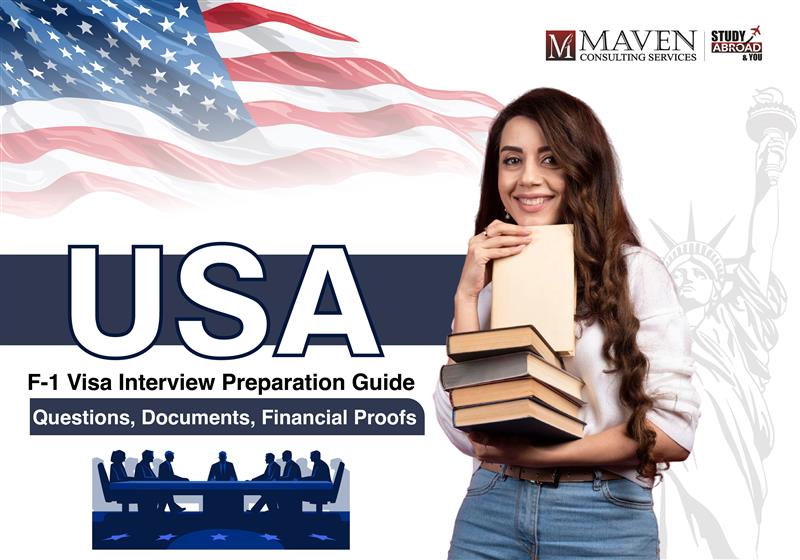
USA Study Visa Process for Indian students (F-1 Visa Guide)
The F-1 visa process is structured and documentation-driven.
Key advantages include:
- Valid I-20 issued by the university
- Proof of funds covering tuition and living costs
- DS-160 confirmation page
- SEVIS fee receipt
- Clear academic and career intent
Visa officers assess seriousness of study plans, financial preparedness, and clarity of purpose.


F1 Visa Interview Questions, Answers & Preparation Tips for USA Student Visa
Preparing for the USA student visa interview is one of the most critical steps in your study abroad journey. Below are practical video guides covering real interview questions, sample answers, and expert strategies.
Key advantages include:
- Common F1 visa interview questions and how to answer them
- Mistakes that lead to visa rejection
- How visa officers evaluate student intent
Playlist
6 Videos


3:42


3:20


3:20


4:22


3:05


4:33
USA Intakes: Fall vs Spring
US universities typically offer two major intakes.
Fall Intake - August–September
- Largest number of programme options
- Greater availability of scholarships and assistantships
- Stronger internship and campus recruitment cycles
- Better networking exposure
Most Indian students prefer Fall because funding and hiring cycles align more favourably.
Spring Intake - January
- Limited programme availability
- Fewer scholarship opportunities
- Suitable for students requiring additional preparation time
For most students planning to Study in USA for Indian Students with maximum academic and career flexibility, the Fall intake is generally recommended.
Timeline Chart For FALL & SPRING Semesters
How to Apply to US Universities: Step-by-Step
1
Profile evaluation and career goal assessment
2
University and programme shortlisting
3
Entrance exam preparation (if required)
4
Application submission and documentation review
5
Offer acceptance and I-20 issuance
6
Visa preparation and interview
7
Pre-departure planning
Starting 12 to 18 months in advance improves admission, funding, and visa outcomes.
Scholarships and Financial Aid for Indian Students studying in the USA
Scholarships are often partial and competitive, especially for undergraduate and taught master’s programmes.
Common Funding Options
| FUNDING TYPE | SUITABLE FOR | COVERAGE |
|---|---|---|
| Merit Scholarships | Strong academic profiles | Partial tuition |
| Teaching Assistantships | Postgraduate students | Tuition + stipend |
| Research Assistantships | Research-focused students | Tuition + stipend |
| PhD Funding | Doctoral candidates | Full funding |
Strong academics, relevant experience, and clear academic goals improve funding prospects.
STEM vs Non-STEM OPT Explained
Scholarships are often partial and competitive, especially for undergraduate and taught master’s programmes.
Common Funding Options
| PROGRAMME TYPE | OPT DURATION |
|---|---|
| Non-STEM | 12 months |
| STEM | Up to 36 months |
OPT allows graduates to gain professional experience but does not guarantee long-term residence.


Work Rights During and After Studies
- On-campus work allowed up to 20 hours per week
- Earnings help with daily expenses only
- Post-study work depends on OPT eligibility
- Career outcomes vary by sector and location
Technology, analytics, healthcare, and research-oriented roles currently offer stronger prospects.
WORK RIGHTS DURING AND AFTER STUDIES
- On-campus work allowed up to 20 hours per week
- Earnings help with daily expenses only
- Post-study work depends on OPT eligibility
- Career outcomes vary by sector and location
CAREER OUTCOMES FOR INDIAN STUDENTS IN THE USA
Career results depend on programme selection, academic performance, location, and networking.
Common pathways include:
- Employment under STEM OPT
- Transition to research or PhD programmes
- Roles in global organisations or policy institutions
- Return to India with international credentials
AVERAGE STARTING SALARIES IN THE USA BY FIELD
While salaries vary by region and employer, indicative ranges include:
- Computer Science: USD 90,000 to 110,000
- Data Science: USD 95,000 to 120,000
- Electrical Engineering: USD 80,000 to 95,000
- Business Analytics: USD 80,000 to 100,000
- Public Health: USD 60,000 to 80,000
QUICK TIP FOR INDIAN STUDENTS APPLYING TO THE USA
- Begin financial documentation early
- Confirm STEM classification before applying
- Review internship statistics, not only rankings
- Apply before scholarship deadlines
- Understand job market realities in your chosen field
Based on our experience guiding 10,000+ students:
- - 70% choose STEM programs
- - Fall intake students have better placement outcomes
USA vs Canada vs Germany
| COUNTRY | KEY HIGHLIGHT |
|---|---|
| USA | High salary, high cost |
| Canada | PR-friendly |
| Germany | Low cost |
Frequently Asked Questions
1. What is the cost of studying in the USA for Indian students?
The total cost typically ranges from USD 35,000 to 70,000 per year depending on university, programme, and location.
2. What is the USA student visa process?
Students must obtain an F-1 visa by securing an I-20, completing DS-160, paying SEVIS fees, and attending a visa interview.
3. How long can students work after studying in the USA?
Students can work up to 12 months under OPT and up to 36 months for STEM programmes.
4. What GPA is required to study in the USA?
Most universities require a minimum GPA of 3.0 on a 4.0 scale, though top institutions expect higher scores.
5. Can Indian students get scholarships in the USA?
Yes, scholarships are available but are competitive and often partially funded.
6. Is studying in the USA worth it for Indian students?
Yes, if course selection, funding, and career outcomes align with long-term goals.
Knowledgebase articles on Study in USA
How Study Abroad Consultants Get Paid: University Commissions Explained, and Seven Questions to Ask Any Adviser
How study abroad consultants get paid: university commission, student fees or both. What the 2026 UK CAS and Australian rules…

Two University Admits, One Decision: How to Compare Offers on Cost, Outcomes and Visa Risk, and When to Pay the Deposit
Holding two university admits and a deposit deadline? Here is a simple way to compare offers on total cost, funding,…
Open Doors 2026: What the Numbers Say About Indian Students in the US, and What They Don't
India is still the top source of international students in the US, but Indian graduate enrolment fell 34 per cent…
University Interviews and Video Essays: What UK, Canadian and US Programmes Ask, and How to Prepare in a Week
Last verified: 5 November 2026, against the official admissions pages of Penn State Smeal, Boston University Questrom, MIT Sloan, the…
Is an MS in Computer Science or Data Science Abroad Still Worth It in 2027? Salary vs Loan Payback, Country by Country
Is an MS in computer science abroad worth it in 2027? We compare realistic first salaries, education loan EMIs and…
The Academic CV for a Master's Abroad: What Committees Read, What They Skip, and the Indian Résumé Habits That Hurt
A practical guide to writing a CV for master's abroad applications: what admissions committees read, what they skip, the Indian…
US Application Fee Waivers for Indian Students: Which Universities Offer Them and the Best Way to Ask Before 1 December
Most US graduate schools limit application fee waivers to US applicants, but Indian students still have four real routes for…
Fewer Indians Are Applying to US Universities. Does That Make a Fall 2027 Admit Easier?
Fewer Indians are applying to US universities, but Fall 2027 US admission is only easier in some places. See where…
Three-Year Bachelor's Degree for a Master's Abroad: Which Countries and Universities Accept It in 2027
Is a three-year bachelor's degree enough for a master's abroad? Country-by-country rules for the US, UK, Ireland, Canada, Germany and…

Letters of Recommendation for Fall 2027: Who to Ask, When to Ask, and Why Generic Indian LORs Get Discounted
Who should write your letter of recommendation for a master's abroad, when to ask for Fall 2027, and why generic…
At Maven Consulting Services, we support students through university selection, applications, and visa preparation — helping them make informed study abroad decisions. Our overseas education consultants guide students from our Bangalore and other offices and through virtual consultations across India. Book a Free Consultation to receive personalized guidance on universities, costs, visas, and funding options.