Last Updated on January 21, 2026
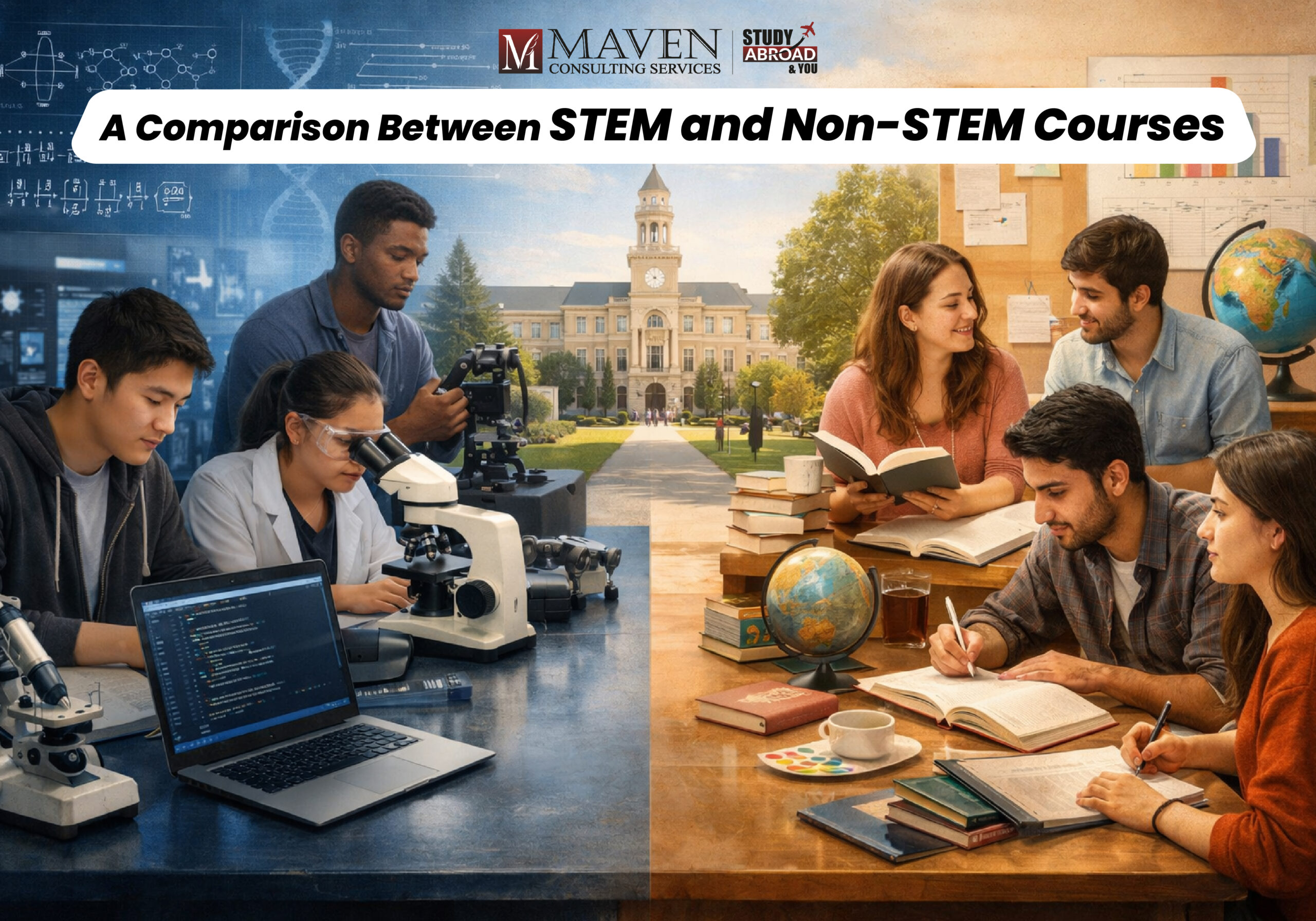
Choosing between a STEM and a non-STEM course is no longer just an academic decision. For Indian students considering undergraduate or postgraduate study abroad, it directly affects employability, visa options, return on investment (ROI), and long-term flexibility.
This blog explains what STEM and non-STEM actually mean, how the difference plays out in today’s global job market, and which types of courses make sense for Indian students in 2026–27. It also looks at how trends have shifted, where non-STEM still works well, and how to evaluate a course beyond labels.
This guide will help you understand:
- What STEM and non-STEM courses really are (and what they are not)
- Which courses deliver better ROI for Indian students today
- How job markets and visa policies treat STEM vs non-STEM graduates
- How requirements, SOPs, and LORs differ by course type
- How to choose the right specialisation for your goals
What Does STEM Mean in International Education?
STEM stands for Science, Technology, Engineering, and Mathematics. In most countries, STEM is not just an academic category, it is also a policy category linked to skills shortages, research funding, and post-study work visas.
Common STEM master’s programs include:
- Computer Science, Data Science, AI, Cybersecurity
- Engineering (Mechanical, Electrical, Civil, Aerospace, Automotive)
- Biotechnology, Life Sciences, Environmental Science
- Applied Mathematics, Statistics, Analytics
In countries like the UK, Germany, Canada, Australia, and the US, STEM courses often receive:
- Longer post-study work rights
- Faster work permit transitions
- Higher employer demand
This is why STEM courses are often perceived as “safer”, but that does not mean they are automatically better for everyone.
What Are Non-STEM Courses?
Non-STEM courses include disciplines that focus on business, humanities, social sciences, creative fields, communication, and management.
Common non-STEM programs include:
- Business, Management, Marketing, Finance
- Economics, International Relations, Public Policy
- Design, Media, Communication, Journalism
- Hospitality, Tourism, Luxury Brand Management
- Psychology (non-clinical), Sociology, Education
Non-STEM does not mean low value. It simply means the course does not fall under technical or scientific classifications used by governments for labour-market planning.
The real question is not STEM vs non-STEM, but whether a specific degree solves a real market need.
Are STEM Courses Always Better for Indian Students?
Not always.
STEM courses tend to offer:
- Clear technical skill outcomes
- Stronger demand across countries
- Easier visa transitions in some regions
However, STEM courses also come with:
- Higher academic rigour
- Less flexibility for students without strong math or technical backgrounds
- Intense competition, especially at top universities
For students who are not suited to technical problem-solving, choosing STEM purely for visa reasons often leads to:
- Poor academic performance
- Limited job outcomes
- Burnout and dissatisfaction
A misaligned STEM degree can have worse ROI than a well-chosen non-STEM one.
Do Non-STEM Degrees Have Good ROI Internationally?
They can—but only when chosen carefully.
Non-STEM degrees with strong outcomes for Indian students in 2026–27 usually have one or more of the following:
- Clear industry alignment
- Practical or applied components
- Strong local demand in that country
- Internships, projects, or co-op exposure
Examples that continue to work well:
- Business Analytics / Management with Analytics (often classified as STEM in some countries)
- Supply Chain & Operations Management
- International Business with regional specialisation
- Marketing with data, digital, or strategy focus
- Design + technology / UX / service design
Generic degrees without a clear focus—such as broad “General Management” or theory-heavy humanities—tend to struggle unless backed by strong language skills or prior experience.
How Have STEM and Non-STEM Trends Changed Over the Years?
Five to ten years ago, the divide was simpler:
STEM meant jobs, non-STEM meant risk.
Today, the picture is more nuanced.
Key changes:
- Many management and business programs now include data, analytics, and tech, blurring the line
- Employers value hybrid profiles more than pure technical or pure theoretical ones
- Countries like Germany, the Netherlands, and Australia increasingly support applied non-STEM roles linked to business, sustainability, and policy
- Visa systems still favour STEM, but outcomes depend more on course structure than labels
Are Requirements Different for STEM vs Non-STEM Programs?
Yes, and this matters a lot.
STEM Program Requirements
Typically expect:
- Strong academic background in relevant subjects
- Mathematics, statistics, or programming exposure
- Technical SOP explaining academic fit
- Academic LORs preferred
Non-STEM Program Requirements
Usually focus on:
- Academic + experiential balance
- Communication and clarity of goals
- Strong SOP linking background to career intent
- Professional or managerial LORs are often accepted
Applying to the wrong category without meeting expectations is a common reason for rejection.
How Should SOPs Differ for STEM and Non-STEM Courses?
This is one of the most misunderstood areas.
- STEM SOPs should emphasise:
- Academic preparation
- Technical projects or research
- Problem-solving mindset
- Non-STEM SOPs should emphasise:
- Decision-making clarity
- Industry understanding
- Practical relevance and outcomes
Using the same SOP framework for both is a mistake.
Where Do Management and Business Degrees Fit: STEM or Non-STEM?
Management traditionally falls under non-STEM, but many programs now sit in a grey zone.
Examples:
- MBA → Non-STEM
- MSc Business Analytics → Often STEM
- MSc Management with Data/Strategy → Mixed classification
- Supply Chain / Operations → Sometimes STEM, depending on curriculum
For Indian students, these hybrid programs often offer the best balance of ROI, flexibility, and employability.
STEM vs Non-STEM by Region: What Indian Students Should Know
Europe
- STEM is highly valued, especially in Germany and the Netherlands
- Non-STEM works best when linked to business, sustainability, policy, or analytics
- Language and local integration matter more for non-STEM roles
Australia & New Zealand
- Clear skill-shortage lists
- STEM and applied business programs perform well
- Strong post-study work options
USA & Canada
- STEM offers longer work rights
- Non-STEM outcomes depend heavily on university brand and internships
- Visa transition is more competitive
How to Choose the Right Course for You
Instead of asking “STEM or non-STEM?”, ask:
- What skills will I graduate with?
- Which industries hire for these skills in that country?
- Does the course include internships, projects, or real exposure?
- How does this degree translate back to India or globally?
The best outcomes come from alignment, not categories.
Common Stigmas Around Non-STEM Courses (And the Reality)
- “Non-STEM has no jobs” → False, but oversupply exists in generic degrees
- “STEM guarantees visas” → False, poor profiles still get rejected
- “Management is useless abroad” → Only if poorly chosen
The market rewards relevance, not labels.
Making the Most of International Education
Regardless of STEM or non-STEM:
- Choose programs with industry links
- Build skills outside the classroom
- Use internships and part-time work strategically
- Treat the degree as a platform, not a promise
Final Perspective: STEM vs Non-STEM Is About Fit, Not Fear
For Indian students, the STEM vs non-STEM decision should not be driven by anxiety about visas alone. It should be guided by strengths, career intent, and how a specific program positions you in a real job market.
A well-chosen non-STEM degree can outperform a poorly chosen STEM one. And a strong STEM degree still requires clarity and planning.
The smartest students in 2026–27 are not choosing categories, they are choosing outcomes.