WhatsAppCHAT
CALL US& CONNECT

For Indian students planning to study in the USA, understanding OPT and CPT is essential before you:
These two work authorisation options decide when you can work, how long you can stay employed, and how smoothly you can move from an F-1 visa to an H-1B opportunity.
Remember: your university and programme selection directly affects internship access, STEM OPT eligibility, and long-term H-1B opportunities, and hence your entire study in USA experience.
This guide explains OPT and CPT in the USA in simple terms including:
— eligibility and duration
— STEM OPT
— full-time CPT risks
— unemployment limits
— H-1B connection
— common mistakes Indian students must avoid
It is meant for Indian students, parents, and families who want to plan their US education with a clear understanding of work rights and long-term career outcomes.
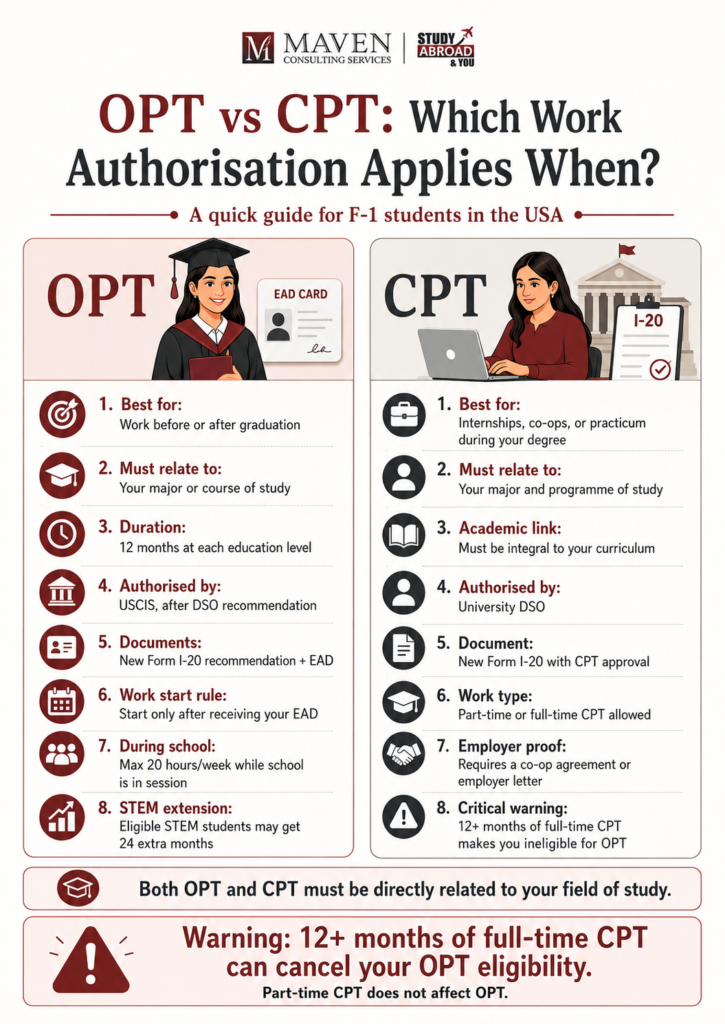
OPT (Optional Practical Training) allows Indian F-1 students to work in the USA for up to 12 months after graduation and is extendable to 36 months for STEM graduates.
OPT requires USCIS approval and an EAD card.
CPT (Curricular Practical Training) allows you to work during your degree as part of your academic curriculum (internships, co-ops), authorised by your university DSO.
CPT is authorised on your I-20. Both require work directly related to your field of study.
| 36 Maximum months of OPT for STEM graduates | 90 Days allowed unemployed during standard OPT | 12+ Months full-time CPT that eliminates OPT |
Optional Practical Training (OPT) is a form of temporary employment authorisation that allows F-1 international students — including Indian students — to work in the United States in a position directly related to their field of study. It is issued by USCIS in the form of an Employment Authorisation Document (EAD card).
OPT is the single most important work authorisation tool available to Indian students in the USA. It is the mechanism by which thousands of Indian graduates transition from student status to professional employment — and ultimately towards an H-1B visa and longer-term immigration pathways.
There are two phases when OPT can be used:
| Maven Tip — Don’t Use Pre-Completion OPT Casually Every month of pre-completion OPT you use reduces your post-completion OPT. Most Indian students maximise value by preserving their full 12 months for post-graduation employment. Discuss this decision with your DSO and with us before acting. |
Standard post-completion OPT gives you 12 months of work authorisation. If your degree is in a qualifying STEM field (Science, Technology, Engineering, or Mathematics), you are eligible for an additional 24-month STEM OPT extension — giving you a total of 36 months of employment authorisation in the USA.
This 36-month window is the primary career bridge that the vast majority of Indian students in STEM use to gain US work experience, build professional credibility, and prepare for H-1B sponsorship.
Students choosing STEM programmes strategically often maximise both OPT duration and long-term salary outcomes in the US job market.
Read more about best courses to study in USA for Indian students.
Curricular Practical Training (CPT) is a form of work authorisation that allows F-1 students to work as part of their academic curriculum — most commonly through internships, cooperative education (co-op) programmes, or practicum placements that are integral to their degree requirements.
Unlike OPT, CPT does not require USCIS approval. It is authorised entirely by your university’s Designated School Official (DSO) and is reflected on your I-20. This makes CPT faster to set up — but it also means university policies on CPT approval vary significantly.
| WARNING: Full-Time CPT and OPT Forfeiture If you use 12 or more months of full-time CPT, you permanently lose all OPT eligibility. Full-time CPT = more than 20 hours per week. 12 months of full-time CPT wipes out your entire post-graduation OPT entitlement — including the STEM extension. Part-time CPT (20 hours/week or fewer) does NOT affect OPT, regardless of how many months it runs. This rule catches many Indian students off guard, especially at universities with aggressive co-op programmes. |
| MYTH | REALITY |
|---|---|
| I can do 2 years of paid CPT internships, then use OPT after I graduate. | If those internships were full-time CPT totalling 12+ months, your OPT is gone. You would graduate with zero post-graduation work authorisation. |
At Maven, we have counselled students who discovered this rule too late — after accepting full-time CPT roles for extended periods. Always plan your CPT usage strategically before semester registration.
| Factor | OPT — Optional Practical Training | CPT — Curricular Practical Training |
|---|---|---|
| Who Authorises It? | USCIS (federal immigration agency) | University DSO — no USCIS involvement |
| Document Required | EAD card (Employment Authorisation Document) | Updated I-20 with CPT endorsement |
| When Can You Use It? | Before or after graduation (pre / post completion) | Only while enrolled; must be tied to a course |
| Processing Time | 3–5 months (apply 90 days before needed) | Days to a few weeks (university internal) |
| Duration Limit | 12 months (+ 24 months for STEM graduates) | No cap, but 12 months full-time = OPT lost |
| Employer Flexibility | Change employers freely (report for STEM OPT) | Employer-specific; re-authorised per change |
| Academic Requirement? | No — any qualifying job in your field | Yes — must satisfy a specific course requirement |
| Full-Time Allowed? | Yes (post-completion OPT) | Yes, but 12+ months full-time = OPT forfeited |
| Impact on OPT | — | Full-time CPT >= 12 months = OPT permanently lost |
| Best Used For | Post-graduation employment; H-1B bridge | Internships and co-ops during the degree |
The STEM OPT extension is arguably the most strategically important visa provision for Indian students studying technology, engineering, data science, or other STEM fields in the USA. It extends your work authorisation from 12 months to a total of 36 months — giving you three full years to gain US work experience, build your professional profile, and pursue H-1B sponsorship.
Your degree must appear on the official DHS STEM Designated Degree Program List. Qualifying fields include:
| MBA Students — Verify Your CIP Code Before Assuming STEM Eligibility Some MBA programmes with a quantitative or analytics focus may qualify for STEM OPT; many do not. Your eligibility depends on the CIP code assigned to your specific programme — not the school’s ranking or reputation. Confirm with your DSO before banking on the STEM extension. |
During the 24-month STEM OPT extension, your employer must be enrolled in the federal E-Verify programme. This is not optional. If your employer is not E-Verify registered, you cannot use the STEM OPT extension with that employer — regardless of how well-known or reputable they are.
For Indian students, OPT is not just a work permit — it is the strategic bridge between your F-1 student visa and a long-term US career. Understanding how it connects to H-1B is essential before you even begin your degree.
The H-1B is a specialty occupation work visa — the primary pathway for Indian professionals to work long-term in the USA. Your employer must sponsor you and file a petition during the annual April lottery window. H-1B begins October 1st if selected. The typical sequence looks like this:
The cap-gap rule protects F-1 students whose OPT expires between April 1st (when the H-1B petition is filed) and September 30th (the last day before H-1B begins). If your employer files a timely H-1B petition and you are selected, your OPT is automatically extended until October 1st — no additional paperwork required from your end.
| Cap-Gap Important Note The cap-gap extension only applies if you are selected in the H-1B lottery. If you are not selected in a given year, you must continue on STEM OPT (if months remain) or make alternative arrangements. This is why having 36 months of OPT — rather than just 12 — is so strategically valuable for Indian students facing the H-1B lottery. |
At Maven, we work with students across the full lifecycle — from university selection through to post-graduation employment strategy. Here are the most consequential mistakes we see, and how to avoid them.
| MYTH | REALITY |
|---|---|
| Waiting until after graduation to apply for OPT because ‘my professor said it’s fine.’ | Apply up to 90 days before your graduation. USCIS takes 3-5 months. A late application means you graduate without an EAD card and cannot legally work. |
Your OPT authorisation does not begin when you submit the application or when it is approved in USCIS records. It begins only when your EAD card physically arrives with your name and start date. Starting work before the card arrives — even by one day — is an F-1 status violation. It can result in unlawful status, deportation, and a multi-year bar from re-entry.
Indian students often receive job offers from startups or smaller firms that are not E-Verify registered. During standard OPT this is acceptable. During STEM OPT, it is not. Always confirm E-Verify status — and request the Employer Identification Number to verify independently — before accepting an offer during your STEM extension period.
This is particularly common among students at universities that aggressively promote paid CPT internship programmes. Taking one or two semesters of full-time CPT sounds attractive (immediate income, US work experience), but if it crosses 12 cumulative months of full-time CPT, the student graduates with no OPT entitlement — and no legal pathway to remain employed in the USA after graduation without immediate H-1B sponsorship.
Both OPT and CPT require that your work be ‘directly related’ to your field of study. A Computer Science student cannot use OPT to work as a marketing coordinator. A Finance student cannot use OPT to work as a software developer. USCIS and DSOs interpret ‘directly related’ strictly. If your job title and duties are challenged, you risk a finding of unauthorised employment.
| Maven Tip — Document the Connection Between Your Job and Your Degree Keep a written record of how your job duties relate to your field of study. If your DSO or USCIS questions the connection, this documentation can be the difference between maintaining valid status and an immigration violation. |
“In my years of counselling Indian students at Maven, OPT and CPT are the two provisions that are simultaneously the most powerful and the most misunderstood. I have seen students arrive at my office after accepting two years of full-time CPT — excited about their US internship experience — only to realise they have accidentally surrendered their right to work in the USA after graduation. I have also seen students who refused CPT out of fear and missed career-defining opportunities.
The rule is straightforward when you understand it: use CPT intelligently and sparingly during your degree; protect your OPT for after graduation; and start the H-1B conversation with your employer in your first year of OPT — not your third. The 36-month STEM OPT window is generous, but the H-1B lottery is uncertain. Give yourself as many chances as possible by planning early. This is the single most impactful piece of career advice I give to every STEM student heading to the USA.”
1. What is the difference between OPT and CPT for Indian students in the USA?
OPT (Optional Practical Training) allows F-1 students to work in a job related to their field of study before or after graduation, with a maximum of 12 months (plus 24 months STEM extension) approved by USCIS. CPT (Curricular Practical Training) is work authorisation embedded into the curriculum — authorised by your university DSO, not USCIS.
2. Can I work in the USA after completing my Master’s degree as an Indian student?
Yes. Indian students who graduate with an F-1 visa can apply for post-completion OPT, which allows 12 months of full-time work authorisation. If your degree is in a STEM field, you can apply for an additional 24-month STEM OPT extension — giving you up to 36 months of work authorisation in the USA.
3. How long is the STEM OPT extension and which degrees qualify?
The STEM OPT extension grants an additional 24 months beyond the standard 12-month OPT. Qualifying degrees include Computer Science, all engineering disciplines, Mathematics, Statistics, Data Science, Biotechnology, Physics, and others on the DHS STEM Designated Degree Program list. Verify your specific CIP code with your DSO.
4. Does full-time CPT affect my OPT eligibility?
Yes — and this is a critical trap. If you use 12 or more cumulative months of full-time CPT (defined as more than 20 hours per week), you permanently lose your entire OPT eligibility. Part-time CPT (20 hours or fewer per week) does not affect OPT, regardless of how long it runs.
5. When should I apply for OPT and how long does it take?
You can apply for OPT up to 90 days before your programme end date. USCIS typically takes 3-5 months to process the application, so applying early is essential. Your OPT start date cannot be more than 60 days after your programme end date. Never wait until after graduation to begin the process.
6. Can I change employers during OPT?
During standard OPT you can change employers as long as the new job is directly related to your field of study — inform your DSO. During STEM OPT, your employer must be enrolled in E-Verify, and you must report any employer changes to your DSO within 10 days via your SEVIS record.
7. How does OPT connect to the H-1B visa for Indian students?
OPT serves as the bridge between your F-1 student status and an H-1B work visa. Your employer files the H-1B petition during the annual April lottery window while you are on OPT. If selected, the cap-gap rule automatically extends your OPT until October 1st, ensuring no gap in your legal status or employment authorisation.
8. What happens if I am unemployed during OPT?
During standard OPT you are allowed a total of 90 cumulative days of unemployment. During STEM OPT, this extends to 150 cumulative days across both OPT periods combined. Exceeding these limits violates your F-1 status, which can have serious immigration consequences.
The universities you choose, the degree you select, and the internship decisions you make during your programme all affect your post-graduation work authorisation. Let Maven help you plan the full picture — from TOEFL preparation to your H-1B timeline.
Disclaimer: This article is for informational purposes only and does not constitute legal immigration advice. Always verify current regulations with your university’s DSO or a licensed US immigration attorney.