WhatsAppCHAT
CALL US& CONNECT

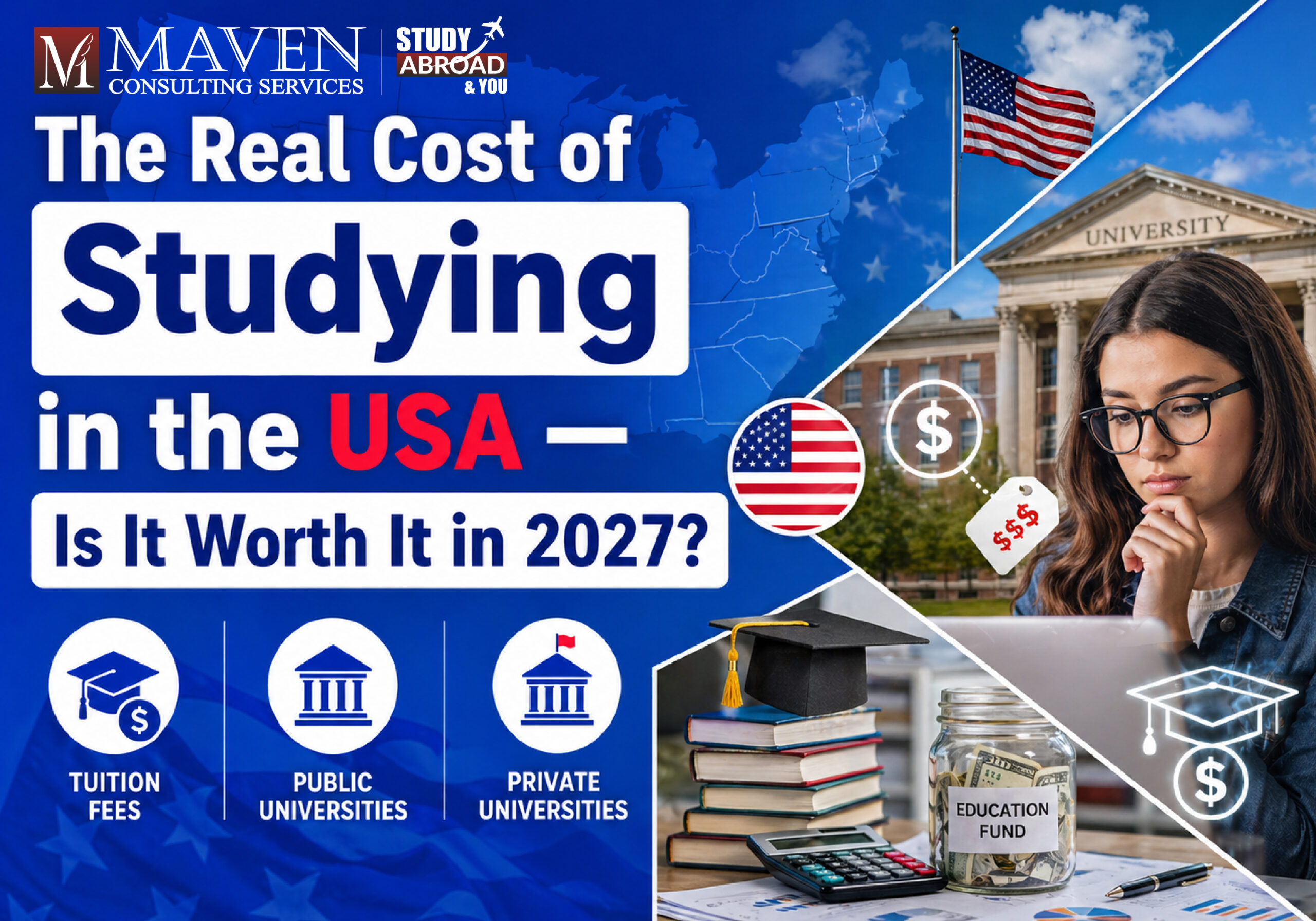
Every rupee accounted for — tuition, living, visa, hidden costs, and how to reduce your financial burden significantly, as an Indian student or parent looking at cost of study in US.
For Indian students, the total annual cost of studying in the USA in 2027 ranges from USD 25,000–35,000 at affordable public state universities to USD 55,000–85,000+ at private and Ivy League institutions. Over a 2-year master’s programme, expect a total spend of USD 88,000–1,92,000 (roughly at ₹83.6 lakhs to 1.82 cr) at current exchange rates.
| $28K–$70K Annual tuition range at US universities (2027) | $14K–$40K Annual living cost depending on city & lifestyle | 3 Years STEM OPT work authorisation post-graduation | ~₹95 USD–INR exchange rate (April 2027 estimate) |
Tuition is your largest single cost. It varies dramatically based on the type of university, the programme level, and the discipline. Here is the 2027 breakdown Indian students need to understand.
| University Type | Annual Tuition (USD) | Annual Tuition (INR) | Best For | Cost Level |
|---|---|---|---|---|
| Public State University | $25,000 – $38,000 | ₹26.6L–36.1L | Budget-conscious students | LOW |
| Public Flagship University | $35,000 – $48,000 | ₹33.25L–45.6L | Good rankings + moderate cost | MID |
| Private University (NYU, USC, BU) | $48,000 – $62,000 | ₹45.6L–57.9L | Urban campuses, strong alumni | HIGH |
| Ivy League / Top 20 | $62,000 – $85,000 | ₹57.9L–80.75L | Brand value, scholarship chances | VERY HIGH |
| Community College → Transfer | $8,000 – $16,000 | ₹7.6L–15.2L | UG cost-reduction strategy | LOWEST |
The subject you choose directly impacts your tuition bill. STEM courses tend to cost more but offer the best return on investment through STEM OPT and salary outcomes.
| Discipline | Avg Annual Tuition | STEM OPT? | Avg Starting Salary (USD) | ROI |
|---|---|---|---|---|
| Computer Science / Software Eng. | $35,000 – $55,000 | ✅Yes (3 years) | $110,000 – $140,000 | Excellent |
| Data Science / AI / ML | $38,000 – $58,000 | ✅Yes (3 years) | $105,000 – $135,000 | Excellent |
| Electrical / Mechanical Eng. | $32,000 – $50,000 | ✅Yes (3 years) | $85,000 – $110,000 | Very Good |
| MBA / Business Administration | $45,000 – $80,000 | ❌No (12 mo OPT) | $90,000 – $130,000 | Good |
| Finance / Economics | $40,000 – $65,000 | Partial | $80,000 – $120,000 | Good |
| Arts / Humanities | $28,000 – $48,000 | ❌No | $45,000 – $70,000 | Lower |
Where you live in the USA can mean a difference of USD 6,000–10,000 per year. Choosing an affordable city while attending a quality university is one of the smartest financial decisions you can make.
| City / State | Monthly Cost (USD) | Annual Cost (USD) | Rent Shared (USD/mo) | Cost Level |
|---|---|---|---|---|
| New York City, NY | $2,500–$3,800 | $30,000–$45,600 | $2,200–$3,500 | Very High |
| San Francisco / Bay Area, CA | $2,800–$4,200 | $33,600–$50,400 | $2,400–$3,800 | Very High |
| Los Angeles, CA | $2,200–$3,200 | $26,400–$38,400 | $1,800–$2,800 | High |
| Boston, MA | $2,000–$3,000 | $24,000–$36,000 | $1,700–$2,600 | High |
| Chicago, IL | $1,600–$2,400 | $19,200–$28,800 | $1,200–$2,000 | Moderate |
| Seattle, WA | $1,800–$2,600 | $21,600–$31,200 | $1,500–$2,200 | Moderate |
| Austin / Houston, TX | $1,200–$1,800 | $14,400–$21,600 | $900–$1,500 | Affordable |
| Columbus, OH | $1,100–$1,600 | $13,200–$19,200 | $800–$1,300 | Affordable |
| Indianapolis, IN | $1,000–$1,500 | $12,000–$18,000 | $750–$1,200 | Very Affordable |
| Raleigh / Durham, NC | $1,100–$1,600 | $13,200–$19,200 | $850–$1,400 | Affordable |
| Atlanta, GA | $1,200–$1,800 | $14,400–$21,600 | $900–$1,500 | Affordable |
These costs are often overlooked when families calculate the total budget. They add up to USD 3,000–6,000 and must be planned for upfront.
| Cost Item | Amount (USD) | Amount (INR) | When Paid |
|---|---|---|---|
| SEVIS Fee (I-901) | $350 | ~₹29,400 | Before visa interview |
| US F-1 Visa Application Fee (MRV) | $185 | ~₹15,500 | Before visa interview |
| University Application Fees (each) | $50 – $150 | ₹4,200 – ₹12,600 | During application |
| GRE Exam Fee | $220 | ~₹18,500 | Before application |
| TOEFL iBT Exam Fee | $220 – $260 | ₹18,500 – ₹21,800 | Before application |
| Credential Evaluation (WES / ECE) | $100 – $250 | ₹8,400 – ₹21,000 | During application |
| University Enrollment / Orientation Fee | $200 – $500 | ₹16,800 – ₹42,000 | On joining |
| Initial Flight to USA | $700 – $1,400 | ₹58,800 – ₹1,17,600 | Before departure |
| Airport Transfer + Initial Setup | $200 – $500 | ₹16,800 – ₹42,000 | On arrival |
| Security Deposit (Accommodation) | $500 – $2,000 | ₹42,000 – ₹1,68,000 | On arrival |
| OPT Application Fee (post-graduation) | $410 | ~₹34,400 | Before graduation |
| TOTAL ONE-TIME COSTS (estimate) | $3,000 – $6,000+ | ₹2.5L – ₹5L | — |
A realistic annual total cost for three common Indian student profiles in the USA in 2027.
| Cost Component | Budget Profile Public Univ, Midwest | Mid-Range Profile Public Flagship, South | Premium Profile Private Univ, Coast |
|---|---|---|---|
| Tuition | $28,000 | $38,000 | $58,000 |
| Rent (shared) | $7,200 | $10,800 | $21,600 |
| Food & Groceries | $3,600 | $4,200 | $5,400 |
| Health Insurance | $1,500 | $2,000 | $2,500 |
| Transport | $600 | $1,200 | $2,400 |
| Books & Supplies | $800 | $1,000 | $1,200 |
| Personal / Entertainment | $1,500 | $2,000 | $3,600 |
| Return Trip to India | $900 | $1,100 | $1,400 |
| Total Annual Cost (USD) | ~$44,100 | ~$60,300 | ~$96,100 |
| Total Annual Cost (INR) | ~₹37 Lakhs | ~₹50.7 Lakhs | ~₹80.7 Lakhs |
| 2-Year Master’s Total (USD) | ~$88,200 | ~$1,20,600 | ~$1,92,200 |
Based on our experience guiding hundreds of students from Karnataka and across India to universities in the USA, the families who plan the most successfully are those who budget for the full two-year cost before selecting their university — not after. We consistently see students at mid-tier public universities in Texas, Georgia, and Ohio outperform their peers at expensive coastal schools in terms of net financial outcomes, because they graduate with lower debt and identical STEM OPT eligibility. The brand name of a private university is worth paying for only when the scholarship or assistantship makes the net cost competitive. Our job at Maven is to help you identify exactly those opportunities.
— Rajshekar Tubachi, Founder, Maven Consulting Services, Bengaluru
These are the costs that surprise Indian students the most, and are rarely mentioned in university brochures.
| 6 Hidden Costs to Plan For |
|---|
| ➤ Mandatory Activity / Technology Fees: USD 500–1,500/year added on top of tuition ➤ Winter Clothing & Setup Costs: USD 300–700 for first winter — coats, boots, bedding, kitchen basics ➤ Late CPT/OPT USCIS Delays: If OPT is delayed, you may go months without authorised work ➤ US Credit Score Building: Without credit history, face higher deposits on apartments and phone plans ➤ Remittance Transfer Fees: Converting money from India adds 1–3% in fees — use Wise or Remitly over bank wires ➤ Tax Filing: USD 0–200/year for professional filing if you have fellowship income or assistantship wages |
The sticker price of a US education does not have to be the actual price you pay. Here are the most effective funding avenues for Indian students in 2027.
Research Assistantships (RA) and Teaching Assistantships (TA) at US graduate programmes typically offer full tuition waiver + monthly stipend of USD 1,200–2,500. For STEM PhD and some Master’s students, this can effectively make education free while providing living expenses.
| University Merit Scholarships $5,000–$20,000/year: Awarded based on GPA and GRE at admission. Apply to 10–15 universities to maximise chances. | Fulbright-Nehru Master’s Fellowship Full Funding (Tuition + Living): Prestigious government scholarship. Highly competitive. Strong for research-oriented students. |
| RA / TA Assistantship Tuition Waiver + $1,200–$2,500/month: Available at public universities, especially in STEM. Requires early application and faculty connection. | On-Campus Employment (F-1) $3,500–$8,000/year: F-1 students can work 20 hrs/week on-campus. Libraries, labs, admin offices are common options. |
These misconceptions cost families money and lead to poor university choices.
| ❌ MYTH | ✅ REALITY |
|---|
| “A US university with lower tuition is a lower-quality university.” | Many of the USA’s strongest STEM programmes — Ohio State, Purdue, UT Dallas, NC State — are at public universities with moderate tuition. Cost and quality are not correlated in US higher education. |
| “You need ₹1 crore in the bank to get a US F-1 visa.” | You need to show funds for one year of study — roughly ₹30–60 lakhs. This can combine savings, FDs, and a loan sanction letter. An education loan from a nationalised bank strengthens the visa case. |
| “Indian students cannot get scholarships — those go to US citizens.” | RA/TA assistantships are openly offered to international students. Indian students frequently receive them in STEM. Many university merit scholarships are also open to international students at admission. |
| “Living in New York or California is fine — more Indian community there.” | Indian communities thrive in Texas, NC, Georgia, and the Midwest — at 40–60% lower cost. Choosing a university based on Indian population often costs USD 15,000–25,000 more per year unnecessarily. |
Use this before finalising your university and funding plan.
Answers to the questions Indian families ask most at Maven Consulting Services about US education costs.
1. What is the total cost of studying in the USA for Indian students in 2027?
The total annual cost ranges from approximately USD 44,000 (₹42 lakhs) at budget-friendly public universities in the Midwest to USD 96,000+ (₹80+ lakhs) at private institutions on the coast. Over a 2-year master’s programme, the total spend is USD 88,000–1,92,000.
2. Which US states are most affordable for Indian students in 2027?
Texas, Indiana, Ohio, Georgia, and North Carolina consistently offer the best combination of quality education and low cost of living. Cities like Houston, Columbus, Indianapolis, Raleigh, and Atlanta have strong Indian communities at 40–60% lower living costs than coastal cities.
3. Can Indian students work while studying in the USA to offset costs?
Yes. On an F-1 visa, Indian students can work up to 20 hours per week on campus during the semester. After graduation, STEM OPT allows up to 3 years of full-time employment — making the USA the most generous destination for post-study work rights.
4. What is the minimum bank balance required for a US F-1 visa in 2027?
You need to demonstrate funds to cover at least one full year of study — typically USD 30,000–85,000 depending on the university’s cost of attendance. This can combine personal savings, fixed deposits, and a sanctioned education loan letter.
5. Are scholarships available for Indian students at US universities?
Absolutely. University merit scholarships, RA/TA assistantships (covering full tuition + stipend), the Fulbright-Nehru Fellowship, and on-campus employment are all accessible. STEM students with GRE 320+ and GPA 8.5+ have the best chances of securing assistantships.
6. How does STEM OPT change the financial calculation for Indian students?
A STEM graduate earning USD 100,000–130,000 annually for 3 years generates USD 300,000–390,000 in gross income. Even after repaying a ₹50–70 lakh education loan, the net return is strongly positive — making US STEM education one of the highest-ROI investments an Indian student can make.
Every student’s financial situation is different. At Maven Consulting Services, we map your profile, your target universities, and your funding options to give you a realistic, number-backed plan — not a vague estimate.
Important disclaimer: This blog is for informational purposes. Costs are estimates for 2027 based on current data, exchange rates and inflation, and may vary. Please consult Maven Consulting Services for personalised guidance.

Sunday, October 26, 2025 | The Taj MG Road, Bangalore | 10 AM – 4 PM