WhatsAppCHAT
CALL US& CONNECT

Last verified: 28 September 2026. We will re-check the court record on 1 October and again after the status conference on 2 October, and update this page the same day if anything changes.
By Rajshekar Tubachi, Founder, Maven Consulting Services, Bengaluru · 15+ years in international education
The Short Answer
Is the Duration of Status rule in effect for F-1 students?
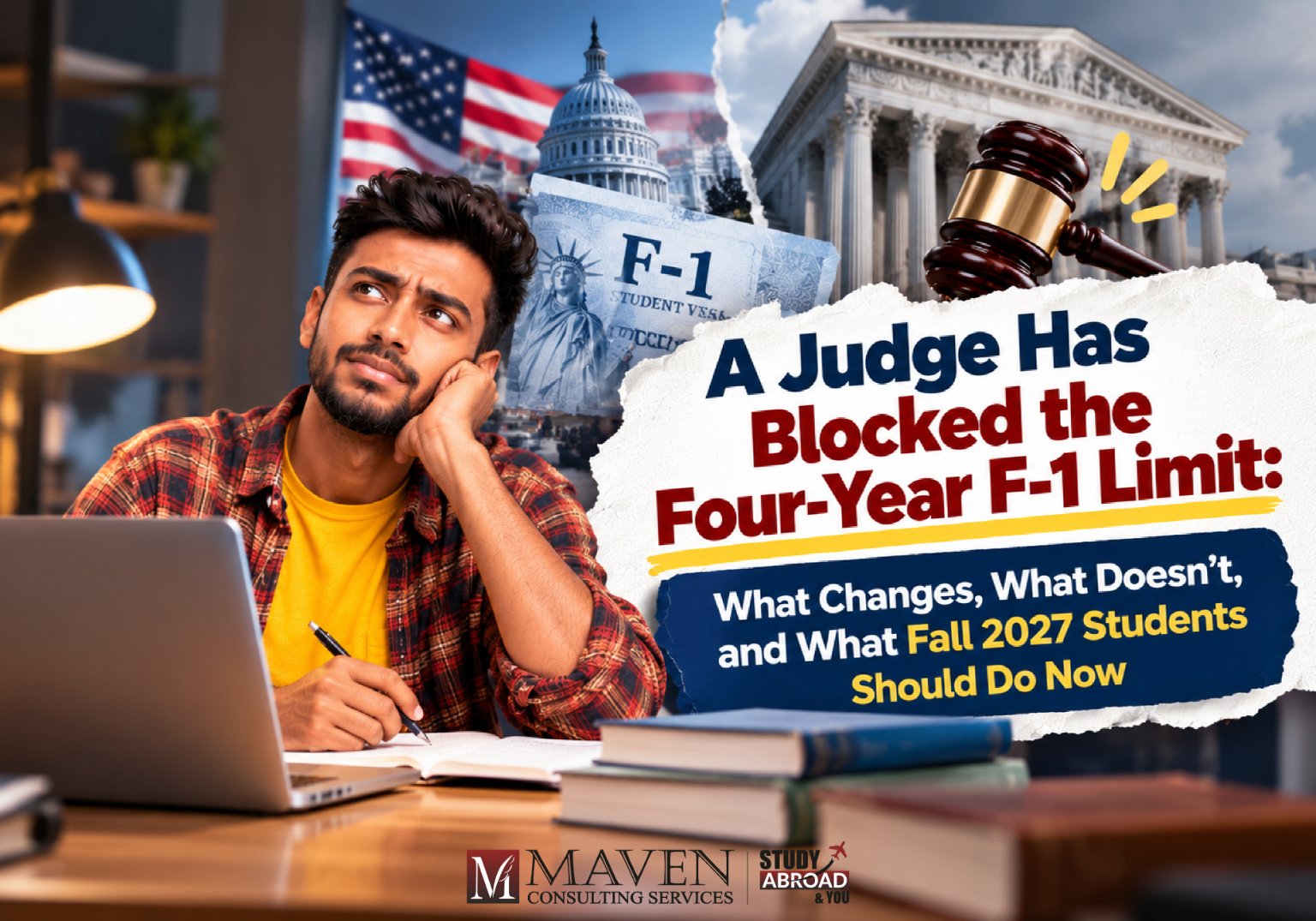
No. On 14 September 2026, Judge F. Dennis Saylor IV of the US District Court for the District of Massachusetts postponed the rule nationwide, one day before it was due to start. F-1 students are still admitted for duration of status (D/S), with the 60-day grace period. The case continues, and the government can appeal.
On 15 September 2026, every new F-1 student landing in the United States was supposed to receive a fixed “admit until” date on their I-94 instead of the familiar “D/S”. It did not happen. The evening before, a federal judge in Boston stopped the rule from taking effect.
This guide explains, in plain language, why the duration of status rule blocked in Boston is paused rather than cancelled. It covers what the court decided, what the order changes and what it leaves untouched, whether the government can bring the four-year limit back, and the practical steps Fall 2027 applicants should take now.
It matters now because most of what Indian students have read still describes the fixed four-year clock as live. That includes our own September explainer, which was accurate when it was published and which we have now corrected. At the same time, Fall 2027 applicants are choosing programmes, shortlisting universities and planning budgets this month. Those decisions should rest on the rule as it actually stands. For the wider picture of studying in America, start with our Study in USA guide.
Yes, the rule is blocked, nationwide, for now. The Department of Homeland Security (DHS) published a final rule on 17 July 2026 that would have replaced duration of status with a fixed period of admission for F, J and I visa holders from 15 September 2026. On 14 September, the court postponed that effective date and barred DHS and US Immigration and Customs Enforcement (ICE) from implementing the rule while the lawsuit continues.
In practice, three things follow. New and returning F-1 students continue to be admitted for D/S. Nobody on an F-1 needs to file an extension of stay with US Citizenship and Immigration Services (USCIS). The 60-day grace period after completing a programme or OPT stays at 60 days, instead of the 30 days the rule would have introduced.
What has not happened is just as important. The rule has not been repealed or struck down. It is still published in the Federal Register (91 FR 44976), and the government can ask a higher court to let it take effect. Harvard’s International Office put it simply in its notice of 14 September: the injunction prevents the rule from going into effect on 15 September, but the government may appeal.
The case is Presidents’ Alliance on Higher Education and Immigration v. Department of Homeland Security (No. 1:26-cv-13799), filed on 18 August 2026 in the US District Court for the District of Massachusetts. The plaintiffs include the Presidents’ Alliance, NAFSA: Association of International Educators and the Association of Independent Colleges and Universities in Massachusetts, together representing more than 600 institutions. The motion for preliminary relief was heard on 3 September, and Judge F. Dennis Saylor IV ruled on 14 September.
The judge found that the plaintiffs are likely to succeed in showing the rule is “arbitrary and capricious” under the Administrative Procedure Act (APA), the US law that governs how federal agencies make rules. According to the court’s reasoning as reported by the Presidents’ Alliance litigation tracker and university advisers, DHS likely failed in four ways:
Two further points shape what the order means for Indian students. First, the relief is nationwide. The court found it would not be workable for universities to operate under different rules depending on where they are, so the order covers every F-1 student, not only those at the plaintiffs’ institutions. Second, the judge chose what he called the more cautious approach. He postponed the rule and barred its implementation, but declined, at this stage, to vacate it, meaning he did not strike it down.
The judge also pointed out that the median time to complete a PhD in the United States is 5.7 years, not four. That single number explains why doctoral applicants were among the most exposed under the rule.
This is the table to show your parents. The left column is what the rule would have changed from 15 September 2026. The right column is where things stand today, under the court’s order.
| Area | Under the rule as written | Today, under the court order |
|---|---|---|
| I-94 admission | Fixed "admit until" date: programme end date on the I-20, capped at four years | D/S continues for new and returning F-1 students |
| Extending your stay | Form I-539 to USCIS before the I-94 date expires | Not required. Programme extensions go through your DSO, as before |
| Grace period | Cut from 60 days to 30 days | Stays at 60 days |
| Transfers and programme changes | Graduate students largely barred from changing objective or transferring | Paused. Existing rules apply |
| Second degree at the same or lower level | Not permitted after completing a degree | Paused. Existing rules apply |
| OPT paperwork | OPT applications generally paired with Form I-539 | Paused. OPT and STEM OPT filed as before |
| Transition date of 14 November 2030 | Outer limit for students admitted under D/S | Paused, and would need recalculating if the rule revives |
| The rule itself | Effective 15 September 2026 | Still published; postponed, not repealed |
| SEVP's August 2026 CPT guidance | Separate from the rule | Unaffected. Still applies |
| Admissions, visa interviews, SEVIS fee | Not part of the rule | Unaffected |
Maven Note: “Blocked” is not the same as “cancelled”. If a reel or a WhatsApp forward tells you the four-year limit is gone for good, it is wrong. If one tells you the limit is already in force, it is also wrong. Today the accurate sentence is: the duration of status rule is blocked and paused nationwide while the court case continues.
Think of a cricket match where the third umpire is still reviewing the footage. Play is stopped. Nobody has been given out, and nobody has been declared not out. A preliminary order in a lawsuit works the same way: the court freezes the situation early in the case so that nobody suffers damage that cannot be undone before a final decision is made.
To grant it, a judge must be satisfied that the challengers are likely to win on the law, that they would suffer irreparable harm without the order, and that the balance of hardship and the public interest favour a pause. Judge Saylor found all of these, noting that damage to universities was already happening, with some students withdrawing before the rule had even started.
Technically, the court postponed the rule’s effective date and prohibited DHS from implementing it. Universities, including Harvard and Yale, describe it as a preliminary injunction, and so do we. What matters for you is the effect: D/S stays in place until the court, or a higher court, says otherwise.
A preliminary order is not the final word. After it, the case moves towards a final judgment, where the court can vacate the rule entirely, uphold it, or send it back to DHS to fix. That process usually takes months.
Yes, it can appeal, and yes, the limit could come back. An appeal would go to the US Court of Appeals for the First Circuit. Under the Federal Rules of Appellate Procedure, when a US government agency is a party, a notice of appeal can generally be filed within 60 days. Counted from 14 September, that window runs to around 13 November 2026. As of 28 September, we have found no report of an appeal being filed, but DHS’s General Counsel has publicly criticised the decision, and immigration lawyers expect an appeal.
The next scheduled step in the district court is a status conference on 2 October 2026, the day after this post goes live. We will update this page after it.
From here, there are three broad paths:
None of these is certain, and anyone who tells you which one will happen is guessing. The honest planning assumption for a student starting in 2027 is that some version of a fixed admission period may be in force before they graduate. Our September explainer on how the fixed admission period would work sets out the full mechanics, from the I-94 date to the extension-of-stay process, if the rule revives.
For now, nothing you need to act on. You remain in duration of status (D/S), you do not need to file Form I-539, and your grace period after completing your programme or OPT remains 60 days. Yale’s international office summarised it for its own students: no action is required at this time.
Keep doing what has always protected your status:
Travel itself has not become riskier because of the ruling. In fact, one of the rule’s most worrying effects is paused: under the rule as written, a student who left and re-entered after 15 September would have lost their transition protection and been given a fixed date. Today, returning students are admitted in D/S.
The caveat is timing. You are admitted under whatever rules apply on the day you re-enter. If a higher court were to let the rule take effect while you are in India, you could come back to a fixed date. That is not a reason to cancel a trip, but it is a reason to talk to your DSO before booking long winter travel, to keep your return date close to the start of term, and to check your I-94 the day you land.
Maven Note: Many students also mix up the I-94 and the visa stamp. Your F-1 visa in your passport is only for entering the United States. Your permission to stay is recorded on the I-94. The court’s order is about the I-94, not about visa appointments or visa validity.
Your application timeline does not change just because the duration of status rule is blocked. The ruling has nothing to do with admissions decisions, test scores, deadlines, visa interviews or the SEVIS fee. Keep working to your Fall 2027 application deadline map.
If the order is still in force when you enter the United States in August 2027, you will be admitted in D/S, just like the students before you. The uncertainty is later. A two-year master’s that starts in 2027 ends in 2029, and OPT or STEM OPT can run into 2031 or 2032. That is a long window in which a revived or rewritten rule could take effect.
So plan for two clocks. Under D/S, you can stay as long as you maintain status. Under a revived fixed-period rule, you would be admitted until your programme end date plus a short departure period, and you would need to file for an extension if your studies ran over. For a typical Indian master’s student who finishes on time, a fixed date would be manageable. For someone whose plan depends on extra semesters, switching programmes or a second master’s, it would not.
If you are still deciding between countries, our USA vs Canada comparison for 2027 sets the US rules against the Canadian alternative, and our H-1B fee explainer covers what happens after OPT.
Curricular Practical Training (CPT) is separate from the duration of status rule, and the court’s order does not affect it. In August 2026, SEVP sent two broadcast messages to designated school officials, BCM 2608-01 on 12 August and BCM 2608-02 on 24 August, setting out a narrower reading of when CPT counts as an “integral part” of a curriculum.
The University of Washington’s summary captures the core of it: CPT should only be authorised when the practical training is required for all students and the degree cannot be completed without it. An optional internship or an elective course will generally not be enough. This is guidance, not a new regulation, but SEVP has warned that schools which use CPT to create work opportunities rather than academic study may face additional scrutiny.
For Indian students, the practical effect is that some universities have paused elective CPT, and programmes marketed on “Day 1 CPT” deserve careful questions before you pay a deposit. We cover exactly which questions to ask in our Day 1 CPT guide, publishing on 7 October.
On 4 September we published an explainer telling students that duration of status would end on 15 September 2026. At the time, that was the law as published, and the post flagged the pending court challenge. Ten days later, the court changed the picture.
We have added a dated update banner to the top of that post, corrected the opening section, and linked it here. We think this matters. Visa and immigration advice has consequences, and a page that silently stays out of date does more harm than no page at all. Every news-led Maven post now carries a “Last verified” date, and we update it whenever a figure or a ruling changes.
She is on F-1 in D/S, with her I-20 ending in May 2027. Today she can travel and return in D/S, as long as she has a valid visa, a travel signature and her documents in order. Her only extra step is timing: she should speak to her DSO before booking, avoid staying away longer than the break, and check her I-94 the day she lands. If the rule has not revived by then, nothing changes for her.
He applies as planned. If the court’s order still stands in August 2027, he is admitted in D/S. If the rule has revived, he would be admitted until his programme end date plus the departure period, which for a two-year programme is roughly two years. That works if he finishes on time. The difference would show up at the OPT and STEM OPT stage, where extra paperwork would be required. His best protection is choosing a programme with a realistic timeline and keeping his academic record clean.
She is the most exposed. Under the rule as written, admission would be capped at four years, while the median PhD takes 5.7 years, so she would almost certainly need at least one extension through USCIS. Under duration of status, as today, that problem does not exist. She should still apply, and she should ask departments about their median time to degree and how their international office supports extensions, so she knows what she is dealing with if the rule returns.
Court cases generate a lot of noise, and the duration of status case is no exception. These are the sources worth checking, in order:
Be wary of any post that names a date for an appeal decision before one has been announced, claims the rule is “cancelled forever”, or says every F-1 student now gets four years. None of those is true today.
Founder Perspective
“The worst thing that happened in September was not the rule itself. It was families making decisions on headlines. I spoke to parents who wanted to pull a daughter’s PhD application because of a four-year limit that never took effect, and students who assumed they had to file forms they did not need. The order from Boston gives everyone breathing space, not a guarantee. My advice to every Maven student is the same as it was before the ruling: choose a programme you can finish on time, keep your documents clean, and let your university’s international office, not social media, tell you when something changes.”
Rajshekar Tubachi, Founder, Maven Consulting Services
Yes. On 14 September 2026, the US District Court for the District of Massachusetts postponed the DHS rule that would have replaced duration of status with a fixed period of admission, and barred DHS and ICE from implementing it while the case continues. F-1 students are still admitted for D/S.
Judge F. Dennis Saylor IV of the US District Court for the District of Massachusetts, in Boston, ruled on 14 September 2026, one day before the rule’s 15 September effective date. The case is Presidents’ Alliance on Higher Education and Immigration v. Department of Homeland Security.
It applies nationwide. The court found it would not be workable for universities to operate under different rules depending on their location, so the order covers all F-1 and J-1 students and I visa holders.
It remains 60 days. The rule would have reduced the grace period to 30 days for students admitted under a fixed date, but that change is paused along with the rest of the rule.
No. While the order is in force, F-1 students remain in duration of status and do not need to file an extension of stay with USCIS. If you need more time to complete your programme, ask your designated school official for a programme extension before the end date on your I-20.
Yes. The government can appeal to the US Court of Appeals for the First Circuit, generally within 60 days of the 14 September order. The rule has been postponed, not repealed, so it could take effect later if the government succeeds on appeal, or DHS could issue a revised rule.
Returning students are currently admitted in D/S, so the ruling has not made travel riskier. You are admitted under the rules that apply on the day you re-enter, so speak to your DSO before booking long trips and check your I-94 the day you land.
No. SEVP’s August 2026 guidance on Curricular Practical Training, issued in broadcast messages on 12 and 24 August, is separate from the duration of status rule and still applies. CPT should be authorised only when the practical training is an integral, required part of the curriculum.
Not their application timeline. Admissions, deadlines and visa interviews are unaffected. Fall 2027 applicants should, however, choose programmes they can finish on time and avoid plans that depend on transferring, switching programmes or a second master’s, in case a fixed admission period returns before they graduate.
OPT and STEM OPT continue as before. The rule would not have shortened them, but it would have added extension-of-stay paperwork to OPT applications. That paperwork change is paused along with the rest of the rule.
The duration of status rule blocked by a Boston court on 14 September 2026 is paused, not dead. F-1 students are still admitted in D/S, no extension filings are needed and the grace period stays at 60 days. The government can appeal, and the rule could return before a 2027 student graduates. So keep your application plan on track, pick programmes you can finish on time, check CPT claims in writing and take updates from your university, not social media. We will keep this page current as the case moves.
Share your profile, target programmes and budget. We will tell you which US universities fit, how realistic each programme’s timeline is, and how to plan around a duration of status rule that is still in court. Maven Consulting Services, Bengaluru, has guided more than 10,000 students across 700-plus university partners in 20-plus countries, with a 99.8 per cent visa success rate and a commission-free model, so our advice follows your interests, not a university’s.
WhatsApp | Bengaluru, Karnataka · Instagram · LinkedIn · YouTube
<< Previous Blog | Next Blog >>
Sources: US District Court for the District of Massachusetts, Presidents’ Alliance on Higher Education and Immigration v. DHS, No. 1:26-cv-13799, order of 14 September 2026 (via the Presidents’ Alliance litigation page); Federal Register, final rule “Establishing a Fixed Time Period of Admission and an Extension of Stay Procedure”, 91 FR 44976, 17 July 2026; Harvard International Office, “Judge Blocks Elimination of Duration of Status”, 14 September 2026; Yale Office of International Students and Scholars, D/S summary and FAQs; University of Washington International Student Services, government updates and CPT policy update; SEVP Broadcast Messages 2608-01 (12 August 2026) and 2608-02 (24 August 2026); Federal Rules of Appellate Procedure, Rule 4; US Customs and Border Protection, I-94 website.
Figures and case status current as of 28 September 2026. This article is general information for Indian students and families, not legal or immigration advice.

Sunday, October 26, 2025 | The Taj MG Road, Bangalore | 10 AM – 4 PM