WhatsAppCHAT
CALL US& CONNECT


Duke University’s Graduate School states in writing that it does not have an absolute cut-off point for undergraduate GPA when considering applicants. The University of Edinburgh will accept a CGPA of 7.0 on a 10-point scale from a student whose university sits on its own India list, while asking 8.0 from everyone else.
Both of those are published, checkable facts. Together they explain something that looks unfair from Bengaluru and is not: every year a 9.0 gets five rejections and a 7.2 from the same city takes an offer from a better university.
So why is a high CGPA rejected while a lower one is admitted? This post answers that with what universities and admissions bodies actually publish, rather than with what gets repeated in counselling rooms. It is not a consolation piece. Marks matter, and in a few specific places they decide everything, and we will name those places plainly. But the number is a filter, not a verdict, and the file that clears the filter is not the file that wins the seat.
We have built this from what universities and admissions bodies actually publish: the Council of Graduate Schools’ own research on how committees read files, the minimum-GPA policies of three large American graduate schools, the India entry pages at Edinburgh and Manchester, and the German grade conversion formula that turns your CGPA into a number you have never seen. If you are still choosing a country, start with our Study in USA 2027 guide and come back to this page once the destination is settled.
Key Takeaways
These are composites. They are built from patterns we see every cycle across our Bengaluru and Belagavi desks, not from two real students, and no detail below identifies anyone. The point is not the biography. It is what each file looks like on a screen at 9 pm when a committee member has forty more to read. One is a high CGPA rejected file. The other is a low CGPA admission abroad.
| What the file showed | Candidate A — 9.04 CGPA | Candidate B — 7.24 CGPA |
|---|---|---|
| Degree | B.E. Computer Science, affiliated college | B.E. Computer Science, autonomous college |
| Grade trend across eight semesters | Flat, 8.9 to 9.2 throughout | 6.1 in the first two years, 8.4 in the last two |
| Core subjects for the intended master’s | Strong averages, no advanced electives taken | Four advanced electives in the target area, two with distinction |
| Backlogs | None | Two, both in semester three, both cleared at the next attempt |
| Evidence of work outside class | One final-year project, listed by title only | A nine-month internship, a published undergraduate paper, a public code repository |
| Recommenders | Head of Department and Principal, both general letters | Project guide and internship manager, both specific and detailed |
| Statement of purpose | Same text to all eight universities, no faculty named | Common spine, one tailored section naming two faculty and a specific lab |
| Outcome | Five rejections, one waitlist, two unfunded admits | Three admits, one with a partial assistantship |
Read the rows again and one thing becomes visible. On the only row where the number appears, A wins by nearly two points. On the six rows underneath it, B wins every single one. A committee is not choosing between 9.04 and 7.24. It is choosing between one row and six. That is how a high CGPA rejected letter and a low CGPA admission abroad arrive in the same week, from the same college.
“Holistic review” gets used so loosely in Indian counselling that it has stopped meaning anything. It has a real definition and real research behind it, and holistic review admissions is the reason a high CGPA rejected at one university can sit beside an admit at a better one.
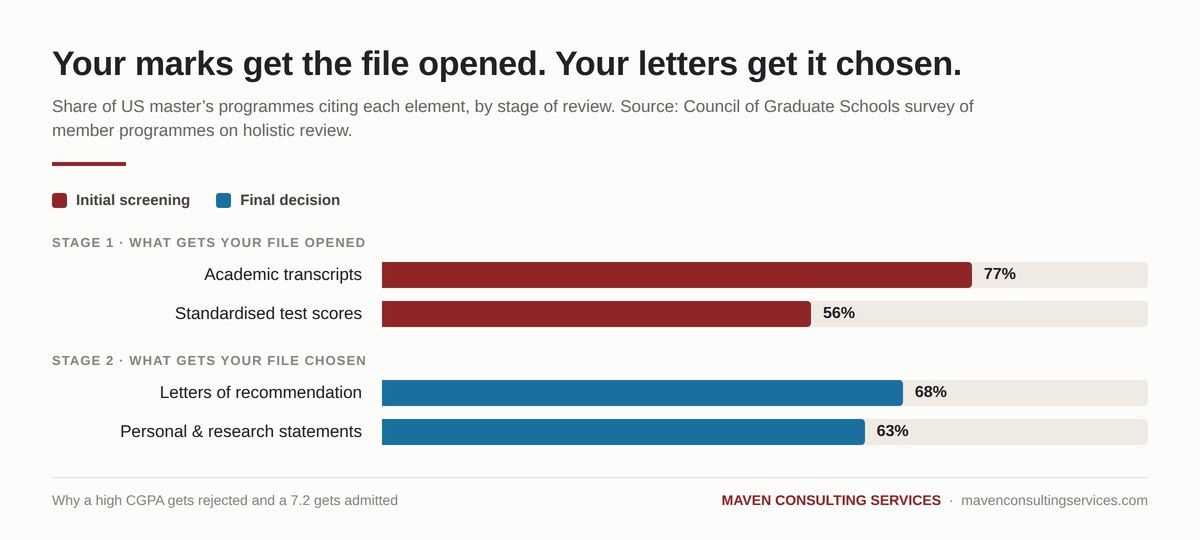
The Council of Graduate Schools, the body that represents graduate deans across North America, defines it as a process by which programmes consider a broad range of characteristics, including noncognitive and personal attributes, when reviewing applications for admission. Its survey of member programmes found something more useful than the definition: the weight of the different parts of your file changes depending on which stage the file is at.
| Application element | Cited at initial screening | Cited at the final decision |
|---|---|---|
| Academic transcripts | 77% master’s, 71% doctoral | Falls behind letters and statements |
| Standardised test scores | 56% master’s, 62% doctoral | Falls behind letters and statements |
| Letters of recommendation | Secondary at this stage | 68% master’s, 67% doctoral |
| Personal and research statements | Secondary at this stage | 63% master’s, 64% doctoral |
That single table is the whole article in miniature. Your marks and your test score are what get your file opened. Your letters and your statement are what get your file chosen. A 9.04 that clears screening and then offers nothing at the decision stage is a file that arrives at the final table with its strongest argument already spent.
The same research also found that 69 per cent of respondents associate holistic review with measuring characteristics other than past academic performance and test scores, and that 58 per cent named limited time and faculty resources as the main obstacle to doing more of it. Read that second number carefully. Committees are short of time. A file that makes its case quickly and specifically is doing the reader a favour, and readers reward it.
Maven Note: Holistic review does not mean marks are ignored. It means marks are one input among several, weighted differently at different stages. Anyone who tells a 5.8 CGPA student that holistic review makes the number irrelevant is selling something. Anyone who tells a 7.2 student the number has already decided the outcome is doing the same thing from the other direction.
Your CGPA is a single number produced by averaging eight semesters of very different things. The transcript underneath it is not averaged, and that is the document the committee actually opens.
Duke’s guidance on preparing a strong application says the review considers undergraduate grades alongside patterns of academic study and relevance of prior coursework to proposed graduate study. Patterns and relevance. Neither of those words describes an average.
Three things inside the transcript move a decision, and none of them show up in the number you quote on WhatsApp.
A student who ran at 6.1 for two years and 8.4 for two years has a 7.2 average and an obvious story: something changed, and the recent work is what the committee is buying. A flat 9.0 has no story at all, which is neutral rather than bad, but it means the transcript contributes nothing beyond the number.
This is not a courtesy. The University of Arizona’s Graduate College calculates admission GPA for international applicants from the last two years of full-time equivalent study, and Illinois sets its minimum on the last two years of undergraduate study as well. The recency bias is written into policy at some universities, not just felt by readers.
Twelve high marks in subjects unrelated to the master’s and no advanced electives in the subject you claim to love is a contradiction the committee can see on one screen. Four advanced electives in the target area, taken voluntarily and passed well, is evidence that survives a lower average.
This is the single most common self-inflicted wound we see in Indian files. Students optimise for the average by avoiding hard electives, and in doing so they remove the only part of the transcript that would have argued for them.
A 7.2 built on 8.5s in core subjects and 5s in an unrelated humanities requirement reads completely differently from a 7.2 built on a flat 7.2 across everything. The first is a specialist. The second is an average student. Same number, different candidate.
Here is something worth saying plainly, because almost nobody in Indian counselling says it: we could not find a single university that publishes a numeric backlog limit on its official admissions pages. The lists you have seen with headings like “UK universities accepting up to 15 backlogs” are compiled by consultancies and aggregators. They are not university policy, they carry no accountability, and a student should not choose a shortlist from them.
What universities do publish is that they read the transcript. So the honest guidance is about how a backlog reads, not how many you are allowed. It matters most in a low CGPA admission abroad, where the transcript is read line by line rather than skimmed.
| What the transcript shows | How it tends to read |
|---|---|
| Two or three backlogs clustered in one semester, all cleared at the next attempt, grades recovering afterwards | A bad patch with a visible recovery. Explain it in one sentence and move on. |
| Backlogs scattered across six semesters, several cleared on a third or fourth attempt | A pattern rather than an episode. Harder to argue away, and the argument has to come from what you did afterwards. |
| Backlogs in the exact subjects the master’s is built on | The most damaging version, because it goes to preparedness rather than discipline. |
| Backlogs still open at the time of applying | A practical problem before it is an academic one, since a provisional or final degree certificate is usually required. |
One rule covers all four. Do not hide a backlog and do not over-explain it. A short, factual line in the SOP, without blame and without a medical certificate you do not have, closes the question. Three paragraphs of justification opens it.
A CGPA is a claim that you learn well. A project, an internship, a paper or a repository is evidence that you can do something with what you learned. Committees read the first and believe the second, and the gap between them is the clearest single reason a high CGPA rejected letter arrives.
Duke lists relevant research or internship experience as an explicit evaluation factor. UVA Engineering describes its committees as reviewing every applicant’s entire package, “looking for academic capabilities, research experiences, leadership and passion for his or her chosen field.” Both institutions are saying that the transcript is one of four things on the table, not the table.
The mistake Indian applicants make here is not an absence of work. Most students have done something. The mistake is listing it instead of evidencing it.
| What most files say | What the same work looks like as evidence |
|---|---|
| “Final year project on machine learning” | The problem, the dataset, the method, the result, what failed, and a link to the code or the report |
| “Internship at a software company, 2 months” | What you owned, what shipped, what you measured, and what a manager can confirm in a letter |
| “Published a paper” | Venue, your contribution in one line, and an honest description of where it sits |
| “Member of the technical club” | What you organised, for how many people, and what existed afterwards that did not before |
A student with a 7.2 and one deeply documented project beats a student with a 9.0 and four undocumented ones, because the first file gives a reader something to believe and the second gives them something to take on trust.
This is the reason most Indian applications lose the seat, it sits behind a large share of every high CGPA rejected decision, and it is entirely fixable.
Duke asks for three recommendation letters and tells applicants to request them from people best qualified to attest to your capacity for graduate work, adding that it prefers academic references representing your major field. Not the most senior person available. The person best qualified to attest.
A Principal who has met you twice writes four sentences confirming that you were a student of good character and secured 9.04. A project guide who supervised you for eight months writes three hundred words about the week you rebuilt the data pipeline after the first approach failed. The first letter is signed by a more important person. The second letter is the only one that adds information the file did not already contain, and information is the currency.
Duke’s own advice tells applicants to approach recommenders four to six weeks before the deadline. In India that timeline has to stretch, because your professors are also handling internal assessments, university inspections and their own examination duties. Ask in the first half of October for a December deadline, and give them the material to be specific with: your CV, your draft statement, the programme list, and a short reminder of exactly what you did together. Our Fall 2027 US application deadline map sets out when each of these has to move.
Cornell’s guidance on the academic statement of purpose asks applicants to describe why you are a good fit for the programme and why the programme is a good fit for you, and for research degrees to identify specific faculty members whose research interests align with your own. Some programmes, it notes, require you to name a professor you would like to work with.
Duke’s advice is the same in different words: make the statement about your skills, your potential and your interest in graduate study in a particular department at a particular institution, and indicate faculty with whom you have an interest to work.
Now consider the standard Indian SOP. It opens with a childhood memory. It states a passion for technology. It praises the university’s global reputation and excellent infrastructure. It names no person, no lab, no course code, and it would read identically if you pasted a different university’s name at the top. That document answers neither of Cornell’s two questions, and under holistic review admissions it is the section that decides the close calls.
The fix is structural, not stylistic. Write one spine covering what you worked on, what it led you to, and what you want to build. Then write one genuinely different paragraph per university naming two faculty, one lab or research group, and one or two courses, and saying in plain terms what you would do there. That paragraph is worth more than the other nine hundred words combined, and it is the paragraph a 9.04 with a generic statement never writes.
Founder Perspective
“I have sat with families where the son has a 9.2 and the parents cannot understand the rejections, and the honest answer is uncomfortable. The file was excellent at the one thing the college taught him to be excellent at, and empty at everything else. Nobody told him that the four years were also supposed to produce evidence.
On the other side, I have seen a 6.9 from Belagavi take a funded offer because he had spent eighteen months building something real and could describe it in four sentences. I am not going to pretend the number does not matter, because in Germany and in a few funded programmes it decides the outcome outright. But in most of the world it opens the door and then stops helping, and after that you are on your own with whatever else you brought.”
Rajshekar Tubachi, Founder, Maven Consulting Services
Most Indian applicants never see the number the committee sees. Each destination converts your CGPA differently, and in one case the conversion depends on a figure printed on your own transcript that you have probably never looked at.
American universities work on a 4.0 grade point average. Duke asks applicants who studied outside the US to recalculate their GPA on a 4.0 scale and points them to a published calculator, while stating that it has no absolute cut-off.
Other graduate schools do publish a minimum GPA for masters abroad, and the floors differ:
| Graduate school | Published minimum | The qualification that matters |
|---|---|---|
| Duke University | None stated | “Duke does not have an absolute cut-off point for UGPA when considering applicants” |
| University of Illinois Urbana-Champaign | 3.0 on a 4.0 scale | Measured on the last two years of undergraduate study; individual programmes may require higher |
| University of Arizona | 3.00 for degree programmes | 3.30 for accelerated master’s, 2.75 for certificates; international GPA taken from the last two years; applicants below 3.0 may still be eligible through alternative routes |
Two practical conclusions. First, “minimum GPA” at a graduate school is a floor for the university, and the department you are applying to may sit well above it. Second, because Illinois and Arizona both look at the last two years, the student who improved in years three and four is being measured on their best work, not their worst.
This is the clearest published proof that the number alone does not decide, and that the minimum GPA for masters abroad is not one figure but many.
The University of Edinburgh’s India page for postgraduate entry states a standard requirement of 60 per cent or a GPA of 8 on a 10-point scale. It then states a reduced requirement of 55 per cent or a GPA of 7.0 on a 10-point scale for applicants from institutions on its own Indian Universities List. The page adds an important limit: colleges affiliated to the universities on that list are not covered by the revised requirement.
The University of Manchester puts it differently and arrives at the same place, stating that the minimum requirement typically ranges from 60 to 80 per cent overall, depending on the quality of the university of prior study and the grading scale.
So a 7.0 from a listed university meets Edinburgh’s stated requirement while an 8.0 is asked of someone else, and Manchester’s bar moves by twenty percentage points depending on where you studied. Two students with identical CGPAs are not identical applicants, and the universities say so in writing. If the UK is on your list, our UK versus Ireland comparison for 2027 covers how the two systems differ beyond entry requirements.
Maven Note: Before you assume you fall short of a UK requirement, check whether your specific university appears on that institution’s own India list, and check whether you studied at the university or at a college affiliated to it. The two are treated differently at Edinburgh, and the distinction decides eligibility for a large number of Karnataka students.
German universities convert foreign grades using the modified Bavarian formula, set out in the 2013 resolution of the Standing Conference of the Ministers of Education. The formula is:
German grade = 1 + 3 × (Nmax − Nd) ÷ (Nmax − Nmin)
Where Nmax is the highest grade achievable in your system, Nmin is the lowest passing grade, and Nd is your own average. On the German scale, 1.0 is the best grade and 4.0 is the minimum pass, so lower is better. TUM notes that its conversion results are for reference only and are not binding.
Run your own numbers and the result is often a surprise, because the CGPA to German grade conversion rewards a high average far more steeply than a 10-point scale suggests:
| Your CGPA (10-point) | German grade if your minimum pass is 5.0 | German grade if your minimum pass is 4.0 |
|---|---|---|
| 9.0 | 1.6 | 1.5 |
| 8.5 | 1.9 | 1.8 |
| 7.2 | 2.7 | 2.4 |
| 6.5 | 3.1 | 2.8 |
Look at the 7.2 row. The same student converts to 2.7 or to 2.4 purely because of the minimum passing grade printed on their own institution’s grading scale. That is why uni-assist asks Indian applicants to supply the grading system showing the maximum grade and the minimum grade needed for the award of the degree. Submit the wrong grading scale, or omit it, and your converted grade can move by three tenths for reasons that have nothing to do with your work.
Two further points for Germany. An APS certificate from the Academic Evaluation Centre is mandatory for Indian applicants, and certain fields now carry a dMAT requirement. Our dMAT or APS for Germany 2027 guide sets out which one applies to you.
A post like this is easy to write dishonestly. Here is the counterweight, and it is real: a low CGPA admission abroad is not available everywhere, and pretending otherwise costs families money.
The honest summary is narrower than either camp claims. A low CGPA does not end your options, but it narrows the list of universities where you are competitive, and it substantially narrows the list where you are competitive with funding. Build the shortlist around that truth instead of against it. Our guide to the cheapest countries to study abroad in 2027 is the right place to see what an unfunded admit actually costs before you accept one.
| What outranks the CGPA | What the committee is checking | How long it takes to fix |
|---|---|---|
| Course rigour and the trend line | Did you take the hard, relevant subjects, and did you get better | One or two semesters, if you still have them |
| Documented evidence of work | Can you do something with what you learned, and can you prove it | Three to six months of real work |
| Specific recommenders | Will someone who worked with you closely vouch for you in detail | Six to eight weeks, mostly other people’s time |
| A fit argument in the SOP | Do you know what this department does, and does it match what you want | Two focused weekends per university |
Notice the last column. Under holistic review admissions these four are what separate two files with the same marks, and the CGPA is the only item on your application you can no longer change. Everything that outranks it is still open.
Nothing in Candidate A’s file was wrong. That is the difficult part. Every element was competent and every element stopped at competent.
The transcript cleared screening and then offered nothing further, because there were no advanced electives to demonstrate depth and no trend to demonstrate growth. The final-year project appeared as a title, which a committee cannot evaluate. The two letters came from senior people who could confirm attendance and conduct but could not describe a single piece of work. The statement was identical across eight universities, which means seven of them read a letter addressed to somebody else.
At the final decision stage, where the CGS research shows letters and statements carry the most weight, this file had nothing left to say. The two unfunded admits were exactly right: strong enough to be admitted, not distinctive enough to be paid for. This is the high CGPA rejected pattern in its purest form, and it repeats every cycle.
Candidate B cleared the screening stage narrowly and sometimes only just, which is the part people forget. Several universities were never realistic and were not applied to, because a low CGPA admission abroad starts with an honest shortlist.
Where the file was applied, the transcript told a story: a weak start, four advanced electives in the target area taken voluntarily, and two years at 8.4. Illinois and Arizona would both have calculated the admission GPA from those last two years. The nine-month internship and the public repository turned the claim into something a reader could check in five minutes. The project guide’s letter described specific technical judgement under pressure. The tailored paragraph named two faculty and a lab, and made the department’s own work the reason for applying.
By the final decision stage this file was still gaining, and one department found it distinctive enough to attach money to. The 7.24 never stopped being a disadvantage. It simply stopped being the most important thing on the page.
For a Fall 2027 intake, this is roughly what is still available to you between now and the December and January deadlines, and it is the shortest honest route to a low CGPA admission abroad.
| Window | What actually moves the file |
|---|---|
| This month | Start one substantial project with a visible output. One, not four. Book a test that your shortlist actually rewards, and check whether each programme requires it at all. |
| Next month | Approach two recommenders who have supervised your work, in person, with a full pack of material. Not the most senior names available. |
| Month three | Write the SOP spine. Separately, research three departments properly and draft one tailored paragraph for each, naming faculty, a lab and a course. |
| Month four | Rebuild the shortlist honestly against published requirements, including institution-specific India lists. Two reach, four match, two safe. |
| Months five and six | Finish the project to a documented state. Submit in the first week of the deadline month, not on the day, and chase recommenders weekly. |
One thing not on that list is a second bachelor’s, a bridge course, or any product sold as a CGPA fix. Your CGPA is closed. Spend the six months on the four things that are not.
Half the students who read this post are not worried about a low number. They should read this section twice.
A high CGPA creates a specific failure mode. It makes the application feel finished before it has started, so the SOP gets written in a weekend, the recommenders get chosen by rank, and the projects get listed rather than documented. The file then screens beautifully and loses at the table. It is the commonest route we see to a high CGPA rejected outcome.
There is also a shortlisting error that follows the same logic. A 9.0 is treated as a guarantee at universities where it is merely an entry ticket, so the list has eight reaches and no matches. When the reaches say no, there is nothing underneath.
The correction is simple and unwelcome. Treat your CGPA as having done its job at the screening stage, then build the rest of the application as though the number were 7.2. That is the file that gets funded.
| The belief | What is published |
|---|---|
| “Every university has a minimum CGPA.” | Duke states it has no absolute cut-off for undergraduate GPA. Others publish 3.0 or 3.30. There is no universal floor. |
| “A 2:1 means the same percentage everywhere in the UK.” | Edinburgh publishes 60% or 8.0, reduced to 55% or 7.0 for listed universities. Manchester quotes a 60 to 80% range depending on the institution. |
| “X backlogs are allowed in the UK, Y in Australia.” | Those lists are compiled by consultancies, not universities. We found no official numeric backlog cap published by a university. |
| “A letter from the Principal or HOD carries the most weight.” | Duke asks for people best qualified to attest to your capacity for graduate work, and prefers academic references in your major field. |
| “The GRE is mandatory for a US master’s.” | Princeton lists programmes as required, optional or not accepted. UVA Engineering has waived the GRE for all 2027 applications to its graduate programmes. |
| “One SOP works for every university.” | Cornell asks you to explain why you fit that programme and to name specific faculty; some programmes require it. |
| “Work experience cannot compensate for academics.” | For DAAD’s development-related postgraduate courses, two years of work experience is mandatory, not optional. |
When a student sends us a CGPA and asks whether it is enough, that question cannot be answered, because it is the wrong question. What we look at instead, in this order:
Only after that, with the minimum GPA for masters abroad checked university by university, does a shortlist get built, and only then does anyone say whether the number is enough. It is a slower conversation than most families expect, and it is the reason our students rarely apply to eight universities where they were never competitive.
The questions families ask us most often about a high CGPA rejected outcome, a low CGPA admission abroad, and the minimum GPA for masters abroad.
Because a CGPA is weighted most heavily at the initial screening stage and least heavily at the final decision. Council of Graduate Schools research shows transcripts are cited by 77 per cent of master’s programmes at screening, while letters of recommendation and personal statements dominate the final decision at 68 and 63 per cent. A file that is excellent on marks and generic everywhere else clears the first stage and loses the second.
Yes, at a narrower set of universities and with more work elsewhere in the file. The University of Edinburgh publishes a postgraduate entry requirement of 55 per cent or a GPA of 7.0 on a 10-point scale for applicants from institutions on its Indian Universities List, against 60 per cent or 8.0 otherwise. Check each university’s own India page rather than assuming a common threshold.
It varies by university. Duke’s Graduate School states that it does not have an absolute cut-off point for undergraduate GPA. The University of Illinois sets 3.0 on a 4.0 scale for the last two years of undergraduate study, and the University of Arizona sets 3.00 for degree programmes and 3.30 for accelerated master’s. Individual departments may require more than their graduate school’s minimum.
There is no published universal limit. The numeric backlog lists circulated online are compiled by consultancies and aggregators rather than by universities, and we could not verify a numeric cap on any official university admissions page. What matters is the pattern: backlogs clustered in one semester and cleared at the next attempt read very differently from backlogs scattered across several years or sitting in subjects central to the master’s.
Using the modified Bavarian formula: German grade = 1 + 3 × (maximum grade − your grade) ÷ (maximum grade − minimum passing grade), where 1.0 is the best German grade and 4.0 the minimum pass. On a 10-point scale with a minimum pass of 5.0, a 9.0 converts to about 1.6 and a 7.2 to about 2.7. The minimum passing grade on your own transcript changes the result, which is why uni-assist asks for your institution’s grading system.
It can change the outcome at universities where you already clear the published minimum, and it cannot get you past a stated hard floor. Cornell’s guidance asks applicants to explain why they fit the programme and to identify specific faculty whose research aligns with their interests, and some programmes require a professor to be named. That is the section that distinguishes files at the decision stage, not a general statement of passion.
Duke’s Graduate School requires three letters and asks applicants to approach people best qualified to attest to their capacity for graduate work, preferring academic references representing the major field. In practice a project guide or internship manager who supervised your work closely writes a stronger letter than a Head of Department who taught you one course, because only the first can be specific.
It depends entirely on the programme. Princeton’s Graduate School categorises programmes as requiring the GRE, treating it as optional, or not accepting it at all, and states that the Graduate School itself has no minimum score requirement. UVA Engineering has waived the GRE test requirement for all 2027 applications to its graduate programmes while still recommending scores from international applicants. Check each programme page before booking.
At several universities it is written into the requirement. Edinburgh applies a lower threshold to applicants from universities on its own Indian list and states that colleges affiliated to those universities are not covered. Manchester states its minimum typically ranges from 60 to 80 per cent depending on the quality of the university of prior study. Two identical CGPAs from different institutions are not treated identically.
Everything except the CGPA. One documented project, two specific recommenders approached early with proper material, a tailored fit paragraph per university, and a shortlist rebuilt against published entry requirements. Those four are the items the Council of Graduate Schools research shows carry most weight at the final decision stage, and all four are still open to you.
Almost every high CGPA rejected outcome we see comes down to the same thing. Your CGPA decides whether your file is opened. Your transcript, your evidence, your recommenders and your fit argument decide whether it is chosen.
A 9.0 that stops at the number arrives at the final table with nothing left to say, and a 7.2 with four advanced electives, a documented project, two specific letters and a real reason for choosing that department keeps gaining right to the end. Where a hard minimum is published, respect it and shortlist around it. Everywhere else, spend your remaining months on the four things that outrank the number, because they are the only four you can still change.
Maven Consulting Services has guided more than 10,000 students across 700-plus university partners in 20-plus countries, with a 99.8 per cent visa success rate and a commission-free model, which means the shortlist we build with you is the one your profile can actually win rather than the one that pays us. Send us your transcript, not just your CGPA, and we will tell you honestly where you stand.
WhatsApp | Bengaluru, Karnataka · Instagram · LinkedIn · YouTube