WhatsAppCHAT
CALL US& CONNECT

If you are mapping the Fall 2027 US application deadlines, start here: the first graduate deadline on Duke University’s published grid is 19 November 2026. Yale’s Graduate School of Arts and Sciences closes its first set of programmes on 1 December 2026, and tells applicants in writing to sit any standardised test no later than November.
That is nine weeks away. The Fall 2027 US application deadlines are not a distant 2027 problem; they are a September 2026 one. If you are reading this in September 2026 and you have not yet booked a test, requested a transcript, or spoken to a professor about a recommendation letter, you are not early. You are roughly on time, and only if you start this week.
This guide sets out the Fall 2027 US application deadlines as a month-by-month working plan rather than a list of dates. Every deadline in a US application is really the end of a chain of smaller deadlines, most of which are controlled by somebody else — your college’s examination section, your recommender, a testing agency’s courier, a consulate’s appointment calendar. Miss any one of those and the deadline you were actually aiming at moves out of reach quietly, weeks before you notice.
We have built this from the dates universities have already published for Fall 2027, the official score-delivery timelines from ETS, the US Department of State’s own visa wait-time data, and the rules that changed on 15 September 2026. If you are still deciding on a destination, start with our Study in USA guide and come back to this page once the country is settled.
What This Guide Covers
The Fall 2027 US application deadlines in this guide matter most to:
There is no single US deadline. The Fall 2027 US application deadlines are a band, and where your programme falls inside that band changes your entire schedule.
Within the Fall 2027 US application deadlines, doctoral programmes cluster earliest, because they are attached to funding decisions that have to be made before a department knows its budget for the year. Master’s programmes run later and wider, and many of them operate a priority date followed by a long space-available period that can extend into spring. Here is what that looks like on two universities that have already published their Fall 2027 dates.
| University and programme type | Fall 2027 deadline | What it tells you |
|---|---|---|
| Duke, Nursing PhD | 19 November 2026 | The earliest date on Duke’s grid. Some fields simply close in November. |
| Duke, sciences PhD (Biology, Chemistry, Biostatistics and others) | 1 December 2026 | The single busiest deadline date in the US calendar. |
| Yale GSAS, first group | 1 December 2026, 11:59 pm ET | Eastern Time, not IST. That is 10:29 am on 2 December in Bengaluru. |
| Yale GSAS, second group (Computer Science PhD, Mathematics, Physics) | 15 December 2026 | The second wall. Most engineering and computing PhDs sit here. |
| Yale GSAS, third group and fee waivers | 2 January 2027 | Fee waiver requests close the same day. Ask in December, not January. |
| Duke, Economics, Earth and Climate Sciences, Music | 6 to 7 January 2027 | The late PhD tail, immediately after the New Year. |
| Duke, master’s programmes | 5 January 2027 onwards, some to 1 June 2027 | A five-month spread. Later does not mean easier — see the priority deadline section. |
| Duke, Biomedical Engineering | 3 December 2026 for guaranteed review, then space-available into March 2027 | “Space available” is a real category, and it is not the same as open. |
Two universities, one intake, and the Fall 2027 US application deadlines run from 19 November to 1 June. You can check both grids yourself on the Duke Graduate School deadlines page and the Yale GSAS dates and deadlines page. Your own shortlist will have its own spread, and the only version of this table that matters is the one you build for your eight or ten programmes. Build it in September. Not in November, when you will be revising for a test you should already have sat.
Maven Note: The Fall 2027 US application deadlines are almost always stated in US Eastern Time at 11:59 pm. India is nine and a half hours ahead of Eastern Standard Time in December and January. A deadline of 11:59 pm ET on 1 December expires at 10:29 am IST on 2 December. Every year a handful of students lose a day by assuming the reverse.
The reason a September start is not early is that four of the things standing between you and the Fall 2027 US application deadlines are not yours to speed up. You can work through the night on an SOP. You cannot work through the night on an examination section in Belagavi, or on a courier from Princeton, New Jersey.
These are the four clocks behind the Fall 2027 US application deadlines. Learn how long each one takes and the rest of the plan builds itself.
| The clock | Who controls it | Lead time to allow |
|---|---|---|
| Official transcripts and consolidated marksheets | Your university’s examination section | Four to ten weeks, longer if your college is affiliated rather than autonomous |
| Credential evaluation, where a university asks for one | WES or a similar agency | WES does not publish a fixed turnaround. It begins only after documents are received, verified and accepted |
| Official test scores reaching the university | ETS or your test provider | GRE scores are available 8 to 10 days after the test. TOEFL scores appear in your account in 3 days, but posted reports take 11 to 15 days |
| Recommendation letters submitted | Your professors and managers | Three to six weeks from the day you ask, and longer across an exam period |
| The visa interview appointment | The US Mission in India | 1.5 to 2.5 months at Indian posts on State Department data updated 17 August 2026 |
Add them up honestly against the Fall 2027 US application deadlines on your own list. A transcript requested in the first week of October, a GRE sat in late October with scores out in early November, and a recommender approached in mid-October gives you a comfortable 1 December submission. Shift each of those three weeks later and the same 1 December deadline becomes a scramble that shows in the quality of what you submit.
September is an administrative month, and it is the month in which the Fall 2027 US application deadlines are quietly won or lost. Almost nothing you do in it is intellectually demanding, and almost all of it is the reason later months either work or do not.
Finish these in September, before the Fall 2027 US application deadlines start biting:
October is where the application starts to exist as a document rather than a plan, and where the Fall 2027 US application deadlines stop being abstract.
Approach your recommenders in the first half of October, a full six weeks before the December Fall 2027 US application deadlines. Ask in person or on a call, not over WhatsApp, and follow it with an email carrying everything they need: your CV, your draft SOP, the programme list with deadlines, and a short note reminding them of the specific work you did with them. A professor who taught you three years ago cannot remember your project. Give them the material to write something specific, because a generic letter is worse than a shorter one.
Sit the tests. If you booked in September, October is when you take them, which leaves November clear for a retake.
Write the first SOP draft. One draft, not one per university. The programme-specific paragraph comes later. What you are producing in October is the spine: what you worked on, what it led you to, and what you now want to build. If your marks are the part you are worried about, our guide to studying abroad with a low GPA, backlogs or an academic gap is the companion to this one.
Order the credential evaluation if you need one. Check first. Not every US university requires it, and many accept transcripts sent directly by your institution. Where it is required, the course-by-course report with ICAP is the usual choice; current pricing sits on the WES evaluations and fees page. Order it in October so the verification step has room to go wrong.
Most students reading the Fall 2027 US application deadlines think of December as the submission month. It is not. December is the deadline month. November is when the work finishes, and Yale says so plainly: schedule any necessary standardised tests no later than November so official scores reach the Graduate School before the programme deadline.
Duke’s Nursing deadline falls on 19 November 2026, and there will be programmes on your own list with November dates you have not noticed yet. This is the month where the Fall 2027 US application deadlines stop being a spreadsheet and start being a queue.
Finish these in November, the month the Fall 2027 US application deadlines turn real:
Founder Perspective
“The single most common way an otherwise strong Fall application fails is the recommendation letter that never arrives. The student asked in the last week of November. The professor said yes, meant it, and then had internal assessments, a university inspection and a family function land in the same fortnight. On 1 December the application sits in the portal marked incomplete, and there is nobody to appeal to, because nobody did anything wrong. Ask in the first half of October and the same professor writes you a better letter with time to spare.”
Rajshekar Tubachi, Founder, Maven Consulting Services
1 December and 15 December are the two heaviest dates among the Fall 2027 US application deadlines, and they carry more weight than their published descriptions suggest. For doctoral programmes and for master’s programmes that offer assistantships, the December date is usually the funding date as well. Applications that arrive later are frequently still considered for admission and no longer considered for money.
In December your own work against the Fall 2027 US application deadlines is mostly done and your job becomes chasing other people’s. Check every portal weekly for items marked incomplete. Portals do not email you when a recommender has not submitted; they simply show a status you have to go and look at.
December is also when the funding conversation becomes real at home. Sanction letters take time, and a loan file opened in December is comfortably ahead of a visa interview in May. Our guide to education loans for study abroad covers what a lender asks for and in what order.
Maven Note: With the December Fall 2027 US application deadlines this close, do not submit an application with a recommender still pending on the assumption that you can add the letter later. Some programmes begin review shortly after the deadline passes and will read the file as it stands. Yale states that programmes start reviewing shortly after their deadline and asks recommenders to submit promptly rather than at leisure.
The first week of January is the tightest fortnight in the Fall 2027 US application deadlines calendar, and it catches people because it follows a holiday.
Yale’s third deadline group closes on 2 January 2027, and fee waiver requests close on the same day. Duke’s later PhD programmes close on 6 and 7 January. Duke’s master’s programmes begin on 5 January. Meanwhile scholarship deadlines from the external funders run through January, and Indian universities are in examination season, which is the worst possible time to discover that you need one more attested transcript.
Finish these in January, the last of the Fall 2027 US application deadlines:
The Fall 2027 US application deadlines end in January. The decisions begin in February. Yale notifies applicants between February and March 2027, with a reply deadline of 15 April 2027. Most US universities follow something close to that rhythm. This is the quarter where the process stops being about you and starts being about paperwork moving between institutions.
| Month | What happens | What you must finish |
|---|---|---|
| February 2027 | First decisions, interview requests from some departments | Prepare for faculty interviews; keep financial documents current |
| March 2027 | The bulk of admits and funding offers arrive | Compare total cost, not tuition; ask departments direct questions in writing |
| April 2027 | Reply deadlines, typically 15 April; deposits paid | Accept one offer, decline the rest in writing, submit financial documents for the I-20 |
| April to May 2027 | I-20 issued by the university | Pay the I-901 SEVIS fee, file the DS-160, book the interview |
An admit is not a visa, and the gap between the two is where most Fall plans actually break. We have written about that separately in admission offer vs visa approval.
A priority deadline is the most misread of the Fall 2027 US application deadlines. It is not a suggestion and it is not a soft version of the real one. It is the date before which your file is considered for everything the programme has to give, and after which it is considered only for a place.
In practice, applying by the priority date among the Fall 2027 US application deadlines puts you in the pool for teaching and research assistantships, departmental fellowships and tuition waivers. Applying after it usually leaves you in the pool for admission alone. For an Indian family funding a US master’s out of a loan, that distinction is worth more than any ranking difference between the universities on your shortlist.
“Space available” is the third category and the most misunderstood. Duke’s Biomedical Engineering programme guarantees review for applications received by early December and then continues reading on a space-available basis into March 2027. That means the programme is not closed, but the seats being competed for are whatever is left after the main round, which is a materially harder competition than the one you would have entered in December.
The letter is the one link in the Fall 2027 US application deadlines chain that somebody else holds entirely. It is the only part of your application written by somebody with no obligation to you and no stake in the outcome. That is exactly why it carries weight, and exactly why it is fragile.
Three things go wrong against the Fall 2027 US application deadlines, and all three are time problems rather than relationship problems. The recommender agrees and then runs out of December. The recommender writes quickly under pressure and produces four generic lines that confirm you attended the course. Or the recommender uses a personal email address that the portal rejects, and the exchange to fix it takes a week neither of you has.
The fix is to ask in the first half of October, supply the material rather than expecting recall, confirm the institutional email address at the time of asking, and check the portal weekly. If a recommender has not submitted by ten days before the deadline, ask them directly and have a second name ready. That is not disloyalty. It is the difference between an application that gets read and one that does not.
This is the most misquoted rule sitting behind the Fall 2027 US application deadlines, and there is a specific change that applies to this cohort.
The Council of Graduate Schools April 15 Resolution is an agreement among signatory graduate schools that a student will not be required to accept or decline before 15 April. Two qualifications matter. First, it applies to offers of financial support — fellowships, traineeships, assistantships and full tuition support — and not to offers of admission. A university can absolutely ask you to confirm an unfunded admission before 15 April. Second, and specific to you: institutions that signed on before 10 April 2026 must re-sign the Resolution for programmes beginning in Fall 2027.
So do not assume last year’s list of signatories still holds for the Fall 2027 US application deadlines cycle. If the timing of a decision matters to you, check the current signatory status of the universities on your shortlist rather than relying on a blog, this one included, to have checked it for you.
One more point people miss. If you accept a funding offer before 15 April and later change your mind, you are expected to inform the programme in writing that you are withdrawing from the offer you had accepted, before you accept anything else. Silence is not a withdrawal.
The Fall 2027 US application deadlines are only the first half of the calendar. Most students plan the visa forwards from the admit. Plan it backwards from the programme start date on the I-20 and the sequencing becomes obvious.
| Rule | What it means for a Fall 2027 start |
|---|---|
| An F visa may be issued up to 365 days before the programme start date | There is no advantage in waiting. Interview as soon as the I-20 is in hand. |
| You may not enter the US more than 30 days before the I-20 start date | An early visa does not mean an early flight. Book travel inside that 30-day window. |
| Apply at the post in the country where you live | Chasing a shorter queue in a third country is harder to justify and rarely worth it. |
| Appointment waits at Indian posts, State Department data updated 17 August 2026 | New Delhi about 2.5 months, Mumbai about 2 months, Kolkata about 2 months, Hyderabad about 1.5 months. Chennai was not publishing a figure. Updated monthly. |
| Government charges before you fly | I-901 SEVIS fee $350, MRV application fee $185, and a $250 visa integrity fee collected at issuance at posts that have begun charging it. |
Work the arithmetic backwards from the Fall 2027 US application deadlines. An I-20 in early May, a DS-160 and SEVIS payment the same week, and a two-month queue puts your interview in early July for a late August start. That works. An I-20 in late June does not, and by then no amount of urgency changes the queue. Check the live figure for your own post on the State Department visa appointment wait times page before you plan around it. The full fee picture is set out in our US student visa cost guide, and the arrival-side logistics in the Fall 2027 pre-departure checklist.
On 15 September 2026 the Department of Homeland Security replaced duration of status with a fixed period of admission for F, J and I nonimmigrants. Every student who meets the Fall 2027 US application deadlines and starts in Fall 2027 will be admitted under this rule from their first day, which makes it a planning matter rather than a news item.
In outline, and it applies to everyone who clears the Fall 2027 US application deadlines: an F-1 student is admitted for the length of the programme, capped at four years, rather than for as long as the study lasts. The grace period after completion is 30 days, not the 60 it used to be. A student who needs longer must file Form I-539 with USCIS for an extension of stay before the authorised period runs out, and that is an adjudicated application with a processing time, not a formality your international office can wave through.
For a two-year master’s starting after the Fall 2027 US application deadlines this is comfortable. Where it bites is a programme that runs long, a thesis that slips, or a change of level. Ask each department on your shortlist one plain question in writing: what is the programme end date you will put on the I-20, and what proportion of your students finish after it. The detail sits in our post on duration of status ending for F-1 students.
Once the Fall 2027 US application deadlines are behind you, the other question worth asking early is what the job market looks like at the other end, because the cost of a US master’s is now being weighed against a very different sponsorship picture. Our analysis of the new H-1B fee and what it means for 2027 starters deals with that honestly, as does our USA versus Canada comparison for 2027. If you are applying for a bachelor’s rather than a master’s, the dates are different again and are set out in our Fall 2027 US undergraduate roadmap.
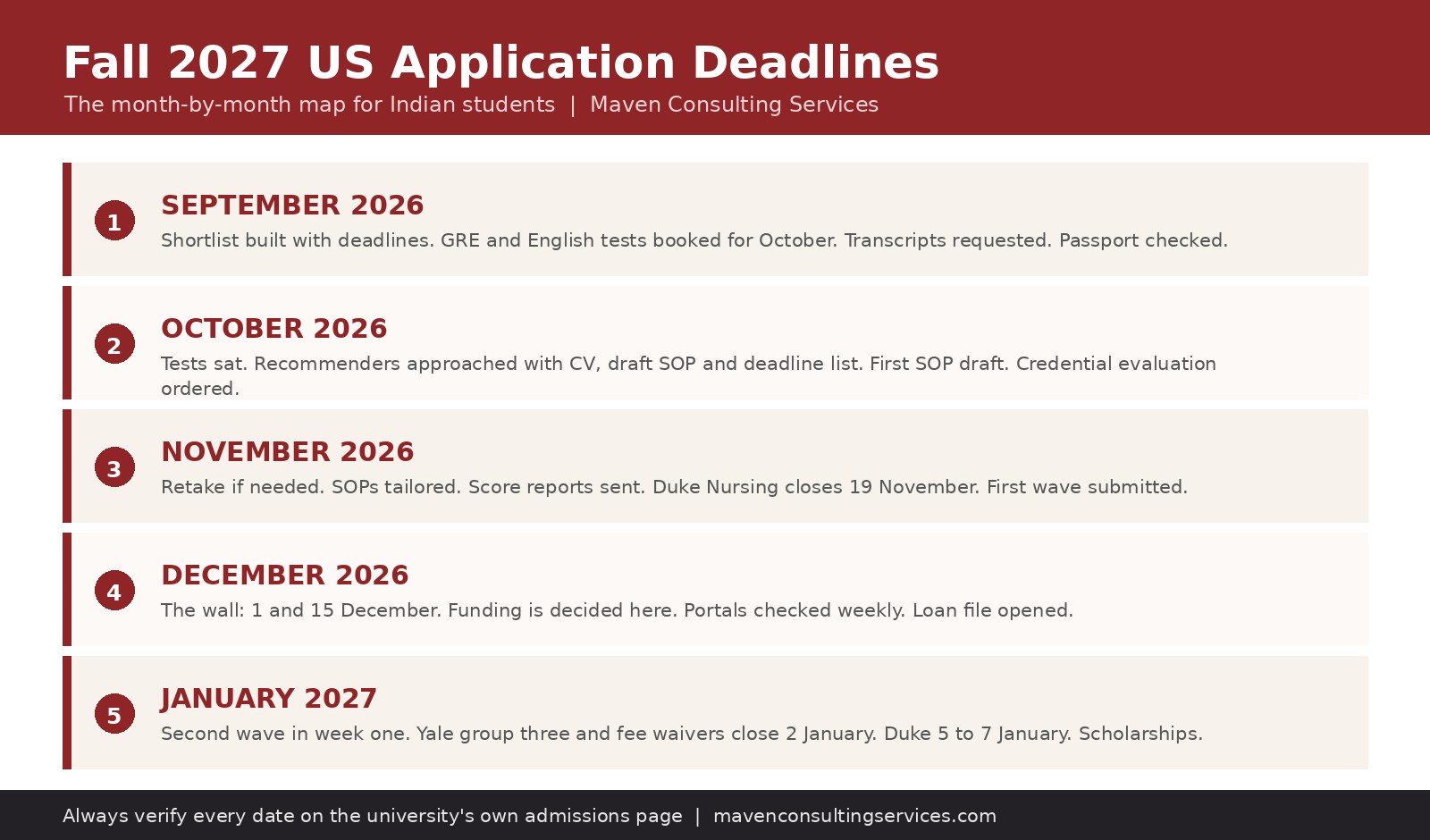
This is every milestone behind the Fall 2027 US application deadlines in one place. Paste it into a spreadsheet, add a column for each programme on your shortlist, and put a date against every row. If a row is blank in October, that is the row that will cost you a deadline in December.
| Month | Must finish | The thing that fails if you skip it |
|---|---|---|
| September 2026 | Shortlist with deadlines, tests booked for October, transcripts requested, passport checked | You lose the retake window and the transcript arrives late |
| October 2026 | Tests sat, recommenders approached with full material, SOP draft one, credential evaluation ordered if required | December letters, and no time to fix a weak score |
| November 2026 | Retake if needed, tailored SOPs, scores sent, first wave submitted | The 1 December wall arrives with files still incomplete |
| December 2026 | 1 and 15 December deadlines met, portals checked weekly, loan file opened | You are admitted without funding, which is the expensive failure |
| January 2027 | Second wave in the first week, scholarships, spare transcripts, visa queue checked | Exam season blocks your college office exactly when you need it |
| February to April 2027 | Decisions compared on total cost, one offer accepted, others declined in writing, I-20 documents submitted | A late I-20 pushes the interview past the queue you can afford |
| May to July 2027 | SEVIS fee, DS-160, interview booked and attended, funds documented | A deferred intake, and a year lost |
The questions Indian students and parents ask us most often about the Fall 2027 US application deadlines.
Most US universities open Fall 2027 applications between August and October 2026. The Fall 2027 US application deadlines then run from 19 November 2026 at the earliest end through 1 and 15 December 2026 for the majority of doctoral programmes, into early January 2027, with many master’s programmes extending to spring and a few as late as 1 June 2027. Check each programme individually rather than assuming a common date.
No, but it is the last comfortable month in which to start work on the Fall 2027 US application deadlines. A September start allows an October test with a November retake, a transcript request with a realistic lead time, and recommenders approached before their own examination season. Starting in November means submitting whatever is ready rather than what is best.
October 2026, with November held in reserve for a retake. That sequence is what keeps you ahead of the Fall 2027 US application deadlines. Official GRE scores are available 8 to 10 days after the test date and are reportable for five years. A test sat in late November leaves no margin against a 1 December deadline.
Against the Fall 2027 US application deadlines, score delivery is the step students underestimate. Scores appear in your ETS account three days after the test. Electronic delivery to institutions depends on how each one receives reports, while posted paper reports take 11 to 15 days from the test date. TOEFL scores are valid for two years.
Among the Fall 2027 US application deadlines, a priority deadline is the date before which your application is considered for funding as well as admission. After it, most programmes consider the file for admission only. A separate category, space-available review, means the programme continues to read applications against whatever seats remain after the main round.
Only if the university has signed it for the Fall 2027 US application deadlines cycle, and only to offers of financial support such as fellowships, assistantships, traineeships and full tuition support. It does not apply to offers of admission. Institutions that signed on before 10 April 2026 must re-sign for programmes beginning in Fall 2027, so confirm the current position with each university rather than assuming it carries over.
Usually between April and June 2027, well after the Fall 2027 US application deadlines have closed, and only after you accept the offer, pay any deposit and submit financial documents. The university controls this date, which is why accepting promptly in April matters more than it appears to at the time.
The Fall 2027 US application deadlines and the visa calendar are separate. A student visa can be issued up to 365 days before the programme start date, so there is no benefit in waiting once you hold the I-20. You may not enter the United States more than 30 days before the start date on the I-20, so an early visa does not permit an early arrival.
On State Department data updated on 17 August 2026, the next available student visa appointment was about 2.5 months at New Delhi, about 2 months at Mumbai and Kolkata, and about 1.5 months at Hyderabad, with no figure published for Chennai. The data is updated monthly, so check the current number for your post before you plan around it.
These sit outside the Fall 2027 US application deadlines but belong in the same budget. The I-901 SEVIS fee is $350 and the MRV visa application fee is $185. A $250 visa integrity fee applies at issuance and is being collected at consular posts that have begun charging it, with refund procedures still being finalised. Budget all three before tuition, living costs or travel.
Not always, and it is worth checking early against the Fall 2027 US application deadlines on your list. Many US universities accept transcripts sent directly by your institution. Where an evaluation is required, the course-by-course report is the usual choice, and the International Credential Advantage Package adds document verification to it. WES does not publish a fixed turnaround and begins processing only once documents are received, verified and accepted, so order it in October rather than December.
The Fall 2027 US application deadlines you will see quoted are 1 December, 15 December and early January, but they are not the ones that decide the outcome. The deadlines that decide whether you meet them are in September and October: the test you book, the transcript you request, and the recommender you approach. Work the Fall 2027 US application deadlines backwards from your own shortlist, not from a generic calendar, and treat every date controlled by somebody else as one that will take longer than you expect.
We have walked more than one cohort through the Fall 2027 US application deadlines. Maven Consulting Services has guided more than 10,000 students across 700-plus university partners in 20-plus countries, with a 99.8 per cent visa success rate and a commission-free model, which means the shortlist we build with you is the one that suits your profile and your budget rather than the one that pays us. If you want the Fall 2027 US application deadlines mapped against your actual programmes, we will do it with you.
WhatsApp | Bengaluru, Karnataka · Instagram · LinkedIn · YouTube